Plant care card
Zoysia grass
Zoysia japonica · Pasto zoysia
Also called Japanese lawngrass, Korean lawngrass or zoysiagrass
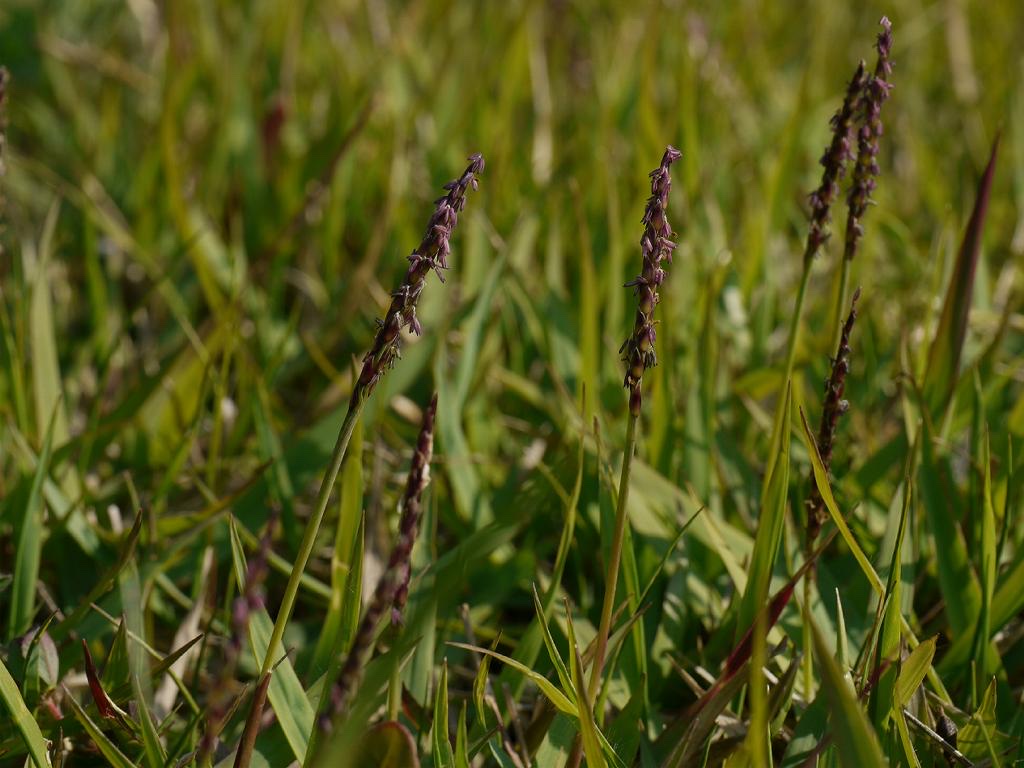
Photo by Keisotyo on Wikimedia Commons, CC BY 4.0

Zoysia grass (Zoysia japonica) is a warm-season lawn grass that makes a thick, dense carpet in full sun or light shade. It grows best in summer heat, turns tan after the first frost and greens up again in late spring. Mow it at 1 to 2½ inches, water deeply when the blades fold or turn blue-gray, and feed it lightly. It spreads slowly, so it is slow to start and slow to repair, but a healthy stand crowds out weeds. No pet toxicity rating exists for it.
Not rated for pets
Neither the ASPCA nor NC State rates zoysia grass. We found no reputable source that lists it as toxic, but none rates it either. Children: No poisoning information found.
Pet poison line: ASPCA (888) 426-4435
Good for: sunny lawns in warm and in-between climates, a dense lawn that crowds out weeds, yards with some light shade · Think twice if: you want a lawn that stays green all winter, your yard is in deep shade, worn spots need to fill in fast.
Needs at a glance
- Light4 of 4 · Some direct sunFull sun is best, 8 hours or more; some types hold up with 4 to 4½ hours of filtered sun
- Water2 of 3 · Water when it wiltsAbout ½ to 1 inch a week to stay green; water when blades fold or turn blue-gray
- Humidity1 of 3 · AverageOutdoor air is fine
- SoilWell-drained soilLoam or sand; a pH of 6.0 to 7.0 is best, though it takes a wide range
Growth: grows best at 80 to 95°F (27 to 35°C).
As a lawn
Season: Warm-season grass. Grows from late spring to early fall and turns tan after the first frost until it greens up in spring.
Mowing height: 1 to 2.5 inches (2.5 to 6.5 cm). Texas A&M gives 1 to 2½ inches for coarse types like this one, UF/IFAS 1¾ to 2½ inches with a rotary mower and NC State 1 to 1½ inches; cut off no more than a third of the blade at a time.
Shade: Fair to good. Best in full sun; some types keep their color with 4 to 4½ hours of filtered sun, but it thins in deep shade.
Foot traffic: Good to fair. Forms a dense turf that stands up to wear, but it is slow to fill back in once worn bare.
Drought: Good. Survives dry spells by turning brown and dormant, then greens up after rain or watering; it wilts sooner than many lawn grasses.
How the rating adds up
0 = easiest · 1 = moderate · 2 = hardest
- Missed waterings1 of 2 · ModerateTurns brown and goes dormant in a dry spell, then greens up again; stays green with about ½ to 1 inch of water a week
- Light flexibility2 of 2 · HardestNeeds sun: full sun is best, some types manage with 4 to 4½ hours, and it thins in deep shade
- Humidity0 of 2 · EasiestOutdoor air is fine; NC State lists humidity among the conditions it tolerates
- Pests and disease1 of 2 · ModerateLarge patch disease and root-feeding insects such as billbugs and white grubs show up at times
- Sensitivity to change1 of 2 · ModerateSlow to recover from scalping, dethatching or disease damage
Growing outdoors
All year: USDA zones 5 to 11, where the coldest winter nights average −20°F (−29°C) or warmer.
- Home lawns
- Parks and golf fairways
- Erosion control on slopes
Sources: NC State, UF/IFAS, Texas A&M, UGA, Clemson, Purdue, ASPCA plant list, USDA zone map, FISC, Hawaii noxious weed list, Cal-IPC, TexasInvasives.org, Queensland Government, GISD and NC State TurfFiles. Full list below.
Verified · How we rate plants
Is zoysia grass safe for cats and dogs?
We can't say for sure. Neither the ASPCA nor NC State rates zoysia grass, and we found no reputable source that lists it as toxic. That is good news, but it isn't a pet safety rating. If your pet chewed a plant and seems unwell, call your vet or the ASPCA Animal Poison Control Center at (888) 426-4435. If a child eats some, call Poison Help at 1-800-222-1222.
Is zoysia a warm-season or cool-season grass?
Warm-season. Clemson, UGA and Texas A&M all say it grows best at 80 to 95°F (27 to 35°C), from late spring to early fall. When nights cool off it slows down, and it turns tan after the first frost and stays that way until spring. Purdue says it starts to lose color when nights drop to the mid-50s°F and greens up in late April to May in Indiana. UF/IFAS adds that it is the first lawn grass to fade in fall and the last to green up in spring. That brown winter look is normal dormancy. Texas A&M notes that in southern Texas, warm-season grasses may not go fully dormant.
How high should I mow zoysia grass?
For a home lawn of this species, about 1 to 2½ inches (2.5 to 6.5 cm). Texas A&M gives 1 to 2½ inches for coarse types like Zoysia japonica, UF/IFAS gives 1¾ to 2½ inches with a rotary mower, UGA 1 to 2 inches and NC State 1 to 1½ inches. Purdue cuts it lower, ½ to 1 inch, with a reel mower. Take off no more than a third of the blade at a time, because zoysia recovers slowly from scalping. Keep the blades sharp: the leaves are tough, and Texas A&M notes they wear mower blades faster.
How much water does zoysia grass need?
NC State suggests about ½ to 1 inch of water a week, wetting the soil 4 to 6 inches deep, when rain falls short. Water when the lawn shows it needs it: blades that fold or wilt, a blue-gray color, or footprints that stay visible. UF/IFAS says to apply ½ to ¾ inch each time, and Clemson ¾ to 1 inch after the turf dries out. Deep, less frequent watering grows deeper roots; Clemson warns that frequent light watering keeps roots shallow. Once it is dormant in winter, it needs little water.
Is zoysia grass drought tolerant?
It survives drought by going dormant. UF/IFAS says it turns brown within about a week of dry weather and greens up again once rain or watering returns. NC State calls it very drought tolerant once established and UGA rates its drought resistance good. Texas A&M notes it wilts earlier than many lawn grasses, and Clemson says it is less drought tolerant than bermudagrass. Letting it go tan in a dry spell is an accepted way to save water, as UF/IFAS puts it, but compacted soil makes recovery harder.
Does zoysia grass grow in shade?
In light shade, yes; in deep shade, it thins out. UGA says it does best with at least 8 hours of sun, though some types keep good color with as little as 4 to 4½ hours of filtered sun. Clemson says it makes a dense lawn in full sun and partial shade, and NC State says it tolerates light shade. Shade tolerance depends a lot on the variety, so ask for one suited to your yard.
Can zoysia handle foot traffic?
Everyday traffic, yes. NC State describes it as a dense turf that tolerates wear, and UF/IFAS lists good traffic tolerance. UGA rates wear tolerance good to fair. The catch is repair: it spreads slowly, so Texas A&M says worn or bare spots take longer to fill in than in faster grasses, and weeds can move in meanwhile.
When and how much should I fertilize zoysia grass?
Lightly, and only while it is green and growing. UGA gives 1 to 2 lb of nitrogen per 1,000 sq ft a year and Texas A&M 1 to 3 lb; NC State caps it at 4 lb. Wait until the lawn has fully greened up in spring, and make the last nitrogen feeding 4 to 6 weeks before your usual first frost (Texas A&M; Clemson says at least 6 weeks). Too much nitrogen builds thatch and, in early spring or late fall, raises the risk of large patch disease, UF/IFAS warns. A soil test tells you what else it needs.
Why does my zoysia lawn have brown patches in spring?
Often large patch, a fungal disease. NC State and UF/IFAS describe circular tan or brown patches, from 2 to 10 feet across, that show up as the lawn greens up, especially after rainy or overcast weather. The fungus is active in fall when soil is 65 to 75°F (18 to 24°C), and because zoysia greens up so late, the damage stays visible well into summer. Mowing at the right height, mowing when dry, keeping thatch down and skipping early spring nitrogen all help. Root-feeding insects can also kill patches: UF/IFAS names hunting billbugs, white grubs and mole crickets, and Purdue names chinch bugs in hot, dry weather. Your local extension office can identify the cause.
How do I start a zoysia lawn?
Sod gives you a lawn right away; plugs and seed take patience. Plant in late spring or early summer, when it grows fastest, so it can root before winter (Texas A&M, Purdue). Clemson says 2-inch plugs set 6 inches apart can cover in two growing seasons or less with good care. Zoysia japonica is the only zoysia sold as seed, with Zenith and Compadre the seeded types, and it germinates slowly. Keep new sod or seed moist until it roots.
How far north does zoysia grass grow?
Farther than most warm-season grasses. NC State lists USDA zones 5a to 11a for zoysia, and Clemson calls it one of the most cold-tolerant warm-season grasses. Purdue says that once established it is winter hardy in Indiana, but it does best in the southern third of the state and stays dormant longer farther north; a lawn planted too late may not survive its first winter. UF/IFAS says Zoysia japonica has the best cold tolerance of the zoysias, and the old variety Meyer is known for winter hardiness.
How Grove helps
Grove can remind you to mow, water in dry spells and feed the lawn at the right times of year. You can add each one as a repeating task and assign it, so whoever is home that week takes care of the lawn.
Sources
- NC State Extension Gardener Plant Toolbox: Zoysia (zoysiagrass; lists Zoysia japonica)
- UF/IFAS EDIS ENH11 (LH011): Zoysiagrass for Florida Lawns (J. B. Unruh and others, 2022)
- Texas A&M AgriLife Extension SCSC-PU-279: Zoysiagrass Lawn Management Guide (P. A. Boeri and others, 2025)
- NC State Extension AG-432: Zoysiagrass Lawn Maintenance Calendar (G. Miller, J. Kerns, T. Billeisen, 2025)
- UGA Extension Bulletin 1533-1: Lawns in Georgia, Selection and Species (C. Waltz, 2020)
- Clemson Cooperative Extension HGIC 1212: Zoysiagrass (G. Forrester, revised 2018)
- Purdue Extension AY-6: Zoysiagrass for Turfgrass Areas in Indiana (C. Throssell, Z. Reicher, J. Lefton)
- ASPCA Animal Poison Control: Toxic and Non-Toxic Plants
- USDA ARS Plant Hardiness Zone Map (2023)
- Florida Invasive Species Council: Plant List, Category I and II (April 2026; no Zoysia)
- Florida Invasive Species Council: Watch List (April 2026; no Zoysia)
- Hawaii Administrative Rules 4-68: plant species designated as noxious weeds (Hawaii Department of Agriculture)
- Cal-IPC (California Invasive Plant Council): plant search, "zoysia" (no listing)
- TexasInvasives.org Invasives Database: plant list (no Zoysia)
- Business Queensland: Restricted invasive plants (Biosecurity Act 2014)
- Global Invasive Species Database: Zoysia japonica
- NC State TurfFiles: Zoysiagrass
- Royal Horticultural Society: Zoysia japonica (Japanese lawn grass)
- Kew WCVP data release (2026-06-04 file), plant_name_id 450644: Zoysia japonica