Plant care card
Frangipani
Plumeria rubra · Plumeria
Also called plumeria, common frangipani or temple tree
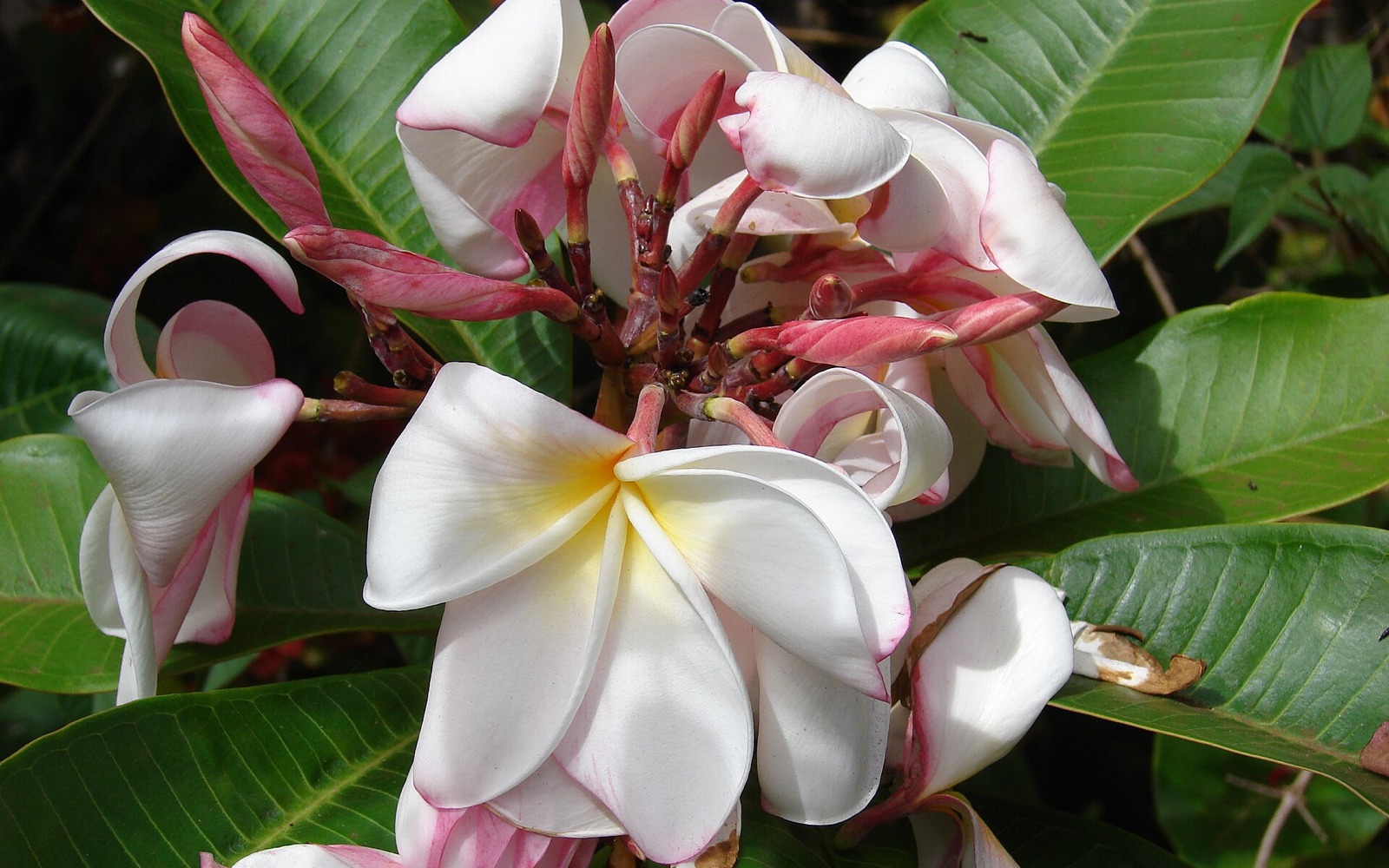
Photo by Forest and Kim Starr on Wikimedia Commons, CC BY 3.0

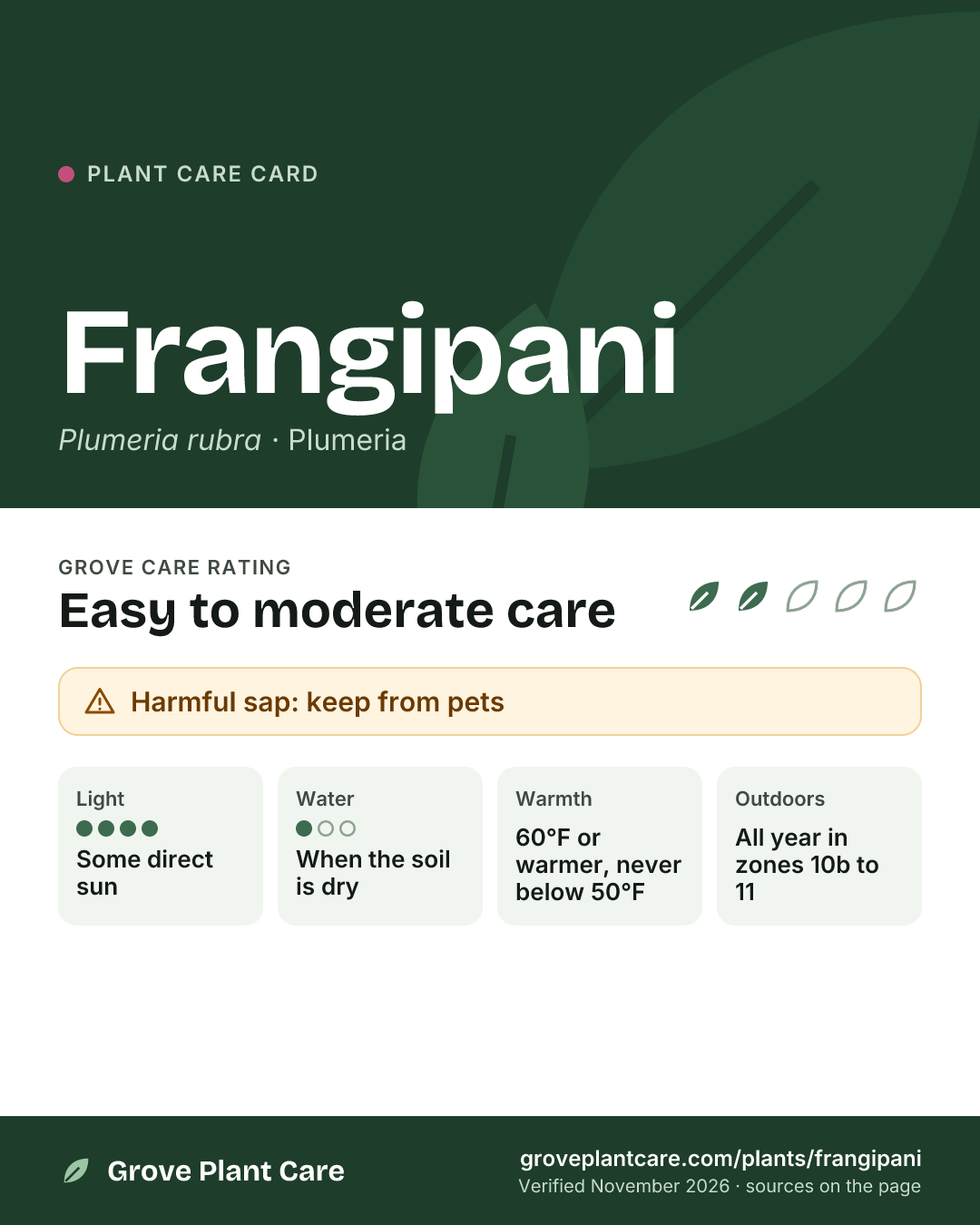
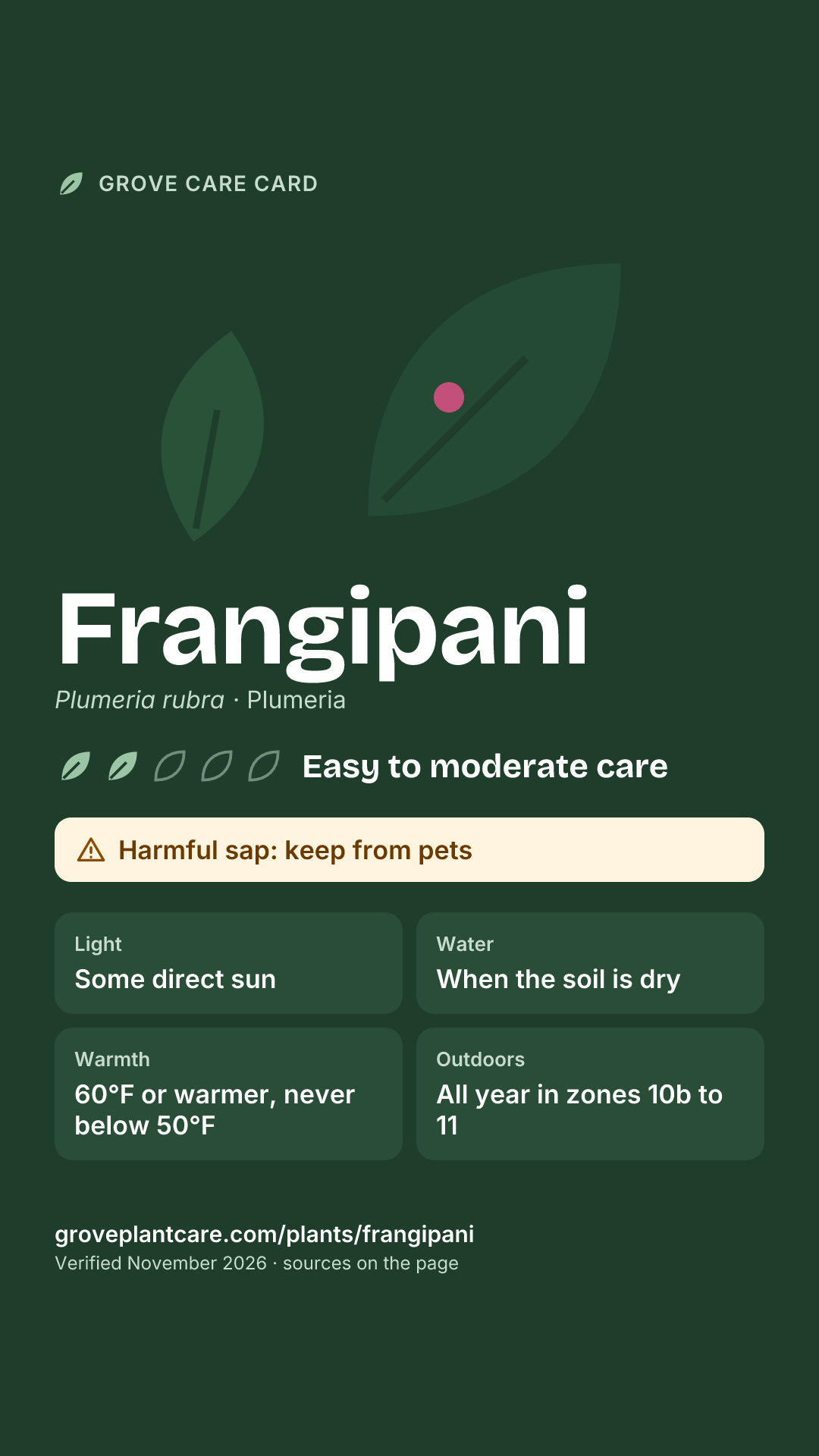
Frangipani wants full sun, a fast-draining mix and little water. It's a tropical tree: outdoors all year only where nights stay above about 35°F (2°C), and in a pot everywhere else. Bring the pot in before nights drop to 50 to 60°F (10 to 15°C) to keep it growing, or let it drop its leaves and rest somewhere dark and dry just above 40°F (4°C). Its milky sap irritates skin, and the RHS lists it as harmful to pets. Unlike bridal bouquet plumeria, it loses its leaves in winter and its flowers are strongly scented.
Harmful to pets if eaten (RHS); the ASPCA doesn’t list it
No pet-specific signs are published; the milky sap irritates skin and eyes. The RHS lists it as harmful to pets, and UF/IFAS says to keep the irritating sap in mind around pets and children. Children: low severity. The milky sap irritates skin and eyes, and the RHS says it’s harmful if eaten; UF/IFAS knows of no deaths.
Pet poison line: ASPCA (888) 426-4435
Good for: sunny patios and big containers, fragrant flowers through summer, hot, dry or coastal gardens without frost · Think twice if: you have no sunny window or yard, pets or small children chew plants, your winters freeze and you have nowhere to keep it above 40°F (4°C).
Needs at a glance
- Light4 of 4 · Some direct sunFull sun outdoors; your sunniest window indoors
- Water1 of 3 · Let the soil dryThen water well; little or none while it rests in winter
- Humidity1 of 3 · AverageNormal home air
- Soil when pottedFast-draining mixCactus mix, or a loam-based mix with grit
Indoors: best at 60°F (15°C) or warmer. Keep it above 50°F (10°C) and away from drafts and heat vents.
How the rating adds up
0 = easiest · 1 = moderate · 2 = hardest
- Missed waterings0 of 2 · EasiestFairly drought tolerant once established; let the mix dry between waterings
- Light flexibility2 of 2 · HardestNeeds full sun; indoors, only your sunniest window will do
- Humidity0 of 2 · EasiestAverage air is fine; it grows easily in hot, dry places
- Pests and disease1 of 2 · ModerateRust is common but rarely serious; spider mites, mealybugs and scale show up too
- Sensitivity to change1 of 2 · ModerateDrops its leaves for winter; rots if kept cold and wet
Growing outdoors
All year: USDA zones 10b to 11, where the coldest winter nights average 35°F (2°C) or warmer.
Elsewhere: summer outside in full sun. Bring it in when nights reach 50 to 60°F (10 to 15°C).
- Shrub or small tree in frost-free gardens
- Container plant moved inside for winter
- Handles salt spray and coastal sites once established
Sources: NParks, UF/IFAS, Wisconsin Extension, RHS, UH CTAHR, Hawaii weed risk assessment, Kew, NYBG, ASPCA plant list, Clemson, USDA zone map, FISC, UF/IFAS Assessment, Hawaii noxious weed list, Rojas-Sandoval and Acevedo-Rodríguez, Queensland Government, Cal-IPC, Texas Invasives and GISD. Full list below.
Verified · How we rate plants
Is frangipani poisonous to cats and dogs?
Treat it as mildly toxic. The ASPCA doesn't list it, and NC State has no page for it. The RHS lists frangipani as harmful if eaten and irritating to skin and eyes, for people and for pets. Singapore's National Parks Board calls the milky sap poisonous, and UF/IFAS says to keep the irritating sap in mind around pets and children. On the other side, Hawaii's weed risk assessment doesn't count it as poisonous to animals. UF/IFAS adds that plumeria is less poisonous than oleander, with no recorded deaths. Wear gloves when you cut it. If a pet chews it and seems unwell, call your vet or the ASPCA Animal Poison Control Center at (888) 426-4435. If a child eats some, call Poison Help at 1-800-222-1222.
ASPCA plant list, RHS, NParks, UF/IFAS, Hawaii weed risk assessment, Wisconsin Extension
How is frangipani different from bridal bouquet plumeria?
Check the leaves and the scent. Frangipani (Plumeria rubra) has long, oblong leaves with pointed tips, up to about 16 inches (40 cm) per the RHS, and it drops them in winter. Bridal bouquet (Plumeria pudica) has narrow, spoon-shaped leaves that stay on where it's warm. Frangipani's flowers come in white, yellow, pink, red and blends and are strongly scented, most of all in the evening. Bridal bouquet's flowers are white with a yellow center and have little or no scent. Frangipani also gets plumeria rust more easily: Hawaii's extension rates the rubra types susceptible and bridal bouquet moderately resistant. A third cousin, Plumeria obtusa, has white flowers and blunt leaf tips and stays evergreen too.
Can frangipani grow outdoors where I live?
All year only in USDA zones 10b to 11, where the coldest winter nights stay around 35°F (2°C) or warmer. UF/IFAS says plumerias suit only those zones and that frost can damage or kill them in zone 9b, though they often regrow if the cold doesn't kill them to the ground. Where it's frost-free, it becomes a shrub or small tree, usually 8 to 25 feet tall, and up to 30 feet in Hawaii. It handles salt spray and coastal sites. It grows wild from Mexico through Central America to Colombia and Venezuela. As of November 2026, no official invasive list we checked names it, UF/IFAS finds it isn't a problem species anywhere in Florida, and Hawaii's weed risk assessment rates it low risk.
UF/IFAS, USDA zone map, Wisconsin Extension, UH CTAHR, NParks, Kew, FISC, UF/IFAS Assessment, Hawaii weed risk assessment, Hawaii noxious weed list
When should I bring my frangipani inside?
You have two choices. To keep it growing, bring it in before nights drop to 50 to 60°F (10 to 15°C): the RHS keeps frangipani at 50°F (10°C) or warmer and warns that the tips can rot below 60°F (15°C). Give it your sunniest window and water sparingly. Or let it rest: NYBG lets the leaves drop as nights cool, brings the pot in at about 40°F (4°C) and keeps it dark and dry just above 40°F, for example in an unheated garage, with no water or light until spring. That works because frangipani naturally goes leafless in winter. Either way, move it back out once frost is past and nights stay in the 50s°F.
How often should I water a frangipani?
Let the mix dry, then water well and let it drain. UF/IFAS calls plumerias fairly drought tolerant once established, and Singapore's parks board says the same of frangipani. Wisconsin warns that too much water causes root rot and can kill the plant, and the more sun it gets, the more water it uses. In winter, the RHS keeps it nearly dry, and a dormant, leafless plant needs no water at all (NYBG). For a pot, use cactus mix or potting mix with grit so water runs straight through.
Why is my frangipani losing its leaves?
In fall and winter, that's normal: frangipani goes dormant and drops its leaves when it turns cool, and UF/IFAS notes the bare green stems keep working until new leaves come in spring. In the growing season, flip a leaf over. Orange, powdery spots underneath mean plumeria rust, which UF/IFAS calls common. Hawaii's extension says it rarely hurts the plant, though a bad case can strip it bare. Rake up fallen leaves in fall to cut it back. Spider mites, mealybugs and scale can also show up, and soggy, cold soil makes the stems rot.
When does frangipani bloom, and why won’t mine flower?
In Florida it blooms from May through November, and Wisconsin sees flowers from early summer until fall, with a single cluster opening 50 to 200 flowers over months. The most common reason for no flowers is too little sun: every source asks for full sun. Age matters too: Wisconsin says cuttings take 1 to 3 years to bloom and seedlings 3 or more. Each branch flowers at its tip, and new branches form only after flowering or an injury, so compact plants bloom more than leggy ones. The RHS feeds it monthly while it grows.
How do I propagate a frangipani?
From cuttings of leafless stem tips in spring, which is also the only way to keep a named color true (Wisconsin). Wear gloves for the sap. Wisconsin uses 12 to 18 inch pieces, and the RHS and Singapore's parks board let the cut end dry for several days first. Hawaii's extension says cuttings rot easily if you skip that step. Plant in a fast-draining mix and keep it barely damp. UF/IFAS says the bare sticks look unpromising at first but grow quickly.
How Grove helps
Grove sets a watering check based on how dry the soil is, so a frangipani gets water only once it has dried out. Before your nights turn cool, you can add bringing the pot inside as a task and assign it, so whoever is home moves it before the cold arrives.
Sources
- National Parks Board Singapore, Flora & Fauna Web: Plumeria rubra
- UF/IFAS Gardening Solutions: Plumeria
- University of Wisconsin-Madison Extension, Wisconsin Horticulture: Plumeria (S. Mahr)
- Royal Horticultural Society: Plumeria rubra (frangipani)
- University of Hawai'i CTAHR OF-31: Plumeria in Hawai'i (R. A. Criley, 2005)
- Hawaii-Pacific Weed Risk Assessment (Plant Pono): Plumeria rubra, low risk, score -5 (2002)
- Kew WCVP data release (2026-06-04 file), plant_name_id 161631: Plumeria rubra
- Royal Horticultural Society growing guide: Frangipani
- University of Hawai'i CTAHR PD-61: Plumeria Rust (S. Nelson, 2009)
- New York Botanical Garden Plant Information: overwintering a plumeria
- ASPCA Animal Poison Control: Toxic and Non-Toxic Plants
- Clemson Cooperative Extension HGIC 1454: Moving Houseplants Indoors and Outdoors
- UF/IFAS Extension Orange County: What's in bloom? Plumerias (J. Roberts, 2021)
- USDA ARS Plant Hardiness Zone Map (2023)
- Florida Invasive Species Council: 2023 Invasive Plant List
- UF/IFAS Assessment of Non-Native Plants in Florida's Natural Areas: Plumeria rubra (not a problem species, 2025)
- Hawaii Administrative Rules 4-68: plant species designated as noxious weeds (Hawaii Department of Agriculture)
- J. Rojas-Sandoval and P. Acevedo-Rodríguez (2015), Naturalization and invasion of alien plants in Puerto Rico and the Virgin Islands, Biological Invasions 17 (supplementary list)
- Business Queensland: Restricted invasive plants (Biosecurity Act 2014)
- California Invasive Plant Council (Cal-IPC): Inventory (no Plumeria listing)
- Texas Invasives plant database, list by scientific name (no Plumeria)
- IUCN Global Invasive Species Database (no Plumeria entry)
- Nicaragua, Decreto No. 1890 (1971): Se declara el Sacuanjoche (Plumeria rubra f. acutifolia) Flor Nacional de Nicaragua