Plant care card
Bower vine
Pandorea jasminoides · Pandorea
Also called bower plant, bower of beauty or bower climber
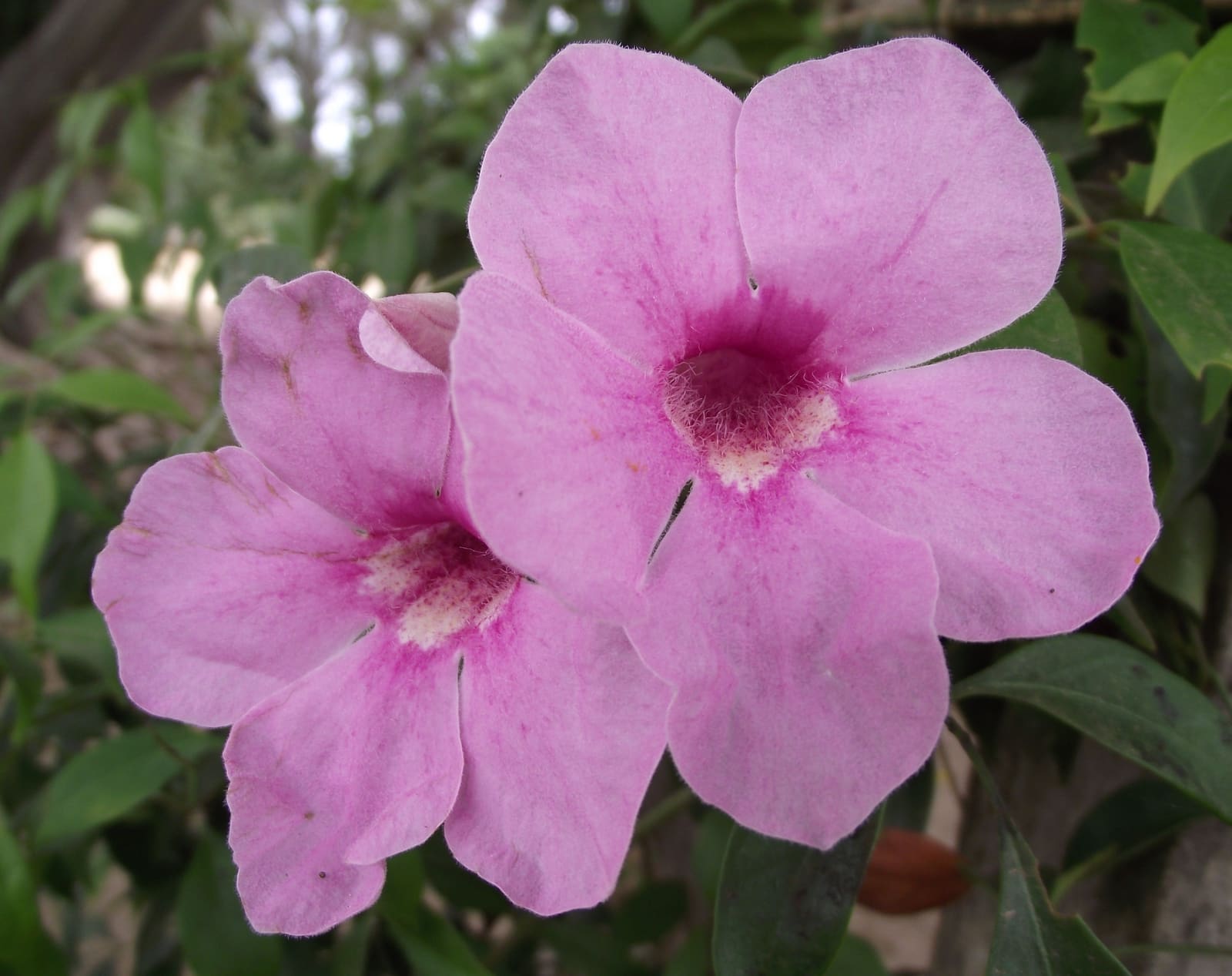
Photo by Tortie tude on Wikimedia Commons

Bower vine (Pandorea jasminoides) is a fast, evergreen climber from eastern Australia with glossy leaves and white or pink trumpet flowers with a deep pink throat. Give it full sun, rich soil that stays evenly moist, and a sturdy trellis or arbor. It grows outdoors in USDA zones 9b to 11; established plants take about 25°F (−4°C), but young ones are frost tender. In colder places, grow it in a big pot and bring it in before nights reach 50°F (10°C). No pet toxicity rating exists, and no official list names it as invasive.
Not rated for pets
Neither the ASPCA nor NC State rates bower vine. No reputable source lists it as toxic, but none rates it either. The Hawaii weed risk assessment found no evidence of toxicity. Children: No poisoning information found.
Pet poison line: ASPCA (888) 426-4435
Good for: covering an arbor, pergola or fence where winters stay mild, a sunny conservatory or greenhouse, a big pot with a trellis · Think twice if: pipes or drains run close by: its roots are strong, winters freeze hard and you have no bright, frost-free spot for it.
Needs at a glance
- Light4 of 4 · Some direct sunFull sun or light shade; the more sun, the more flowers
- Water2 of 3 · Water regularlyKeep the soil evenly moist while it grows; never soggy
- Humidity1 of 3 · AverageTakes a range of humidity
- Soil when pottedRich, moist, well-drained soilLoam-based potting mix in a pot; in the ground it takes clay, sand, acid or slightly alkaline soil
Indoors: best at 60°F (16°C) or warmer. Keep it above 41°F (5°C) and away from drafts and heat vents.
How the rating adds up
0 = easiest · 1 = moderate · 2 = hardest
- Missed waterings1 of 2 · ModerateLikes ample water; copes with a short dry spell
- Light flexibility2 of 2 · HardestFull sun to flower well; part shade means fewer flowers
- Humidity0 of 2 · EasiestTakes a range of humidity
- Pests and disease1 of 2 · ModerateAphids and spider mites under glass; nematodes in the ground
- Sensitivity to change1 of 2 · ModerateWants shelter from wind; young plants are frost tender
Growing outdoors
All year: USDA zones 9b to 11, where the coldest winter nights average 25°F (−4°C) or warmer.
Elsewhere: summer outside in full sun, sheltered from strong wind, on a trellis. Bring it in when nights reach 41 to 50°F (5 to 10°C).
- Climber on an arbor, pergola or fence
- Large container with a trellis
- Greenhouse or conservatory climber
Sources: UF/IFAS, NParks Singapore, Arizona State University, RHS, Australian National Botanic Gardens, ASPCA plant list, Hawaii weed risk assessment, Clemson, USDA, FISC, Hawaii noxious weed list, Biological Invasions, Cal-IPC, Global Invasive Species Database and Flora of New Zealand. Full list below.
Verified · How we rate plants
Is bower vine toxic to cats and dogs?
We can't say for sure. Neither the ASPCA nor NC State rates bower vine, and we found no reputable source that lists it as toxic. The Hawaii weed risk assessment found no evidence that it is toxic to animals or people, which helps but isn't a pet safety rating. If your pet chewed a plant and seems unwell, call your vet or the ASPCA Animal Poison Control Center at (888) 426-4435. If a child eats some, call Poison Help at 1-800-222-1222.
How much sun does bower vine need?
Plenty. The RHS and UF/IFAS both call for full sun, and the RHS suggests a sheltered south or west-facing wall. The Australian National Botanic Gardens and Singapore's National Parks Board say it also grows in part shade, but it needs enough sun to flower well. As a rainforest climber, it reaches toward the light.
RHS, UF/IFAS, Australian National Botanic Gardens, NParks Singapore
How often should I water and feed bower vine?
Keep the soil evenly moist while it grows. UF/IFAS says it wants fertile, rich soil with ample moisture and rates its drought tolerance as moderate. Arizona State University notes that in Phoenix it needs regular watering to do its best. In the ground in a mild, rainy climate, the Australian National Botanic Gardens says established plants rarely need extra water. For food, light doses of slow-release or liquid fertilizer are enough. A pot dries out much faster than the ground, so check it often in summer.
UF/IFAS, Arizona State University, Australian National Botanic Gardens
How cold can bower vine get?
UF/IFAS lists USDA zones 9b to 11 and says it grows in the warmest parts of zone 9 in many years. Arizona State University says it is hardy to 20 to 25°F (−7 to −4°C). Young plants are much more tender: a light freeze damages them, though they still flower quickly afterward. Older plants that get frosted usually resprout, according to a reference the Hawaii risk assessment cites. In a pot, bring it in as nights head toward 50°F (10°C). The RHS rates it H1C, which means a frost-free greenhouse or bright room kept at 41 to 50°F (5 to 10°C) or warmer in winter. Clemson Extension adds to check for pests before it comes inside.
UF/IFAS, Arizona State University, Hawaii weed risk assessment, USDA, RHS, Clemson
Is bower vine invasive?
No official invasive list we checked names it. It isn't on the Florida Invasive Species Council's 2026 lists, Hawaii's noxious weed list, the Cal-IPC inventory or the Global Invasive Species Database, and a study of invasive plants in Puerto Rico and the Virgin Islands doesn't include it. UF/IFAS says it has no known record of invading, and Hawaii's weed risk assessment rates it low risk. Still, it is a vigorous climber: its stems root where they touch the ground, and the Flora of New Zealand records it spreading into a small patch of native forest there. Keep it trimmed and off nearby trees.
FISC, Hawaii noxious weed list, Cal-IPC, Global Invasive Species Database, Biological Invasions, UF/IFAS, Hawaii weed risk assessment, Flora of New Zealand
How big does bower vine get, and when should I prune it?
It grows fast. UF/IFAS says it can cover a 15 ft arbor in one or two seasons, Arizona State University gives 20 ft or more, and the RHS lists 4 to 8 m (13 to 26 ft) tall. It twines, so give it a trellis, wires or an arbor. Prune right after flowering, as the RHS and the Australian National Botanic Gardens suggest; it takes hard pruning well, which keeps it the size you want.
UF/IFAS, Arizona State University, RHS, Australian National Botanic Gardens
Can I grow bower vine in a pot or greenhouse?
Yes. The RHS grows it on patios and in containers, and under glass in a cool greenhouse or conservatory in loam-based compost and full light. Give it a big pot, a trellis and steady water. To make more plants, the RHS uses layering or semi-ripe cuttings with bottom heat in summer, and UF/IFAS and the Australian National Botanic Gardens add softwood cuttings and fresh seed.
What pests bother bower vine?
Not many. UF/IFAS says no pests or diseases are of major concern. Under glass, the RHS says it may get aphids and red spider mites and is generally free of disease. In Phoenix gardens, Arizona State University mentions nematodes, tiny worms that attack roots. Check under the leaves now and then, especially indoors in winter.
How Grove helps
Grove can remind you to water the pot in summer, to bring it in before cold nights and to prune it after it flowers. You can assign each of these as a task to anyone who helps with the plants.
Sources
- UF/IFAS Extension FPS453: Pandorea jasminoides, Bower Plant, Bower Vine (Gilman, Klein and Hansen, revised 2023)
- National Parks Board Singapore, Flora & Fauna Web: Pandorea jasminoides
- Arizona State University Library plant pages (C. A. Martin): Pandorea jasminoides (bower vine)
- Royal Horticultural Society: Pandorea jasminoides (bower plant)
- Australian National Botanic Gardens, Growing Native Plants: Pandorea jasminoides (R. Vatchenko, 2014)
- ASPCA Animal Poison Control: Toxic and Non-Toxic Plants
- Hawaii-Pacific Weed Risk Assessment (Plant Pono): Pandorea jasminoides, low risk, score 0 (2012)
- Royal Horticultural Society: RHS hardiness ratings (H1C, heated glasshouse, warm temperate, 5 to 10°C)
- Clemson Cooperative Extension HGIC 1454: Moving Houseplants Indoors and Outdoors
- USDA ARS Plant Hardiness Zone Map (2023)
- Florida Invasive Species Council: Plant List, Category I and II (April 2026)
- Hawaii Administrative Rules 4-68: plant species designated as noxious weeds (Hawaii Department of Agriculture)
- Rojas-Sandoval and Acevedo-Rodríguez (2015), Naturalization and invasion of alien plants in Puerto Rico and the Virgin Islands, Biological Invasions 17 (Table S2)
- California Invasive Plant Council (Cal-IPC): plant search, "pandorea" (no listing)
- IUCN Global Invasive Species Database: Pandorea jasminoides (no entry)
- Flora of New Zealand Vol. IV (1988), Landcare Research: Pandorea jasminoides (naturalised)
- Kew WCVP data release (2026-06-04 file), plant_name_id 317949: Pandorea jasminoides
- Kew WCVP data release (2026-06-04 file), plant_name_id 317844: Podranea ricasoliana (pink trumpet vine; synonym Pandorea ricasoliana)
- NC State Extension Gardener Plant Toolbox: Pandorea pandorana (wonga vine)