Plant care card
Brazilian red cloak
Megaskepasma erythrochlamys · Megaskepasma
Also called red cloak or red justicia
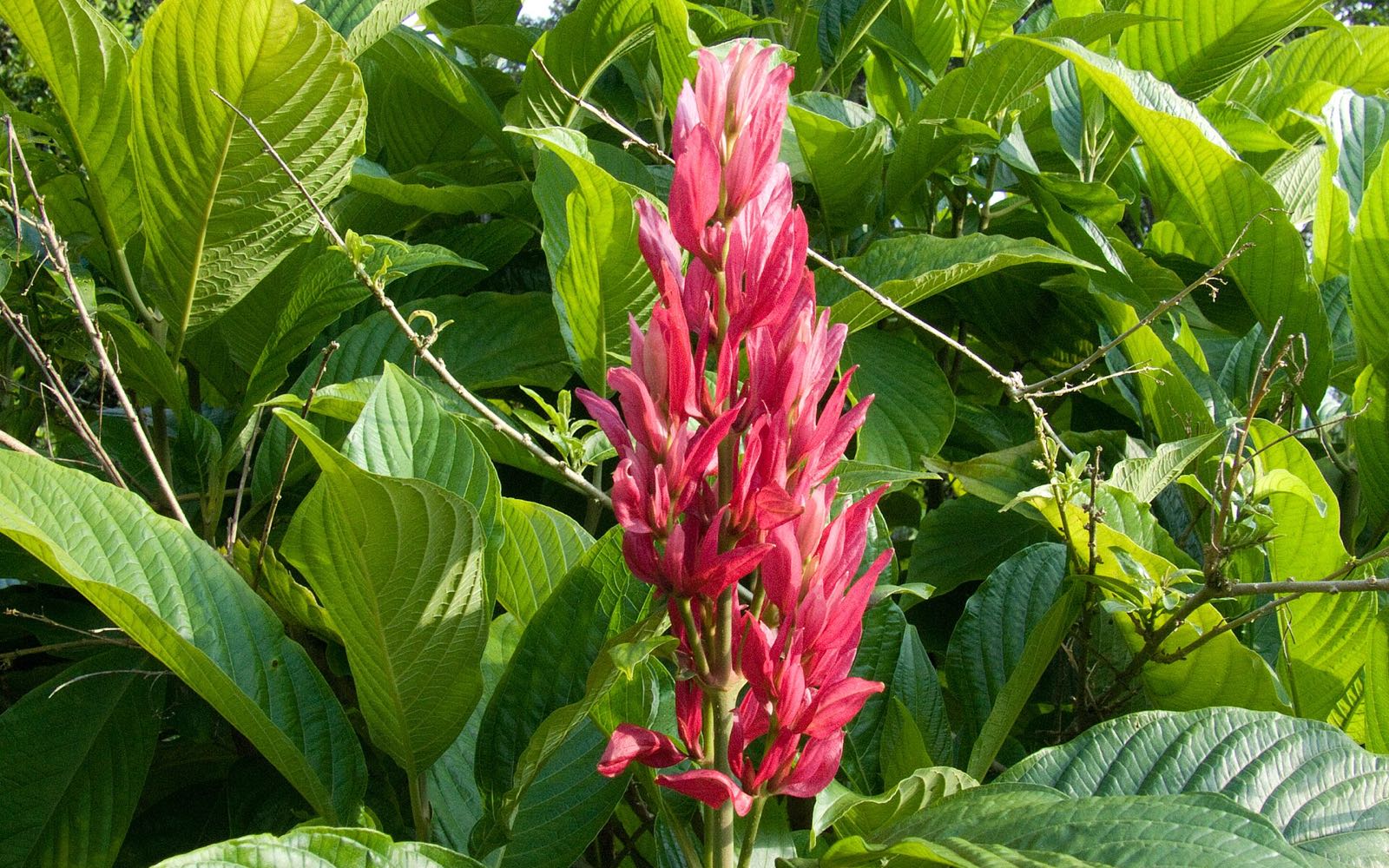
Photo by Andres Rueda on Wikimedia Commons, CC BY 2.0

Brazilian red cloak is a fast tropical shrub grown for tall spikes of red bracts around white flowers. Give it morning sun with afternoon shade and moist, well-drained soil. It stays outdoors all year in USDA zones 10 to 12, where frost is rare and it regrows after a light one. In colder places, keep it in a big pot and bring it in before nights drop to 50 to 60°F (10 to 16°C). Neither the ASPCA nor NC State rates it for pets. It isn't from Brazil: it grows wild in Venezuela and Suriname.
Not rated for pets
Neither the ASPCA nor NC State rates Brazilian red cloak. No reputable source lists it as toxic, and Hawaii’s weed risk assessment found no evidence of harm, but no one rates it as safe. Children: No poisoning information found.
Pet poison line: ASPCA (888) 426-4435
Good for: bold red color in part shade, hedges and screens in frost-free gardens, hummingbird gardens · Think twice if: you garden in Hawaii or another wet tropical island, where it can escape, your only spot gets full afternoon sun, you want a small plant: it can reach 8 ft in a year.
Needs at a glance
- Light4 of 4 · Some direct sunMorning sun with afternoon shade; your brightest window indoors
- Water2 of 3 · Let the top dryMoist, well-drained soil; never soggy
- Humidity1 of 3 · AverageNo special humidity needs in the sources
- Soil when pottedMoist, well-drained soilLoam is ideal; acid, neutral or alkaline
Indoors: best at 60°F (16°C) or warmer. Keep it above 50°F (10°C) and away from drafts and heat vents.
How the rating adds up
0 = easiest · 1 = moderate · 2 = hardest
- Missed waterings1 of 2 · ModerateLikes moist, well-drained soil; no source calls it drought tolerant
- Light flexibility1 of 2 · ModerateSun or part shade; morning sun with afternoon shade suits it best
- Humidity0 of 2 · EasiestNo special humidity needs in the sources
- Pests and disease1 of 2 · ModerateSpider mites, whiteflies, mealybugs and scale now and then; generally disease-free
- Sensitivity to change1 of 2 · ModerateFrost damages it, though it regrows; harsh afternoon sun wilts it
Growing outdoors
All year: USDA zones 10 to 12, where the coldest winter nights average 30°F (−1°C) or warmer.
Elsewhere: summer outside in morning sun and afternoon shade, or part shade. Bring it in when nights reach 50 to 60°F (10 to 16°C).
- Specimen shrub, informal hedge or screen where frost is rare
- Big container plant, even a houseplant
- Regrows after an occasional light frost
Sources: RHS, NParks, Florida Museum, UF/IFAS, Hawaii weed risk assessment, ASPCA plant list, Clemson, USDA zone map, FISC, Hawaii noxious weed list, Rojas-Sandoval and Acevedo-Rodríguez, Queensland Government, Cal-IPC, Texas Invasives and GISD. Full list below.
Verified · How we rate plants
Is Brazilian red cloak poisonous to cats and dogs?
No one has rated it, so we can't call it safe. It isn't on the ASPCA's lists of toxic or non-toxic plants, and NC State has no page for it. Hawaii's weed risk assessment checked a major poisonous plants reference and found no evidence that it harms animals or people, and none of the gardens and extension services we read mention a risk. Until someone rates it, keep it away from pets that chew plants. If a pet chews it and seems unwell, call your vet or the ASPCA Animal Poison Control Center at (888) 426-4435. If a child eats some, call Poison Help at 1-800-222-1222.
Is Brazilian red cloak from Brazil? Is it a justicia?
Neither, despite its names. Kew's checklist places its home in Venezuela and Suriname, and UF/IFAS says it's native to Venezuela and now grown across tropical America. Some gardens list Costa Rica, Nicaragua and El Salvador as native too, but Kew counts those plants as introduced. It's also sold as red justicia, and it does look like a Justicia, but Costa Rica's flora says it differs in its leaves and much bigger bracts. It is the only species in its genus, Megaskepasma, so a plant labeled just "Megaskepasma" is this one. The name means a large covering cloaked in red, for the bracts.
Kew, UF/IFAS, NParks, NTBG, Hawaii weed risk assessment, RHS
How much sun does Brazilian red cloak need?
Morning sun with some afternoon shade is the sweet spot, according to UF/IFAS. Too much full afternoon sun makes it wilt and bleaches the bracts. The RHS and Singapore's parks board say full sun or part shade both work, and in Hawaii it even grows in shade. Indoors, give it your brightest window.
How often should I water Brazilian red cloak?
Keep the soil moist but well drained, and never soggy. The RHS asks for moist, well-drained soil, and Singapore's parks board gives it moderate water. No source calls it drought tolerant, so check pots often in hot weather. No source gives a feeding schedule for it either.
Can Brazilian red cloak grow outdoors where I live?
All year in USDA zones 10 to 12, where the coldest nights stay around 30°F (-1°C) or warmer. UF/IFAS calls it hardy in zone 10: frost damages it now and then, but it grows back with little lasting harm. The RHS rates it for growing under glass or somewhere frost-free. In the garden it becomes a fast, robust shrub, 6 to 8 feet tall and wide per UF/IFAS (the agent's own plant reached about 8 feet in a year), and up to about 15 feet in the wild. Use it as a specimen, an informal hedge or a screen.
When should I bring my Brazilian red cloak inside?
Before nights drop to 50 to 60°F (10 to 16°C). The RHS protects it below 10 to 15°C (50 to 59°F), and Clemson Extension warns that 50°F (10°C) or lower hurts many tropical plants. UF/IFAS moves large container plants indoors whenever frost threatens. Indoors, give it your brightest spot and water a little less. Move it back out once nights stay above 60°F (16°C).
Is Brazilian red cloak invasive?
It can be on wet tropical islands. Hawaii's weed risk assessment rates it high risk: it has gone wild on Oahu, Kauai and the Big Island, where it fills the understory of gulches and roadsides, and it spreads mostly from stem pieces and suckers. As of November 2026, it isn't on Hawaii's noxious weed list, Florida's invasive plant list, Queensland's lists, the lists for Texas and California, or the Global Invasive Species Database. Wherever you live, bag your trimmings and never dump them in wild areas.
Hawaii weed risk assessment, Hawaii noxious weed list, FISC, Queensland Government, Texas Invasives, Cal-IPC, GISD
When does Brazilian red cloak bloom, and how do I prune it?
Grown in the ground, mature plants bloom off and on all year, most from late fall to early summer (UF/IFAS); the RHS sees flowers from late summer into winter. The red parts are bracts that hide small, curly white flowers and stay red after the flowers fade, on spikes up to a foot tall. Hummingbirds visit. It grows fast, so prune to keep it bushy: the RHS cuts the stems hard in spring. New plants come easily from stem cuttings, since it rarely sets seed in gardens.
How Grove helps
Grove sets a watering check based on how dry the soil is, so a Brazilian red cloak in a pot gets water before it dries out in summer. You can add pruning or bringing the pot inside as tasks and assign them, so whoever is home takes care of it.
Sources
- Royal Horticultural Society: Megaskepasma erythrochlamys (Brazilian red cloak, H1B)
- National Parks Board Singapore, Flora & Fauna Web: Megaskepasma erythrochlamys
- Florida Museum of Natural History (University of Florida), plant listing: Brazilian red cloak
- UF/IFAS Extension Charlotte County: Brazilian red cloak, landscape plant extraordinaire! (R. Mitchell, 2026)
- Hawaii-Pacific Weed Risk Assessment (Plant Pono): Megaskepasma erythrochlamys, high risk, score 6 (2012)
- UF/IFAS Extension Charlotte County: My Brazilian red cloak is looking great (blog title shortened) (R. Mitchell, 2021)
- ASPCA Animal Poison Control: Toxic and Non-Toxic Plants
- Clemson Cooperative Extension HGIC 1454: Moving Houseplants Indoors and Outdoors
- USDA ARS Plant Hardiness Zone Map (2023)
- Florida Invasive Species Council: 2023 Invasive Plant List
- Hawaii Administrative Rules 4-68: plant species designated as noxious weeds (Hawaii Department of Agriculture)
- J. Rojas-Sandoval and P. Acevedo-Rodríguez (2015), Naturalization and invasion of alien plants in Puerto Rico and the Virgin Islands, Biological Invasions 17 (supplementary list)
- Business Queensland: Restricted invasive plants (Biosecurity Act 2014)
- California Invasive Plant Council (Cal-IPC): Inventory (no Megaskepasma listing)
- Texas Invasives plant database, list by scientific name (no Megaskepasma)
- IUCN Global Invasive Species Database: Megaskepasma erythrochlamys (no entry)
- National Tropical Botanical Garden, Tropical Plant Database: Megaskepasma erythrochlamys
- Kew WCVP data release (2026-06-04 file), plant_name_id 2362705: Megaskepasma erythrochlamys (the only species in the genus, 2362695)