Plant care card
Firespike
Odontonema (O. tubaeforme, O. callistachyum, O. cuspidatum) · Odontonema
Also called fire spike, purple firespike or cardinal's guard
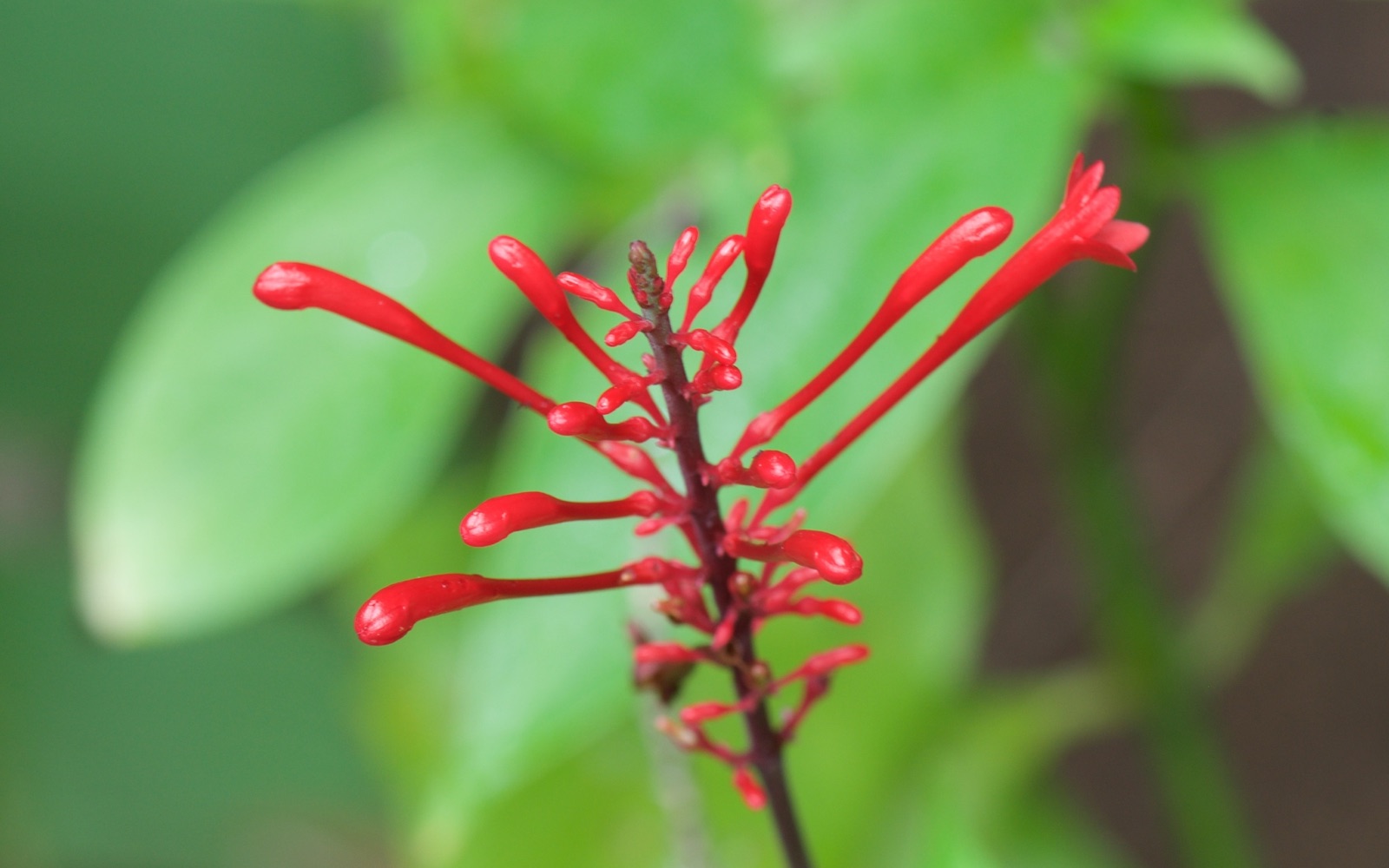
Photo by Jonathan Eisen on Wikimedia Commons, CC BY 4.0

Firespike is an easy tropical shrub grown for spikes of tubular red or purple flowers that hummingbirds love. Give it full sun or part shade and moist, well-drained soil. A hard freeze kills the top, but the roots usually regrow in USDA zones 9 to 11. In colder places, grow it in a pot and bring it in before nights drop to 50 to 60°F (10 to 16°C). Neither the ASPCA nor NC State rates it for pets.
Not rated for pets
Neither the ASPCA nor NC State rates firespike. The “cardinal flower” on the ASPCA’s toxic list is Lobelia cardinalis, a different plant. No reputable source lists firespike as toxic, but none rates it as safe either. Children: No poisoning information found.
Pet poison line: ASPCA (888) 426-4435
Good for: hummingbird and butterfly gardens, red flowers in part shade, fall and winter color in warm climates · Think twice if: you garden where it can escape, such as Queensland or Hawaii, you want a small, tidy plant: it gets tall and leggy without pruning.
Needs at a glance
- Light4 of 4 · Some direct sunFull sun for the most flowers; it still blooms in part shade
- Water2 of 3 · Let the top dryMoist, well-drained soil; it rides out short dry spells; less in winter
- Humidity1 of 3 · AverageNo special humidity needs in the sources
- Soil when pottedMoist, well-drained soilSand, loam or clay, acid to slightly alkaline; it dislikes salt
Indoors: best at 75 to 77°F (24 to 25°C). Keep it above 50°F (10°C) and away from drafts and heat vents.
How the rating adds up
0 = easiest · 1 = moderate · 2 = hardest
- Missed waterings1 of 2 · ModerateLikes moist soil; copes with short dry spells once settled
- Light flexibility1 of 2 · ModerateFull sun to part shade; fewer flowers in more shade
- Humidity0 of 2 · EasiestNo special humidity needs in the sources
- Pests and disease0 of 2 · EasiestNo serious pests; whiteflies now and then
- Sensitivity to change1 of 2 · ModerateFrost kills the top growth; the roots usually regrow in spring
Growing outdoors
All year: USDA zones 9a to 11, where the coldest winter nights average 20°F (−7°C) or warmer.
Elsewhere: summer outside in full sun or part shade; afternoon shade helps in hot climates. Bring it in when nights reach 50 to 60°F (10 to 16°C).
Invasive in: Queensland (Australia). Queensland records red firespike as an environmental weed, and Hawaii’s weed risk assessment rates all three firespikes high risk. Bag the trimmings and never dump them in the wild. Lists checked .
- Perennial or shrub where frost is rare
- Dies back and regrows where winters freeze lightly
- Summer annual in colder places
- Mass plantings, borders and big containers
Sources: NC State, UF/IFAS, UGA Extension, Bok Tower Gardens, RHS, ASPCA plant list, ASPCA, MSD Veterinary Manual, Hawaii weed risk assessment, Horticulturae, Clemson, USDA zone map, Queensland Government, FISC, Hawaii noxious weed list, Rojas-Sandoval and Acevedo-Rodríguez, GISD, Texas Invasives and Cal-IPC. Full list below.
Verified · How we rate plants
Is firespike poisonous to cats and dogs?
No one has rated it, so we can't call it safe. Firespike isn't on the ASPCA's lists of toxic or non-toxic plants, NC State gives no poison rating, and the MSD Veterinary Manual doesn't list it. Hawaii's weed risk assessment found no evidence that it harms animals. Watch the name, though: NC State also calls firespike "cardinal flower", and the ASPCA's cardinal flower is Lobelia cardinalis, a different plant that is toxic to dogs, cats and horses. If a pet chews firespike and seems unwell, call your vet or the ASPCA Animal Poison Control Center at (888) 426-4435. If a child eats some, call Poison Help at 1-800-222-1222.
ASPCA plant list, NC State, MSD Veterinary Manual, Hawaii weed risk assessment, ASPCA
Which firespike do I have: red, purple, strictum or tubaeforme?
Probably one of three close cousins, which is why this card covers the whole group, Odontonema. Red firespike is sold as Odontonema strictum, but Kew now files that name under Odontonema tubaeforme, the name NC State uses. Florida's plant atlas calls the red firespike growing there Odontonema cuspidatum, a separate species. Purple firespike, Odontonema callistachyum, has lavender to purple spikes and grows taller, about 8 to 10 feet at Bok Tower Gardens. All of them want the same care: sun, moist soil that drains, and shelter from hard frost.
Kew, Bishop Museum, Atlas of Florida Plants, UF/IFAS, NC State, RHS, Bok Tower Gardens
How much sun does firespike need?
Full sun gives the most flowers, but it takes part shade too. UF/IFAS says it's one of the few plants that still gives good red color in a partly shaded spot, and UGA agrees. In very hot sun, Bok Tower Gardens says purple firespike likes a break from the afternoon sun. A Mississippi State study found that heavy shade (65%) delayed the first flowers. In a pot indoors for winter, give it your sunniest window.
UF/IFAS, UGA Extension, NC State, Bok Tower Gardens, Horticulturae
How often should I water firespike?
Keep the soil moist while it grows, and let it drain well. NC State says to water moderately from spring to fall and sparingly in winter. Once it's settled in the ground, UF/IFAS calls it moderately drought tolerant, and UGA says it handles all but the longest dry spells. Pots dry out faster, so check them more often in summer. For food, NC State gives a balanced liquid feed about once a month in the growing season, and UGA suggests a weekly liquid feed for container plants.
Can firespike grow outdoors where I live?
Year round in USDA zones 9a to 11, where the coldest nights stay around 20°F (−7°C) or warmer. NC State lists zones 9a to 12b and UF/IFAS lists 8b to 11. A hard freeze kills the stems and leaves, but the roots usually send up new shoots in spring, so it acts like a perennial that dies back. In south Florida it stays leafy and can bloom all year. In north Florida and the far south of Georgia, mulch the roots in late fall. Farther north, treat it as a summer annual or keep it in a pot.
NC State, UF/IFAS, USDA zone map, Bok Tower Gardens, UGA Extension
When should I bring a potted firespike inside?
Before nights fall to 50 to 60°F (10 to 16°C). Clemson Extension waits until nights stay above 60°F before moving tropical plants out in spring, and warns that 50°F or colder can damage many of them. The RHS rates its cousin, Odontonema schomburgkianum, for 10 to 15°C (50 to 59°F) at the coldest. Check for pests, even under the pot, before you carry it in. Indoors, give it the brightest window you have and water less. In a greenhouse study, plants grew and bloomed best at about 75°F (24 to 25°C).
When does firespike bloom?
Red firespike blooms from late summer into fall and winter, which is when hummingbirds really need it. NC State says summer through fall, UF/IFAS says fall and winter, and in south Florida it can flower all year. The flowers are slim red tubes about an inch long, packed on spikes up to a foot tall. Purple firespike blooms from about October to July at Bok Tower Gardens, on spikes that can reach 2 feet. Both draw hummingbirds and butterflies. In the Mississippi State study, plants kept at about 59°F (15°C) or 95°F (35°C) didn't form flower spikes during the trial.
NC State, UF/IFAS, UGA Extension, Bok Tower Gardens, Horticulturae
How do I prune and propagate firespike?
It flowers on new growth, so NC State prunes in spring. To keep it bushy, UGA pinches the shoot tips through early summer. UF/IFAS suggests cutting it to the ground in winter to clean it up, and cutting it back a few times in the growing season if it gets too tall. Bok Tower Gardens does a hard cut to a foot or two in late summer or early fall, after purple firespike stops blooming. New plants are easy: UGA says softwood cuttings root readily, and spring cuttings bloom by fall. You can also divide a clump, and it may reseed.
Is firespike invasive?
It can be in warm, wet places. The Queensland Government lists red firespike as an environmental weed in Australia, and Hawaii's weed risk assessment rates all three firespikes high risk: it forms dense stands in wet forest and spreads from stem pieces in dumped garden waste. UF/IFAS says it has naturalized in Florida, though it isn't on Florida's invasive plant list. As of November 2026, Hawaii's noxious weed list, the Global Invasive Species Database and the Texas and California lists don't name it. Wherever you live, bag your trimmings for the trash.
Queensland Government, Hawaii weed risk assessment, UF/IFAS, FISC, Hawaii noxious weed list, GISD, Texas Invasives, Cal-IPC, NC State
How Grove helps
Grove sets a watering check based on how dry the soil is, so firespike gets water before it dries out in summer. You can add pruning as a repeating task and assign it to whoever looks after the garden.
Sources
- NC State Extension Gardener Plant Toolbox: Odontonema tubaeforme (firespike)
- UF/IFAS Extension EDIS FPS445: Odontonema strictum, Firespike (E. F. Gilman and others; rev. October 2023)
- UF/IFAS Gardening Solutions: Firespike
- University of Georgia CAES Extension (B. V. Pennisi): Striking flowers make Firespike a landscape winner (2007)
- Bok Tower Gardens (P. Lynch): Purple Blooms for A Plant On Fire, purple firespike (2020)
- Royal Horticultural Society: Odontonema schomburgkianum (H1B)
- ASPCA Animal Poison Control: Toxic and Non-Toxic Plants
- ASPCA Animal Poison Control: Cardinal Flower (Lobelia cardinalis)
- MSD Veterinary Manual: Poisonous Houseplants and Ornamentals (table; no Odontonema)
- Hawaii-Pacific Weed Risk Assessment (Plant Pono): Odontonema cuspidatum, high risk, score 7 (2008)
- Rezazadeh, Harkess and Telmadarrehei (2018), The Effect of Light Intensity and Temperature on Flowering and Morphology of Potted Red Firespike, Horticulturae 4(4): 36
- Clemson Cooperative Extension HGIC 1454: Moving Houseplants Indoors and Outdoors
- USDA ARS Plant Hardiness Zone Map (2023)
- Queensland Government WildNet: Odontonema tubaeforme (exotic; environmental weed)
- Hawaii-Pacific Weed Risk Assessment (Plant Pono): Odontonema tubaeforme, high risk, score 11 (2011)
- Hawaii-Pacific Weed Risk Assessment (Plant Pono): Odontonema callistachyum, high risk, score 8 (2022)
- Florida Invasive Species Council: Plant List, Category I (April 2026)
- Hawaii Administrative Rules 4-68: plant species designated as noxious weeds (Hawaii Department of Agriculture)
- J. Rojas-Sandoval and P. Acevedo-Rodríguez (2015), Naturalization and invasion of alien plants in Puerto Rico and the Virgin Islands, Biological Invasions 17 (supplementary list)
- IUCN Global Invasive Species Database: Odontonema (no entry)
- Texas Invasives plant database, list by scientific name (no Odontonema)
- California Invasive Plant Council (Cal-IPC): Inventory (no Odontonema listing)
- Kew WCVP data release (2026-06-04 file), plant_name_id 2388486: genus Odontonema
- Kew WCVP data release (2026-06-04 file), plant_name_id 2401155: Odontonema tubaeforme (O. strictum is its synonym)
- Kew WCVP data release (2026-06-04 file), plant_name_id 2391047: Odontonema cuspidatum
- Kew WCVP data release (2026-06-04 file), plant_name_id 2391035: Odontonema callistachyum (purple firespike)
- Bishop Museum, Plants of Hawai'i: Odontonema callistachyum
- Atlas of Florida Plants (University of South Florida): Odontonema cuspidatum, firespike
- Royal Horticultural Society: Odontonema tubaeforme