Plant care card
Crown of thorns
Euphorbia milii · Corona de Cristo
Also called Christ plant or Christ thorn
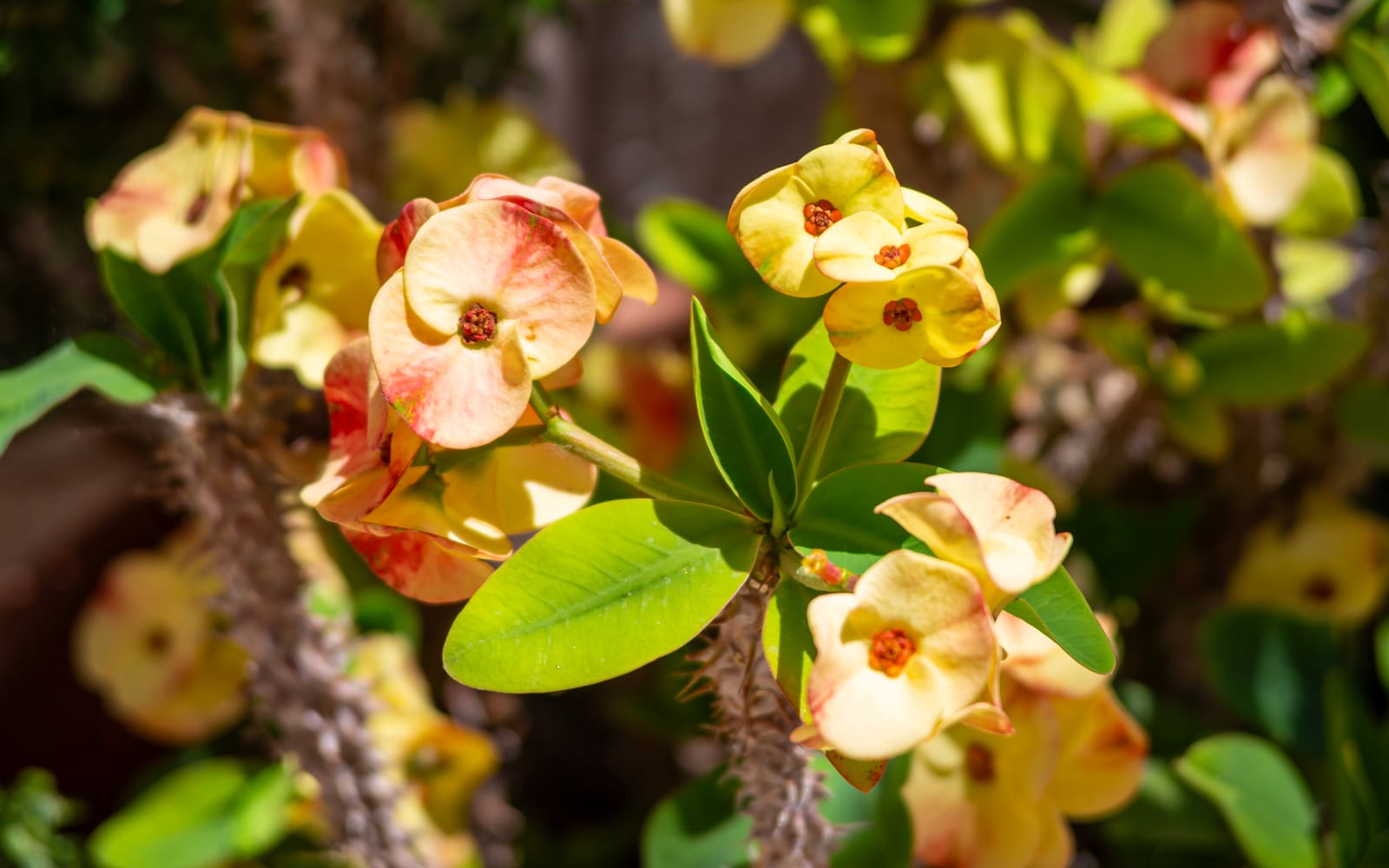
Photo by Macieklew on Wikimedia Commons, CC0 1.0

Crown of thorns is a spiny succulent that flowers for much of the year if you give it your sunniest window and let the soil dry between waterings. It's easy to keep alive and fussier to keep in bloom: low light, cold drafts and wet soil cost you flowers and leaves. Handle it with gloves. The spines are sharp, and the milky sap irritates skin and can hurt eyes. NC State lists it as mildly toxic to cats, dogs and horses.
Mildly toxic to cats, dogs and horses (NC State)
Drooling, vomiting or diarrhea; the sap irritates the mouth, skin and eyes. The ASPCA list leaves it out; NC State rates it low severity for cats, dogs and horses. Children: low severity. NC State rates it low severity; the milky sap irritates skin, can hurt eyes and blisters the mouth if chewed, and the spines are sharp.
Pet poison line: ASPCA (888) 426-4435
Good for: sunny windows, people who forget to water, flowers for much of the year · Think twice if: pets, horses or small children chew plants or play close by, your only window is dim.
Needs at a glance
- Light4 of 4 · Some direct sunThe sunniest window you have; 6 or more hours of direct sun
- Water1 of 3 · Let the soil dryThen water deeply; never leave it soggy
- Humidity1 of 3 · AverageDry indoor air is fine, even in winter
- Soil when pottedFast-draining mixCactus mix or potting soil with extra perlite or grit
Indoors: best at 60 to 75°F (16 to 24°C). Keep it above 50°F (10°C) and away from drafts and heat vents.
How the rating adds up
0 = easiest · 1 = moderate · 2 = hardest
- Missed waterings0 of 2 · EasiestDrought tolerant: its stems store water
- Light flexibility2 of 2 · HardestNeeds full sun; flowers less in shade
- Humidity0 of 2 · EasiestPrefers dry air; heated homes are fine
- Pests and disease1 of 2 · ModerateMealybugs most often; rot when kept too wet
- Sensitivity to change1 of 2 · ModerateDrops leaves after cold drafts, long dry spells or heat
Growing outdoors
All year: USDA zones 10b to 11, where the coldest winter nights average 35°F (2°C) or warmer.
Elsewhere: summer outside in full sun, with midday shade in hot summers. Bring it in when nights reach 50 to 60°F (10 to 16°C).
- Containers and sunny windows
- Low hedges, borders and rock gardens in warm climates
- Deer and rabbit resistant
Sources: NC State, RHS, Wisconsin Extension, Arkansas Extension, NYBG, Illinois Extension, Texas Tech, Pet Poison Helpline, ASPCA plant list, USDA zone map, FISC, UF/IFAS and Hawaii weed risk assessment. Full list below.
Verified · How we rate plants
Is crown of thorns poisonous to cats, dogs and horses?
It's mildly toxic, so keep it out of reach. The ASPCA plant list doesn't include crown of thorns, but NC State lists it as a problem for cats, dogs and horses and rates it low severity. Every part of the plant holds a milky latex with irritating compounds (diterpene esters). The Pet Poison Helpline says a pet that chews it usually gets mild mouth and stomach upset: drooling, a poor appetite, vomiting or diarrhea. Sap on the skin or in the eyes can irritate too. The spines are their own hazard. If a pet chews it and seems unwell, call your vet or the ASPCA Animal Poison Control Center at (888) 426-4435 (a fee may apply).
NC State, Pet Poison Helpline, ASPCA plant list, Wisconsin Extension
Is crown of thorns sap dangerous to people?
It can be, so treat it with care. NC State says the milky latex can cause mild to severe skin rashes, can damage the eye's surface, sometimes for good, and blisters the lips and mouth if chewed. Wisconsin Extension warns that sap in the eyes can cause temporary blindness. Wear gloves, and eye protection when you prune. NC State rates it low severity for children, but the sap and the sharp spines are reasons to keep it out of small hands. If a child eats some, call Poison Help at 1-800-222-1222.
NC State, Wisconsin Extension, RHS, Arkansas Extension, NYBG
How often should I water crown of thorns?
When the soil has dried. Water until it runs out the bottom, empty the saucer, and wait for the mix to dry again. Its stems store water, so it handles a missed watering, but the NYBG warns against leaving the roots dry for long: long droughts make it drop leaves. Soggy soil is the real danger: it rots the roots. Wisconsin Extension notes that many hybrids want water a little more often than the species. Give it less after it finishes flowering.
NYBG, Wisconsin Extension, NC State, Arkansas Extension, RHS
How much light does crown of thorns need?
As much as you can give it. NC State calls for full sun, 6 or more hours of direct light a day, and the NYBG suggests 6 to 8 hours in a sunny window. Turn the pot every week or so to keep it even. It can live in part shade, but Wisconsin Extension says it flowers less there. Outdoors in hot summers, a little midday shade helps. When you move it outside, ease it into full sun gradually so it doesn't scorch.
NC State, NYBG, Wisconsin Extension, Arkansas Extension, Illinois Extension
Why is my crown of thorns losing leaves?
Some leaf drop is normal. Each leaf lasts a few months, and NC State says a round of dropping often comes before its winter rest, so older stems end up bare. Fast or heavy drop points to stress. The NYBG names three causes: soil left dry too long, temperatures below about 60°F (16°C), and too little light. Cold drafts from doors and windows count. Wisconsin Extension adds that drought or heat can strip a plant bare. Fix the cause and new leaves grow from the stem tips.
Why won't my crown of thorns bloom?
Light is the first thing to check: the NYBG calls strong, direct light the most important factor. Flowers form only on growing, leafy stem tips. Too much fertilizer and soggy soil also cut flowering, the NYBG and Wisconsin Extension say. Wisconsin adds that it needs dark nights, so a lamp on all evening can reduce blooms. The large-flowered hybrids are less picky: Arkansas Extension says they keep setting buds whenever they're growing, whatever the day length. A healthy plant can flower from late winter into fall.
What are the big Thai crown of thorns hybrids?
They're the plants with large flower clusters and long leaves, sold as Thai or giant crown of thorns. Arkansas Extension says they come from Euphorbia × lomi, a garden cross of crown of thorns with a related Madagascar species, E. lophogona, that never grew in the wild. They're generally less thorny and keep their leaves better, and Kew lists the cross under its own name. Wisconsin Extension notes many hybrids need a bit more water. Care is otherwise the same, so they're on this card. Older labels may say E. milii var. splendens: Kew now treats that plant as its own species, E. splendens.
Can crown of thorns grow outdoors?
Yes, where winters stay mild. NC State lists USDA zones 9 to 11, but NC State and Wisconsin Extension both say it can't take nights below 35°F (2°C), so it's safest where nights stay above that, about zone 10b and warmer. There it makes a low hedge, border or rock garden plant, deer and rabbits leave it alone, and it handles drought and salt. Elsewhere, it can summer outside in full sun with some midday shade. Bring it in well before frost, by the time nights fall to 50 to 60°F (10 to 16°C). It isn't on Florida's 2026 invasive plant lists, UF/IFAS finds it isn't a problem species, and the Hawaii weed risk assessment rates it low risk.
NC State, Wisconsin Extension, Texas Tech, RHS, NYBG, FISC, UF/IFAS, Hawaii weed risk assessment
How do I propagate or prune crown of thorns?
Take stem tip cuttings from young, leafy stems: 3 to 6 inches long, wearing gloves. Rinse the cut in cool water to stop the sap, then let the cutting dry for 2 to 3 days. Set it in a fast-draining mix kept barely moist, out of hot sun. Roots form in about 5 to 8 weeks in warm conditions. Prune in spring while it's growing. The NYBG says to keep about half the leafy stems, and Wisconsin Extension suggests a knife, since the sap gums up shears. Old, leggy plants are often best restarted from cuttings.
How Grove helps
Grove sets a watering check based on how dry the soil is, so a crown of thorns gets water only once it has dried out. You can add a gloves-on pruning or repotting job as a task and assign it to whoever is home, so nobody grabs a spiny stem by surprise.
Sources
- NC State Extension Gardener Plant Toolbox: Euphorbia milii
- Royal Horticultural Society: Euphorbia milii (crown of thorns)
- University of Wisconsin-Madison Extension, Wisconsin Horticulture: Crown of Thorns, Euphorbia milii (S. Mahr, revised 2026)
- University of Arkansas Extension, Plant of the Week: Crown-of-Thorns Hybrids, Euphorbia × lomi (G. Klingaman, 2011)
- New York Botanical Garden Mertz Library: Crown of Thorns (Euphorbia milii)
- University of Illinois Extension, Houseplants: Lighting (crown of thorns under high light)
- Texas Tech University Plant and Soil Science, Plant Database: Euphorbia milii (crown of thorns)
- Pet Poison Helpline: Crown of Thorns
- ASPCA Animal Poison Control: Toxic and Non-Toxic Plants
- University of Illinois Extension, Houseplants: Care (temperature for foliage plants)
- USDA ARS Plant Hardiness Zone Map (2023)
- Florida Invasive Species Council: Plant List, Category I and II and Watch List (April 2026)
- UF/IFAS Assessment of Non-Native Plants: Euphorbia milii
- Hawaii-Pacific Weed Risk Assessment (Plant Pono): Euphorbia milii, low risk, score 1
- Kew WCVP data release (2026-06-04 file), plant_name_id 80891: Euphorbia milii
- Kew WCVP data release (2026-06-04 file), plant_name_id 80627: Euphorbia × lomi
- Kew WCVP data release (2026-06-04 file), plant_name_id 82291: Euphorbia splendens (syn. E. milii var. splendens)
- Texas A&M AgriLife, Ornamental Production: Crown of Thorns (listed as Euphorbia milii splendens)