
Plant care card
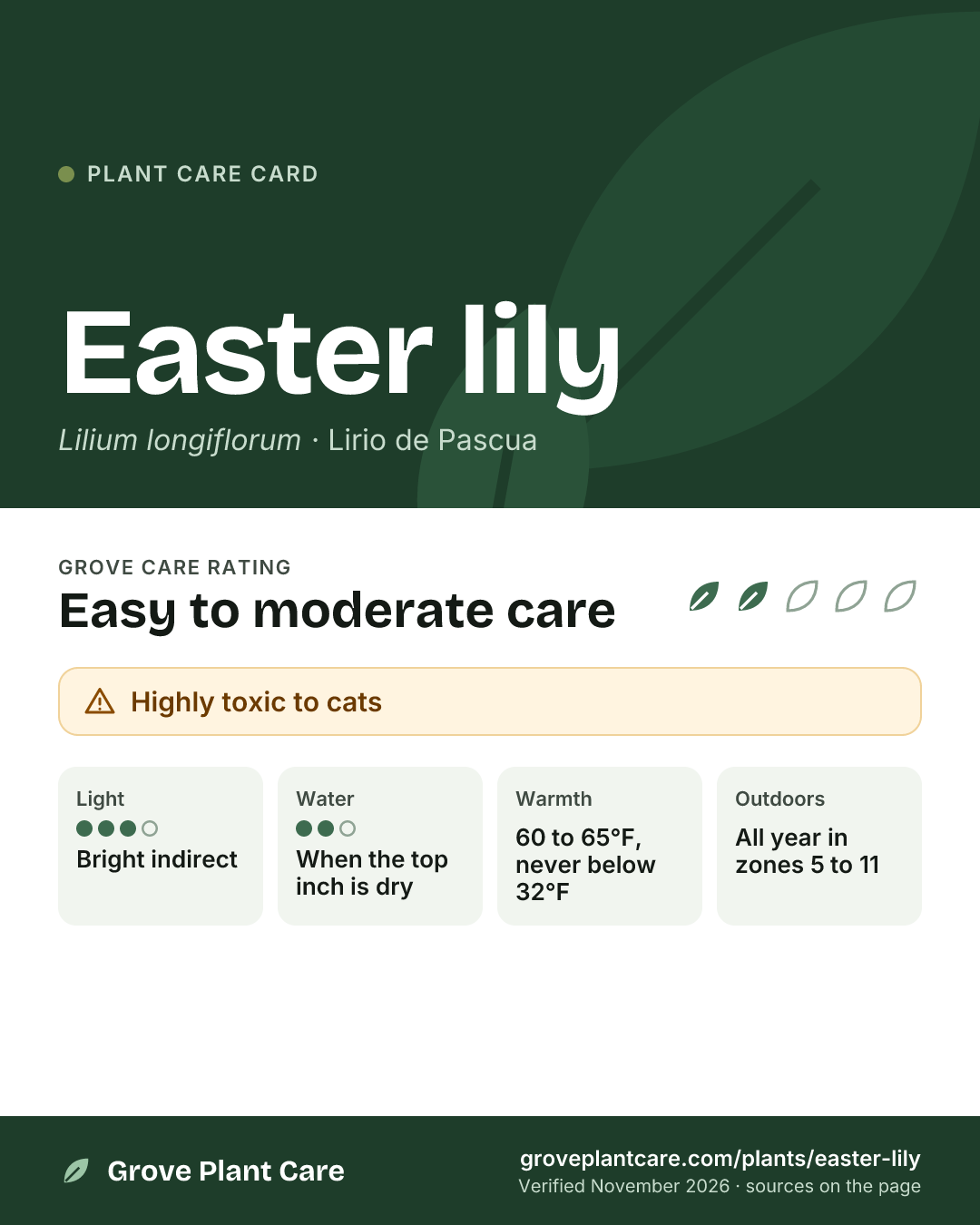
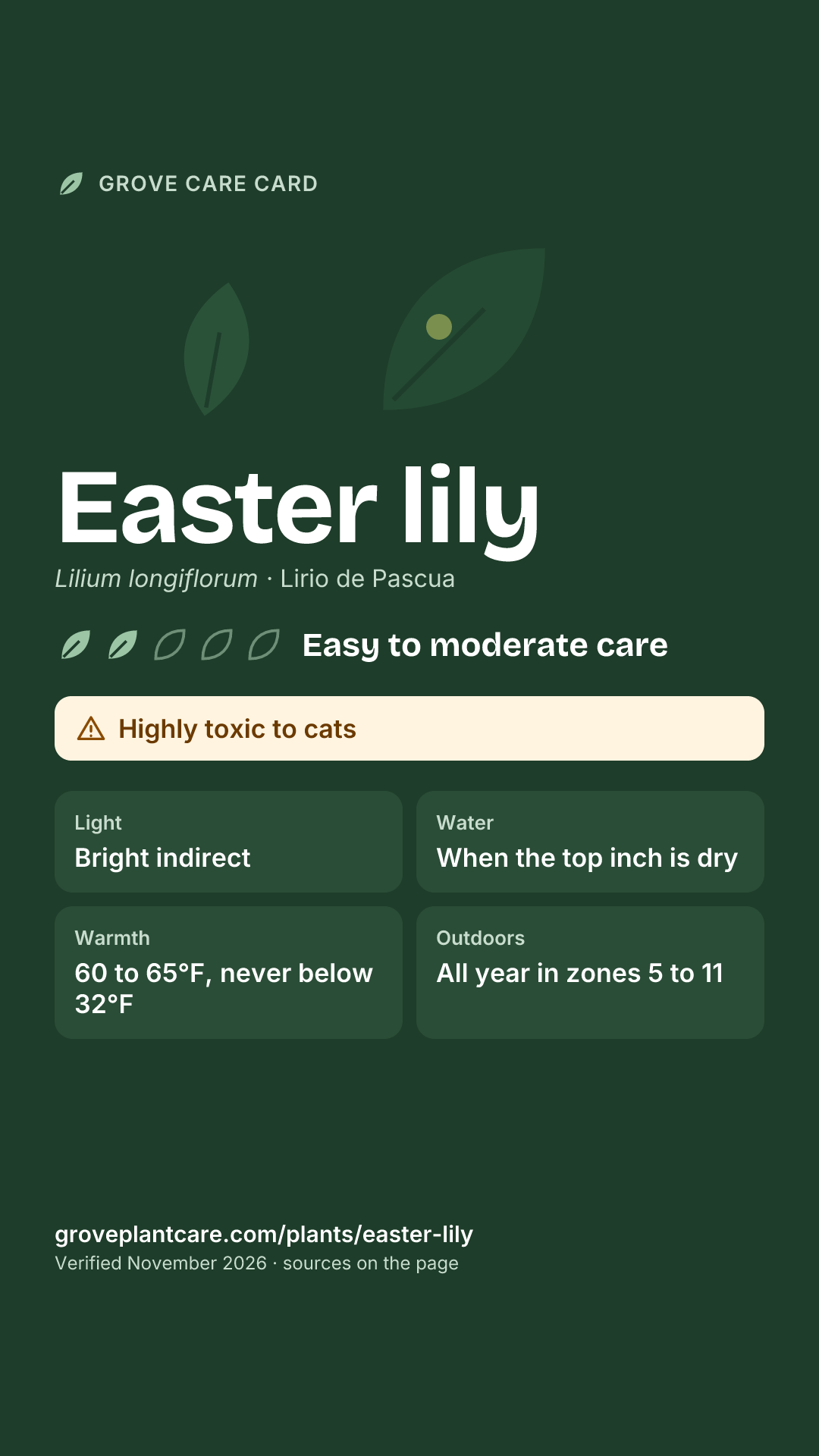
Easter lily
Lilium longiflorum · Lirio de Pascua
Also called Bermuda lily, trumpet lily or November lily
Photo by Bruce Dupree, Alabama Extension on Wikimedia Commons, CC0 1.0

An Easter lily is easy to enjoy in bloom: bright indirect light, a cool room, and water when the top inch of soil is dry. After Easter you can plant the bulb outside, where it usually blooms again in summer. Keep it out of any home with a cat. Every part, even a little pollen or the water in a vase, can cause kidney failure in cats, and a cat that touches it needs a vet right away.
Highly toxic to cats: can cause kidney failure (ASPCA)
Cat chewed any part, licked pollen or drank vase water? Call your vet right away.
Dogs: an upset stomach at most, no kidney damage (FDA, UVM); the ASPCA lists it non-toxic to dogs
Vomiting, drooling, low appetite and lethargy within about 12 hours; kidney failure can follow within 1 to 3 days, and death is possible. Every part counts, even a little pollen licked off fur or water from the vase. Don't wait for signs: the ASPCA says treatment delayed past 18 hours is often fatal. Children: low severity. Poison Control says it isn't poisonous to children, though pieces can choke a small child; UF/IFAS says garden lilies contain alkaloids that can poison if eaten.
Pet poison line: ASPCA (888) 426-4435
Good for: easter and spring gifts for homes without cats, fragrant summer flowers in the garden, cutting and cottage gardens · Think twice if: a cat is anywhere in the home, or cats visit the garden, you hope to see it bloom again next Easter.
Needs at a glance
- Light3 of 4 · Bright indirectOut of direct sun while it blooms; a sunny window afterward
- Water2 of 3 · Let the top inch dryWater until it drains; never leave it standing in foil or a saucer
- Humidity1 of 3 · AverageA normal home is fine, away from heaters
- Soil when pottedWell-drained soilIn the garden, a sunny bed with compost; drainage matters most
Indoors: best at 60 to 65°F (16 to 18°C). Keep it above 32°F (0°C) and away from drafts and heat vents.
How the rating adds up
0 = easiest · 1 = moderate · 2 = hardest
- Missed waterings1 of 2 · ModerateWater when the top inch is dry; soggy soil rots the bulb
- Light flexibility1 of 2 · ModerateBright indirect light in bloom, full sun in the garden
- Humidity0 of 2 · EasiestNo extra humidity; keep it away from heat vents
- Pests and disease0 of 2 · EasiestPests are rarely serious; bulbs rot in wet soil
- Sensitivity to change1 of 2 · ModerateHeat and drafts shorten the bloom
Growing outdoors
All year: USDA zones 5 to 11, where the coldest winter nights average −20°F (−29°C) or warmer.
Elsewhere: summer outside in full sun, with mulch to keep the roots cool. Bring it in before nights drop below 32°F (0°C).
- Potted gift plant
- Perennial bulb in the garden
- Borders and cutting gardens
- Containers
Sources: NC State, Purdue, Clemson, Wisconsin Extension, Illinois Extension, UF/IFAS, University of Missouri, Nebraska Extension, Iowa State, ASPCA, FDA, UVM Extension, MSD Veterinary Manual, National Capital Poison Center, K-State, RHS, USDA zone map, USDA PLANTS, FISC, Cal-IPC, GISD and Kew WCVP. Full list below.
Verified · How we rate plants
Are Easter lilies poisonous to cats and dogs?
Yes for cats, and it's serious. The ASPCA lists the Easter lily as toxic to cats, and cats are the only animal it lists as affected: it can cause vomiting, low appetite, lethargy and kidney failure, and death is possible. Every part counts, the FDA and Clemson say, including the leaves, flowers, pollen and even the water in a vase. A cat can be poisoned by chewing one or two leaves or by licking a little pollen off its fur. For dogs, the ASPCA lists it as non-toxic; the FDA and UVM Extension say a dog that eats some may get an upset stomach, with no kidney failure. For people, Poison Control says it isn't poisonous to children, though pieces can be a choking risk. If a pet eats some and seems unwell, call your vet or the ASPCA Animal Poison Control Center at (888) 426-4435. If a person eats some, call Poison Help at 1-800-222-1222.
ASPCA, FDA, Clemson, UVM Extension, National Capital Poison Center
What should I do if my cat chewed an Easter lily or licked the pollen?
Call your vet right away, even if your cat seems fine. The FDA says early signs (drooling, vomiting, being less active, loss of appetite) start within 12 hours, and signs of kidney damage about 12 to 24 hours after eating. The ASPCA says aggressive vet care can prevent the kidney injury, but treatment delayed more than 18 hours is often fatal. The FDA suggests bringing the plant or a photo of it, so the vet can tell which lily it was. Because the risk is so high, the FDA says it's best to keep Easter lilies out of any home with a cat, and to plant them only where no cat, yours or a neighbor's, can reach them. You can also call the ASPCA Animal Poison Control Center at (888) 426-4435.
How do I care for an Easter lily while it blooms?
Give it a bright spot out of direct sun, and keep it cool: Clemson and Wisconsin suggest about 60 to 65°F (16 to 18°C) by day, a little cooler at night, away from drafts, heaters and vents. Cool rooms make the flowers last longer. Take the plant out of any plastic sleeve when you get it home. As each flower opens, you can pull off the yellow anthers with a tissue before they shed pollen; that keeps the pollen from staining petals, cloth and skin and helps the flower last. Snip off each flower as it fades. When buying, Clemson suggests a plant with one or two flowers open and three or more buds.
Clemson, Wisconsin Extension, Illinois Extension, Purdue, Nebraska Extension
How often should I water an Easter lily?
Check the soil instead of following a schedule. Purdue says to water when the top inch or so feels dry, then water until some drains out the bottom. Most potted lilies come wrapped in foil, which can trap water around the roots, so take the pot out of the foil to water it (or poke holes in the bottom) and pour off what drains. Overwatering is the usual way people lose them: the bulb rots in soggy soil. Wisconsin adds that the soil shouldn't stay dry for more than a day or two.
What do I do with an Easter lily after Easter?
Keep it growing instead of tossing it. Once the last flower fades, cut the flowers off and keep the stem and leaves, which feed the bulb. Move it to a sunny window, keep watering when the top of the soil is dry, and start feeding it: Iowa State uses a diluted fertilizer every two weeks, and Purdue suggests a balanced or flowering-plant fertilizer. Wisconsin says not to feed it while it's still in bloom. If you don't want to plant it outside, Wisconsin says you can let it go dormant in the pot, store it over winter and plant it the next spring.
Iowa State, Purdue, Clemson, Wisconsin Extension, Nebraska Extension
How do I plant an Easter lily outside?
Wait until the danger of frost has passed, then get the plant used to the outdoors over about a week. Choose a sunny spot with soil that drains well; Clemson suggests a slightly raised bed with compost. Plant it so the top of the bulb sits about 6 inches (15 cm) deep, since lilies grow roots along the buried stem. Water it in and add a 2 inch (5 cm) layer of mulch: lilies like their heads in the sun and their roots in the shade. Don't worry when the old stem turns brown within a few weeks. Cut it back once it's brown, and new growth should come up from the bulb.
Clemson, Wisconsin Extension, Iowa State, Purdue, UVM Extension, University of Missouri
Will my Easter lily bloom again?
Usually yes, outdoors, on its natural schedule. Growers force Easter lilies to bloom in spring; in the garden they flower in summer. Clemson says replanted lilies bloom in June or July from the next year on. Some bloom a second time sooner: Iowa State says lucky gardeners get flowers in September, Purdue expects a late summer bloom, and Wisconsin says the first outdoor bloom usually comes that fall. Clemson calls a second bloom that first summer unlikely, so treat it as a bonus. Planted out, it can grow 3 feet (90 cm) tall, much taller than the potted plant. It won't bloom again in time for next Easter.
Can an Easter lily stay outside through winter?
In many places, yes. Wisconsin and UVM Extension say it's hardy in USDA zones 5 to 11, where the coldest winter nights average −20°F (−29°C) or warmer, and NC State lists zones 5 to 8. Near the cold end it's a gamble: Iowa State, Purdue and K-State say it isn't reliably hardy in the Midwest, though it often survives with mulch. After the stems die back in fall, cover the spot with about 4 inches (10 cm) of straw or 3 inches (7.5 cm) of pine needles or wood chips, and pull the mulch back in spring when shoots appear. Illinois suggests growing it in a pot you can bring indoors if you'd rather not risk a hard freeze.
Wisconsin Extension, UVM Extension, NC State, USDA zone map, Iowa State, Purdue, K-State, Illinois Extension
Which lilies are dangerous to cats?
True lilies (Lilium, including Easter, Asiatic, Oriental and Stargazer lilies) and daylilies (Hemerocallis) can cause kidney failure in cats, the ASPCA and FDA say. Many plants called lily are a different story. Peace lilies and calla lilies irritate the mouth and can cause drooling and vomiting, and the Peruvian lily (Alstroemeria) can upset the stomach; none of these cause kidney failure. Lily of the valley is a separate danger: it affects the heart in cats and dogs. If you aren't sure which lily your cat got into, treat it as an emergency and call your vet.
How Grove helps
Grove sets a watering check based on how dry the soil is, so nobody drowns a lily that's still wet in its foil. After Easter, planting it outside can be one of the tasks you can assign, with reminders to cut back the brown stem and to mulch the bed before winter.
Sources
- NC State Extension Gardener Plant Toolbox: Lilium longiflorum
- Purdue Consumer Horticulture, Indiana Yard and Garden: Easter Lily Heralds Arrival of Spring
- Clemson Cooperative Extension HGIC 1555: Easter Lily (rev. 2016)
- University of Wisconsin-Madison Extension, Wisconsin Horticulture: Easter Lily, Lilium longiflorum (S. Mahr)
- University of Illinois Extension, Home, Yard and Garden Newsletter: Easter lily after it blooms (2021)
- UF/IFAS Gardening Solutions: Easter Lily
- University of Missouri IPM: Lily, more than an Easter flower (2024)
- Nebraska Extension in Lancaster County: Easter Lily Care
- Iowa State University Extension, Yard and Garden: Can I plant my Easter lily outdoors after it is done blooming?
- ASPCA Animal Poison Control: Easter Lily
- ASPCA: Which Lilies Are Toxic to Pets? (2022)
- U.S. Food and Drug Administration: Lovely Lilies and Curious Cats, a Dangerous Combination
- University of Vermont Extension: Easter flowers (D. J. Benoit)
- MSD Veterinary Manual: Houseplants and Ornamentals Toxic to Animals
- National Capital Poison Center (webPOISONCONTROL): Easter lilies and cats, a dangerous combination
- K-State Research and Extension: K-State expert shares tips to keep Easter lilies blooming (2024)
- Royal Horticultural Society: Lilium longiflorum (Easter lily)
- USDA ARS Plant Hardiness Zone Map (2023)
- USDA PLANTS Database: Lilium longiflorum (LILO3), introduced, no noxious or invasive status
- Florida Invasive Species Council: 2023 Invasive Plant List (no Lilium listed)
- California Invasive Plant Council (Cal-IPC): plant search, "Lilium" (no listing)
- IUCN Global Invasive Species Database: Lilium longiflorum (no entry)
- Kew WCVP data release (2026-06-04 file), plant_name_id 280023
- University of Wisconsin-Madison Extension, Wisconsin Horticulture: Tips for Buying and Caring for Easter Lilies