Plant care card
Pink banana
Musa velutina · Banano rosado
Also called hairy banana, pink velvet banana or pink fruiting banana
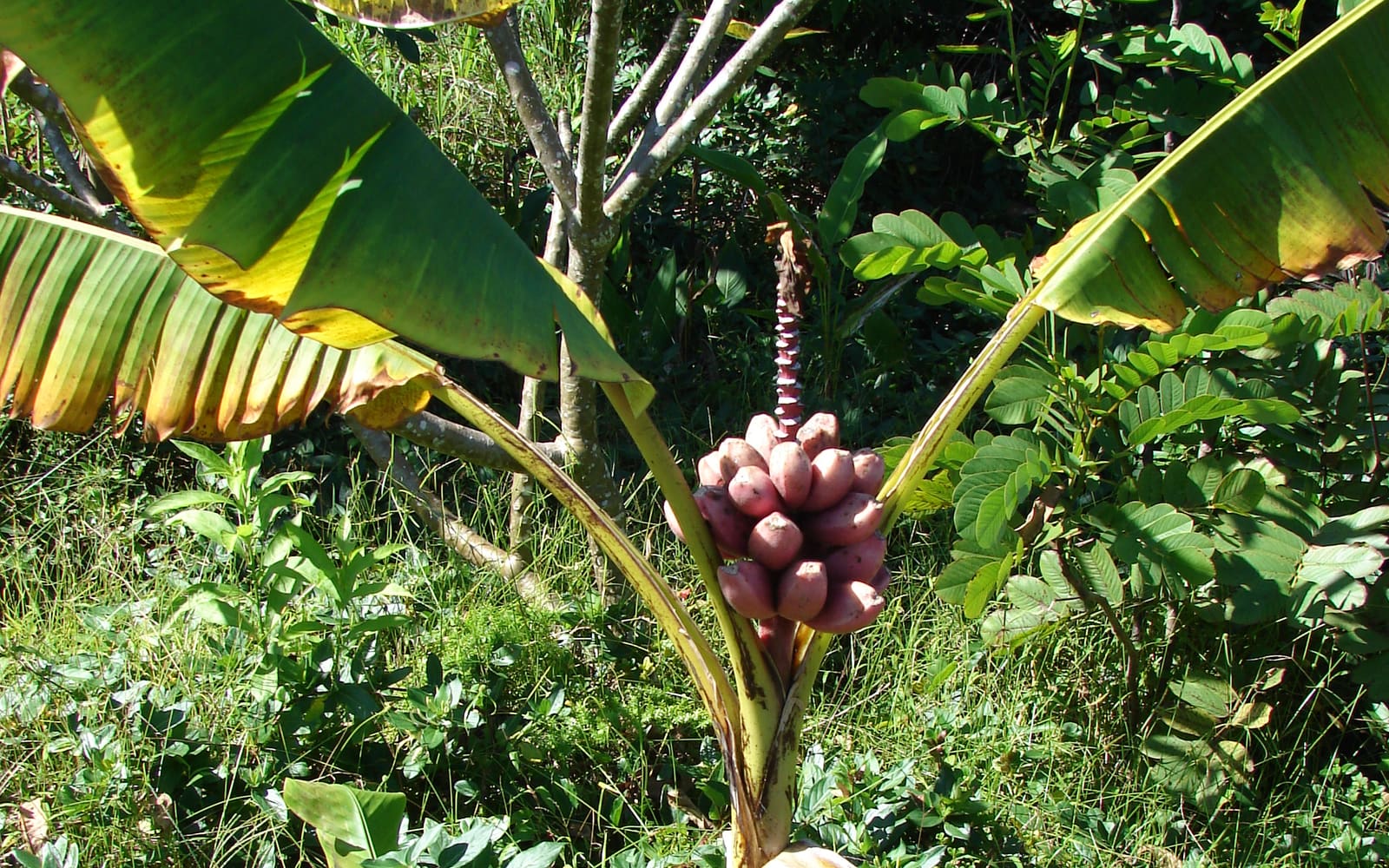
Photo by Forest and Kim Starr on Wikimedia Commons, CC BY 3.0

Pink banana (Musa velutina) is a small ornamental banana with upright pink flower stalks and fuzzy pink fruit that splits open on its own. Give it full sun, keep the soil moist while it grows, and bring the pot inside before nights drop to about 50°F. It grows 4 to 8 feet tall. Neither the ASPCA nor NC State has rated it for pets. It has escaped into forest in parts of Australia, Costa Rica and Colombia, so check local rules before planting it outdoors in a warm, wet climate.
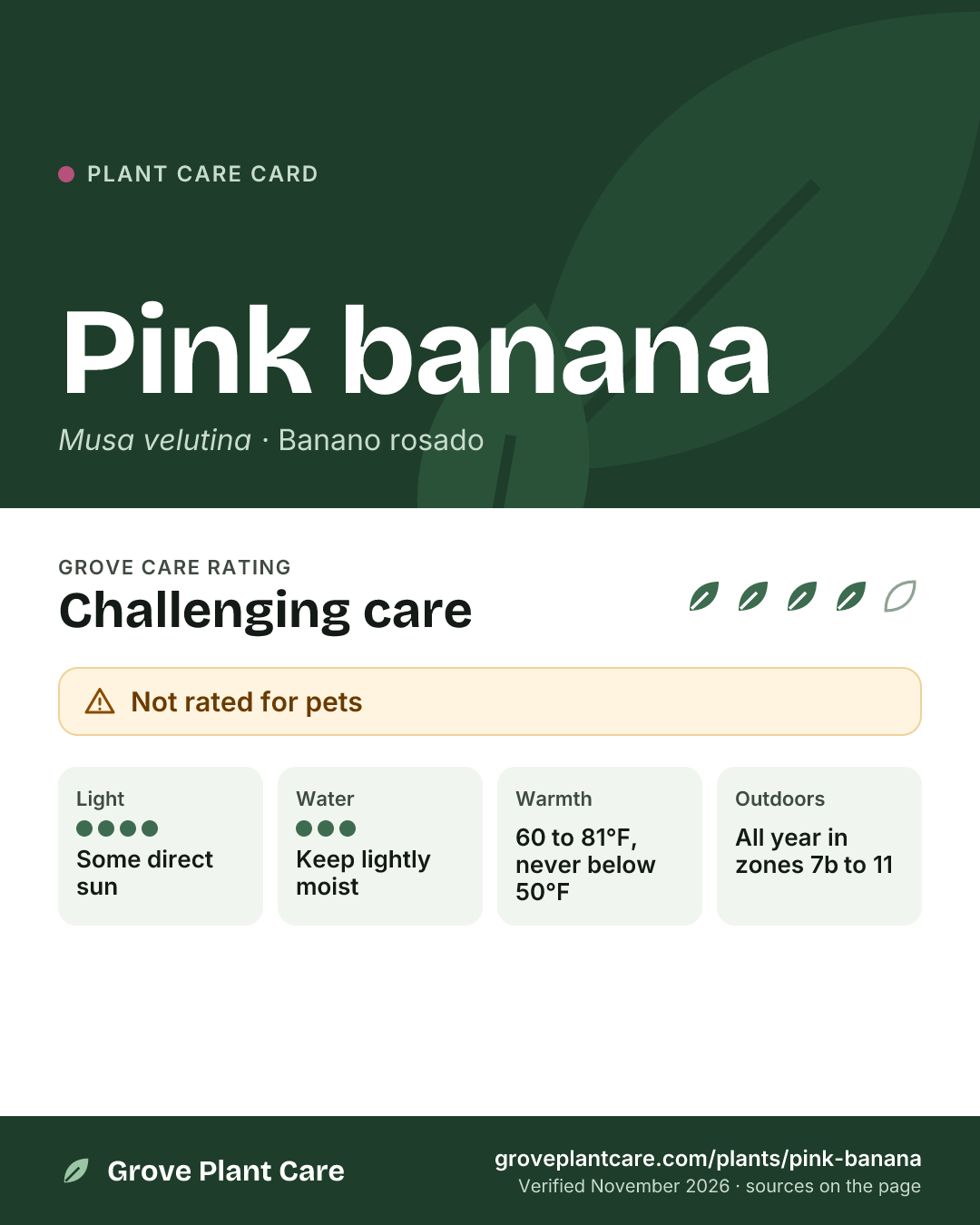
Not rated for pets
Neither the ASPCA nor NC State rates pink banana. The ASPCA lists the edible banana (Musa acuminata) as non-toxic, a different species. No reputable source lists pink banana as toxic. Children: No poisoning information found; NC State and NParks call the fruit edible, though full of hard seeds.
Pet poison line: ASPCA (888) 426-4435
Good for: a sunny patio in summer, pink flowers and fruit in its first year or two, a big, bright sunroom in winter · Think twice if: you garden near forest or streams in a warm, wet climate, you have no sunny window for winter, you often forget to water.
Needs at a glance
- Light4 of 4 · Some direct sunFull sun outdoors; indoors, the sunniest window you have
- Water3 of 3 · Keep lightly moistKeep the soil moist from spring to fall; barely moist in winter
- Humidity2 of 3 · Above averageDry indoor air browns the leaf edges; group plants or use a pebble tray
- Soil when pottedRich mix that holds moisture and drainsLoam-based potting mix with some grit added
Indoors: best at 60 to 81°F (15 to 27°C). Keep it above 50°F (10°C) and away from drafts and heat vents.
How the rating adds up
0 = easiest · 1 = moderate · 2 = hardest
- Missed waterings2 of 2 · HardestLow drought tolerance; keep the soil moist while it grows
- Light flexibility2 of 2 · HardestFull sun suits it best; indoors it needs the sunniest spot
- Humidity1 of 2 · ModerateDry air browns the leaf edges; grouping plants or a pebble tray helps
- Pests and disease1 of 2 · ModerateSpider mites and mealybugs indoors, mostly in winter
- Sensitivity to change1 of 2 · ModerateDrops some leaves after moving indoors; cold and wind damage the leaves
Growing outdoors
All year: USDA zones 7b to 11, where the coldest winter nights average 5°F (−15°C) or warmer.
Elsewhere: summer outside in full sun to part shade, sheltered from wind, which tears the leaves. Bring it in when nights reach 50 to 59°F (10 to 15°C).
Invasive in: New South Wales (Australia). On the North Coast of New South Wales, Australia, the state asks people to remove it and never buy, sell or plant it. Peer-reviewed studies record it spreading into forest in Costa Rica and Colombia, where animals eat the fruit and carry the seeds. Florida, Hawaii, California and the global database leave it off their lists. Lists checked .
- A summer patio plant in a big pot
- A clump in a sunny, sheltered bed that dies back in winter
Sources: NC State, RHS, UF/IFAS, NParks Singapore, RHS banana guide, Illinois Extension, ASPCA plant list, ASPCA, Duke Gardens, USDA zone map, NSW WeedWise, Universidad de Costa Rica, Universidad Nacional de Colombia, FISC, Hawaii noxious weed list, Cal-IPC, GISD and Rojas-Sandoval and Acevedo-Rodríguez. Full list below.
Verified · How we rate plants
Is pink banana safe for cats and dogs?
We can't say for sure. The ASPCA has no entry for pink banana. Its "Banana" entry is the edible banana, Musa acuminata, which it lists as non-toxic to dogs, cats and horses, but that is a different species. NC State lists no toxicity for pink banana, and NC State and NParks Singapore both say the fruit is edible, though packed with hard black seeds. We found no reputable source that calls it toxic. Until someone rates it, keep it away from pets that chew plants. If your pet chewed it and seems unwell, call your vet or the ASPCA Animal Poison Control Center at (888) 426-4435. If a child eats some and seems unwell, call Poison Help at 1-800-222-1222.
How is pink banana different from other bananas?
It's a small species grown for looks. NC State says it usually stays 4 to 6 feet tall, with pink bracts and pink, velvety fruit about 3 inches long that splits open when ripe. The bananas you buy at the store are seedless kinds bred from Musa acuminata and Musa balbisiana, as NSW's weed agency explains, and they grow far taller. Pink banana fruit is full of hard black seeds. NC State adds that it's often mixed up with Musa ornata, the flowering banana, a separate species. Check the botanical name on the tag.
How much light does pink banana need?
As much as you can give it. NC State says it grows in full sun or part shade and does best in full sun. Indoors, the RHS keeps bananas in a warm, sunny room, sunroom or heated greenhouse over winter, and Illinois Extension says to give a potted banana the brightest spot you have. A south- or west-facing window works. Outdoors, pick a sheltered spot, because wind shreds the big leaves.
How often should I water pink banana?
Often, while it's growing. NC State says it doesn't tolerate drought and needs frequent watering in rich soil that drains. The RHS says to water generously from spring through summer, then keep the soil barely moist in winter, when growth slows. UF/IFAS rates bananas low on drought tolerance too.
What temperature and humidity does pink banana need?
Warmth. The RHS rates pink banana H1B: it can go outside in summer, but it needs a winter minimum of about 10 to 15°C (50 to 59°F) under glass. The RHS banana guide says bananas need more than 15°C (60°F) to fruit, and ideally about 27°C (81°F). Brown leaf edges mean too little water or dry air, so group plants or set the pot on a tray of damp pebbles. Illinois Extension notes that a banana moved indoors often loses a few leaves; that's normal.
When does pink banana flower and fruit, and can you eat the fruit?
Fast, for a banana. NC State says it flowers 9 to 12 months after planting, then the fruit takes about 3 more months to ripen. The RHS lists it among the bananas most likely to flower indoors in a sunny sunroom. The pink fruit splits open by itself when ripe, which is why NParks Singapore calls it the self-peeling banana. NC State and NParks say the fruit is edible, but it's packed with hard black seeds, so most people grow it to look at.
What pests bother pink banana?
Indoors, mostly spider mites and mealybugs. The RHS says bananas are rarely troubled outdoors but pick up mealybugs and red spider mites inside, and lists glasshouse red spider mite for pink banana. NC State says it has no serious problems but to watch for spider mites, mealybugs and aphids. Check under the leaves often while it spends the winter inside.
Can pink banana stay outside in winter?
In mild places, as a plant that dies back. NC State and Duke Gardens rate it for USDA zones 7b to 11. In the colder part of that range the leaves and stems die in frost and new shoots come up from the base in spring. Duke suggests piling leaves over it for winter. That 7b rating means the roots ride out nights near 5°F (−15°C) under mulch. Everywhere colder, grow it in a pot and bring it in when nights drop to 50 to 59°F (10 to 15°C), the RHS winter range. Or do what Illinois Extension suggests: after the first frost, cut off the leaves, lift the plant and keep it nearly dry in a cool basement until spring.
NC State, Duke Gardens, USDA zone map, RHS, RHS banana guide, Illinois Extension
Is pink banana invasive?
In some places, yes. On the North Coast of New South Wales, Australia, the state's weed rules ask people to remove it and never buy, sell or grow it, and to report plants they find. Birds, bats, possums and other animals eat the fruit and spread the seeds. Peer-reviewed studies also record it as an invader of forest in three areas of Costa Rica, and growing wild near streams in Colombia's Antioquia mountains at 600 to 1,800 m. Florida's FISC list, Hawaii's noxious weed list, Cal-IPC and the global invasive species database don't list it.
NSW WeedWise, Universidad de Costa Rica, Universidad Nacional de Colombia, FISC, Hawaii noxious weed list, Cal-IPC, GISD
How Grove helps
Grove sets a watering check based on how dry the soil is, so pink banana gets frequent water in summer and less in winter. You can add a leaf check for spider mites as a repeating task and assign it, and set a reminder to bring the pot inside before cool nights.
Sources
- NC State Extension Gardener Plant Toolbox: Musa velutina
- RHS: Musa velutina (pink banana)
- UF/IFAS EDIS ENH-568: Musa spp., Banana (rev. 2018)
- NParks Singapore, Flora and Fauna Web: Musa velutina
- RHS: How to grow bananas
- University of Illinois Extension: Go tropical with ornamental bananas (2018)
- ASPCA Animal Poison Control: Toxic and Non-Toxic Plants
- ASPCA Animal Poison Control: Banana (Musa acuminata), non-toxic
- Duke Gardens, Duke University: Garden Talk, Pink banana
- USDA ARS Plant Hardiness Zone Map (2023)
- NSW WeedWise (NSW Department of Primary Industries and Regional Development): Seeded banana (Musa species)
- B. Morera Chacón, J. E. Jiménez Castro and P. M. Steinbacher (2020), Musa velutina: aspectos ecológicos que han favorecido su dispersión en ecosistemas naturales, InterSedes 21 (Universidad de Costa Rica)
- D. Giraldo-Cañas (2024), Primeros registros de poblaciones silvestres de Musa velutina en Colombia, Cinchonia 19 (Universidad Nacional de Colombia)
- Florida Invasive Species Council: Plant List, Category I and II (April 2026)
- Hawaii Administrative Rules 4-68: plant species designated as noxious weeds (Hawaii Department of Agriculture)
- California Invasive Plant Council (Cal-IPC): plant search, "musa" (no listing)
- IUCN Global Invasive Species Database: Musa velutina (no record)
- J. Rojas-Sandoval and P. Acevedo-Rodríguez (2015), Naturalization and invasion of alien plants in Puerto Rico and the Virgin Islands, Biological Invasions 17 (supplementary list)
- EPPO Global Database: Musa velutina (MUBVE), common names
- Kew WCVP data release (2026-06-04 file), plant_name_id 255036: Musa velutina