Plant care card
Giant white bird of paradise
Strelitzia nicolai · Ave del paraíso blanca
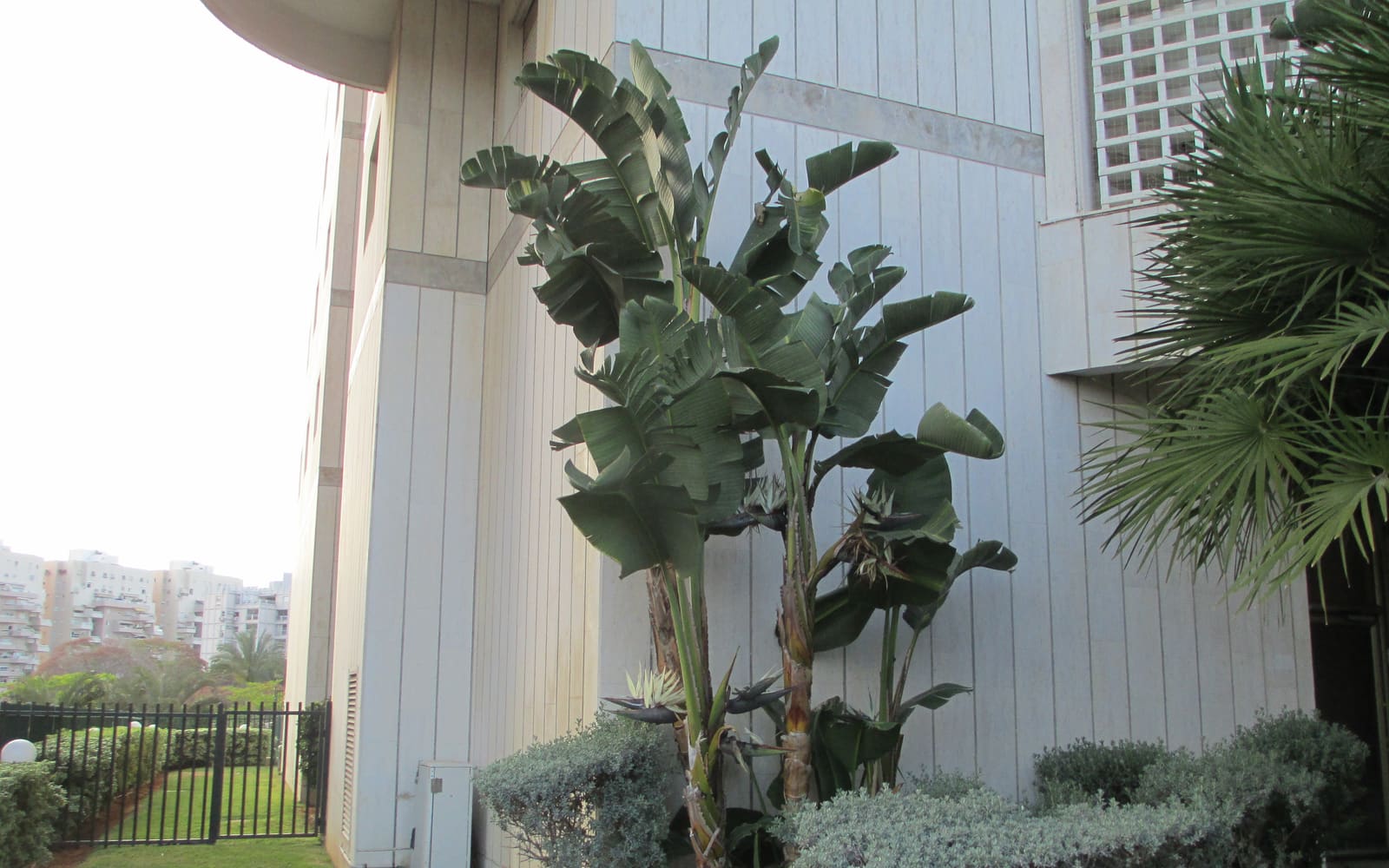
Also called white bird of paradise, giant bird of paradise or wild banana
Photo by Dr. Avishai Teicher on Wikimedia Commons, CC BY 2.5

The giant white bird of paradise (Strelitzia nicolai) is a big, banana-leaved plant for a bright room or a frost-free garden. Give it the sunniest window you have, water when the top of the soil dries, and keep it above 50°F (10°C). It grows slowly indoors and needs years before it flowers. Outdoors it can reach 20 to 30 feet. NC State lists it as mildly toxic to cats, dogs and horses. It's much bigger than the orange bird of paradise, and its flowers are white and blue.
Mildly toxic to cats, dogs and horses (NC State)
Nausea, vomiting and drowsiness; the sap can irritate skin. The ASPCA doesn’t list this species; it lists the orange bird of paradise as toxic with the same mild signs, mostly from the fruit and seeds. Children: low severity. NC State rates it low severity; eating the fruit or seeds can upset the stomach, and the sap can irritate skin.
Pet poison line: ASPCA (888) 426-4435
Good for: a big, sunny room with a high ceiling, patios in summer, a bold, tropical look · Think twice if: your brightest window is still dim, you want flowers soon, pets chew plants.
Needs at a glance
- Light4 of 4 · Some direct sunThe brightest window you have; some sun helps, but shade it from harsh midday sun
- Water2 of 3 · Let the top dryWater when the top of the soil feels dry; less in winter
- Humidity2 of 3 · Above averagePrefers humid air; dry air browns the leaf edges
- Soil when pottedRich, well-drained mixLoam-based potting mix with some grit, in a big, heavy pot
Indoors: best at 65 to 85°F (18 to 29°C). Keep it above 50°F (10°C) and away from drafts and heat vents.
How the rating adds up
0 = easiest · 1 = moderate · 2 = hardest
- Missed waterings1 of 2 · ModerateWater when the top of the soil dries; never soggy, never bone dry in summer
- Light flexibility2 of 2 · HardestWants the brightest spot you have, with some sun
- Humidity1 of 2 · ModeratePrefers humid air; a pebble tray or humidifier helps
- Pests and disease1 of 2 · ModerateScale, spider mites and mealybugs; no common diseases
- Sensitivity to change1 of 2 · ModerateDislikes cold drafts and sudden changes; blooms better left a little pot-bound
Growing outdoors
All year: USDA zones 10 to 11, where the coldest winter nights average 30°F (−1°C) or warmer.
Elsewhere: summer outside in full sun to part shade, in a warm spot sheltered from wind. Bring it in before nights drop below 54°F (12°C).
Invasive in: Queensland (Australia). Queensland lists it as an environmental weed, naturalized near the southeast coast, and it has escaped in New South Wales. No list in Florida, Hawaii or California names it. Lists checked .
- Big tubs indoors and on patios
- A specimen clump in frost-free gardens, away from walls and paths
Sources: NC State, Wisconsin Extension, RHS strelitzia guide, RHS, ASPCA, ASPCA plant list, USDA zone map, UF/IFAS Gardening Solutions, Queensland Government, Telopea, FISC, Hawaii noxious weed list, Cal-IPC and GISD. Full list below.
Verified · How we rate plants
Is the white bird of paradise toxic to cats and dogs?
Mildly. NC State lists Strelitzia nicolai as toxic to cats, dogs and horses, with low severity: a pet that eats it may have nausea, vomiting and drowsiness, and the sap can irritate skin. The ASPCA doesn't list this species. It does list the orange bird of paradise (Strelitzia reginae) as toxic, with mild nausea, vomiting and drowsiness, mostly from the fruit and seeds. Careful with the name: the ASPCA also uses "bird of paradise" for Caesalpinia gilliesii, a different shrub that is more toxic. Keep it out of reach. If a pet eats some, call your vet or the ASPCA Animal Poison Control Center at (888) 426-4435. If a child eats some, call Poison Help at 1-800-222-1222.
How is it different from the orange bird of paradise?
Size first. UF/IFAS says the orange bird of paradise (Strelitzia reginae) forms a clump 3 to 5 feet tall, while the white one grows 20 to 30 feet tall on woody stems. The leaves differ too: the orange has stiff, blue-green leaves about 12 to 18 inches long, and the white has huge, banana-like gray-green leaves that tear in the wind. The flowers give it away: the orange has orange and blue blooms, and the white has white and blue flowers coming out of a dark, beak-shaped bract. The RHS notes that the orange is the usual houseplant, since the white gets too big for most homes in time.
UF/IFAS Gardening Solutions, UF/IFAS, NC State, RHS strelitzia guide, RHS, Wisconsin Extension
How much light does a white bird of paradise need indoors?
As much as you can give it. The RHS suggests a large sunny window or a conservatory, with some shade from hot midday sun. Wisconsin Extension says these plants want nearly full sun in summer and as much light as possible in winter, and that too little light is a common reason they don't bloom. NC State says it prefers bright, indirect light. Wipe the big leaves now and then, as the RHS suggests, so dust doesn't block the light.
How often should I water a white bird of paradise?
When the top of the soil feels dry, per NC State. Wisconsin Extension says to let the pot dry out a bit between waterings indoors. The RHS waters freely in spring and summer and sparingly in winter, letting the mix get fairly dry between waterings from late fall. Water until it drains and empty the saucer. NC State says it can handle an occasional dry spell, but don't leave it bone dry in summer.
What temperature and humidity does it need?
NC State says it likes 65 to 85°F (18 to 29°C) and won't tolerate temperatures below 50°F (10°C). The RHS puts its winter minimum at 10 to 15°C (50 to 59°F). NC State also says to keep it away from cold drafts and sudden temperature changes. It prefers humid air: NC State and the RHS suggest a tray of damp pebbles, misting or a humidifier, and the RHS says dry air is a common cause of brown leaf edges.
Why are my white bird of paradise leaves splitting?
It's normal. NC State says the leaves look like banana leaves and rip easily along their veins, and UF/IFAS says they shred in the wind. The splits don't hurt the plant. Older leaves also dry and drop, leaving bare stalks low down, per UF/IFAS. You can cut off torn or brown leaves at the base, as NC State and the RHS suggest. If the edges turn brown, the RHS points to dry air.
When will my white bird of paradise flower?
Not soon. NC State says mature plants may take 5 to 6 years to flower, and the RHS says strelitzias usually need to be 5 to 10 years old. Wisconsin Extension says the giant species bloom only when quite mature. Light is the main thing you control: give it the sunniest spot you have. The RHS says it also flowers better when it's a little pot-bound and well fed, so repot only every second year and add fresh mix on top in the years between.
What pests bother a white bird of paradise, and how do I propagate it?
NC State lists scale, spider mites, aphids and mealybugs, and the RHS names scale, red spider mites and mealybugs. Check under the leaves and along the stalks, and wipe the leaves with a soft cloth; Wisconsin Extension says to skip leaf shine, which spoils their natural matte finish. No common diseases are reported. To make a new plant, divide off a rooted sucker in spring, as the RHS suggests. Seed works too, but its coat is very thick and it takes years to flower.
Can a white bird of paradise grow outdoors, and is it invasive?
Outdoors all year it needs a frost-free climate: NC State lists USDA zones 10 to 11, and UF/IFAS says 9B to 11 and calls it cold sensitive. Give it full sun to part shade and shelter from strong wind, and plant it well away from walls and sidewalks, since NC State warns its roots are aggressive. Where winters are colder, it can spend summer outside in its pot; the RHS says to bring it in before nights approach 54°F (12°C). On invasiveness: Queensland's government database lists it as an environmental weed that has naturalized near the southeast coast, and a 2017 study recorded it escaping in New South Wales. It isn't on Florida's, Hawaii's or California's invasive lists.
NC State, UF/IFAS Gardening Solutions, RHS strelitzia guide, Queensland Government, Telopea, FISC, Hawaii noxious weed list, Cal-IPC
How Grove helps
Grove sets a watering check based on how dry the soil is, so the white bird of paradise gets water once the top has dried, and less in winter. You can add a monthly leaf wipe and pest check as a repeating task and assign it, and set a reminder to bring the pot inside before cool nights.
Sources
- NC State Extension Gardener Plant Toolbox: Strelitzia nicolai
- University of Wisconsin-Madison Extension: Bird of paradise, Strelitzia
- RHS: How to grow strelitzia
- RHS: Strelitzia nicolai (white bird of paradise)
- ASPCA Animal Poison Control: Bird of Paradise Flower (Strelitzia reginae)
- ASPCA Animal Poison Control: Toxic and Non-Toxic Plants
- USDA ARS Plant Hardiness Zone Map (2023)
- UF/IFAS Gardening Solutions: Bird of paradise
- Queensland Government WildNet: Strelitzia nicolai (environmental weed, naturalised in Queensland)
- M. F. Duretto et al. (2017), Strelitzia nicolai, a new weed record for New South Wales, Telopea 20
- Florida Invasive Species Council: Plant List, Category I and II (April 2026)
- Hawaii Administrative Rules 4-68: plant species designated as noxious weeds (Hawaii Department of Agriculture)
- California Invasive Plant Council (Cal-IPC): plant search, "strelitzia" (no listing)
- IUCN Global Invasive Species Database: Strelitzia nicolai (no record)
- UF/IFAS EDIS ENH-79: Bird-of-Paradise (S. P. Brown and R. J. Black, rev. 2024)
- Kew WCVP data release (2026-06-04 file), plant_name_id 267253: Strelitzia nicolai
- ASPCA Animal Poison Control: Bird of Paradise (Caesalpinia gilliesii)