Plant care card
String of pearls
Curio rowleyanus · Planta rosario
Also called string of beads
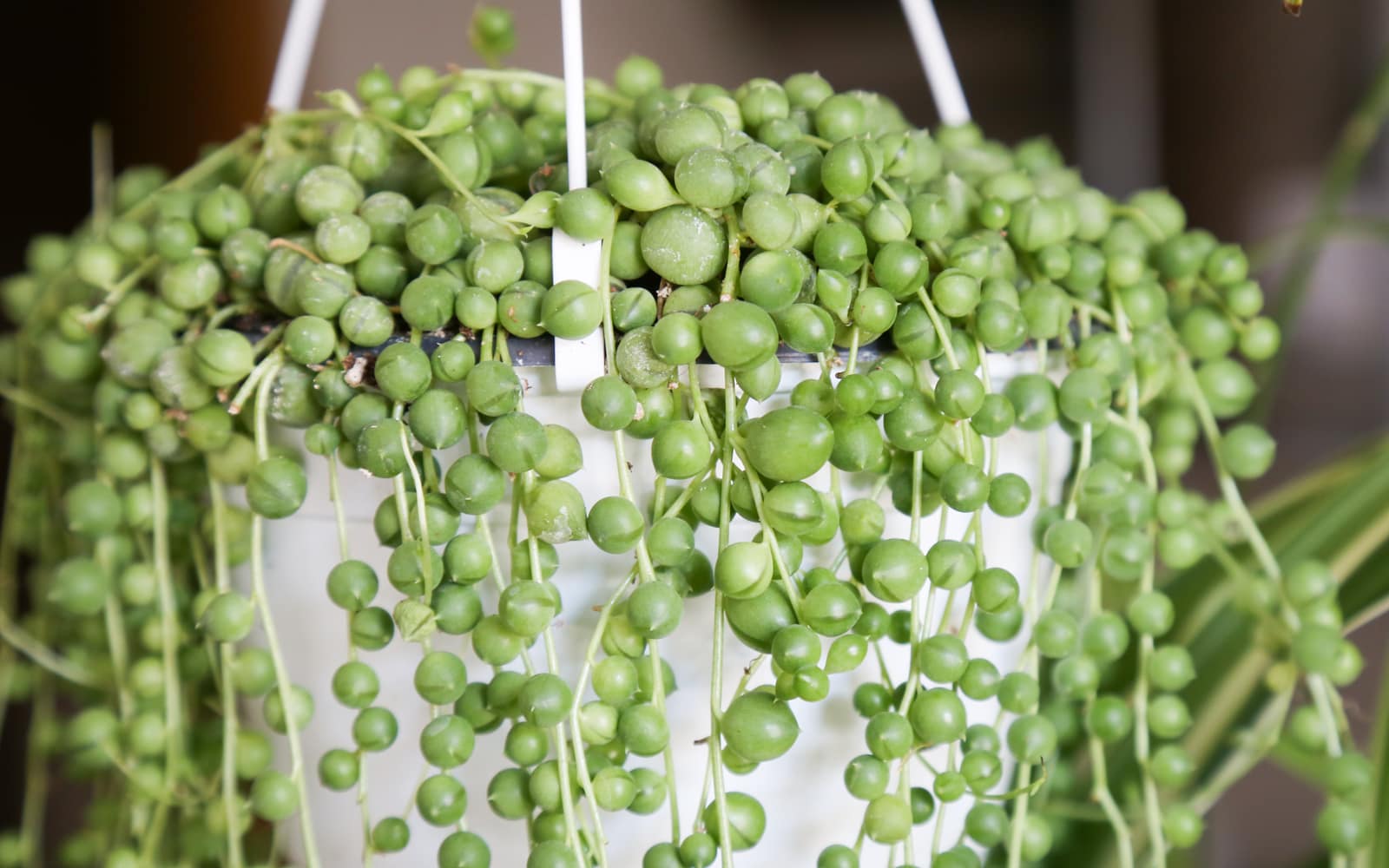
Photo by Maja Dumat on Wikimedia Commons, CC BY 2.0

String of pearls (Curio rowleyanus, formerly Senecio rowleyanus) wants bright light without hot midday sun, a gritty mix in a shallow pot, and a light hand with the watering can. Its round leaves store water, so let the mix dry out between drinks; too much water is what kills it. It’s toxic to cats and dogs, so a hanging pot works well.
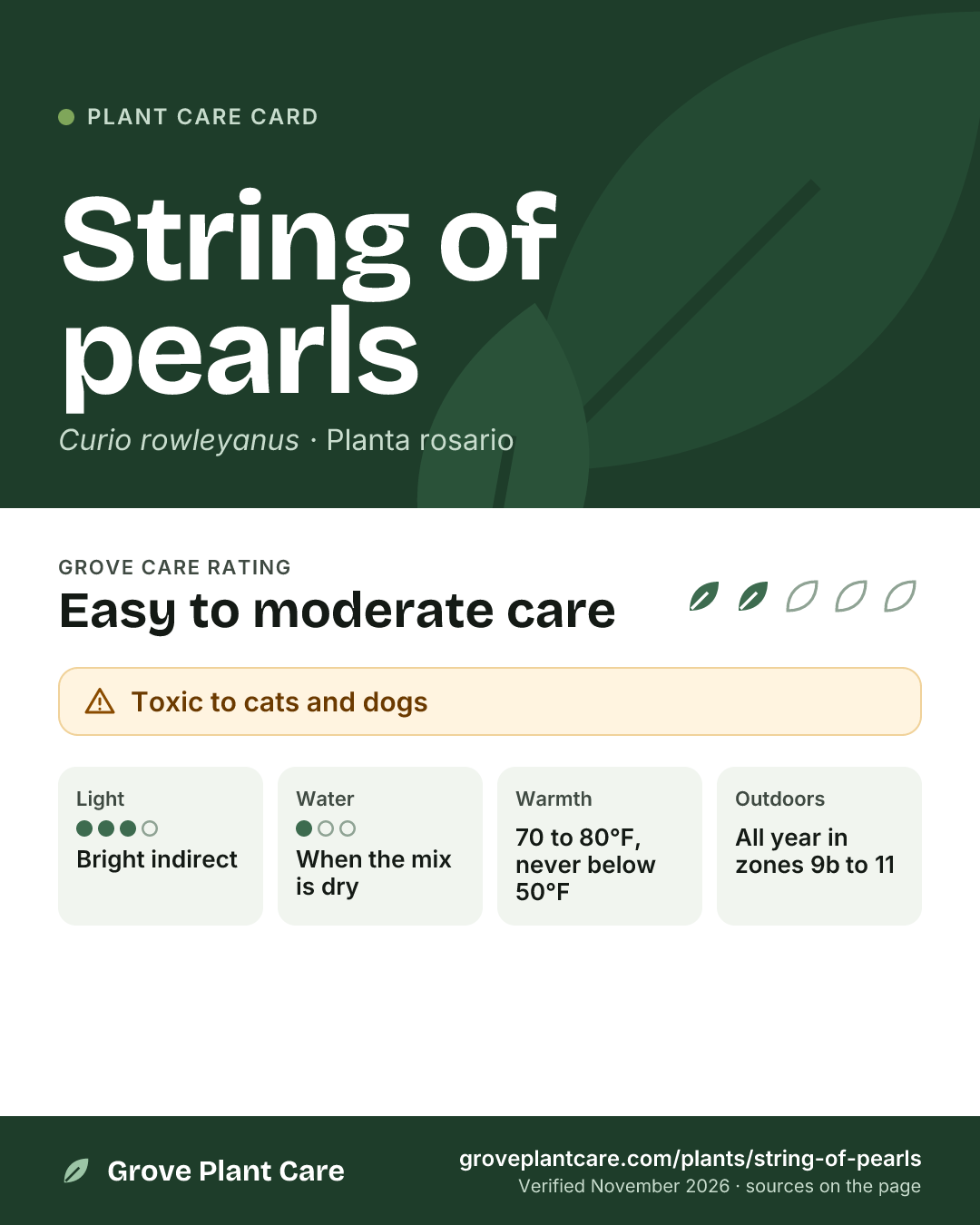
Toxic to cats and dogs · Mild
Vomiting and lethargy; can upset the stomach. Listed as toxic in the ASPCA succulents article; NC State says the same. Children: low severity. NC State rates it low severity; eating the leaves can cause vomiting and diarrhea, and the sap can irritate skin.
Pet poison line: ASPCA (888) 426-4435
Good for: a hanging basket in a bright window, people who water too little rather than too much · Think twice if: you like to water often, pets or small children can reach the strands, your brightest spot is far from a window.
Needs at a glance
- Light3 of 4 · Bright indirectNear an east or west window; out of hot midday sun
- Water1 of 3 · Let the soil dryWater lightly in spring and summer; barely at all in winter
- Humidity1 of 3 · AverageDry air is fine; don’t mist it
- Soil when pottedCactus or succulent mixOr add grit, sand or perlite; a shallow clay pot with drain holes
Indoors: best at 70 to 80°F (21 to 27°C). Keep it above 50°F (10°C) and away from drafts and heat vents.
How the rating adds up
0 = easiest · 1 = moderate · 2 = hardest
- Missed waterings0 of 2 · EasiestLet the mix dry between waterings; the pearls store water
- Light flexibility1 of 2 · ModerateBright light; stretches when dim, scorches in hot sun
- Humidity0 of 2 · EasiestDislikes humid air; no misting
- Pests and disease2 of 2 · HardestRot from overwatering is the top killer; aphids and mealybugs too
- Sensitivity to change1 of 2 · ModerateParticular about conditions; old plants fade and need restarting
Growing outdoors
All year: USDA zones 9b to 11, where the coldest winter nights average 25°F (−4°C) or warmer.
Elsewhere: summer outside in bright shade, eased in slowly; shelter from heavy rain. Bring it in before nights drop below 50°F (10°C).
- Hanging baskets
- Containers
- Groundcover in rock gardens where there’s no frost
Sources: NC State, Wisconsin Extension, RHS, ASPCA and USDA zone map. Full list below.
Verified · How we rate plants
How often should I water a string of pearls?
Lightly, and only once the mix has dried. Wisconsin Extension says to let it dry completely and to water when the pearls start to look a little wrinkled, and the RHS lets the compost dry out between waterings from April to September. In winter, the RHS waters barely at all, just enough to keep the pearls from shriveling. NC State is more cautious about dry spells and says never to let it dry out completely, so if your pearls wrinkle fast, water a little sooner. Every source agrees on the main danger: soggy soil rots the roots and stems, and Wisconsin calls overwatering the most common way to lose one. Empty the saucer so the pot never sits in water.
How much light does a string of pearls need?
Bright light, but out of hot midday sun. NC State asks for bright, indirect light indoors, and the RHS suggests an east or west window, warning that summer sun at midday scorches the pearls. The RHS plant profile is more generous and lists several hours of direct sun, so gentle morning or late afternoon sun is fine. Too little light gives you weak, straggly strands with small, widely spaced pearls. Outdoors, Wisconsin says to ease it into brighter light so it doesn’t sunburn.
Why are my string of pearls shriveling or mushy?
Check the soil and the stems where they meet it. Mushy, yellow or gray pearls and soft stems in damp soil mean rot from too much water, the problem Wisconsin and NC State see most, so let the mix dry out. Wrinkled pearls in bone-dry soil just need a drink. Careful, though: the RHS says overwatering also leaves the pearls shriveled, so wrinkled pearls in wet soil mean rot. Brown, scorched pearls come from hot direct sun. A thinning crown on an older plant is normal aging: NC State says plants decline after a few years and are best restarted from cuttings. Yellowing can also point to insects, NC State adds, so look for mealybugs and aphids.
How do I propagate a string of pearls?
From stem cuttings, which root easily. NC State uses 3 to 5 inch pieces with a few nodes pressed into potting mix, and Wisconsin strips the bottom few pearls and lays the cutting on moist cactus mix with the lowest nodes lightly covered; roots form at each node. Wisconsin mists the surface instead of watering until roots take hold. The RHS says cuttings root in about a month, or you can pin a strand onto the soil of a pot and cut it free once it has rooted. Spring and summer are the times the RHS gives. A single pearl dropped on soil can root too, but NC State says it’s slow and unreliable.
When should I repot a string of pearls?
Every year or two, says Wisconsin, into a shallow pot, since the roots stay small. The RHS says a new plant can usually stay in its nursery pot for about a year, unless the mix stays very wet. Go only a little bigger, with plenty of drain holes; both like unglazed clay or terracotta because it lets water escape through the sides. Use cactus mix, or add grit, pumice or sharp sand.
Is string of pearls toxic to cats and dogs?
Yes. In its article on succulents and pets, the ASPCA lists string of pearls among the toxic ones: eating it can cause stomach upset, mostly vomiting, and lethargy. NC State flags it as a problem for cats, dogs and horses and rates it low severity, and the RHS says all parts can upset the stomach and the sap can irritate skin. The ASPCA’s tip is to grow it as a hanging plant, out of reach. If a pet eats part of it and seems unwell, call your vet or the ASPCA Animal Poison Control Center at (888) 426-4435.
Can string of pearls grow outdoors?
In frost-free gardens, as a trailing groundcover. NC State gives USDA zones 9b to 11 and says it can’t take frost, so bring a pot inside before the first fall frost; we bring it in at 50°F (10°C), the low end of the winter range NC State and the RHS give. Outdoors it likes partial shade, and Wisconsin says to shelter it from heavy rain. A summer outside is fine anywhere if you ease it into the light.
Does string of pearls need a winter rest?
It helps. Wisconsin gives it a cooler winter at 55 to 60°F (13 to 16°C) with less water, and NC State suggests 50 to 60°F in winter after 70 to 80°F in summer. The RHS profile gives 13 to 16°C in winter. Keep it away from cold drafts and heaters, the RHS adds.
How Grove helps
Grove sets a watering check based on how dry the mix is, so the pearls get a drink only once it has dried out, and nobody waters on autopilot in winter. You can add a reminder to take cuttings in spring as a task and assign it, so an aging plant gets restarted before it thins out.
Sources
- NC State Extension Gardener Plant Toolbox: Curio rowleyanus
- University of Wisconsin-Madison Extension: String of pearls, Senecio rowleyanus
- Royal Horticultural Society: How to grow string of beads
- Royal Horticultural Society: Curio rowleyanus plant details
- ASPCA: Are Succulents Safe to Have Around Pets? (2021)
- USDA ARS Plant Hardiness Zone Map (2023)
- Kew Plants of the World Online: Curio rowleyanus
- Kew: World Checklist of Vascular Plants (June 2026 release), the data behind Plants of the World Online
- NC State Extension Gardener Plant Toolbox: Ceropegia woodii