Plant care card
Taro
Colocasia esculenta · Colocasia
Also called elephant ear, dasheen, eddo or kalo
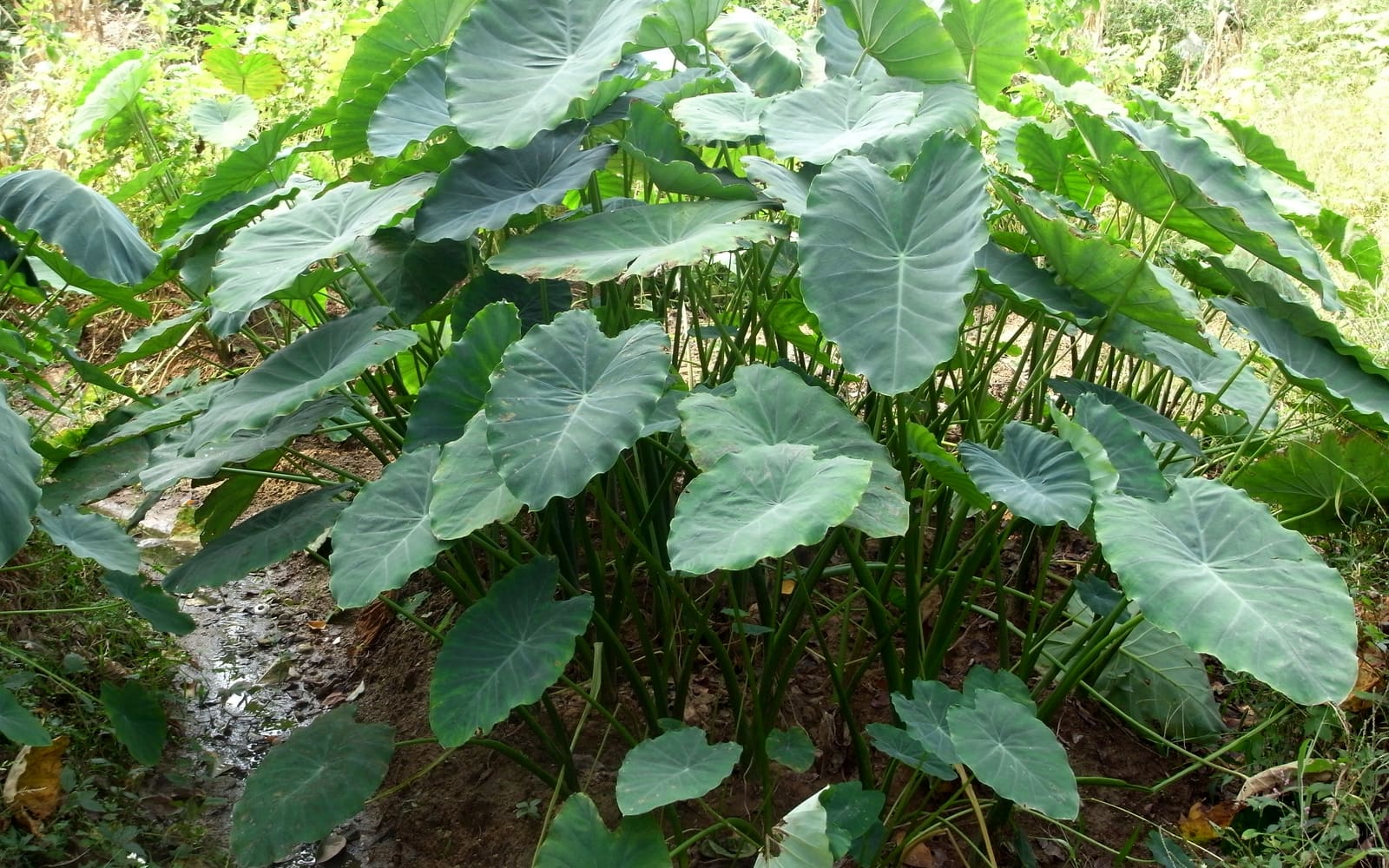
Photo by Dalgial on Wikimedia Commons, CC BY 3.0

Taro (Colocasia esculenta) is the elephant ear with big heart-shaped leaves that hang down from tall stalks. Keep the soil moist all the time, give it bright filtered light indoors or sun to part shade outside, and bring it in before nights drop to about 50°F. It's toxic to cats, dogs and horses. Florida lists wild taro as invasive, and it spreads along streams in other warm places, so never plant it near natural water.
Toxic to cats, dogs and horses · Moderate
Mouth pain and swelling, drooling, vomiting and trouble swallowing. All parts hold needle-like calcium oxalate crystals; NC State rates the severity as medium. Children: moderate severity. NC State rates it medium severity; raw, every part burns the mouth, and the sap can irritate skin and eyes.
Pet poison line: ASPCA (888) 426-4435
Good for: huge leaves in a summer container, soggy spots and water-garden pots, fast growth in warm weather · Think twice if: pets or small children chew plants, you garden near a creek, pond or wetland in a warm climate, you often forget to water.
Needs at a glance
- Light3 of 4 · Bright indirectBright, filtered light indoors; sun to part shade outside
- Water3 of 3 · Keep lightly moistNever let it dry out while it grows; just moist in winter
- Humidity2 of 3 · Above averageGrows best in warm, humid air
- Soil when pottedRich soil that stays moistRich potting mix; it tolerates wet, poorly drained soil
Indoors: best at 70°F (21°C) or warmer. Keep it above 50°F (10°C) and away from drafts and heat vents.
How the rating adds up
0 = easiest · 1 = moderate · 2 = hardest
- Missed waterings2 of 2 · HardestNever let the soil dry out while it grows; it even tolerates standing water
- Light flexibility1 of 2 · ModerateBright, filtered light indoors; dark-leaved kinds color best in more sun
- Humidity1 of 2 · ModerateLikes warm, humid air; no source asks for an enclosure
- Pests and disease1 of 2 · ModerateSpider mites, aphids and whitefly indoors; few problems outside
- Sensitivity to change1 of 2 · ModerateSlows down and drops leaves in cool rooms; it rests and regrows from the corm
Growing outdoors
All year: USDA zones 8 to 11, where the coldest winter nights average 10°F (−12°C) or warmer.
Elsewhere: summer outside in sun to part shade in moist soil, sheltered from strong wind. Bring it in when nights reach 50 to 59°F (10 to 15°C).
Invasive in: Florida, California, Texas. Florida lists wild taro as a Category I invader and UF/IFAS says not to plant it there. Cal-IPC rates it a moderate threat on alert in California, Texas Invasives lists it, and a 2025 federal screening rates it high risk across the lower 48 states. It spreads along streams and wetlands, so keep it away from natural water. Lists checked .
- Summer pots, including water-garden containers
- A bold accent in moist beds away from natural water
Sources: NC State, RHS, Wisconsin Extension, Clemson HGIC, ASPCA, ASPCA plant list, FNAI, USDA zone map, UF/IFAS Gardening Solutions, FISC, UF/IFAS Assessment, Cal-IPC, Texas Invasives, U.S. Fish and Wildlife Service, Hawaii noxious weed list, GISD and Rojas-Sandoval and Acevedo-Rodríguez. Full list below.
Verified · How we rate plants
Is taro toxic to cats and dogs?
Yes. The ASPCA lists elephant ears (Colocasia esculenta) as toxic to dogs, cats and horses. All parts hold insoluble calcium oxalate crystals, tiny needles that hurt the mouth. A pet that chews it may get mouth pain and swelling, drool, vomit (horses don't vomit) and have trouble swallowing. NC State rates the severity as medium for people and pets. Taro grown as food is always cooked, because raw it burns the mouth. The RHS and Wisconsin Extension say the sap irritates skin and eyes, so wear gloves when you cut it. If a pet eats some, call your vet or the ASPCA Animal Poison Control Center at (888) 426-4435. If a child eats some, call Poison Help at 1-800-222-1222.
How do I tell taro from giant taro and other elephant ears?
Look at the leaves. Clemson Extension says taro (Colocasia) leaves point down, while alocasia leaves, like giant taro's, point up. Wisconsin Extension adds that taro leaves are peltate: the stalk joins the leaf near its middle. Texas Invasives notes that in arrowleaf elephant ear (Xanthosoma) the stalk joins right at the notch. Taro also handles wetter soil than alocasias, per Clemson. Caladium is called elephant ears too, but it's a smaller plant grown from tubers for its colorful leaves. Even the ASPCA uses "elephant ears" and "taro" for both Colocasia and Caladium; all of them are toxic, so go by the botanical name on the tag.
Clemson HGIC, Wisconsin Extension, Texas Invasives, NC State, ASPCA
How much light does taro need?
Bright light. Indoors, the RHS suggests bright, filtered light. Outdoors, NC State says it grows in sun or part shade and does best in part shade or filtered sun. Clemson says green-leaved kinds take more sun than dark ones, while Wisconsin Extension says dark-leaved kinds like 'Black Magic' color best in full sun. Pick a spot out of strong wind, which tears the big leaves.
How often should I water taro?
Often. NC State says to keep the soil from drying out, and it tolerates wet soil. The RHS says to water generously while it grows and keep it just moist in winter. Wisconsin Extension says it needs plenty of water and fertilizer, especially in pots, and most kinds grow in a few inches of standing water as a water-garden plant. That thirst is the main reason it's harder than giant taro, which likes its top 2 inches to dry first.
NC State, RHS, Wisconsin Extension, Clemson HGIC, RHS alocasia guide
What temperature and humidity does taro need?
Warmth and humid air. The RHS says it needs at least 21°C (70°F) to stay in leaf all year, and rates it H1B: outside in summer, about 10 to 15°C (50 to 59°F) minimum in winter. Wisconsin Extension says taro grows best when it's warm and humid, sits still until summer heat arrives, and falters when it stays below 50°F. In a cool room it slows down and may rest, which is normal.
How do I keep taro through the winter?
Two ways. As a houseplant: Wisconsin Extension says to bring it in before cold weather, cut it back to the top two leaves, and keep it in bright light at room temperature, a little drier while it rests. As a dormant corm: Clemson says to cut it back in fall, dig the corm, dry it for a few days and store it in an open box lightly covered with dry peat moss at 45 to 55°F (7 to 13°C), never letting it freeze. In USDA zones 8 to 11 (NC State) the corm can stay in the ground: frost kills the leaves, and new ones come up in spring. Clemson suggests a thick mulch. Zone 8's floor is about 10°F (−12°C).
Wisconsin Extension, Clemson HGIC, RHS, NC State, USDA zone map
What pests bother taro?
Indoors, the RHS names glasshouse red spider mite, aphids and glasshouse whitefly, and says it's generally free of disease. Outdoors, NC State reports no serious insect or disease problems. Check under the leaves often while it's inside for the winter.
How big does taro get, and how do I propagate it?
NC State lists 3 to 6 feet tall and wide, with leaves up to about 3 feet long. In a pot, the RHS gives 1 to 1.5 m (3 to 5 ft). To make more, divide the clump or replant the small corms, called eddos, that form beside the main one (NC State, RHS, Wisconsin). Wisconsin says plain green taro can even sprout from a grocery-store taro root, if it wasn't treated to stop sprouting.
Is taro invasive?
Yes, in several warm places. Florida's FISC list names wild taro a Category I invader, and UF/IFAS rates it invasive across the state and says not to plant it; it suggests alocasias instead. Florida's Natural Areas Inventory says it takes over swamps and stream banks, carried by water. Cal-IPC rates it a moderate threat on alert in California, the Texas Invasives database lists it, and a 2025 U.S. Fish and Wildlife Service screening rates it high risk across the lower 48 states. A peer-reviewed study counts it among invasive plants in Puerto Rico. Hawaii's noxious weed list doesn't name it. Wherever you are, UF/IFAS says never to plant elephant ears in or near natural waterways.
FISC, UF/IFAS Assessment, UF/IFAS Gardening Solutions, FNAI, Cal-IPC, Texas Invasives, U.S. Fish and Wildlife Service, Rojas-Sandoval and Acevedo-Rodríguez, Hawaii noxious weed list, RHS
How Grove helps
Grove sets a watering check based on how dry the soil is, so a thirsty taro gets water before it dries out. You can add a leaf check for spider mites as a repeating task and assign it, and set a reminder to bring the pot in, or dig the corm, before cold nights.
Sources
- NC State Extension Gardener Plant Toolbox: Colocasia esculenta
- RHS: Colocasia esculenta (taro)
- University of Wisconsin-Madison Extension: Elephant ears, Colocasia, Alocasia and Xanthosoma
- Clemson HGIC: Fun with Elephant Ears in the Garden (2020)
- ASPCA Animal Poison Control: Elephant Ears (Colocasia esculenta)
- ASPCA Animal Poison Control: Toxic and Non-Toxic Plants
- Florida Natural Areas Inventory: invasive plant summary, wild taro
- USDA ARS Plant Hardiness Zone Map (2023)
- UF/IFAS Gardening Solutions: Elephant ears
- Florida Invasive Species Council: Plant List, Category I and II (April 2026)
- UF/IFAS Assessment of Non-Native Plants: Colocasia esculenta (invasive, no uses; 2025)
- California Invasive Plant Council (Cal-IPC): Colocasia esculenta profile (Moderate, Alert)
- Texas Invasives (Texas Invasive Plant and Pest Council): plant database, Colocasia esculenta
- U.S. Fish and Wildlife Service: Ecological Risk Screening Summary, wild taro (Colocasia esculenta), High Risk (2025)
- Hawaii Administrative Rules 4-68: plant species designated as noxious weeds (Hawaii Department of Agriculture)
- IUCN Global Invasive Species Database: Colocasia esculenta (no record)
- J. Rojas-Sandoval and P. Acevedo-Rodríguez (2015), Naturalization and invasion of alien plants in Puerto Rico and the Virgin Islands, Biological Invasions 17 (supplementary list)
- EPPO Global Database: Colocasia esculenta (CXSES), nombres comunes
- Kew WCVP data release (2026-06-04 file), plant_name_id 46275: Colocasia esculenta
- NC State Extension Gardener Plant Toolbox: Alocasia (genus page, lists giant taro)
- University of Wisconsin-Madison Extension, Wisconsin Horticulture: Caladium (S. Mahr)
- NC State Extension Gardener Plant Toolbox: Caladium bicolor
- RHS: How to grow alocasias