Plant care card
Anthurium
Anthurium · Anturio
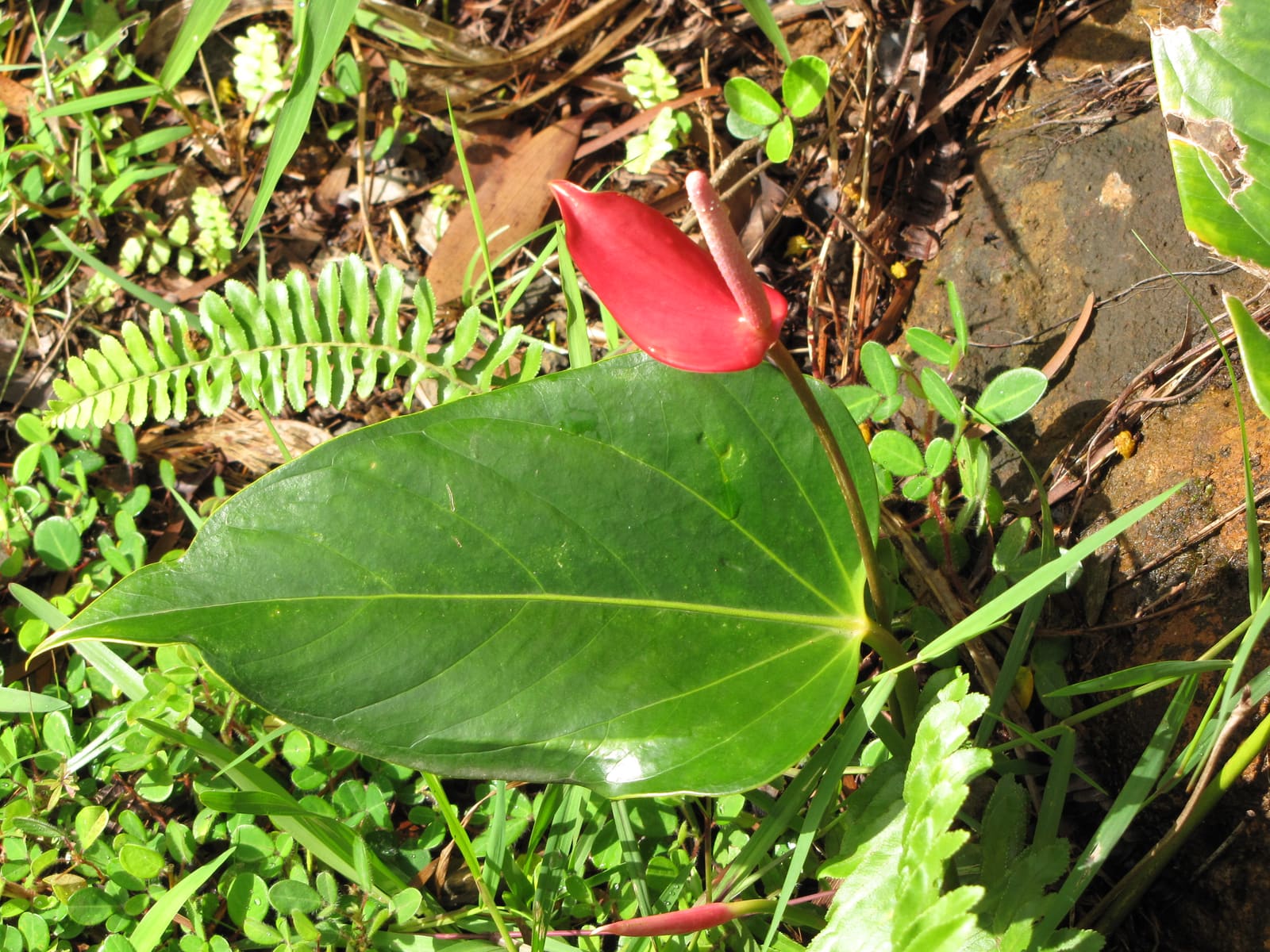
Also called flamingo flower, flamingo lily, tailflower or laceleaf
Photo by Forest and Kim Starr on Wikimedia Commons, CC BY 3.0 US

Anthurium, the flamingo flower, gives you glossy red, pink or white blooms that last for weeks, if you give it what a rainforest plant expects. Put it in bright, indirect light, water when the top inch or two of mix is dry, and keep the air above 50% humidity and the room above 60°F (16°C). Too little light is the usual reason it stops flowering. It's toxic to cats, dogs and horses, though NC State rates the risk as low.
Toxic to cats, dogs and horses · Mild
Mouth pain and swelling, drooling, vomiting and trouble swallowing. All parts hold insoluble calcium oxalate crystals; NC State rates the severity as low. Children: low severity. NC State rates it low severity; chewing irritates the mouth, and the sap can irritate skin and eyes.
Pet poison line: ASPCA (888) 426-4435
Good for: long-lasting flowers indoors, bright, humid rooms such as a bathroom, cut flowers · Think twice if: pets chew plants, your indoor air is very dry, your tap water is hard.
Needs at a glance
- Light3 of 4 · Bright indirectBright, indirect light, such as an east or west window; direct summer sun scorches the leaves, and dim light means few flowers
- Water2 of 3 · Let the top dryWater when the top 1 to 2 in (2.5 to 5 cm) feels dry, then water well; never let it dry out completely
- Humidity2 of 3 · Above averageKeep humidity above 50%, with a pebble tray, a humidifier or a bathroom; dry air browns the leaf edges
- Soil when pottedChunky, acidic, fast-draining mixAbout 2 parts peat-free ericaceous compost, 1 part perlite or grit and 1 part orchid bark
Indoors: best at 65 to 80°F (18 to 27°C). Keep it above 60°F (16°C) and away from drafts and heat vents.
How the rating adds up
0 = easiest · 1 = moderate · 2 = hardest
- Missed waterings1 of 2 · ModerateWater when the top inch or two is dry; flower buds can drop if the roots dry out
- Light flexibility1 of 2 · ModerateBright, indirect light; too little light means few or no flowers
- Humidity1 of 2 · ModerateWants humidity above 50%; dry air browns the leaf tips and dulls the shine
- Pests and disease1 of 2 · ModerateMealybugs, scale, mites and thrips; root rot and leaf spot when kept too wet
- Sensitivity to change2 of 2 · HardestDislikes cold drafts, sudden temperature swings and hard tap water
Growing outdoors
All year: USDA zones 11 to 12, where the coldest winter nights average 40°F (4°C) or warmer.
Elsewhere: summer outside in shade or part shade in a sheltered spot; direct sun scorches the leaves. Bring it in when nights reach 60 to 65°F (16 to 18°C).
- Shady beds, borders and mass plantings in frost-free gardens
- Pots on a shaded patio in summer
Sources: NC State, RHS anthurium guide, NYBG, UF/IFAS, UF/IFAS interior guide, Clemson HGIC, RHS, ASPCA, ASPCA plant list, USDA zone map, FISC, Plant Pono, Hawaii noxious weed list, GISD, Cal-IPC and Rojas-Sandoval and Acevedo-Rodríguez. Full list below.
Verified · How we rate plants
Is anthurium toxic to cats and dogs?
Yes. The ASPCA lists anthurium (under flamingo flower) as toxic to cats, dogs and horses. Every part holds insoluble calcium oxalate crystals, tiny needles that irritate the mouth. A pet that chews it may drool, paw at its mouth, vomit and have trouble swallowing. NC State rates the severity as low, and UF/IFAS agrees. The sap can also irritate skin and eyes, so the RHS suggests gloves when you handle it, and NC State suggests a high shelf or a hanging basket if small children or pets share the room. If a pet eats some and seems unwell, call your vet or the ASPCA Animal Poison Control Center at (888) 426-4435. If a child eats some, call Poison Help at 1-800-222-1222.
ASPCA, NC State, UF/IFAS, RHS anthurium guide, ASPCA plant list
Which anthurium do I have?
Most likely a flamingo flower. Anthurium is a huge genus, with more than 1,300 species per UF/IFAS. The potted ones sold in bloom are mostly compact hybrids, and the classic is A. andraeanum, the flamingo flower, with a shiny heart-shaped spathe in red, pink, orange, white or green. The pigtail anthurium (A. scherzerianum) has a curly spadix. Others are grown for their leaves: crystal anthurium (A. crystallinum) has velvety, patterned leaves, and bird's nest anthurium (A. hookeri) forms a rosette of big, stiff leaves. Their care is close, and this card covers them all. NC State lists peace lily, Chinese evergreen and dumb cane among the plants people confuse with anthurium; the flamingo flower's tell is its waxy, heart-shaped spathe that lasts for weeks.
UF/IFAS, UF/IFAS interior guide, NC State, RHS anthurium guide, Kew WCVP
How much light does an anthurium need?
Bright, indirect light. NC State, the RHS and Clemson all ask for it. The RHS suggests an east or west window, or a south window behind a sheer curtain, because direct summer sun scorches the leaves. Light decides the flowers: NC State says too little light cuts blooming, and UF/IFAS names low light as the reason a plant makes plenty of leaves but few or no flowers. UF/IFAS did find some cultivars kept flowering for over a year under low indoor light, so it copes, but a bright spot gives you the most color.
NC State, RHS anthurium guide, Clemson HGIC, UF/IFAS interior guide
How often should I water an anthurium?
When the top of the mix starts to dry. NC State says water when the top inch feels dry, and the RHS checks about 2 inches (5 cm) down and waters when it is nearly dry. Then water well and empty the saucer. Don't let it dry out completely: the New York Botanical Garden warns that flower buds may drop if the roots get close to dry even once. Soggy mix is the other risk, since overwatering causes root rot (NC State, RHS). The RHS and NC State prefer rainwater or filtered water at room temperature, because hard tap water can harm it.
How do I get my anthurium to bloom again?
Give it more light first. UF/IFAS says a flowering anthurium can bloom 4 to 6 times a year. Each bloom lasts about six weeks per UF/IFAS, up to four weeks per NC State and up to two months per the New York Botanical Garden. UF/IFAS's interior care guide names low light as the cause of leaves without flowers. Then feed: NC State and NYBG suggest a fertilizer higher in phosphorus during the growing season, and the RHS feeds every two weeks with an orchid fertilizer from spring to fall. Keep the humidity up, since NYBG links dry air to poor flowering. Cut faded blooms off at the base. NYBG also gives it a slightly cooler, drier rest in winter, still above 60°F (16°C).
UF/IFAS, UF/IFAS interior guide, NC State, NYBG, RHS, RHS anthurium guide
Why are my anthurium leaves turning brown or yellow?
Brown tips and edges usually mean dry air: NC State and the RHS both say so, and UF/IFAS says leaves lose their shine and can die back when humidity stays under 50%. Too much fertilizer also burns the tips, per UF/IFAS. Yellow older leaves with damaged roots point to too much water, so let the mix dry a little more between waterings. Broad tan patches or bleached leaves mean too much sun. Check under the leaves too, because mealybugs, scale and mites suck the sap (NC State, RHS).
NC State, RHS anthurium guide, UF/IFAS, UF/IFAS interior guide
What humidity and temperature does an anthurium need?
Warm and humid. UF/IFAS asks for humidity above 50%, and NC State gives 60 to 80% for the flamingo flower. A pebble tray, a humidifier, grouping plants or a bright bathroom all help (RHS, NYBG). For warmth, NC State gives 65 to 80°F (18 to 27°C) and the RHS 18 to 30°C (65 to 86°F). The New York Botanical Garden says don't let it drop below 60°F (16°C), and the RHS keeps it above 18°C (65°F) in winter. NC State adds that it dislikes cold drafts and sudden temperature changes, so keep it away from air conditioning and heat vents (NYBG).
How do I repot or propagate an anthurium?
Repot every 2 or 3 years in spring, one pot size up, since a pot that's too big stays wet and invites root rot (RHS). Use an airy, acidic mix: the RHS uses 2 parts peat-free ericaceous compost, 1 part perlite or grit and 1 part orchid bark, and UF/IFAS growers use equal parts peat, perlite and bark. To make more plants, divide a crowded clump so each piece has roots and a growing point, or stand a stem piece with aerial roots in water until it roots (RHS, NYBG). Wear gloves, because the sap irritates skin.
Can anthurium grow outdoors, and is it invasive?
Only where it never gets cold. NC State puts it in USDA zones 11 and 12, and UF/IFAS says 10A to 11B depending on the species, with frost protection needed. There it works in shady beds, borders and mass plantings, with humidity above 50% and soil rich in organic matter (UF/IFAS). In colder places, give it summer outside in shade and bring it in before nights drop to 60 to 65°F (16 to 18°C), the minimums NYBG and the RHS give. No official invasive list names it: Florida's FISC list leaves it out, UF/IFAS says it isn't known to be invasive, and Hawaii's weed risk assessment rates the flamingo flower and bird's nest anthurium low risk.
NC State, UF/IFAS, NYBG, RHS, FISC, Plant Pono, Hawaii noxious weed list, GISD
How Grove helps
Grove sets a watering check based on how dry the mix is, so your anthurium gets water once the top inch or two has dried, before the roots get thirsty enough to drop buds. You can add a feeding reminder every few weeks in spring and summer, and a monthly leaf check for mealybugs, as repeating tasks you can assign.
Sources
- NC State Extension Gardener Plant Toolbox: Anthurium (genus page)
- NC State Extension Gardener Plant Toolbox: Anthurium andraeanum (flamingo flower)
- RHS: How to grow anthuriums
- New York Botanical Garden, Mertz Library: Houseplant Care, Anthurium
- UF/IFAS EDIS FPS-42: Anthurium spp., Tailflower, Flamingo Flower, Anthurium (rev. December 2025)
- UF/IFAS EDIS ENH956: Cultural Guidelines for Commercial Production of Interiorscape Anthurium (Chen et al.)
- Clemson HGIC: Anthurium, Easy Houseplants That Offer Long-Lasting Color (T. Lott, 2020)
- RHS: Anthurium andraeanum (flamingo flower)
- ASPCA Animal Poison Control: Flamingo Flower (Anthurium scherzeranum)
- ASPCA Animal Poison Control: Toxic and Non-Toxic Plants
- USDA ARS Plant Hardiness Zone Map (2023)
- Florida Invasive Species Council: Plant List, Category I and II (April 2026)
- Plant Pono (Hawaii-Pacific Weed Risk Assessment): Anthurium andraeanum, Pono Plant (low risk), score 5
- Plant Pono (Hawaii-Pacific Weed Risk Assessment): Anthurium hookeri, Pono Plant (low risk), score -1
- Hawaii Administrative Rules 4-68: plant species designated as noxious weeds (Hawaii Department of Agriculture)
- IUCN Global Invasive Species Database: Anthurium (no record)
- California Invasive Plant Council (Cal-IPC): site search "anthurium" (no listing)
- J. Rojas-Sandoval and P. Acevedo-Rodríguez (2015), Naturalization and invasion of alien plants in Puerto Rico and the Virgin Islands, Biological Invasions 17 (supplementary list)
- Kew WCVP data release (2026-06-04 file), plant_name_id 10581: genus Anthurium
- Kew WCVP data release (2026-06-04 file), plant_name_id 10633: Anthurium andraeanum