Plant care card
Blue sky vine
Thunbergia grandiflora · Thunbergia azul
Also called blue trumpet vine, Bengal clock vine, skyflower or blue thunbergia
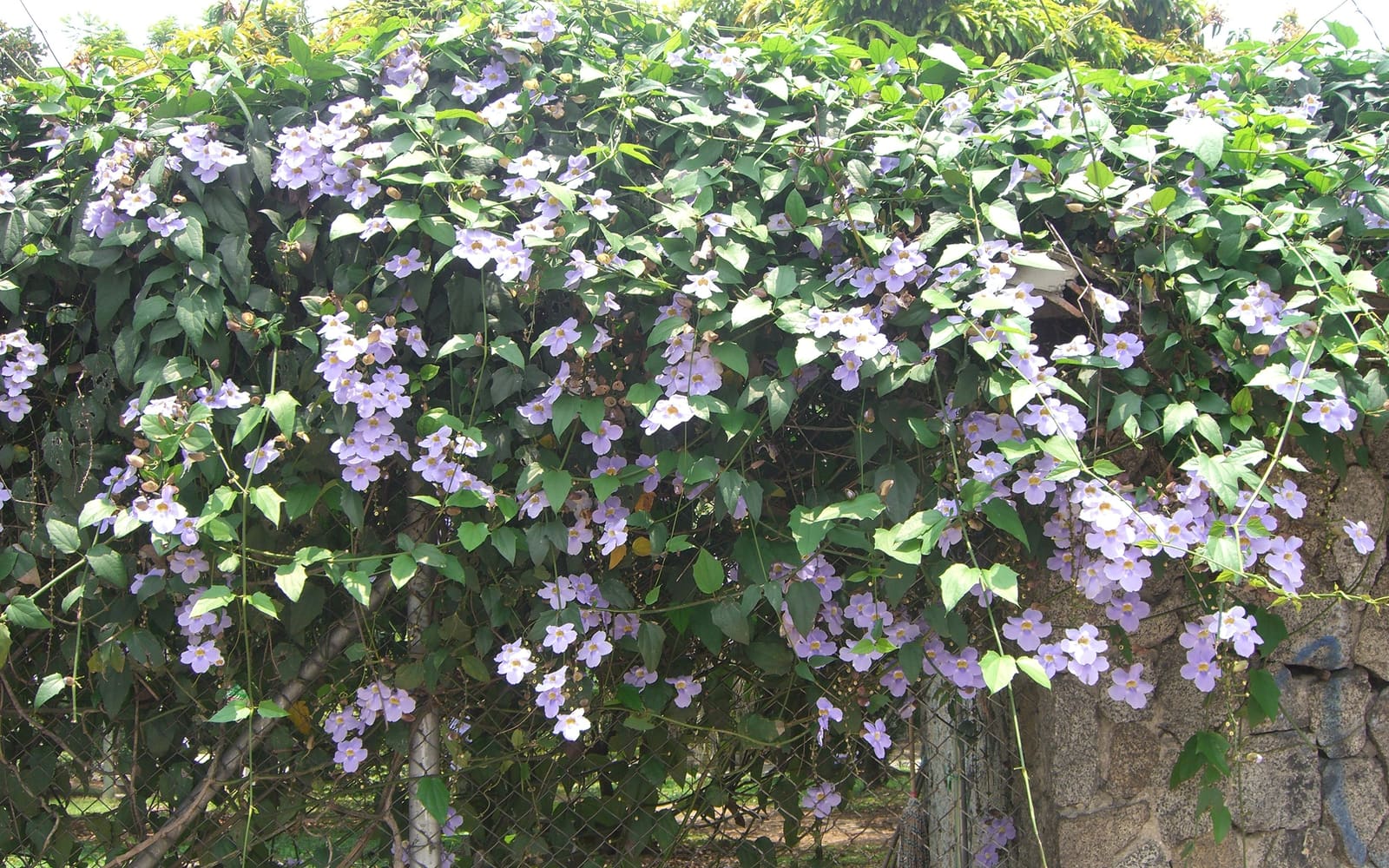
Photo by Philipp Weigell on Wikimedia Commons, CC BY 3.0

Blue sky vine (Thunbergia grandiflora) is a fast, heavy climber with big lavender-blue trumpet flowers. It wants full sun, regular water while it grows and winter warmth; in cold climates the RHS grows it under glass. It is also one of the worst invasive vines in warm places. Queensland restricts it by law, UF/IFAS advises against planting it in Florida, Hawaii rates it high risk, and it runs wild in Puerto Rico and on many islands. Where it can escape, choose another vine. No pet toxicity rating exists.
Not rated for pets
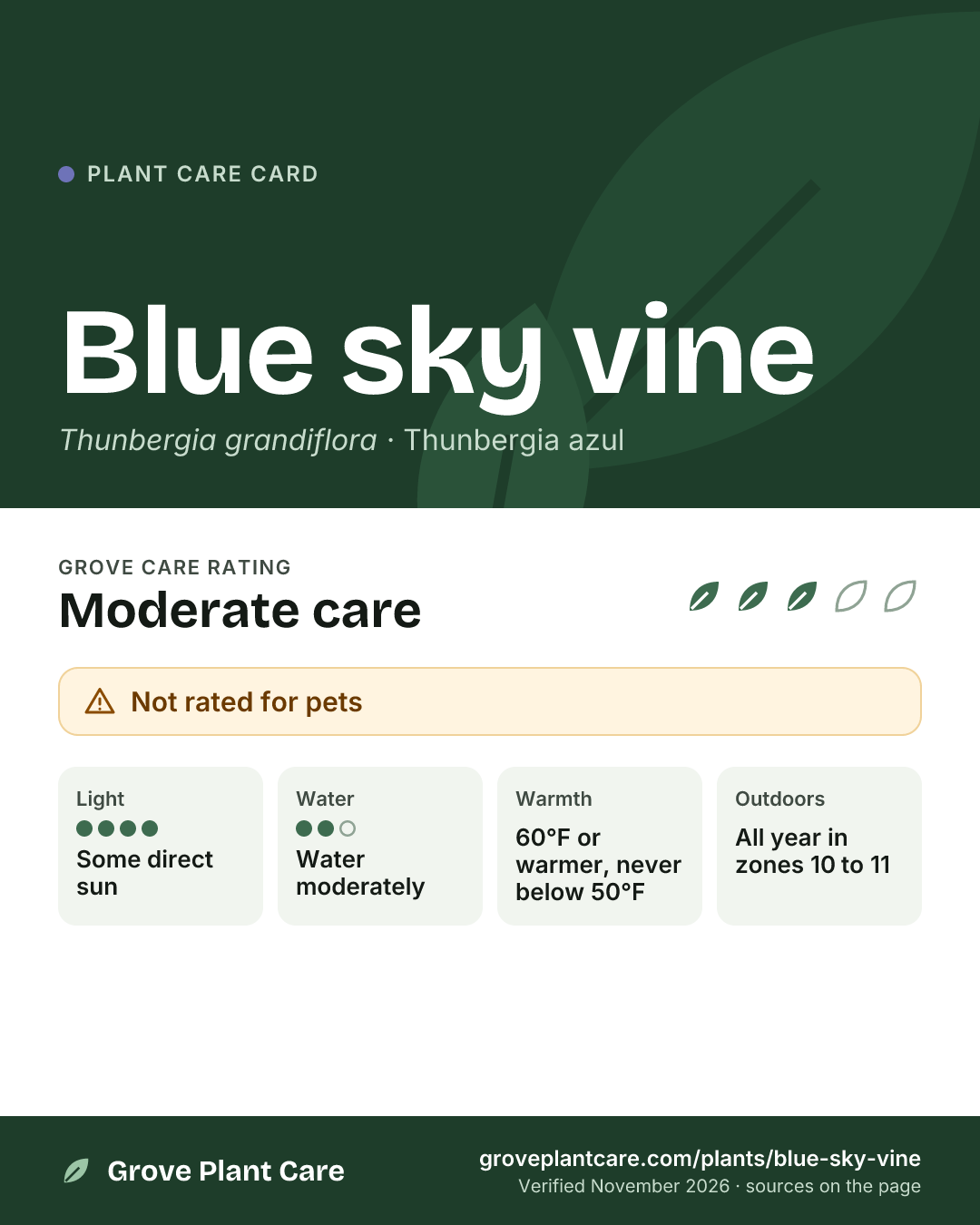
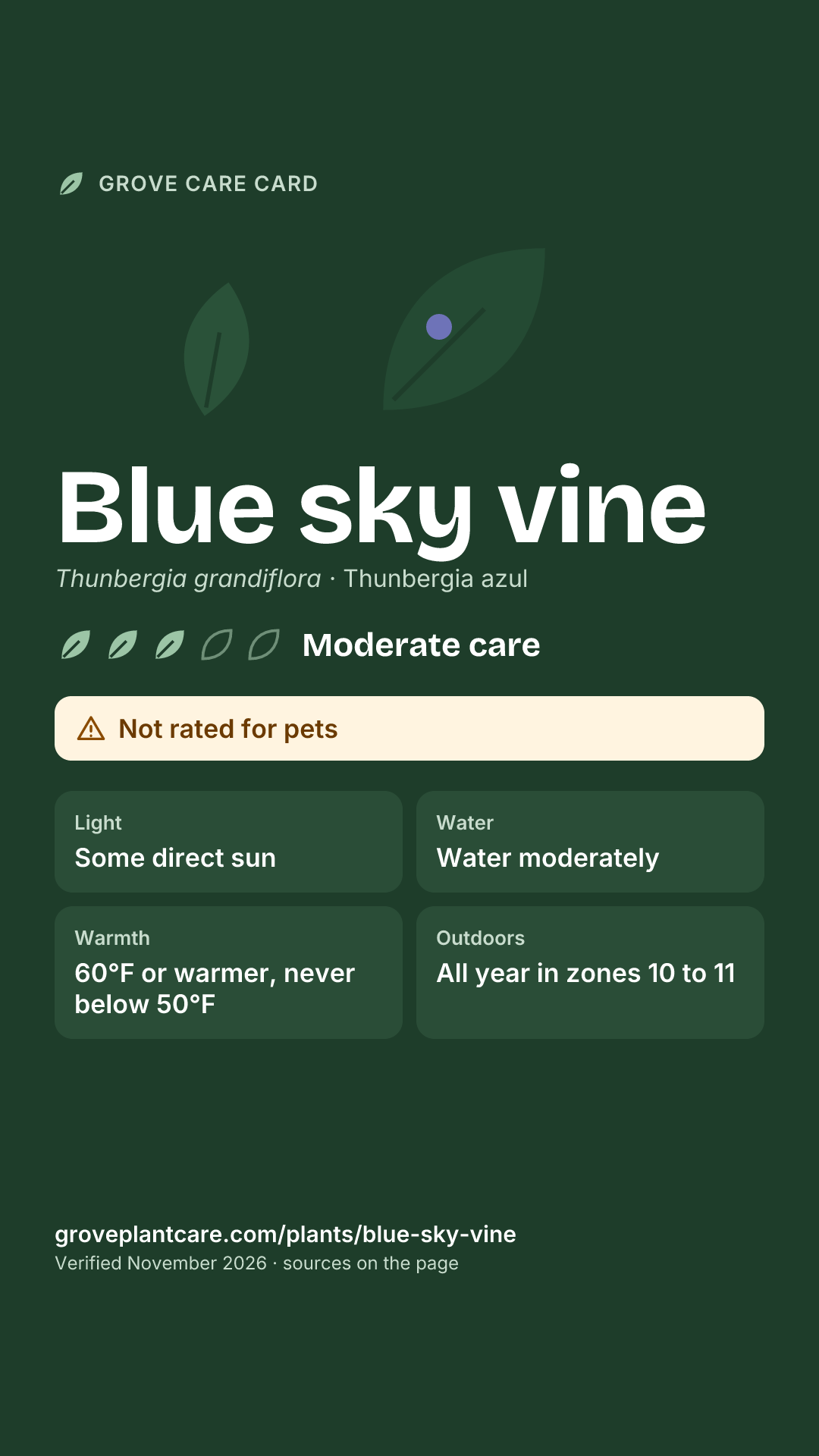
Neither the ASPCA nor NC State rates blue sky vine. No reputable source lists it as toxic, but none rates it either. The Florida and Hawaii weed risk assessments found no evidence of toxicity. Children: No poisoning information found.
Pet poison line: ASPCA (888) 426-4435
Good for: a sunny greenhouse or conservatory, a big pot with a strong trellis, bees, including large carpenter bees · Think twice if: you garden somewhere frost-free, such as Florida, Hawaii or Queensland, you have little space: it climbs 13 ft (4 m) or more.
Needs at a glance
- Light4 of 4 · Some direct sunFull sun outdoors; under glass, bright light with shade from the hottest sun
- Water2 of 3 · Water moderatelyRegular water while it grows; much less in winter
- Humidity1 of 3 · AverageCopes with humid air; no source asks for more
- Soil when pottedRich, moist, well-drained soilLoam-based potting mix in a pot; tolerates many garden soils
Indoors: best at 60°F (16°C) or warmer. Keep it above 50°F (10°C) and away from drafts and heat vents.
How the rating adds up
0 = easiest · 1 = moderate · 2 = hardest
- Missed waterings1 of 2 · ModerateWater regularly while it grows; it rides out a short dry spell
- Light flexibility2 of 2 · HardestFull sun or close to it; it climbs out of shade to find light
- Humidity0 of 2 · EasiestNo source asks for extra humidity
- Pests and disease1 of 2 · ModerateWhitefly, spider mites, aphids and scale, mostly under glass
- Sensitivity to change1 of 2 · ModerateNeeds winter warmth under glass; frost burns it back
Growing outdoors
All year: USDA zones 10 to 11, where the coldest winter nights average 30°F (−1°C) or warmer.
Elsewhere: summer outside in full sun on a sturdy trellis; keep it in its pot. Bring it in when nights reach 55 to 60°F (13 to 16°C).
Invasive in: Queensland (Australia), Réunion. Restricted in Queensland, where selling or giving it away is against the law. UF/IFAS advises against planting it in Florida, Hawaii's weed risk assessment rates it high risk, and it runs wild in Puerto Rico. Where it is listed or rated high risk, don't plant it. Lists checked .
- Large container with a sturdy trellis
- Greenhouse or conservatory climber
Sources: Port St. Lucie Botanical Gardens, RHS, UF/IFAS Charlotte County, NParks Singapore, UF/IFAS weed risk assessment, ASPCA plant list, Hawaii weed risk assessment, Clemson, USDA, Queensland Government, Global Invasive Species Database, UF/IFAS Assessment, University of Hawaiʻi, Biological Invasions and FISC. Full list below.
Verified · How we rate plants
Is blue sky vine toxic to cats and dogs?
We can't say for sure. Neither the ASPCA nor NC State rates blue sky vine, and we found no reputable source that lists it as toxic. The weed risk assessments from UF/IFAS and Hawaii both found no evidence that it is toxic to animals or people, which helps but isn't a pet safety rating. If your pet chewed a plant and seems unwell, call your vet or the ASPCA Animal Poison Control Center at (888) 426-4435. If a child eats some, call Poison Help at 1-800-222-1222.
ASPCA plant list, UF/IFAS weed risk assessment, Hawaii weed risk assessment
Is blue sky vine invasive? Where should I avoid planting it?
Yes, in many warm places. In Queensland, Australia, it is a category 3 restricted invasive plant under the Biosecurity Act 2014. Selling it, giving it away or releasing it is against the law there, and people must control it on their land. The state says it threatens rainforest remnants in the Wet Tropics and wears away creek banks, and its tubers can weigh 70 kg (about 150 lb). In Florida, UF/IFAS predicts it will be invasive and advises against planting it anywhere in the state. The Florida Invasive Species Council hasn't listed it yet. Hawaii's weed risk assessment rates it high risk, and the University of Hawaii says it has escaped along trails and smothers tall trees. A peer-reviewed study lists it among the invasive plants of Puerto Rico and the Virgin Islands, and the Global Invasive Species Database records it in Réunion, New Caledonia, French Polynesia, Martinique, Guadeloupe and other places. If you live anywhere frost-free like these, choose a different vine and ask your local extension office for one that is safe to plant there.
Queensland Government, UF/IFAS Assessment, UF/IFAS weed risk assessment, FISC, Hawaii weed risk assessment, University of Hawaiʻi, Biological Invasions, Global Invasive Species Database
How much sun does blue sky vine need?
As much as you can give it. The RHS and Singapore's National Parks Board both list full sun, and the UF/IFAS risk assessment notes that it climbs over trees and shrubs to reach light. Port St. Lucie Botanical Gardens and Charlotte County Extension in Florida say it also takes part shade. Under glass, the RHS suggests bright filtered light with shade from hot midday sun.
RHS, NParks Singapore, UF/IFAS weed risk assessment, Port St. Lucie Botanical Gardens, UF/IFAS Charlotte County
How often should I water and feed blue sky vine?
Regularly in the growing season, and much less in winter. The RHS says to water moderately while it grows and sparingly the rest of the year, and to feed it once a month with a general liquid fertilizer. Port St. Lucie Botanical Gardens says it likes evenly moist, well-drained soil and handles a short dry spell. Charlotte County Extension adds that it does better with regular watering. A pot dries out faster than the ground, so check it often in summer.
RHS, Port St. Lucie Botanical Gardens, UF/IFAS Charlotte County
How cold can blue sky vine get?
It's a tropical plant. The RHS rates it H1B, which means it needs heated glass in winter with a minimum of about 10 to 15°C (50 to 59°F). Port St. Lucie Botanical Gardens lists USDA zones 10a to 11. Charlotte County Extension in Florida says frost can damage it there but it recovers quickly, and the University of Hawaii notes it regrows from its tubers. In a pot, bring it in before nights fall to about 55 to 60°F (13 to 16°C); Clemson warns that 50°F (10°C) or lower damages many tropical plants.
RHS, Port St. Lucie Botanical Gardens, UF/IFAS Charlotte County, University of Hawaiʻi, Clemson
How big does blue sky vine get, and how do I keep it in check?
Big. The RHS gives 4 to 8 m (13 to 26 ft) under glass, and Port St. Lucie Botanical Gardens says it can reach 15 to 30 ft and add 6 to 8 ft in one season. Underground it builds large tubers. Give it a strong trellis or arbor, and prune it to keep it within bounds, as Charlotte County Extension suggests. Bag the cuttings for the trash: Queensland says root pieces spread it, and the University of Hawaii notes it resprouts from tubers.
RHS, Port St. Lucie Botanical Gardens, Queensland Government, UF/IFAS Charlotte County, University of Hawaiʻi
What pests bother blue sky vine?
Under glass, the RHS lists glasshouse whitefly, red spider mite, aphids and scale insects, and says it is generally free of disease. Port St. Lucie Botanical Gardens names scale, spider mites and whiteflies, with no serious problems. Check under the leaves now and then, especially indoors in winter.
Can I grow blue sky vine in a pot?
Yes, and in a cold climate that's the safe way to grow it. The RHS suggests it as a patio and container plant and grows it under glass in loam-based potting mix. Give it a big pot, a sturdy frame and full sun. The RHS lists seed and softwood cuttings for propagation, and Charlotte County Extension says cuttings root easily. Where it is restricted, such as Queensland, sharing plants or cuttings is against the law.
How Grove helps
Grove can remind you to bring the pot in before cold nights and to prune the vine on a schedule. You can assign both as tasks, and the pruning reminder can say to bag the cuttings for the trash.
Sources
- Port St. Lucie Botanical Gardens: Sky Vine (Thunbergia grandiflora)
- Royal Horticultural Society: Thunbergia grandiflora (blue trumpet vine)
- UF/IFAS Extension Charlotte County: A fine vine is the sky vine (R. Mitchell, 2018, updated 2022)
- National Parks Board Singapore, Flora & Fauna Web: Thunbergia grandiflora
- UF/IFAS Assessment of Non-Native Plants: Thunbergia grandiflora weed risk assessment (2016, PDF)
- ASPCA Animal Poison Control: Toxic and Non-Toxic Plants
- Hawaii-Pacific Weed Risk Assessment (Plant Pono): Thunbergia grandiflora, high risk, score 11
- Clemson Cooperative Extension HGIC 1454: Moving Houseplants Indoors and Outdoors
- USDA ARS Plant Hardiness Zone Map (2023)
- Business Queensland (Queensland Government): Thunbergia (Thunbergia grandiflora), restricted invasive plant
- IUCN Global Invasive Species Database: Thunbergia grandiflora
- UF/IFAS Assessment of Non-Native Plants: Thunbergia grandiflora (high invasion risk)
- University of Hawaiʻi CTAHR, Weeds of Hawaiʻi's Pastures and Natural Areas (Motooka et al., 2003): Thunbergia grandiflora
- Rojas-Sandoval and Acevedo-Rodríguez (2015), Naturalization and invasion of alien plants in Puerto Rico and the Virgin Islands, Biological Invasions 17 (Table S2)
- Florida Invasive Species Council: Plant List, Category I and II (April 2026)
- Kew WCVP data release (2026-06-04 file), plant_name_id 2436154: Thunbergia grandiflora
- Kew WCVP data release (2026-06-04 file), plant_name_id 2436041: Thunbergia laurifolia (laurel clock vine)
- NC State Extension Gardener Plant Toolbox: Thunbergia alata (black-eyed Susan vine)