Plant care card
Chinese evergreen
Aglaonema · Aglaonema
Also called aglaonema or Philippine evergreen
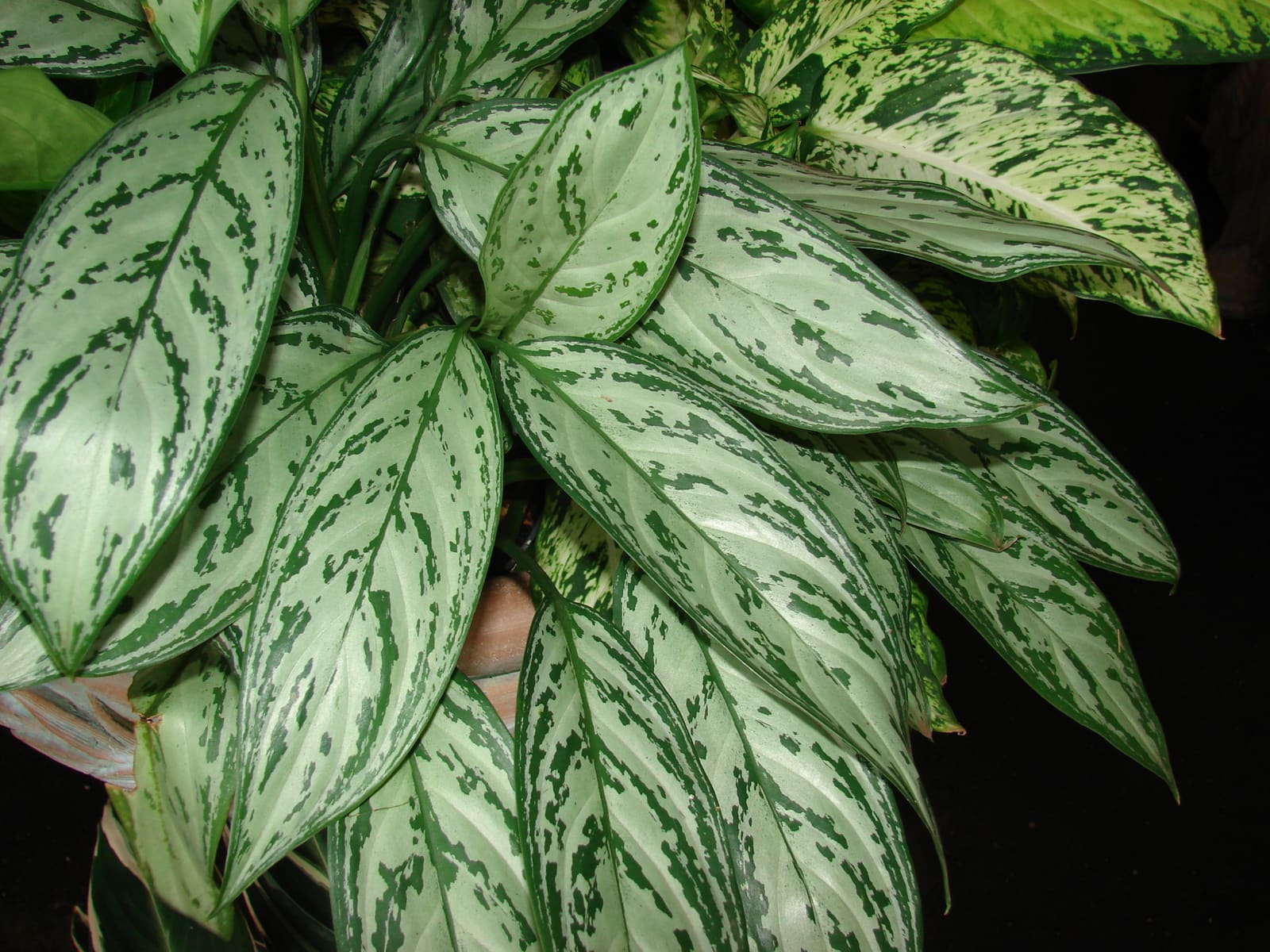
Photo by Forest and Kim Starr on Wikimedia Commons, CC BY 3.0

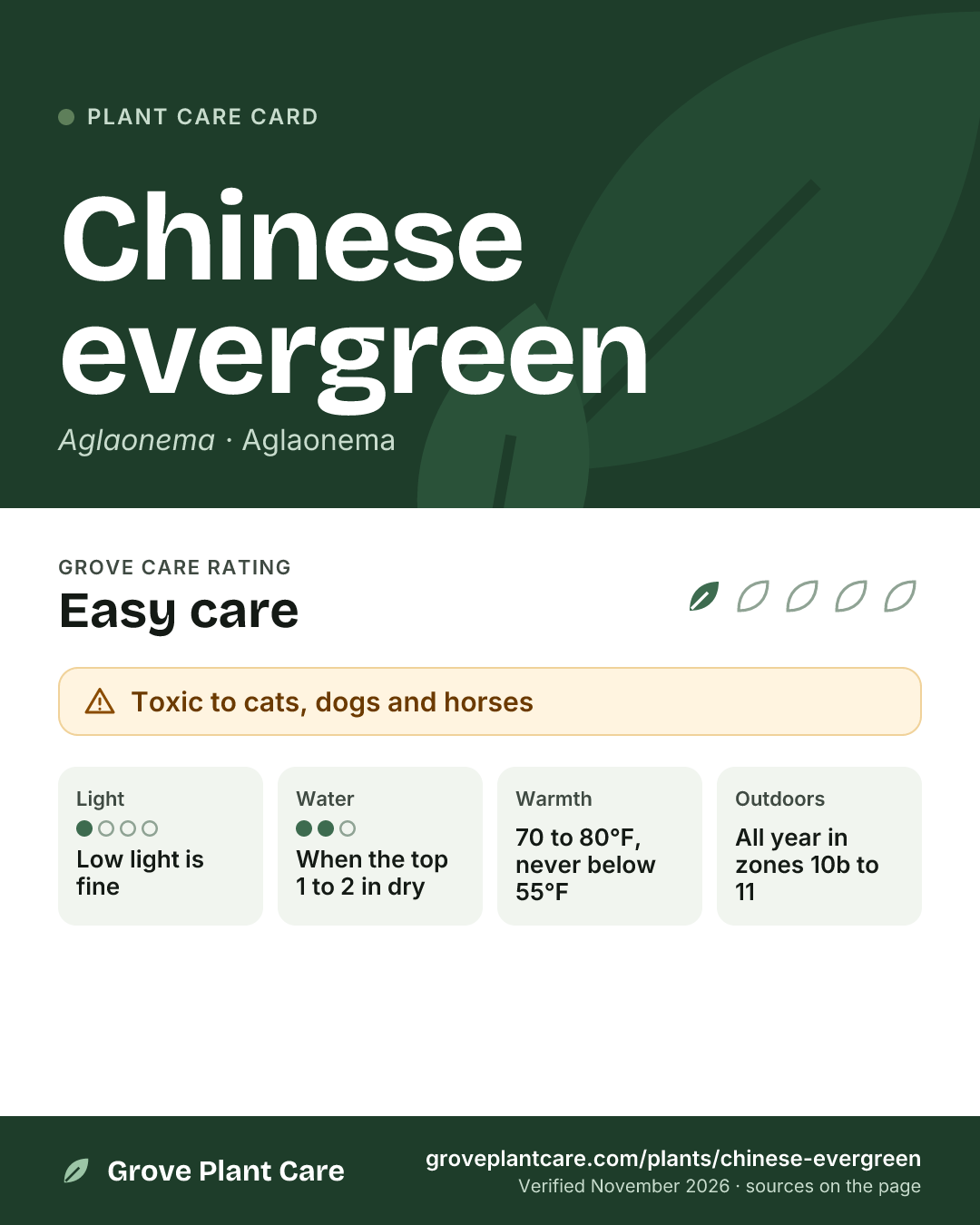
Chinese evergreen (Aglaonema) is one of the easiest houseplants for a dim room. Green and silver kinds grow in low light, while pink and red ones need bright, indirect light to keep their color. Water when the top 1 to 2 inches of soil are dry, and keep it above 55°F (13°C), because cold leaves dark patches on the leaves. It's toxic to cats, dogs and horses, though NC State rates the risk as low.
Toxic to cats, dogs and horses · Mild
Mouth pain and swelling, drooling, vomiting and trouble swallowing. All parts hold insoluble calcium oxalate crystals; NC State rates the severity as low. Children: low severity. NC State rates it low severity; chewing irritates the mouth, and the sap can irritate skin and eyes.
Pet poison line: ASPCA (888) 426-4435
Good for: dim rooms and offices, dry indoor air, colorful leaves without fuss · Think twice if: pets chew plants, your home gets cold at night in winter.
Needs at a glance
- Light1 of 4 · Low light is fineGreen and silver kinds take low light; pink and red ones need bright, indirect light to keep their color. No direct sun
- Water2 of 3 · Let the top dryWater when the top 1 to 2 in (2.5 to 5 cm) is dry; less in winter
- Humidity1 of 3 · AverageCopes with dry indoor air; very dry air or drafts can brown the leaf edges
- Soil when pottedWell-drained potting mixA standard soilless mix with extra organic matter, in a pot with drainage holes
Indoors: best at 70 to 80°F (21 to 27°C). Keep it above 55°F (13°C) and away from drafts and heat vents.
How the rating adds up
0 = easiest · 1 = moderate · 2 = hardest
- Missed waterings1 of 2 · ModerateWater when the top 1 to 2 in (2.5 to 5 cm) is dry; it has little drought tolerance
- Light flexibility0 of 2 · EasiestGrows in low light up to bright, indirect light; colorful kinds want the brighter end
- Humidity0 of 2 · EasiestAverage indoor air is fine; it tolerates dry air
- Pests and disease0 of 2 · EasiestRarely bothered; watch for mealybugs and mites, and root rot in soggy soil
- Sensitivity to change1 of 2 · ModerateCold air, cold water and drafts mark the leaves
Growing outdoors
All year: USDA zones 10b to 11, where the coldest winter nights average 35°F (2°C) or warmer.
Elsewhere: summer outside in shade, such as the north side of the house or under trees; sun scorches the leaves. Bring it in before nights drop below 60°F (16°C).
- Groundcover in deep shade in frost-free gardens
- Pots on a shady patio in summer
Sources: NC State, Clemson HGIC, UF/IFAS, ASPCA, ASPCA plant list, RHS, USDA zone map, FISC, UF/IFAS Assessment, Hawaii weed risk assessment, Hawaii noxious weed list, GISD, Cal-IPC and Rojas-Sandoval and Acevedo-Rodríguez. Full list below.
Verified · How we rate plants
Is Chinese evergreen toxic to cats and dogs?
Yes. The ASPCA lists Chinese evergreen as toxic to cats, dogs and horses. Every part holds insoluble calcium oxalate crystals, tiny needles that irritate the mouth. A pet that chews it may drool, paw at its mouth, vomit and have trouble swallowing. NC State rates the severity as low, and the ASPCA's poison center says these plants aren't considered life-threatening, though a pet with bad stomach trouble or any trouble breathing needs a vet. The RHS says the sap can irritate skin and eyes, so wear gloves when you cut it. If a pet eats some and seems unwell, call your vet or the ASPCA Animal Poison Control Center at (888) 426-4435. If a child eats some, call Poison Help at 1-800-222-1222.
Which Chinese evergreen do I have?
Probably a hybrid. Chinese evergreen is the genus Aglaonema, with about two dozen wild species and many cultivars, and Clemson says most plants sold come from crosses of A. commutatum, A. modestum, A. nitidum and A. crispum. Silver Queen, Silver Bay and Maria are A. commutatum types; pink and red ones like Siam Aurora are newer hybrids. Their care is the same, apart from light. It also looks a lot like dumb cane (Dieffenbachia). NC State's tip: a Chinese evergreen leaf has 5 to 8 main side veins, and the plant stays around 1 to 3 feet, while dumb cane grows a thick, cane-like stem and gets much taller.
Can Chinese evergreen grow in low light?
Yes, and that's why people love it. NC State calls it an excellent low-light houseplant, and Clemson says green kinds grow fine in low light. The catch is color: UF/IFAS says high-color kinds need bright, indirect light to hold their pink, red or yellow, and Clemson puts variegated ones in low to moderate light. Keep every kind out of direct sun, which scorches the leaves. A spot a few feet back from a bright window suits most of them.
How often should I water Chinese evergreen?
When the top 1 to 2 inches (2.5 to 5 cm) of soil are dry, per Clemson, who suggests the two-finger test: dry means water, cold and damp means wait. NC State says keep the mix moist from spring to fall and water less in winter. UF/IFAS rates its drought tolerance as low and warns that overwatering brings root rot and yellow leaves. So aim for evenly moist and never soggy, in a pot with drainage holes. Use room-temperature water, since NC State and Clemson both say cold water can harm it.
What temperature does Chinese evergreen need?
Warmth. NC State says it grows best at about 70 to 80°F (21 to 27°C) by day, and Clemson gives 68 to 80°F. Clemson says to keep it above 55°F (13°C). UF/IFAS research found chilling injury anywhere from just above freezing to about 59°F (15°C): 'Silver Queen' was hurt after a day at 55°F, while the toughest cultivars came through 35°F unharmed. Damage shows up two days later as dark, greasy patches on the leaves. Keep it away from cold windows in winter, and from drafts, which NC State says can brown the leaves.
Why are my Chinese evergreen leaves turning yellow or brown?
Check the soil first. UF/IFAS says overwatering leads to root rot and yellow leaves, and Clemson says slow-draining soil does the same. Brown edges have other causes: NC State points to very dry air and drafts, and Clemson says too much fertilizer burns the leaf edges. Dark, greasy patches that appear a day or two after a cold night are chilling injury, per UF/IFAS. Older lower leaves also drop as the stem gets longer, which Clemson treats as normal aging; a bare, leggy plant can be cut back and the top rooted.
What pests bother Chinese evergreen?
Not many. NC State says it has no serious pest or disease problems, and UF/IFAS says pests rarely affect its long-term health. Clemson and NC State still list mealybugs, aphids, scale and spider mites, so check under the leaves and along the stems now and then. The RHS mentions mealybugs too. The disease to watch is root or stem rot, which every source ties to soil that stays too wet.
How do I propagate or repot Chinese evergreen?
In spring. The RHS says to separate shoots from the base that have three or four leaves and some roots, or divide the whole clump, and to move it to a bigger pot every 2 to 3 years. NC State and Clemson also root stem cuttings. If the lower leaves have dropped and the stem looks bare, Clemson suggests cutting off the top and rooting it. Wear gloves, because the sap can irritate skin.
Can Chinese evergreen grow outdoors, and is it invasive?
Only where winters stay warm. NC State and UF/IFAS put it in USDA zones 10b to 11, where it makes a groundcover in deep shade. UF/IFAS says temperatures below 45°F (7°C) injure the leaves and that too much sun scorches it, so plant it on a north side or under trees. In colder places, give it summer outside in the shade and bring it in before nights drop to 60°F (16°C), the top of the chilling range UF/IFAS found. No official invasive list names it: Florida's FISC list leaves it out, UF/IFAS says it isn't known to be invasive, and Hawaii's weed risk assessment rates it low risk.
NC State, UF/IFAS, FISC, UF/IFAS Assessment, Hawaii weed risk assessment, Hawaii noxious weed list, GISD
How Grove helps
Grove sets a watering check based on how dry the soil is, so your Chinese evergreen gets water once the top inch or two has dried, and less in winter. You can add a monthly leaf check for mealybugs as a repeating task and assign it, and set a reminder to bring the pot inside before cool nights.
Sources
- NC State Extension Gardener Plant Toolbox: Aglaonema (genus page)
- Clemson HGIC 1500: Chinese Evergreen (rev. 2025)
- UF/IFAS EDIS FPS25: Aglaonema spp., Chinese Evergreen (rev. 2025)
- UF/IFAS EDIS EP103: Chilling Injury in Tropical Foliage Plants: II. Aglaonema
- ASPCA Animal Poison Control: Chinese Evergreen (Aglaonema modestum)
- ASPCA Animal Poison Control Center: Is That Houseplant Safe for Your Pets? (2019)
- ASPCA Animal Poison Control: Toxic and Non-Toxic Plants
- RHS: Aglaonema modestum (Chinese evergreen)
- RHS: Aglaonema 'Maria' (Chinese evergreen)
- USDA ARS Plant Hardiness Zone Map (2023)
- Florida Invasive Species Council: Plant List, Category I and II (April 2026)
- UF/IFAS Assessment of Non-Native Plants: Aglaonema commutatum var. maculatum
- Hawaii-Pacific Weed Risk Assessment, assessment list: Aglaonema commutatum (low risk, score 1)
- Hawaii Administrative Rules 4-68: plant species designated as noxious weeds (Hawaii Department of Agriculture)
- IUCN Global Invasive Species Database: Aglaonema commutatum (no record)
- California Invasive Plant Council (Cal-IPC): plant search, "aglaonema" (no listing)
- J. Rojas-Sandoval and P. Acevedo-Rodríguez (2015), Naturalization and invasion of alien plants in Puerto Rico and the Virgin Islands, Biological Invasions 17 (supplementary list)
- Kew WCVP data release (2026-06-04 file), plant_name_id 4599: genus Aglaonema
- Kew WCVP data release (2026-06-04 file), plant_name_id 4614: Aglaonema commutatum