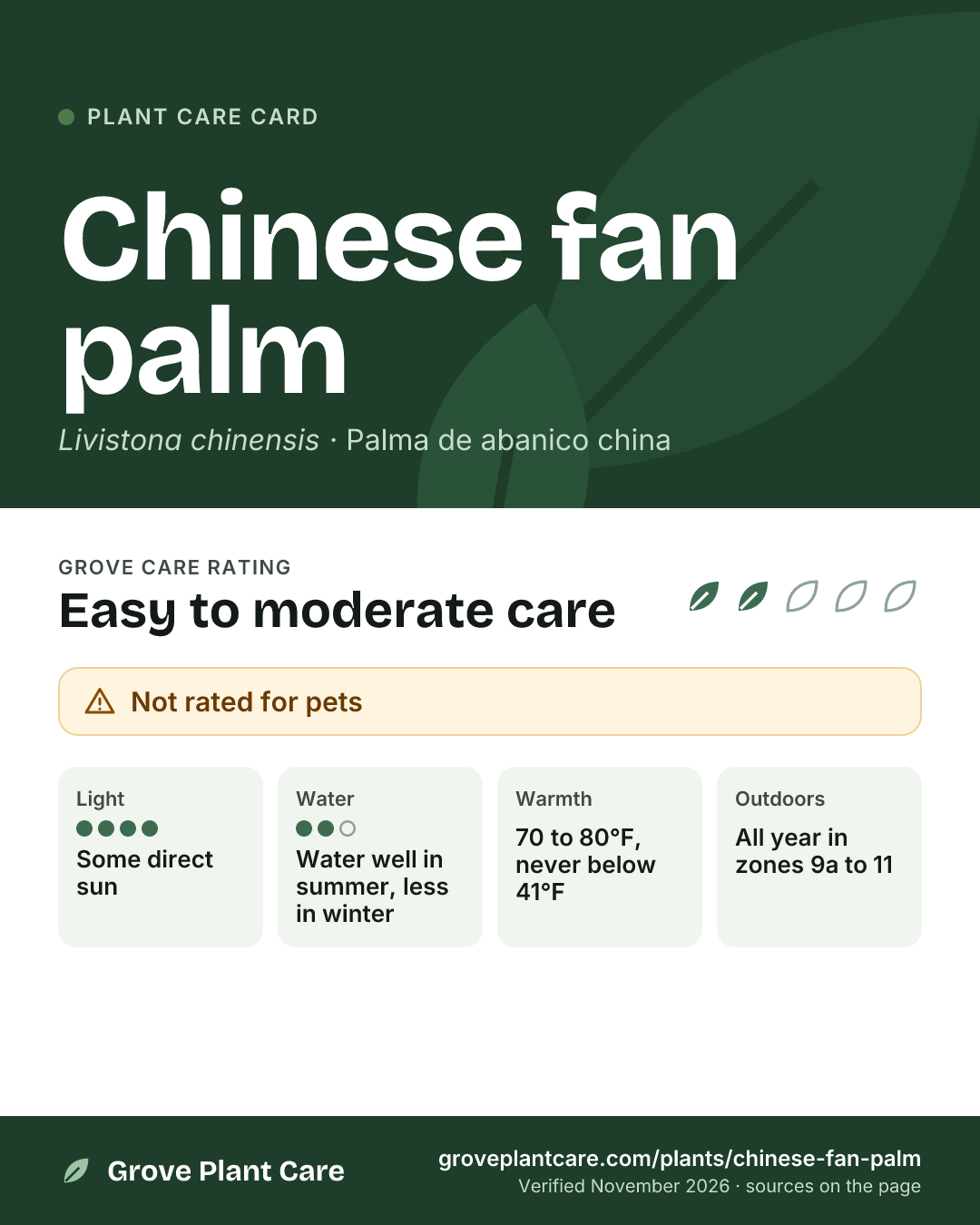
Plant care card
Chinese fan palm
Livistona chinensis · Palma de abanico china
Also called fountain palm or Chinese fountain palm
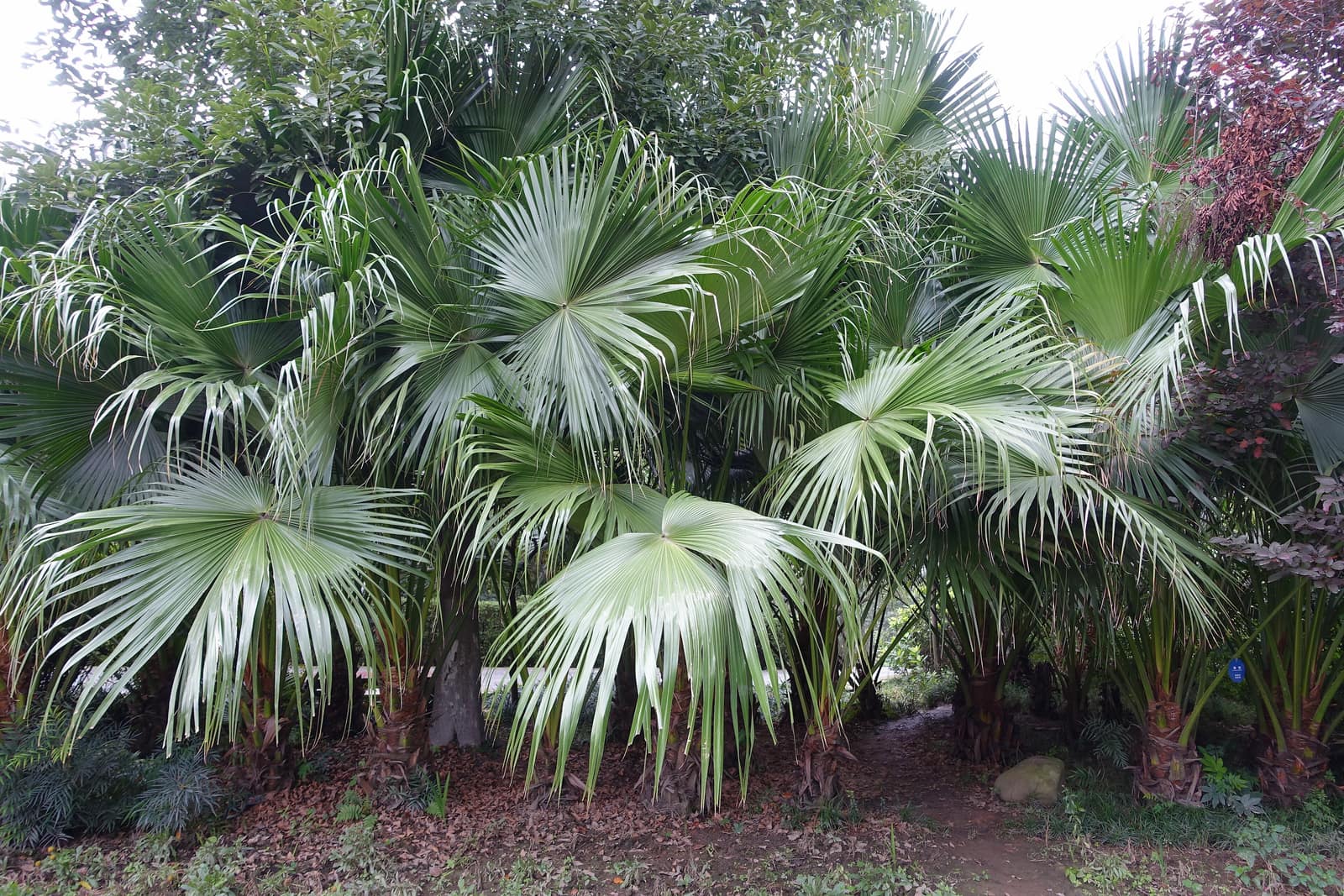
Photo by Daderot on Wikimedia Commons, CC0 1.0

The Chinese fan palm is a slow, tough fan palm whose leaf tips droop like a fountain. It takes full sun to part shade, dry spells once planted in the ground, and cold down to about 20°F (−7°C), UF/IFAS says. In a pot it makes a good conservatory palm. It is listed as invasive in Central and South Florida, Bermuda and Mauritius, because animals spread its fruit. Young plants have spiny leaf stalks. Neither the ASPCA nor NC State rates it for pets.
Not rated for pets
Neither the ASPCA nor NC State rates the Chinese fan palm. No reputable source lists it as toxic, but none rates it for pets either. Young plants have spiny leaf stalks. Children: low severity. No poisoning information found, but the leaf stalks of young palms carry sharp spines.
Pet poison line: ASPCA (888) 426-4435
Good for: bright rooms and conservatories, gardens that dip to about 20°F (−7°C), dry spells and some salt spray · Think twice if: you garden in Central or South Florida, where it spreads into wild areas, children or pets brush past young plants with spiny leaf stalks, you need it to stay narrow: it spreads 10 to 16 ft.
Needs at a glance
- Light4 of 4 · Some direct sunFull sun to part shade outdoors; your brightest window indoors
- Water2 of 3 · Water well while it grows, less in winterDrought tolerant once planted in the ground
- Humidity1 of 3 · AverageNo source asks for extra humidity
- Soil when pottedMost well-drained soilsLoam or sand, acid to alkaline; a loam-based mix in pots
Indoors: best at 70 to 80°F (21 to 27°C). Keep it above 41°F (5°C) and away from drafts and heat vents.
How the rating adds up
0 = easiest · 1 = moderate · 2 = hardest
- Missed waterings1 of 2 · ModerateDrought tolerant in the ground; water a pot freely while it grows
- Light flexibility1 of 2 · ModerateFull sun to part shade; bright indirect light indoors
- Humidity0 of 2 · EasiestNo source asks for extra humidity
- Pests and disease1 of 2 · ModerateSpider mites and scale indoors; potassium shortage and palm diseases outdoors
- Sensitivity to change0 of 2 · EasiestHardy to about 20°F and happy in most soils
Growing outdoors
All year: USDA zones 9a to 11, where the coldest winter nights average 20°F (−7°C) or warmer.
Elsewhere: summer outside in full sun to part shade, sheltered from strong wind. Bring it in before nights drop below 41°F (5°C).
Invasive in: Florida, Bermuda, Mauritius. A Category II invasive in Central and South Florida on the FISC list (the UF/IFAS Assessment says plant it only with caution), listed in Bermuda, and invasive in Mauritius. Hawaii’s weed risk assessment rates it high risk. Birds and small animals spread the fruit, so cut off flower stalks before fruit forms and never dump seedlings in wild areas. Lists checked .
- Single-trunk specimen or street tree
- Container palm moved outside for summer
- Conservatory palm
Sources: Missouri Botanical Garden, UF/IFAS, RHS, NParks Singapore, Hawaii weed risk assessment, ASPCA plant list, Bermuda Department of Environment, Clemson, Penn State, USDA zone map, FISC, UF/IFAS Assessment, GISD, Hawaii noxious weed list, Rojas-Sandoval and Acevedo-Rodríguez, TexasInvasives.org, Cal-IPC and Queensland Government. Full list below.
Verified · How we rate plants
Is a Chinese fan palm safe for cats and dogs?
Nobody has rated it. The Chinese fan palm is on neither ASPCA list, NC State has no page for it, and we found no reputable source that calls it toxic. Hawaii’s weed risk assessment lists it as non-toxic, but that is a weed screen, so we can’t call it pet safe. The real risk is physical: UF/IFAS says young palms have spiny leaf stalks, and Bermuda’s Department of Environment tells people to wear gloves when handling them. If your pet chews it and seems unwell, call your vet or the ASPCA Animal Poison Control Center at (888) 426-4435. If a child eats some and seems unwell, call Poison Help at 1-800-222-1222.
ASPCA plant list, Hawaii weed risk assessment, UF/IFAS, Bermuda Department of Environment
Is the Chinese fan palm invasive?
In some places, yes. As of November 2026 the Florida Invasive Species Council lists it as a Category II invasive in Central and South Florida, and the UF/IFAS Assessment says to plant it only with caution and manage it so it can’t escape. Bermuda lists it among its invasive plants, where thickets crowd out other plants along roadsides, and the Global Invasive Species Database records it as invasive in Mauritius. Hawaii’s weed risk assessment rates it high risk; it has gone wild on Kauai, Oahu and Maui. Birds and small animals eat the fruit and spread the seed, which sprouts easily, UF/IFAS says. Cutting off flower stalks before fruit forms stops the seed and, UF/IFAS adds, keeps heavy fruit from splitting the crown.
FISC, UF/IFAS Assessment, Bermuda Department of Environment, GISD, Hawaii weed risk assessment, UF/IFAS
Chinese fan palm or ruffled fan palm: which is which?
Look at the leaf edge. The Chinese fan palm splits each round leaf into about 75 long segments whose tips droop, which is why it is also called fountain palm, NParks Singapore and UF/IFAS say. The ruffled fan palm keeps its leaf almost whole, a pleated circle with notched tips, and wants shade. The Washington fan palm is a different, taller fan palm that FISC also lists as invasive in Central and South Florida, and the European fan palm grows in clumps, UF/IFAS notes. In Bermuda, people mix it up with the native palmetto; Bermuda’s Department of Environment says fan palm leaf stalks usually have thorns and the palmetto’s never do. Feather palms like the areca, Christmas and foxtail palms have long leaves made of leaflets instead.
NParks Singapore, UF/IFAS, FISC, Bermuda Department of Environment
How much light does a Chinese fan palm need?
Bright light. The RHS grows it in full sun or partial shade, and indoors in full or bright indirect light. NParks Singapore lists full sun, and Hawaii’s weed risk assessment notes it tolerates shade. Outdoors, sun gives the fullest crown; indoors, give it your brightest window.
How often should I water a Chinese fan palm?
In a pot, water freely while it grows in spring and summer and sparingly in winter, the RHS says, in a loam-based mix that drains well. Once it is planted in the ground, UF/IFAS calls it drought tolerant and says it adapts to a wide range of soils.
Can a Chinese fan palm grow indoors?
Yes. The RHS recommends it for indoor or conservatory growing, under glass or in a container that goes outdoors for summer. It wants full or bright indirect light, a monthly balanced liquid feed while it grows, and a cool but frost-free winter. It grows slowly and takes years to form a trunk, UF/IFAS says, so a young plant stays a fountain of leaves for a long time. Indoors, the RHS lists red spider mite and scale as possible pests.
How cold can a Chinese fan palm get?
Established palms in the ground are cold hardy to about 20°F (−7°C), UF/IFAS says, which suits USDA zones 9a to 11. Potted plants are more exposed: the RHS rates it for frost-free winters, about 1 to 5°C (34 to 41°F), so bring a pot in before nights fall to 41°F (5°C).
Why are the lower leaves on my Chinese fan palm turning yellow or orange?
Usually potassium deficiency, which UF/IFAS calls fairly common: the oldest leaves get dead tips and may turn orange-yellow in the middle. A regular slow-release palm fertilizer fixes it and keeps it from coming back. Remove only leaves that are completely dead, UF/IFAS says, because half-dead ones still feed potassium to the palm, and a healthy palm should have a full, round crown of green leaves. Outdoors in Florida, watch for Ganoderma butt rot, which has no cure, and lethal yellowing, to which it is moderately susceptible.
How big does a Chinese fan palm get?
About 30 feet tall, slowly, UF/IFAS says, with a crown 10 to 12 feet across; its list of South Florida palms gives 30 by 16 feet. The leaves can be 3 to 4 feet across. The RHS gives 8 to 12 meters tall, taking 20 to 50 years. Young palms take years to form a trunk, so people sometimes plant them close together, but UF/IFAS warns that most will need removing once they spread.
How Grove helps
Grove can remind you to cut off flower stalks before fruit forms, which keeps seed out of wild areas, and to feed a palm that runs short of potassium. For a potted palm, a fall reminder to bring it in before nights reach 41°F (5°C) can be one of the tasks you can assign.
Sources
- Missouri Botanical Garden Plant Finder: Livistona chinensis (no record found through search; hand check pending)
- UF/IFAS EDIS ENH-524: Livistona chinensis, Chinese Fan Palm (Broschat, Klein, Hilbert; rev. March 2024)
- RHS Plants: Livistona chinensis (Chinese fan palm)
- National Parks Board Singapore, Flora & Fauna Web: Livistona chinensis
- Hawaii-Pacific Weed Risk Assessment (Plant Pono): Livistona chinensis, high risk, score 13 (2020)
- ASPCA Animal Poison Control: Toxic and Non-Toxic Plants
- Bermuda Department of Environment and Natural Resources: Chinese Fan Palm (Livistona chinensis)
- UF/IFAS EDIS ENH21: Ornamental Palms for South Florida (T. K. Broschat and R. J. Black; rev. 2016, reviewed 2017)
- Clemson Cooperative Extension HGIC 1508: Indoor Palms
- Penn State Extension: Palms as Houseplants (M. L. Smith, 2023)
- USDA ARS Plant Hardiness Zone Map (2023)
- Florida Invasive Species Council: Plant List, Category I and II (April 2026); Chinese fan palm in Category II, Central and South
- UF/IFAS Assessment of Non-Native Plants in Florida: Livistona chinensis (caution, manage to prevent escape; 2026)
- Bermuda Department of Environment and Natural Resources: Invasive Species (Invasive Plants)
- IUCN Global Invasive Species Database: Livistona chinensis
- Hawaii Administrative Rules 4-68: plant species designated as noxious weeds (Hawaii Department of Agriculture)
- J. Rojas-Sandoval and P. Acevedo-Rodríguez (2015), Naturalization and invasion of alien plants in Puerto Rico and the Virgin Islands, Biological Invasions 17 (supplementary list)
- TexasInvasives.org Invasives Database: plant list (no Licuala, Wodyetia, Livistona or other palm)
- California Invasive Plant Council (Cal-IPC): plant search, "livistona" (no listing)
- Business Queensland: Restricted invasive plants (Biosecurity Act 2014)
- Kew WCVP data release (2026-06-04 file), plant_name_id 114913: Livistona chinensis
- National Parks Board Singapore, Flora & Fauna Web: Licuala grandis