Plant care card
Christmas cactus
Schlumbergera × buckleyi · Cactus de Navidad
Also called holiday cactus
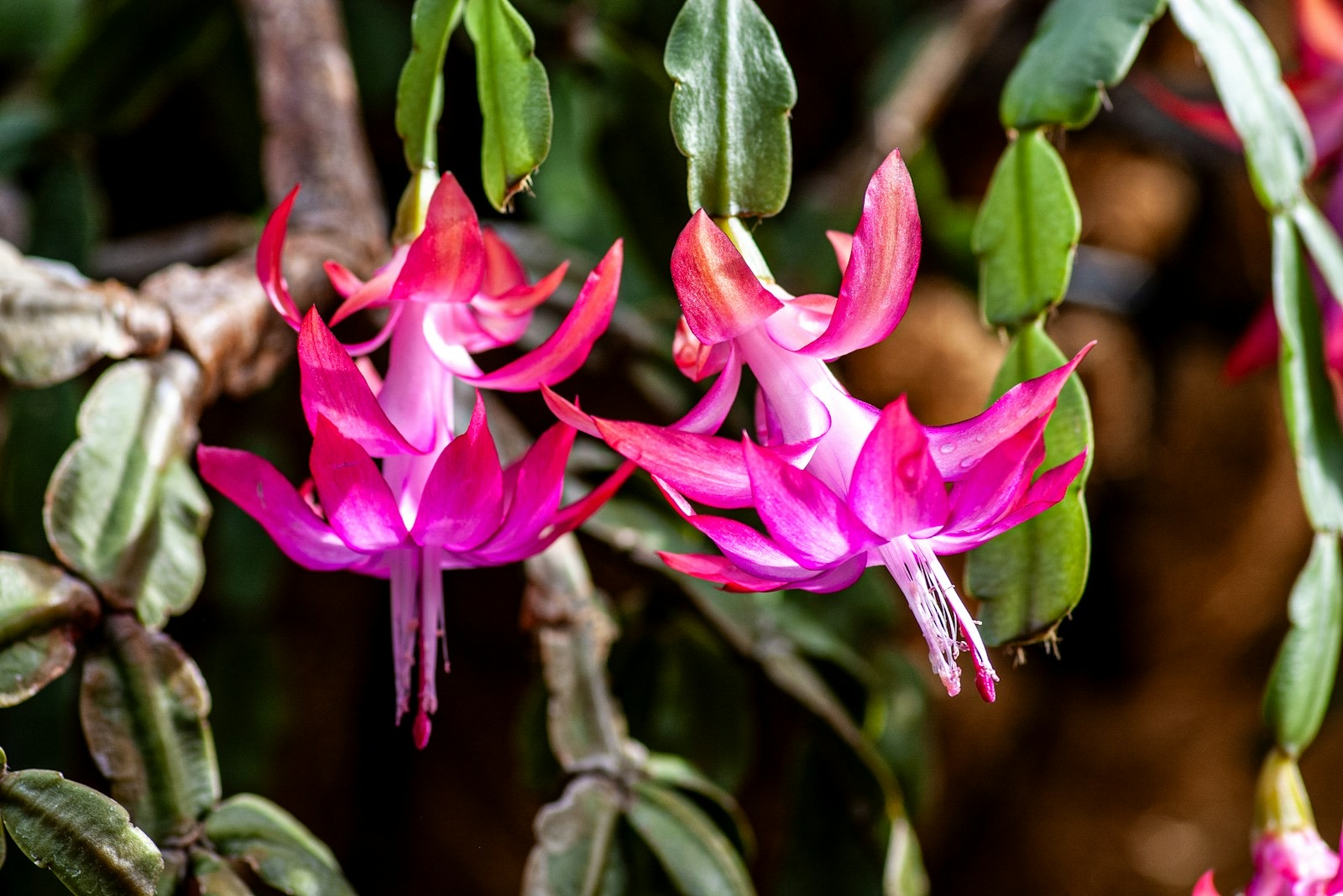
Photo by Yoksel Zok on Unsplash
A Christmas cactus is easy to keep and lives for decades: give it bright, indirect light, water when the top inch of soil is dry, and keep it away from drafts. It's a rainforest cactus from Brazil, so it wants more water and less sun than a desert cactus. Getting it to bloom again takes long, dark nights or cool nights in fall, and then leaving it alone while the buds form.
Non-toxic to cats, dogs and horses
No signs of poisoning listed. Any plant can still upset a pet’s stomach if it eats enough. Children: NC State lists it as non-toxic.
Pet poison line: ASPCA (888) 426-4435
Good for: homes with cats and dogs, winter color, a plant to pass down · Think twice if: lamps or streetlights shine on it at night in fall, you like to move plants around in late fall.
Needs at a glance
- Light3 of 4 · Bright indirectWithin about 6 ft of a south, east or west window
- Water2 of 3 · Let the top dryWater when the top inch is dry; evenly moist while budding
- Humidity2 of 3 · Above averageA pebble tray helps in dry winter rooms
- Soil when pottedAiry, well-drained mixPotting mix with perlite or coarse sand
Indoors: best at 60 to 70°F (16 to 21°C). Keep it above 50°F (10°C) and away from drafts and heat vents.
How the rating adds up
0 = easiest · 1 = moderate · 2 = hardest
- Missed waterings1 of 2 · ModerateFine drying a little, but drought drops buds
- Light flexibility1 of 2 · ModerateNeeds bright, indirect light; hot sun scorches it
- Humidity1 of 2 · ModeratePrefers humid air; dry air can drop buds
- Pests and disease1 of 2 · ModerateMealybugs, spider mites; rot if overwatered
- Sensitivity to change1 of 2 · ModerateDrops buds if moved or chilled while budding
Growing outdoors
All year: USDA zones 10 to 12, where the coldest winter nights average 30°F (−1°C) or warmer.
Elsewhere: summer outside in part shade. Bring it in when nights reach 50 to 55°F (10 to 13°C).
- Containers
- Trailing over a pot edge
Sources: NC State, Clemson, Illinois, Purdue, UF/IFAS, RHS, Chicago Botanic Garden, Penn State, NYBG, ASPCA, ASPCA plant list, Iowa State, UConn and USDA PLANTS. Full list below.
Verified · How we rate plants
How often should I water a Christmas cactus?
Water when the top inch of soil feels dry, soak it until water drains out, and empty the saucer. How often that is changes with the season. Keep the soil evenly moist while buds form and the plant blooms, then water much less for about two months after flowering. Overwatering is what usually kills it, because soggy soil rots the roots.
How do I get a Christmas cactus to bloom?
Give it long nights or cool nights in fall. Starting around mid-September to October, give it about 13 hours of complete darkness every night (sources range from 12 to 16 hours) for about six weeks. A spare room with no lamps works, and so does a box. Nights of 50 to 55°F (10 to 13°C) also set buds, whatever the day length. Keep streetlights and evening lamps off it, keep the room below about 70°F (21°C), and once buds appear, keep the soil evenly moist and don't move it.
NC State, Clemson, Chicago Botanic Garden, NYBG, Iowa State, RHS
Why is my Christmas cactus dropping buds?
Something changed while the buds were forming. The usual causes are moving the plant, drafts or sudden temperature swings, soil that dried out or stayed soggy, dry air, too little light, or a room that's too warm or below about 50°F (10°C). Pick a bright spot before buds appear, then leave the plant there until the flowers open.
What's the difference between Christmas, Thanksgiving and Easter cactus?
Look at the edges of the flat stem segments. A Thanksgiving cactus has two to four pointed, claw-like teeth on each segment, yellow pollen and blooms from late November. A Christmas cactus has rounded, scalloped edges with no sharp teeth, purplish-brown pollen and blooms from December. An Easter cactus has rounded segments with small bristles at the tips, star-shaped flowers and blooms in spring; it belongs to a different genus. Bloom time can shift with growing conditions, so the segment shape is the surest clue. Sources differ on what stores sell: Illinois, Iowa State and Clemson Extension say most plants sold as Christmas cactus are Thanksgiving cactus or hybrids, while NC State says most are hybrids sold as Schlumbergera × buckleyi. Wisconsin Extension says most come from both. Either way, they need the same care.
Clemson, Penn State, Illinois, Colorado State, Iowa State, NC State, Wisconsin
Which Easter cactus do I have?
The Easter cactus you'll find in stores goes by three botanical names: Rhipsalidopsis gaertneri (used by Kew's Plants of the World Online and NC State), Hatiora gaertneri (USDA PLANTS and Clemson) and Schlumbergera gaertneri (the RHS and Iowa State). They're all the same plant. Two DNA studies in 2011 disagreed about which genus it belongs in: Calvente and colleagues moved it into Schlumbergera, while Korotkova and colleagues supported keeping Rhipsalidopsis separate. Two other Easter cacti are sold too. Rhipsalidopsis rosea is a smaller plant with narrow segments about 1 to 1.5 inches long that start out red, and small pink, funnel-shaped flowers. Rhipsalidopsis gaertneri has bigger segments, about 1.5 to 2.5 inches long, with brownish bristles at the tips and starry red flowers. Rhipsalidopsis × graeseri is a cross between the two, sold in many colors, and no source we found gives a reliable way to tell it apart without a plant label. All three get the same care.
Kew, NC State, USDA PLANTS, RHS, Calvente et al. 2011, Korotkova et al. 2011, Arkansas, Texas A&M
Is a Christmas cactus safe for cats and dogs?
Yes. The ASPCA lists the Christmas cactus as non-toxic to cats, dogs and horses, and NC State lists both the Christmas and Thanksgiving cactus as non-toxic. One naming note: the ASPCA files it under Schlumbergera bridgesii, a name NC State treats as a former name of Schlumbergera russelliana, one of the Christmas cactus's parents. Any plant can still upset a pet's stomach if it eats enough, so a cat that chews the stems may throw up.
How much light does a Christmas cactus need?
Bright, indirect light, such as within about 6 feet of a south, east or west window. A little gentle winter sun helps it flower, while hot summer or midday sun can bleach or scorch the stems. Too little light means fewer flowers and can make buds drop.
Why are my Christmas cactus leaves limp or turning red?
Limp, dull stems usually mean root trouble from overwatering: the roots rot and can't take up water, so the plant wilts even in wet soil. Underwatering can cause wilting too, so check the soil before you water. Red or purplish segments most often mean too much direct sun, according to Purdue, Virginia Cooperative Extension's Piedmont Master Gardeners and Michigan State, so move the plant somewhere with gentler light. Extension volunteers also name a shortage of phosphorus or magnesium as a less common cause. On an Easter cactus, purplish segment edges are normal.
Illinois, Penn State, UConn, Purdue, Virginia Cooperative Extension, Michigan State, Ask Extension, Arkansas
How do I propagate a Christmas cactus?
Take a cutting of two to five segments in late spring or early summer, twisting or cutting it at a joint. Let the cut end dry for a few hours to two days, then push it about an inch deep, right way up, into moist perlite, sand or a well-drained mix. Cover it loosely with plastic and keep it in bright, indirect light. Roots form in about three to eight weeks.
Can a Christmas cactus live outdoors?
Yes, all year in USDA zones 10 to 12, where the coldest winter nights average 30°F (−1°C) or warmer, in shade or filtered light and with protection from frost. Elsewhere it can spend summer outside in part shade. Check it for pests and bring it in when nights drop to the low 50s°F (about 10 to 13°C).
How Grove helps
Grove turns watering into a check of the soil, so nobody waters a wet pot. In fall, you can add the nightly darkness routine as a repeating task and assign it, so whoever is home that evening covers the plant or moves it to a dark room.
Sources
- NC State Extension Gardener Plant Toolbox: Schlumbergera x buckleyi
- NC State Extension Gardener Plant Toolbox: Schlumbergera truncata
- Clemson Cooperative Extension HGIC: Thanksgiving and Christmas Cacti
- University of Illinois Extension: How to identify and care for holiday cacti
- Purdue Consumer Horticulture: Holiday Cactus FAQs
- UF/IFAS Gardening Solutions: Christmas Cactus
- NC State Extension Gardener Plant Toolbox: Schlumbergera russelliana
- Royal Horticultural Society: Christmas cactus
- Chicago Botanic Garden: Christmas Cactus
- Penn State Extension: Christmas Cactus Diseases
- New York Botanical Garden: How do I care for my Christmas cactus?
- Penn State Extension: Holiday Cacti Care
- ASPCA Animal Poison Control: Christmas cactus
- ASPCA Animal Poison Control: Toxic and Non-Toxic Plants
- Iowa State University Extension: All About Holiday Cacti
- UConn Home and Garden Education Center: Holiday Cacti
- USDA PLANTS Database: Schlumbergera truncata
- Colorado State University Extension PlantTalk: Holiday Cacti
- University of Wisconsin-Madison Extension: Holiday Cactus
- Kew Plants of the World Online: Rhipsalidopsis gaertneri
- NC State Extension Gardener Plant Toolbox: Rhipsalidopsis gaertneri
- USDA PLANTS Database: Hatiora gaertneri
- Royal Horticultural Society: Schlumbergera gaertneri
- Calvente et al. (2011), Molecular phylogeny of tribe Rhipsalideae, Molecular Phylogenetics and Evolution
- Korotkova et al. (2011), relationships in the epiphytic Rhipsalideae, American Journal of Botany
- NC State Extension Gardener Plant Toolbox: Rhipsalidopsis rosea
- University of Arkansas Cooperative Extension: Easter Cactus
- Texas A&M AgriLife Extension: Easter Cactus
- Piedmont Master Gardeners (Virginia Cooperative Extension): holiday cactus
- Michigan State University Extension: How to care for and get your holiday cactus to rebloom
- Ask Extension: purple Christmas cactus leaves (Minnesota Master Gardener answer)