Plant care card
Christmas palm
Adonidia merrillii · Palma de Navidad
Also called Manila palm or dwarf royal palm
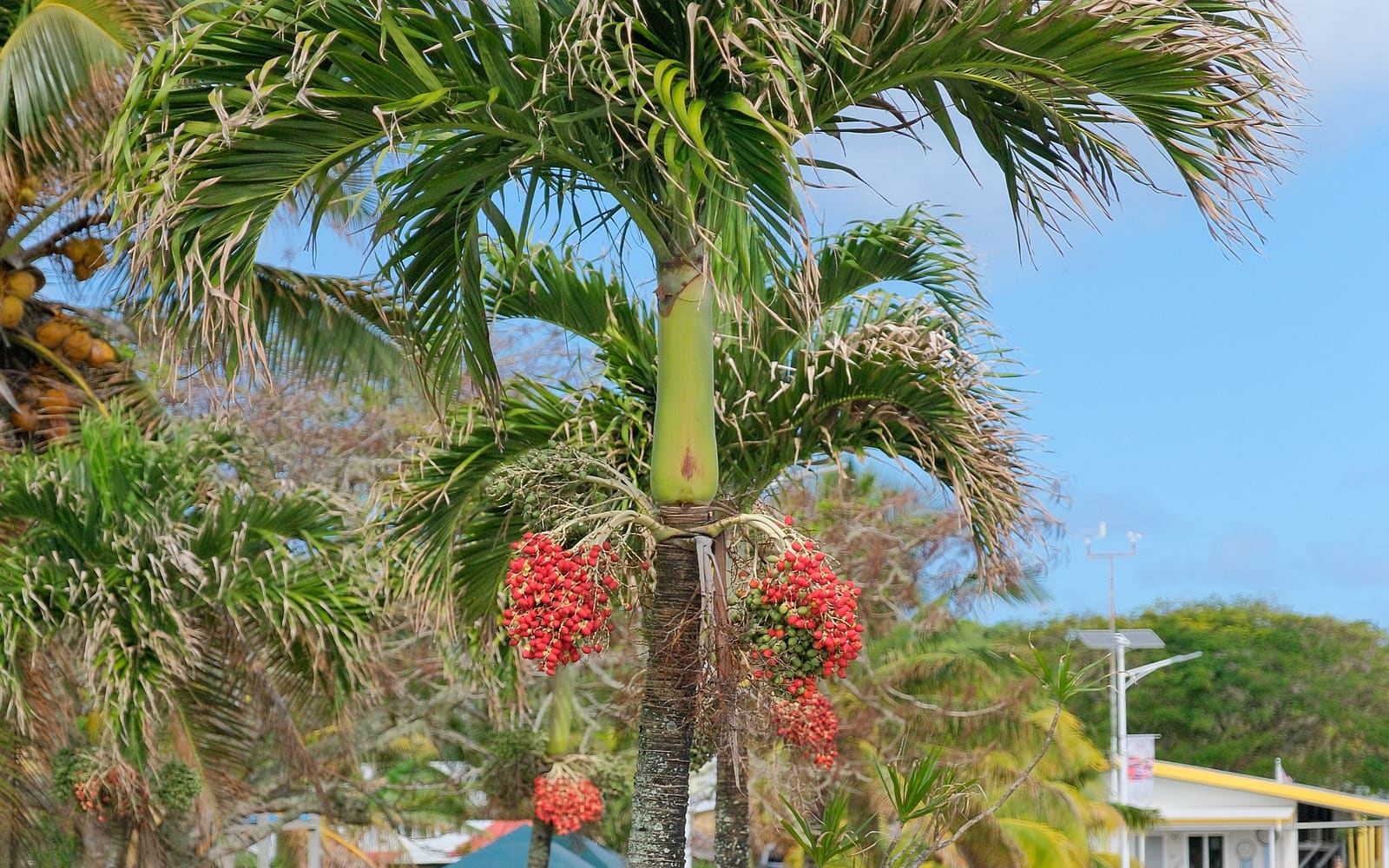
Photo by Pseudopanax at English Wikipedia on Wikimedia Commons

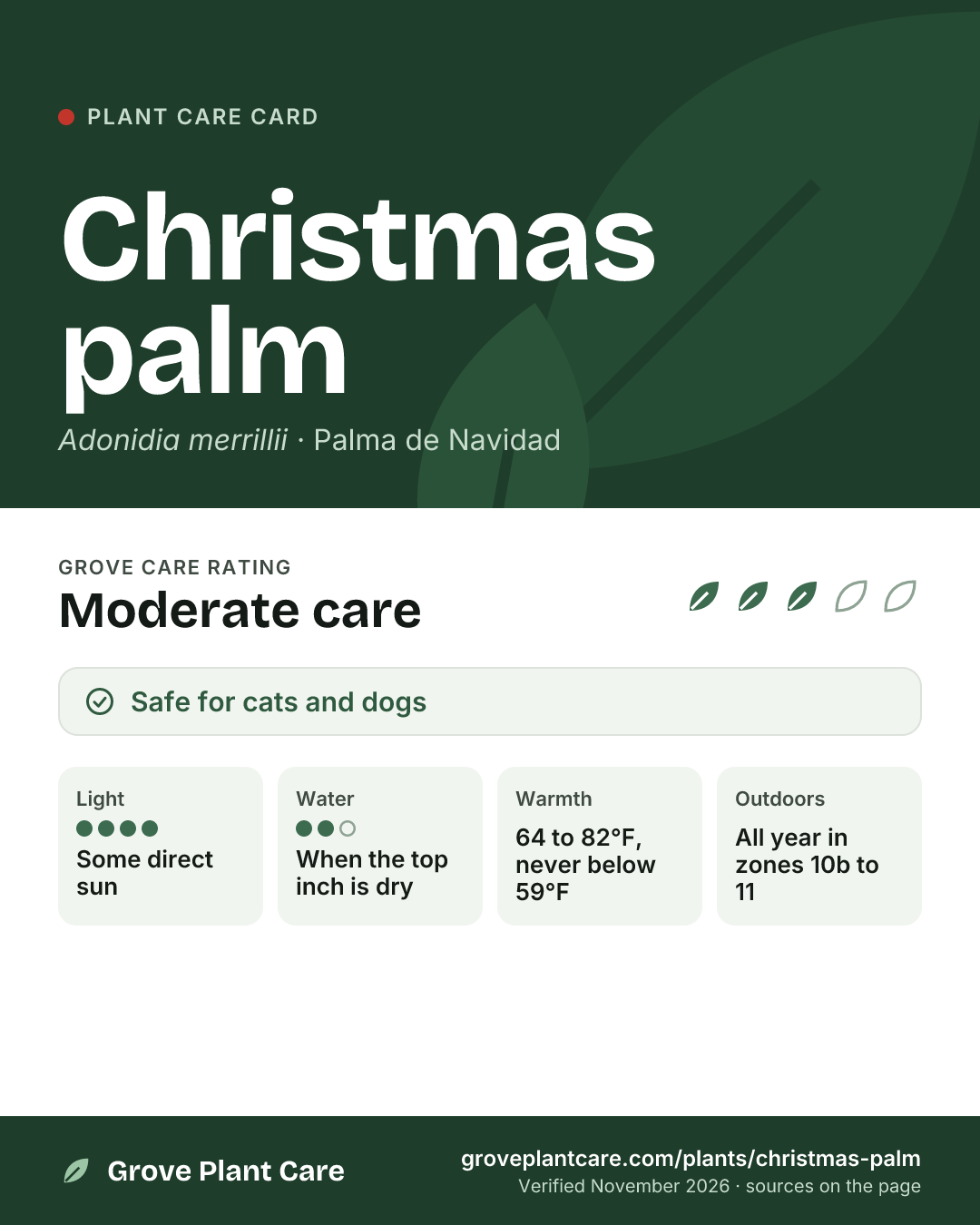
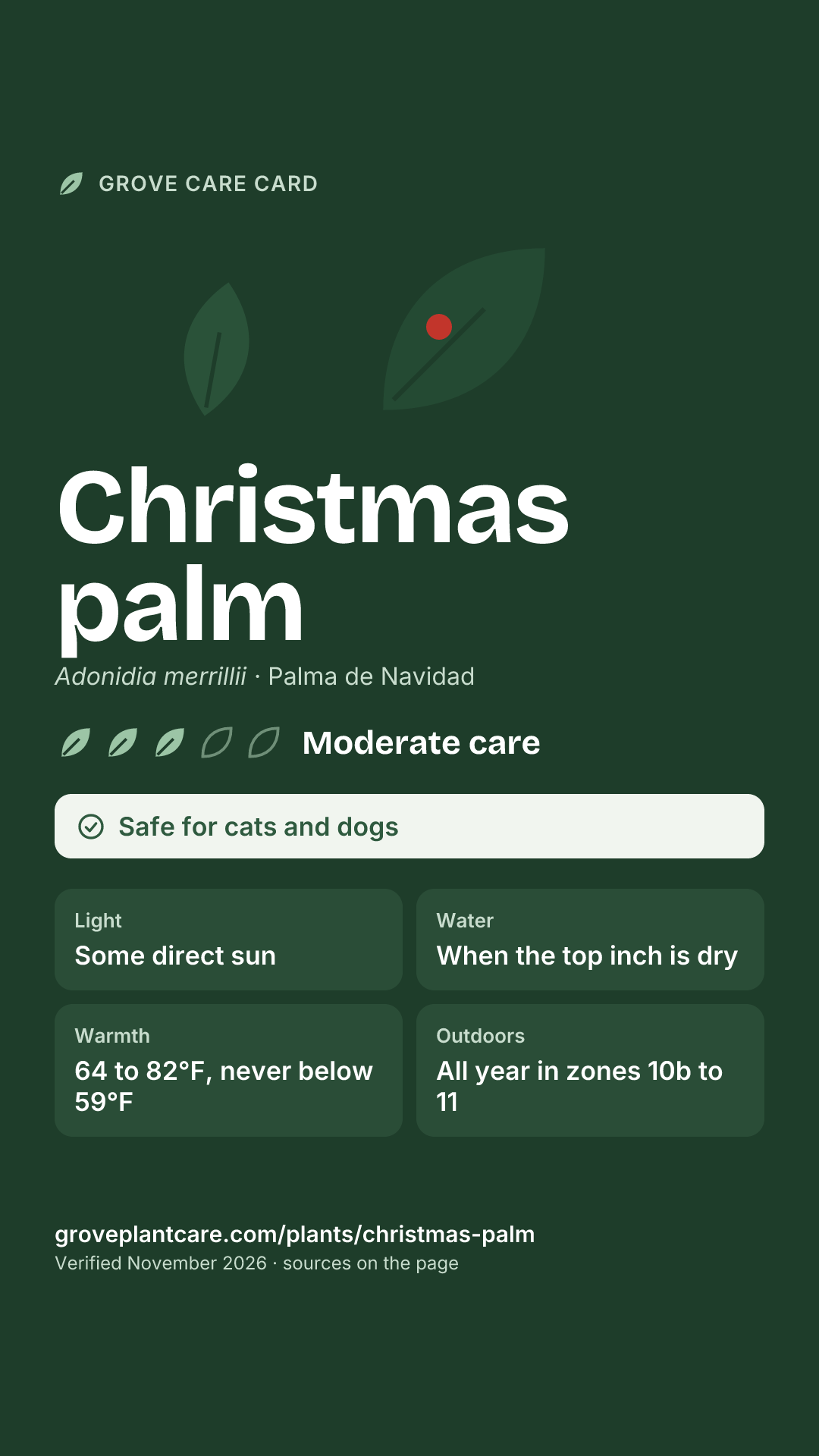
The Christmas palm is a small, tidy palm that wants full sun, water when the top inch of soil dries, and no frost. Outdoors it lives all year only where winter nights stay above about 30°F (−1°C); elsewhere it grows in a pot in your brightest window. The ASPCA lists it as non-toxic to cats, dogs and horses. It gets its name from clusters of red fruit that ripen around Christmas.
Non-toxic to cats, dogs and horses
No signs of poisoning listed. Any plant can still upset a pet’s stomach if it eats enough. Children: No source we checked lists it as poisonous to people.
Pet poison line: ASPCA (888) 426-4435
Good for: small yards and patios in frost-free places, winter color from red fruit, pet-friendly homes · Think twice if: you have no sunny window or yard, your winters freeze and you have nowhere bright to keep it, lethal yellowing is common in palms near you.
Needs at a glance
- Light4 of 4 · Some direct sunYour brightest window; outdoors, full sun or part shade
- Water2 of 3 · When the top inch is dryNever let the pot sit in water
- Humidity2 of 3 · Above averageThe RHS suggests misting it regularly
- Soil when pottedWell-drained mixNot fussy: loam or sandy mixes both work
Indoors: best at 64 to 82°F (18 to 28°C). Keep it above 59°F (15°C) and away from drafts and heat vents.
How the rating adds up
0 = easiest · 1 = moderate · 2 = hardest
- Missed waterings1 of 2 · ModerateWater when the top inch dries; drought tolerant only once settled in the ground
- Light flexibility2 of 2 · HardestWants full sun; indoors, only the brightest window will do
- Humidity1 of 2 · ModerateThe RHS suggests misting it regularly
- Pests and disease1 of 2 · ModerateNow and then mites, mealybugs, thrips or scale; lethal yellowing outdoors in Florida
- Sensitivity to change1 of 2 · ModerateVery frost sensitive; palms planted together compete
Growing outdoors
All year: USDA zones 10b to 11, where the coldest winter nights average 30°F (−1°C) or warmer.
Elsewhere: summer outside in full sun or part shade, eased in over a few days. Bring it in before nights drop below 59°F (15°C).
- Small accent or street tree where it never freezes
- Often planted 2 to 4 in one hole
- Container plant brought in for winter
Sources: NC State, RHS, UF/IFAS, Clemson, ASPCA, ASPCA plant list, Hawaii weed risk assessment, FISC, UF/IFAS Assessment, Hawaii noxious weed list, Rojas-Sandoval and Acevedo-Rodríguez and GISD. Full list below.
Verified · How we rate plants
Is a Christmas palm safe for cats and dogs?
Yes. The ASPCA lists the Christmas palm, also called Manila palm, as non-toxic to cats, dogs and horses, and NC State marks it non-toxic for all three. Any plant can still upset a pet’s stomach if it eats enough, so call your vet or the ASPCA Animal Poison Control Center at (888) 426-4435 if your pet seems unwell after chewing it. No source we checked lists it as poisonous to people. If a child eats some and seems unwell, call Poison Help at 1-800-222-1222.
ASPCA, NC State, ASPCA plant list, Hawaii weed risk assessment
Christmas palm, Manila palm or royal palm: which is which?
Christmas palm and Manila palm are the same plant, Adonidia merrillii; older tags call it Veitchia merrillii. NC State and the ASPCA also list the name dwarf royal palm, which makes it sound like a small royal palm. Royal palms belong to a different genus, Roystonea. The Christmas palm takes its name from its fruit, which turns bright red around Christmas, so it is a palm, never a Christmas tree you decorate. Look for one smooth gray trunk, a green crownshaft at the top and arching feather leaves.
How cold can a Christmas palm get?
UF/IFAS says it is cold hardy down to about 30°F (−1°C), which puts it in USDA zones 10b to 11, and NC State calls it highly sensitive to frost. It can live outdoors all year only where it never freezes hard, and UF/IFAS notes its range has moved north into Central Florida. In the ground it grows quickly to about 6 feet, then slowly, reaching up to 20 or 25 feet with a canopy 5 to 8 feet wide. It takes some salt spray and drops its old leaves on its own. As of November 2026, no official invasive list names it: UF/IFAS rates it no problem in Florida, and Hawaii’s weed risk assessment rates it low risk.
UF/IFAS, NC State, Hawaii weed risk assessment, UF/IFAS Assessment, FISC, Hawaii noxious weed list
Can a Christmas palm grow indoors?
Yes, if you have a bright spot. The RHS grows it indoors in bright, filtered light at 64 to 82°F (18 to 28°C), never below 59°F (15°C), and suggests misting it regularly. NC State lists it as a large houseplant, and the RHS says it reaches about 8 to 13 feet indoors over time. If it summers outside, move it out slowly so the fronds get used to the sun, and bring it back in before nights drop to 59°F (15°C). Keep it away from drafty doors and heater vents.
How often should I water a Christmas palm?
Water when the top inch of soil is dry, then let the extra drain away. The RHS says it dislikes being waterlogged, and NC State says it needs regular watering. UF/IFAS calls it fairly drought tolerant, but that is for palms settled in the ground; a pot dries out much faster.
Does a Christmas palm need full sun?
It grows best in full sun, and NC State and UF/IFAS say it puts up with some shade outdoors. Indoors, give it your brightest window: the RHS suggests bright, filtered light from an east, south or west window. In the northern hemisphere the sunniest windows usually face south; in the southern hemisphere, north.
Why is my Christmas palm turning yellow?
In a pot, check the basics first: soggy soil, too little light or a cold draft. Small, deformed new leaves that grow sideways point to a lack of boron, which UF/IFAS sees now and then. Outdoors in Florida, watch for lethal yellowing, a disease that wilts and discolors the fronds until the bud dies; the oldest leaf often bends in the middle. UF/IFAS says there is no cure, though trunk injections of an antibiotic can prevent it, and they must continue for the palm’s whole life. Indoors, the RHS lists aphids, red spider mite and mealybugs as occasional pests.
When does a Christmas palm get its red fruit?
Small cream flowers open below the leaves in summer and draw bees. The fruit follows in clusters, pale green at first, turning bright red in late fall and winter, which is where the name comes from. NC State gives each fruit as about 1 inch long and UF/IFAS as about 1.5 inches. If fallen fruit would make a mess on a patio, UF/IFAS suggests cutting off the flower stalks before the fruit forms.
Why are there three Christmas palms in one pot?
Each Christmas palm has a single trunk, so growers often pot two to four together to look like a clump. NC State says three per pot is common. UF/IFAS warns that in a group one palm may end up shorter, look starved or die, from competition or from sitting a little deeper. It can’t be divided like a clumping palm. New plants come from seed only: the RHS soaks the seed before planting, and NC State says seedlings sprout and grow quickly.
How Grove helps
Grove sets a watering check based on how dry the soil is, so the Christmas palm gets water once the top inch dries. Before nights cool down, you can add bringing the pot inside as a task and assign it, so whoever is home moves it before the cold.
Sources
- NC State Extension Gardener Plant Toolbox: Adonidia merrillii
- RHS: Adonidia merrillii (Manila palm)
- UF/IFAS EDIS ENH-815: Adonidia merrillii, Christmas Palm (T. K. Broschat; rev. 2024)
- UF/IFAS Gardening Solutions: Christmas Palm
- Clemson Cooperative Extension HGIC 1508: Indoor Palms
- ASPCA Animal Poison Control: Christmas Palm
- ASPCA Animal Poison Control: Toxic and Non-Toxic Plants
- Hawaii-Pacific Weed Risk Assessment (Plant Pono): Adonidia merrillii (as Veitchia merrillii), low risk
- Florida Invasive Species Council: Invasive Plant List
- UF/IFAS Assessment of Non-Native Plants in Florida: Adonidia merrillii
- Hawaii Administrative Rules 4-68: plant species designated as noxious weeds (Hawaii Department of Agriculture)
- J. Rojas-Sandoval and P. Acevedo-Rodríguez (2015), Naturalization and invasion of alien plants in Puerto Rico and the Virgin Islands, Biological Invasions 17 (supplementary list)
- IUCN Global Invasive Species Database: Adonidia merrillii (no entry)
- Kew WCVP data release (2026-06-04 file), plant_name_id 3315: Adonidia merrillii
- CONABIO EncicloVida: Roystonea regia (palma botella)