
Plant care card
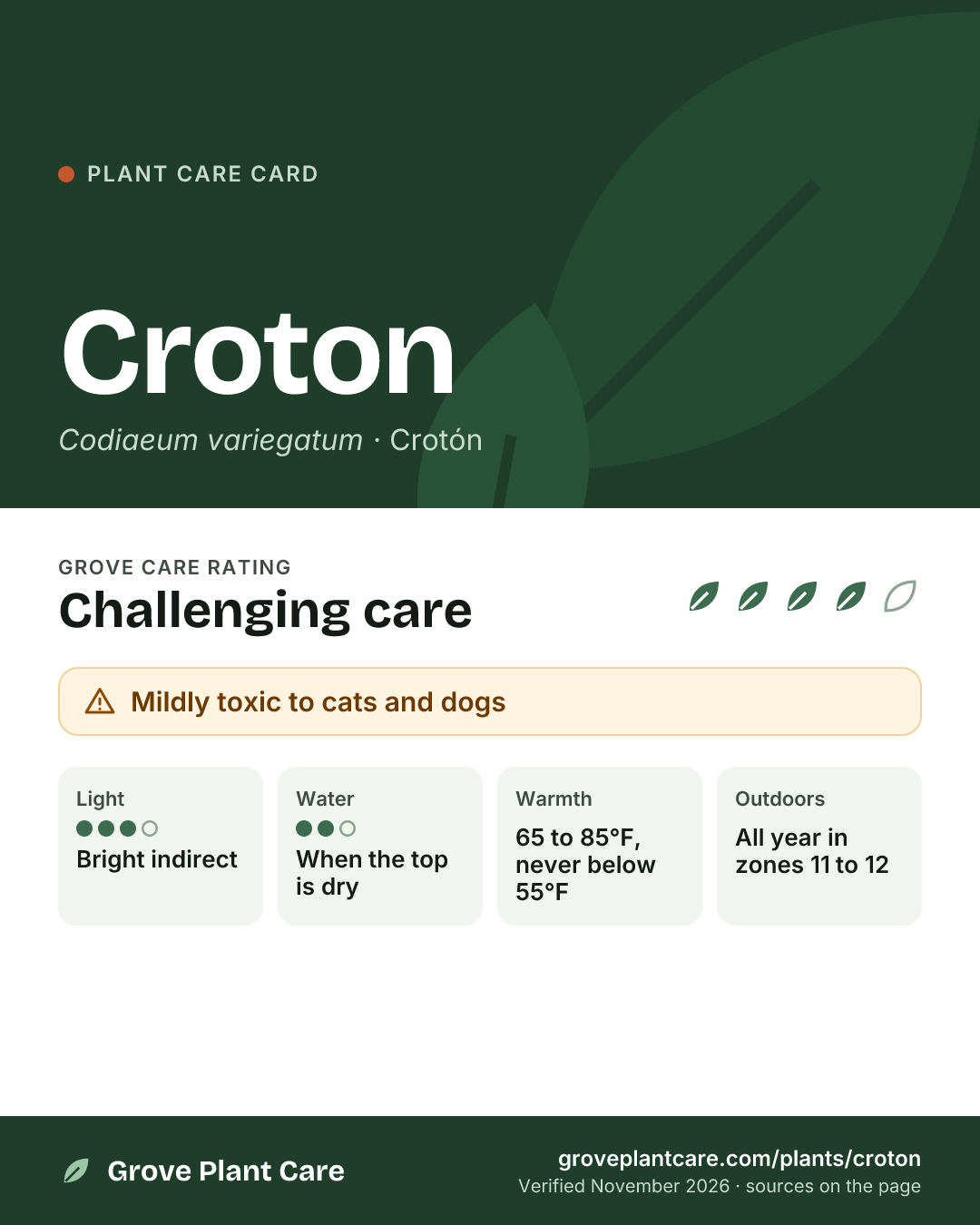
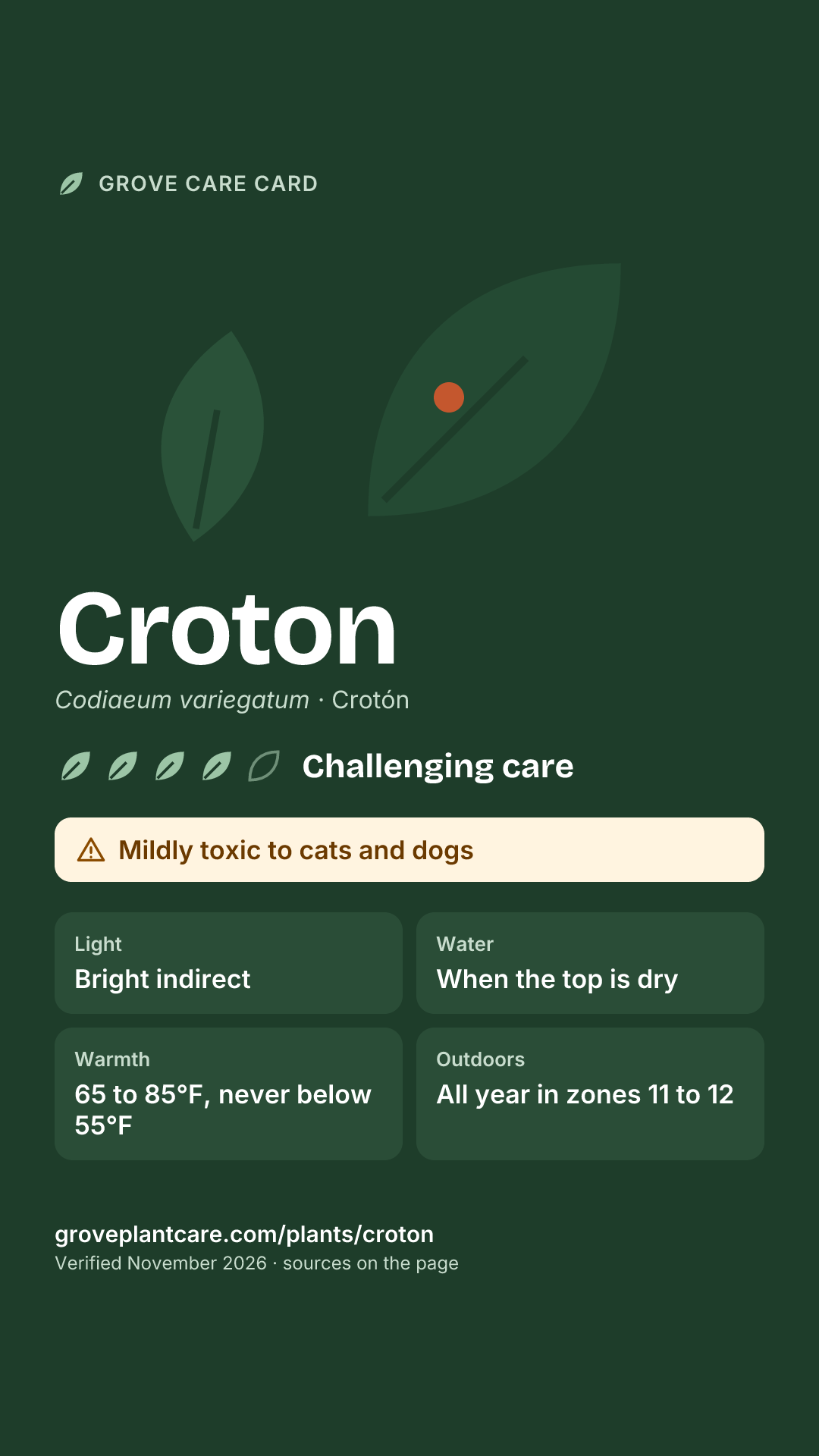
Croton
Codiaeum variegatum · Crotón
Also called garden croton or Joseph's coat
Photo by David E Mead on Wikimedia Commons, CC0 1.0

Croton is a tropical shrub grown for its painted leaves in red, orange, yellow and green. It keeps those colors in bright light, steady warmth, evenly moist soil and fairly humid air. It's touchy about change: drafts, cold and even a move across the room can make it drop leaves. Spider mites love it too. The sap irritates skin, and RHS and UF/IFAS say to keep pets and kids from chewing it.
Mildly toxic to cats and dogs (RHS, UF/IFAS)
Drooling, vomiting or diarrhea; the sap can irritate skin. The ASPCA list leaves it out; RHS and UF/IFAS say to keep pets from chewing it. Children: low severity. NC State rates it low severity; the sap irritates skin and eyes, and eating it can cause nausea, vomiting and diarrhea.
Pet poison line: ASPCA (888) 426-4435
Good for: bright, warm rooms, bold leaf color all year, summer containers on a patio · Think twice if: your brightest spot is still fairly dim, it would sit near a drafty door or get moved around often, pets or small children chew on plants.
Needs at a glance
- Light3 of 4 · Bright indirectThe brightest spot you have; a little gentle sun helps the color
- Water2 of 3 · Let the top dryWater when the top ½ to 1 inch is dry; never let it dry out fully
- Humidity2 of 3 · Above averageAround 40 to 80%; a pebble tray helps in dry rooms
- Soil when pottedRich, well-drained mixGood potting mix with grit or perlite, in a pot with drain holes
Indoors: best at 65 to 85°F (18 to 29°C). Keep it above 55°F (13°C) and away from drafts and heat vents.
How the rating adds up
0 = easiest · 1 = moderate · 2 = hardest
- Missed waterings2 of 2 · HardestWants steady moisture; drops leaves if it dries out
- Light flexibility2 of 2 · HardestNeeds bright light; loses color and leaves in less
- Humidity1 of 2 · ModerateLikes moderate to high humidity
- Pests and disease1 of 2 · ModerateSpider mites most often; also mealybugs and scale
- Sensitivity to change2 of 2 · HardestDrops leaves after drafts, temperature swings or a move
Growing outdoors
All year: USDA zones 11 to 12, where the coldest winter nights average 40°F (4°C) or warmer.
Elsewhere: summer outside in bright shade or part sun; ease it into more sun slowly. Bring it in when nights reach 55 to 60°F (13 to 16°C).
- Houseplants and patio containers
- Hedges, accents and foundation shrubs in frost-free climates
- A summer accent planting where winters are cold
Sources: NC State, Wisconsin Extension, Colorado State, Texas Tech, UF/IFAS, RHS, Pet Poison Helpline, ASPCA plant list, USDA zone map, FISC, UF/IFAS Assessment, Plant Pono HPWRA and GISD. Full list below.
Verified · How we rate plants
Is croton poisonous to cats and dogs?
It's mildly toxic, so keep it out of reach. The ASPCA plant list doesn't include croton, but the RHS says every part is poisonous and UF/IFAS says to keep pets from nibbling the leaves. The Pet Poison Helpline says a pet that chews it usually gets mild mouth and stomach upset: drooling, vomiting or diarrhea. Sap from the leaves, stems or roots can also irritate skin. If a pet chews it and seems unwell, call your vet or the ASPCA Animal Poison Control Center at (888) 426-4435 (a fee may apply).
Is croton sap dangerous to people?
It's an irritant, so handle it with care. NC State rates croton low severity and says it's toxic only if a lot is eaten, when it can cause nausea, vomiting and diarrhea. The sap can make skin itch and swell. Most reactions are brief, but repeated contact can cause an allergic rash. The RHS says it irritates eyes too, so wear gloves when you prune and keep your hands away from your face. The sap also stains fabric for good. If a child eats some, call Poison Help at 1-800-222-1222.
Why is my croton dropping leaves?
Usually because something changed. Wisconsin Extension names drafts, sudden temperature swings, cold below about 50°F (10°C) and quick changes in its surroundings, which is why a new croton often sheds leaves on the way home from the store. The RHS adds soil that dried out, dry air and long cool spells below about 55°F (13°C). Too little light drops the lower leaves, NC State says. Too much water causes trouble too. Find a bright, warm spot away from doors and vents, keep the soil evenly moist and then leave it alone. New leaves come once it settles.
How much light does a croton need?
Lots: light is what keeps the colors. Wisconsin Extension and the RHS call for bright, indirect light, and NC State says some direct sun gives the best color. In too little light, new leaves turn mostly green and the lower ones drop. Hot summer sun through glass can scorch it, though, and Wisconsin notes too much direct sun makes leaves look gray and dull. UF/IFAS suggests 'Petra' for indoors because it holds its color in lower light. New leaves start out green and color up as they age, so give a new leaf time.
How often should I water a croton?
Often enough that the soil never dries out. Wisconsin Extension says to water when the top ½ to 1 inch feels dry, and Colorado State says to keep the mix evenly moist. UF/IFAS notes that new leaves wilt when it's thirsty. Never let the pot sit in water: soggy soil rots the roots, the RHS warns. Water less in winter, when growth slows. Crotons like humid air too, about 40 to 80% per Colorado State. In a dry room, set the pot on a tray of damp pebbles. The RHS prefers rainwater at room temperature over hard tap water.
Is a croton the same plant as Croton?
No, and the name trips people up. Linnaeus named this plant Croton variegatus in 1753, and botanists moved it to its own genus, Codiaeum, in 1824. The common name stuck. Croton is still the name of a separate, much larger genus of spurges (Euphorbiaceae), the same group as the garden croton: Kew lists over 1,100 species, including Croton tiglium. Those plants need their own advice. Another name to watch is Joseph's coat. NC State uses it for croton, but the ASPCA uses it for bloodleaf (Iresine herbstii), a different plant. Check the botanical name on the label.
How do I keep spider mites off my croton?
Watch for them, because crotons draw them. NC State says spider mites are the reason crotons in offices are often only short-term plants. Look under the leaves for fine webbing and tiny specks, especially in dry, warm rooms. UF/IFAS suggests rinsing indoor plants outside in the shade, which knocks mites off and cleans the dust away. Mealybugs and scale show up too, Wisconsin Extension says. Disease is rare, so most problems come from pests, water or cold.
NC State, UF/IFAS, Wisconsin Extension, Texas Tech, Colorado State
Can croton grow outdoors?
Yes, where it never gets cold. NC State and Wisconsin Extension say it's winter-hardy only in USDA zones 11 and 12. There it makes a colorful hedge, accent or foundation shrub. UF/IFAS says frost damages it, though it often grows back. Elsewhere, it can spend the warm months outside in bright shade or part sun, eased into more sun slowly so it doesn't burn. NC State and Wisconsin give 50°F (10°C) as the limit, so bring it in earlier, once nights reach 55 to 60°F (13 to 16°C). It isn't on Florida's 2026 invasive plant lists or the Global Invasive Species Database, and UF/IFAS and the Hawaii weed risk assessment rate it low risk.
NC State, Wisconsin Extension, UF/IFAS, FISC, UF/IFAS Assessment, Plant Pono HPWRA, GISD
How do I propagate or prune a croton?
Take stem cuttings 3 to 6 inches long in summer, wearing gloves. UF/IFAS suggests 3 to 5 leaves per cutting, rooting hormone and a moist, never soggy mix; roots form in under a month at 70 to 80°F (21 to 27°C). Colorado State says you can root them in water first. The RHS dips the cut ends in powdered charcoal to slow the sap. Air layering in spring works for larger stems. Plants from seed don't look like the parent, so cultivars are always grown from cuttings. To fix a leggy plant, Wisconsin Extension suggests a hard prune in early spring.
How Grove helps
Grove sets a watering check based on how dry the soil is, so a croton gets water before it dries out. You can add a look under the leaves for spider mites as a task and assign it to whoever is home that week.
Sources
- NC State Extension Gardener Plant Toolbox: Codiaeum variegatum
- University of Wisconsin-Madison Extension, Wisconsin Horticulture: Croton, Codiaeum variegatum (S. Mahr; rev. 2025)
- Colorado State University Extension, PlantTalk Colorado 1346: Croton (Codiaeum variegatum)
- Texas Tech University Plant Database: Croton, Joseph's Coat (Codiaeum variegatum)
- UF/IFAS Gardening Solutions: Crotons
- Royal Horticultural Society: Codiaeum growing guide
- Pet Poison Helpline: Croton
- ASPCA Animal Poison Control: Toxic and Non-Toxic Plants
- USDA ARS Plant Hardiness Zone Map (2023)
- Florida Invasive Species Council: Plant List and Watch List (April 2026; no Codiaeum listed)
- UF/IFAS Assessment of Non-Native Plants: Codiaeum variegatum
- Hawaii-Pacific Weed Risk Assessment (Plant Pono): Codiaeum variegatum, low risk
- IUCN Global Invasive Species Database: Codiaeum variegatum (no entry)
- Royal Horticultural Society: Codiaeum variegatum var. pictum (garden croton)
- Kew WCVP data release (2026-06-04 file), plant_name_id 44790
- Kew WCVP data release (2026-06-04 file), plant_name_id 49179 (genus Croton)