Plant care card
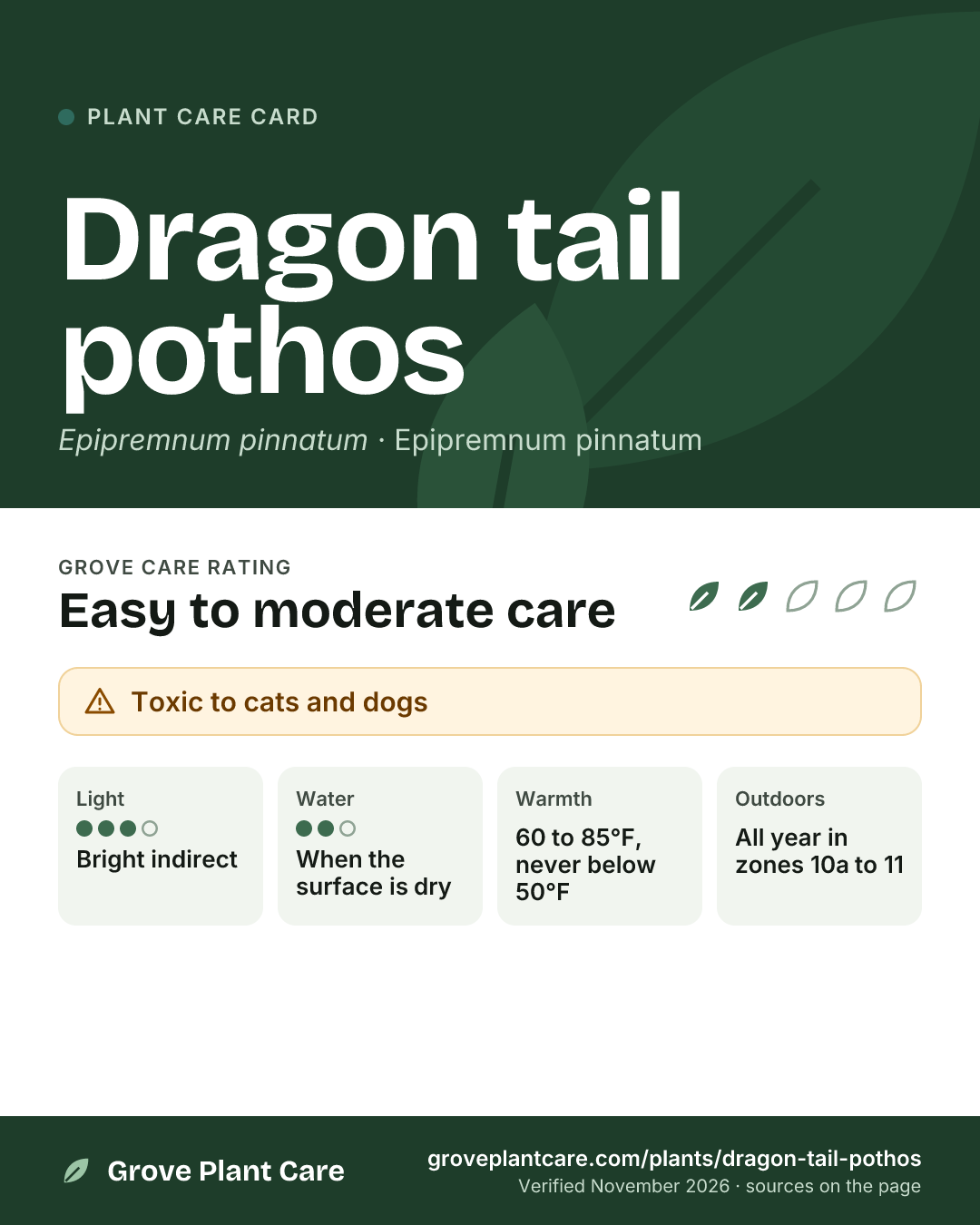
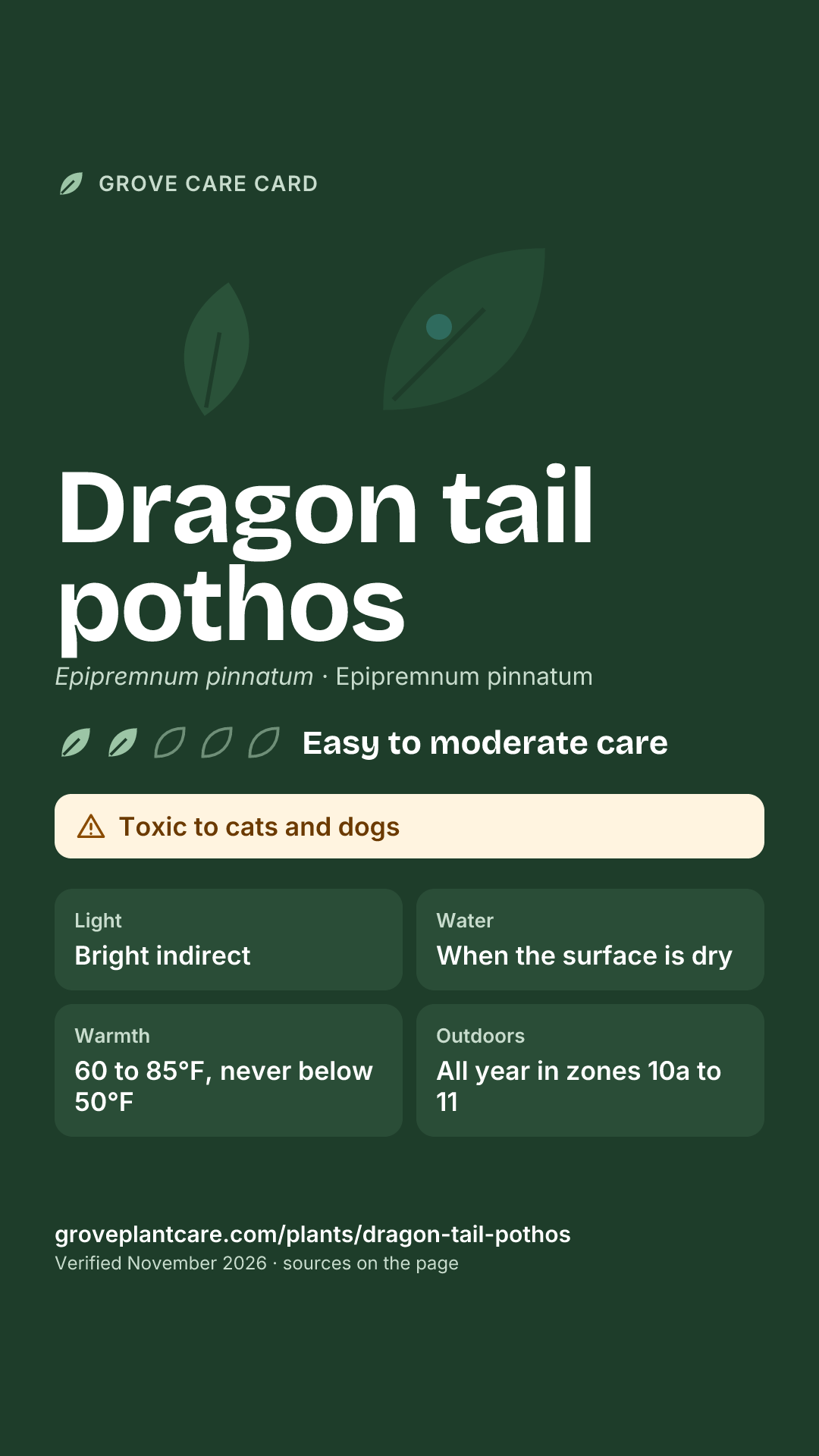
Dragon tail pothos
Epipremnum pinnatum · Epipremnum pinnatum
Also called dragon-tail plant, centipede tongavine, Cebu Blue pothos or taro vine
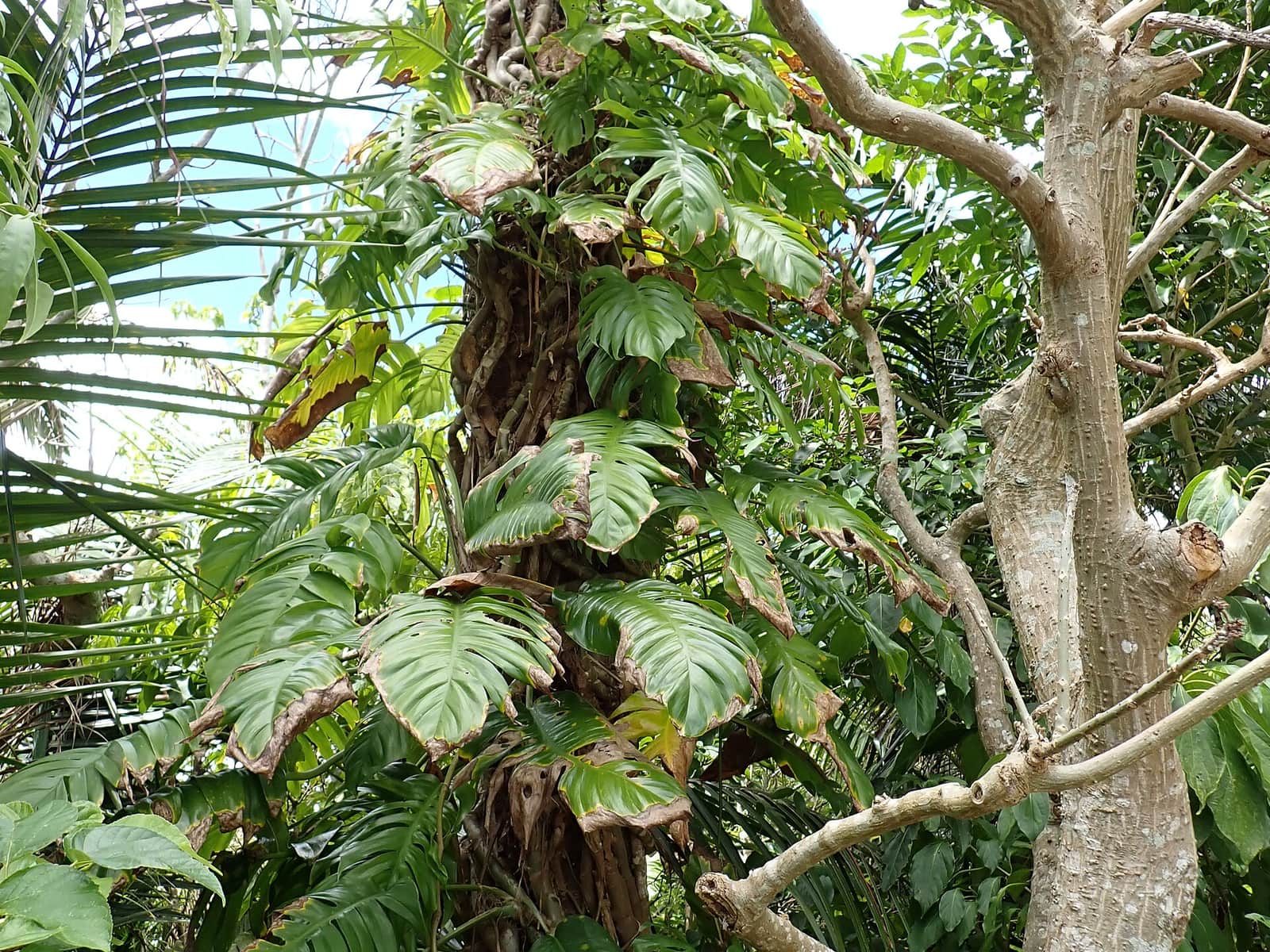
Photo by M108t on Wikimedia Commons, CC BY 4.0

Dragon tail pothos is a close cousin of golden pothos, and its care is much the same: bright, indirect light, water when the top of the mix is dry, and no soggy soil. The difference is the leaves. Give it a moss pole to climb and the grown-up leaves get big and split into deep lobes with small holes, which golden pothos leaves never do. It's toxic to cats and dogs if chewed, and in frost-free places it escapes, so keep it in a pot.
Toxic to cats and dogs · Moderate
Mouth and throat irritation, drooling, vomiting and trouble swallowing. The ASPCA lists golden pothos, its close relative, as toxic; this species has no ASPCA entry of its own. NC State rates dragon tail medium severity; the sap can irritate skin. Children: moderate severity. NC State rates it medium severity; chewing irritates the mouth and throat, and the sap can irritate skin.
Pet poison line: ASPCA (888) 426-4435
Good for: a moss pole in a bright room, shelves and hanging baskets, big split leaves on a climbing vine · Think twice if: pets or small children chew plants, you want to plant it outdoors where it never freezes.
Needs at a glance
- Light3 of 4 · Bright indirectBright light with no hot direct sun; low light weakens growth
- Water2 of 3 · Let the top dryWater when the top of the mix is dry; never let it sit soggy
- Humidity2 of 3 · Above averageHome air is fine; a humidifier helps in dry rooms
- Soil when pottedAiry, well-drained mixA rich, airy potting mix that drains freely, in a pot with drainage holes
Indoors: best at 60 to 85°F (16 to 29°C). Keep it above 50°F (10°C) and away from drafts and heat vents.
How the rating adds up
0 = easiest · 1 = moderate · 2 = hardest
- Missed waterings1 of 2 · ModerateWater when the top of the mix is dry; NC State says keep it lightly moist, never soggy
- Light flexibility1 of 2 · ModerateBright, indirect light or partial shade; low light weakens growth
- Humidity1 of 2 · ModerateCopes with home air, but prefers 50 to 70%
- Pests and disease1 of 2 · ModerateMealybugs, scale, thrips and spider mites; root rot if overwatered
- Sensitivity to change0 of 2 · EasiestTakes moves and repotting well; keep it out of cold drafts
Growing outdoors
All year: USDA zones 10a to 11, where the coldest winter nights average 30°F (−1°C) or warmer.
Elsewhere: summer outside in light to heavy shade. Bring it in when nights reach 50 to 60°F (10 to 16°C).
Invasive in: Puerto Rico, Mexico. UF/IFAS rates it a high invasion risk in all of Florida and advises against planting it. It runs wild in Puerto Rico, and Mexico lists it as an invasive exotic. Keep it in a pot. Lists checked .
- Containers
- Hanging baskets
- A moss pole or stake
Sources: NC State, Clemson, RHS, ASPCA, ASPCA plant list, USDA, UF/IFAS Assessment, GISD, Rojas-Sandoval and Acevedo-Rodríguez, Smithsonian, CONABIO, FISC, Hawaii noxious weed list and Cal-IPC. Full list below.
Verified · How we rate plants
Dragon tail pothos vs golden pothos: what is the difference?
They are two species in the same genus. Dragon tail is Epipremnum pinnatum and golden pothos is E. aureum. Young plants look alike, with smooth, arrow-shaped leaves, but NC State says mature dragon tail leaves turn thick and leathery and split into deep lobes with holes, and Clemson says it has more of those openings than golden pothos. The two were long mixed up: golden pothos was once sold as E. pinnatum 'Aureum' until botanists separated it, and USDA PLANTS and the RHS still file it under E. pinnatum. Kew accepts both species. They also come from different places, since golden pothos is native only to the island of Mo'orea in French Polynesia, while dragon tail grows wild from India to Australia. Clemson says their care is similar.
Is Cebu Blue pothos the same as dragon tail?
Same species, different form. NC State and Clemson both list 'Cebu Blue' as a cultivar of Epipremnum pinnatum, with slender, pointed, silvery blue-green leaves. NC State says it trails 5 to 6 feet and keeps its small young leaves unless it climbs a stake or moss pole, where the leaves mature and split. Other cultivars include 'Baltic Blue', 'Marble King', 'Skeleton Key' and the cream-splashed 'Albo-Variegata'. Dragon tail is a common name for the species as a whole, so all of these share one care plan.
How do I get split leaves on a dragon tail pothos?
Let it climb. Clemson says a moss pole or wooden rod may be needed for the plant to grow large enough to make its split leaves, and NC State suggests a wooden or bamboo stake or a sphagnum moss pole. A vine that only trails keeps its smaller young leaves. Bright, indirect light helps too, since the RHS says too little light weakens growth. Be patient: NC State says mature leaves can reach 12 to 20 inches, and a plant only makes them once it has climbed for a while.
How often should I water a dragon tail pothos?
Water when the top of the mix is dry, then soak it until water runs out of the drainage holes. Clemson says to let the soil dry between waterings, and the RHS says to water when the mix is nearly dry. NC State's dragon tail page asks for soil that stays moist but drains well, so don't let it go bone dry for long. What all three agree on is that soggy soil causes root rot. Use room-temperature water.
How much light does a dragon tail pothos need?
Bright, indirect light. NC State says it prefers bright, indirect sun and lists partial shade, and the RHS suggests a window with a sheer curtain, since direct summer sun can scorch the leaves. Too little light weakens growth, and Clemson notes that low light fades variegated kinds such as 'Albo-Variegata'. Clemson also says 'Skeleton Key' needs less light than the other dragon tail cultivars.
Is dragon tail pothos toxic to cats and dogs?
Yes. NC State lists Epipremnum pinnatum as poisonous to cats, dogs and people, with medium severity. Its leaves and stems hold calcium oxalate crystals that cause mouth and throat pain, drooling, vomiting and trouble swallowing, and NC State lists trouble breathing too. The ASPCA doesn't list this species by name, but it lists its close relative golden pothos as toxic to cats and dogs, and Clemson calls the whole genus mildly toxic. The RHS says the sap can irritate skin, so wear gloves when you cut it. Keep it out of reach. If a pet eats some and seems unwell, call your vet or the ASPCA Animal Poison Control Center at (888) 426-4435. If a child eats some, call Poison Help at 1-800-222-1222.
Why are my dragon tail pothos leaves yellow or brown?
Check the soil first. Clemson says yellow leaves usually mean too much water or too little fertilizer, and NC State says overwatering leads to root rot and fungal or bacterial trouble. Crispy brown tips and edges point to dry air or harsh light, per Clemson and the RHS. Keep it away from heating and cooling vents and cold windows, which Clemson says dry out the leaves. Then look under the leaves for mealybugs, scale, thrips and spider mites, which NC State lists as its pests.
How do I propagate and repot a dragon tail pothos?
Cut a piece of vine with at least one node and root it in water or moist mix, as Clemson describes for every Epipremnum. The RHS adds that you can pin a trailing stem onto a pot of mix so it roots at a leaf joint. Repot in spring when roots crowd the pot or poke out of the drainage holes, and move up just one size. NC State says that is about every 2 to 3 years and suggests pruning in spring or early summer.
Can dragon tail pothos grow outdoors, and is it invasive?
Only where it never freezes, and even there it's safest in a pot. NC State puts it in USDA zones 10a to 11, where winter nights average 30°F (−1°C) or warmer. The UF/IFAS Assessment rates Epipremnum pinnatum a high invasion risk in all of Florida and doesn't recommend planting it. The Global Invasive Species Database records it as an alien in Puerto Rico and on many Pacific islands, a peer-reviewed study counts it among Puerto Rico's invasive plants, and Mexico's CONABIO lists it as an invasive exotic. Elsewhere it can spend summer outside in shade: move it out once nights stay above 60°F (16°C) and bring it in before they drop to 50°F (10°C). Bag trimmings for the trash, since bits of stem root easily.
NC State, USDA, UF/IFAS Assessment, GISD, Rojas-Sandoval and Acevedo-Rodríguez, CONABIO, Clemson
How Grove helps
Grove turns watering into a check of the soil, so your dragon tail gets water when the top of the mix is dry and not on a fixed schedule. You can add misting the moss pole or checking for mealybugs as a repeating task and assign it to anyone who helps with the plants. If you're unsure whether you have golden pothos or dragon tail, a photo gives you a best guess that you can correct.
Sources
- NC State Extension Gardener Plant Toolbox: Epipremnum pinnatum (dragon-tail plant)
- Clemson Cooperative Extension HGIC: How to Grow Pothos Indoors
- RHS: How to grow epipremnum
- ASPCA Animal Poison Control: Golden Pothos
- ASPCA Animal Poison Control: Toxic and Non-Toxic Plants
- Clemson Cooperative Extension HGIC: Moving Plants Indoors and Outdoors
- USDA ARS Plant Hardiness Zone Map (2023)
- UF/IFAS Assessment of Non-Native Plants: Epipremnum pinnatum (high invasion risk, 2022)
- IUCN Global Invasive Species Database: Epipremnum pinnatum
- J. Rojas-Sandoval and P. Acevedo-Rodríguez (2015), Naturalization and invasion of alien plants in Puerto Rico and the Virgin Islands, Biological Invasions 17 (supplementary list)
- Smithsonian, Flora of the West Indies: Epipremnum pinnatum (exotic in Florida, Hispaniola and the Lesser Antilles)
- EncicloVida (CONABIO): Epipremnum pinnatum, exótica invasora en México
- Florida Invasive Species Council: Plant List, Category I and II (April 2026)
- Hawaii Administrative Rules 4-68: plant species designated as noxious weeds (Hawaii Department of Agriculture)
- California Invasive Plant Council (Cal-IPC): plant search, "epipremnum" (no listing)
- Kew WCVP data release (2026-06-04 file), plant_name_id 70510: Epipremnum pinnatum
- USDA PLANTS Database: Epipremnum pinnatum (symbol EPAU resolves here)
- Kew WCVP data release (2026-06-04 file), plant_name_id 70476: Epipremnum aureum