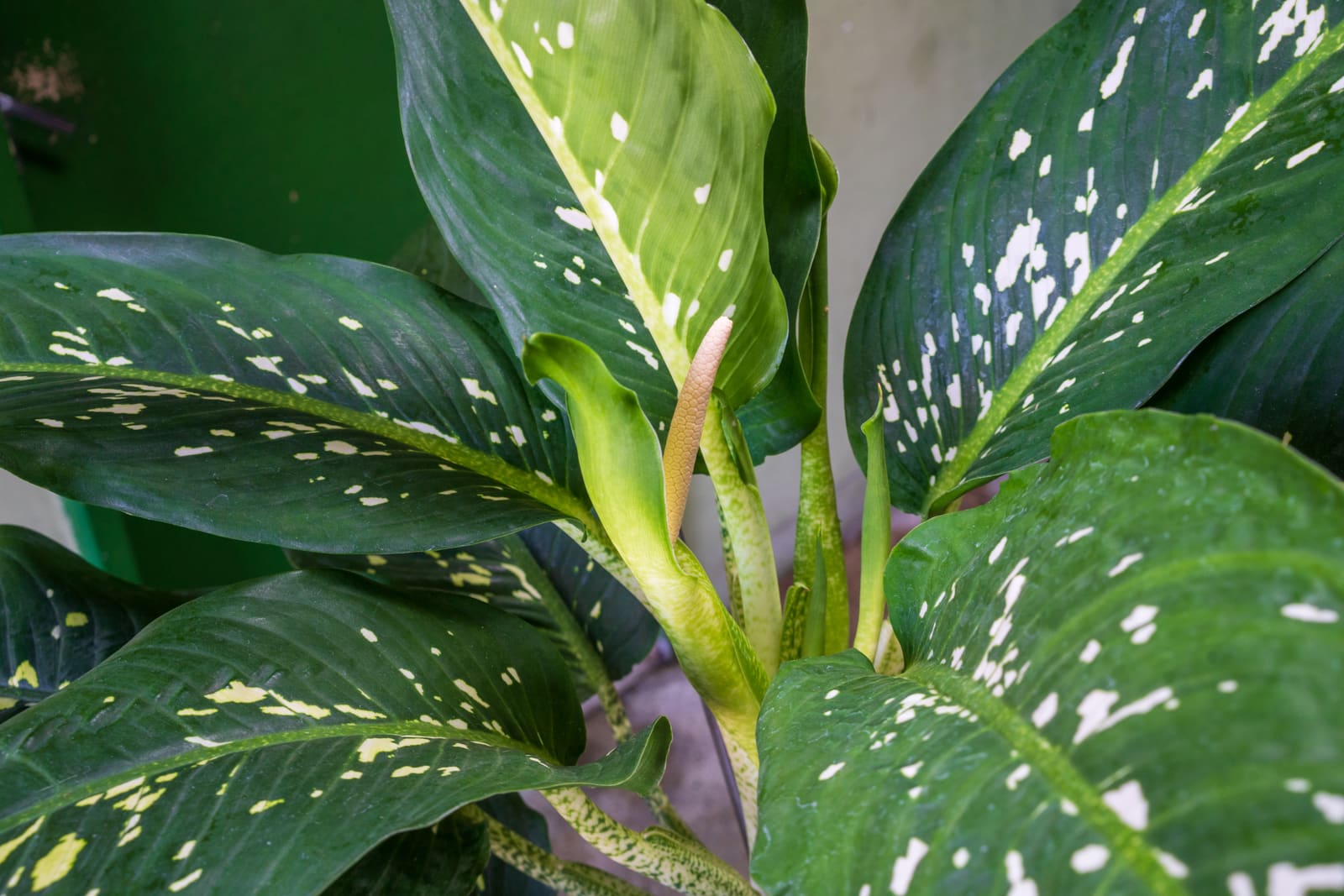
Plant care card
Dumb cane
Dieffenbachia seguine · Dieffenbachia
Also called dieffenbachia, dumbcane or spotted dumb cane
Photo by Alex Rio Brazil on Wikimedia Commons, CC0 1.0

Dumb cane (Dieffenbachia seguine) is a big-leaf houseplant with spotted or splashed leaves on thick, cane-like stems. Give it bright, filtered light, water when the top inch of soil is dry, and keep it above 55°F (13°C), away from drafts. Its sap is the catch: chewing any part burns and swells the mouth and throat, and NC State rates it highly toxic to cats, dogs, horses and children. Keep it well out of reach.
Toxic to cats, dogs and horses · Severe
Pet chewed it and is struggling to breathe or swallow? Call your vet right away.
Intense mouth burning and swelling, heavy drooling, vomiting and trouble swallowing. All parts hold calcium oxalate crystals. NC State rates the severity as high; the ASPCA says most cases aren’t life-threatening, and that breathing trouble needs a vet. Children: high severity. NC State rates it high severity; chewing can swell the mouth and throat, which needs medical care right away, and the sap can injure eyes and irritate skin.
Pet poison line: ASPCA (888) 426-4435
Good for: bold, patterned leaves in a bright room, a tall plant for a corner with filtered light · Think twice if: small children or pets chew plants, you garden where it can escape, such as Florida, Hawaii or Queensland, your home is cold or drafty in winter.
Needs at a glance
- Light3 of 4 · Bright indirectBright, filtered light; it puts up with shade but grows slowly and gets leggy. Keep it out of hot direct sun
- Water2 of 3 · Let the top dryWater well, then wait until the top inch (2.5 cm) is dry; less in winter
- Humidity2 of 3 · Above averageLikes humid air; dry air near heaters dries out the leaves
- Soil when pottedLoose, rich, well-drained mixPotting mix with plenty of organic matter that drains well; slow-draining soil rots the roots
Indoors: best at 60 to 75°F (16 to 24°C). Keep it above 55°F (13°C) and away from drafts and heat vents.
How the rating adds up
0 = easiest · 1 = moderate · 2 = hardest
- Missed waterings1 of 2 · ModerateWater well, then wait until the top inch (2.5 cm) is dry; soggy soil rots the roots and canes
- Light flexibility1 of 2 · ModerateGrows best in bright, indirect light; in shade it slows down and gets leggy
- Humidity1 of 2 · ModeratePrefers humid air; a pebble tray or grouping plants helps
- Pests and disease1 of 2 · ModerateMealybugs, spider mites, aphids and scale; root and stem rot when overwatered
- Sensitivity to change1 of 2 · ModerateCold, drafts and sudden temperature swings make it drop leaves
Growing outdoors
All year: USDA zones 10 to 11, where the coldest winter nights average 30°F (−1°C) or warmer.
Elsewhere: summer outside in partial shade or diffused sun; full sun yellows the leaves. Bring it in before nights drop below 60°F (16°C).
Invasive in: Queensland (Australia). Queensland lists it as an environmental weed. Florida's FISC list leaves it out, but UF/IFAS predicts it will turn invasive there and no longer recommends it, and Hawaii's weed risk assessment rates it high risk. Keep it in a pot and never dump cuttings outdoors. Lists checked .
- A potted plant on a shady patio in summer
Sources: NC State, Clemson HGIC, UConn Extension, Illinois Extension, UF/IFAS Gardening Solutions, RHS, UF/IFAS, ASPCA, ASPCA plant list, USDA zone map, Queensland Government, UF/IFAS Assessment, Hawaii weed risk assessment, FISC, Hawaii noxious weed list, GISD, Cal-IPC and Rojas-Sandoval and Acevedo-Rodríguez. Full list below.
Verified · How we rate plants
Is dumb cane toxic to cats and dogs?
Yes. The ASPCA lists dieffenbachia as toxic to cats and dogs, and NC State adds horses. The sap carries insoluble calcium oxalate crystals and an enzyme that cause intense burning of the mouth, tongue and lips, heavy drooling, vomiting and trouble swallowing. NC State rates the severity as high and says it can be fatal to pets and livestock. The ASPCA's poison center says most cases aren't life-threatening, though rarely the tongue and throat swell, and a pet with any trouble breathing needs a vet right away. Keep it where pets can't reach it. If a pet chews it, call your vet or the ASPCA Animal Poison Control Center at (888) 426-4435.
Is dumb cane dangerous for children?
It can be. NC State rates it high severity for children. Clemson says chewing a leaf numbs and burns the mouth and throat, can make it hard to speak, and can swell the throat enough to block breathing, which needs medical care right away. Sap in the eyes is painful and, per NC State and UConn, can damage the cornea; on skin it can cause a rash. Clemson advises against keeping it where small children play. Wear gloves when you cut it, and wash your hands after. If a child chews it, call Poison Help at 1-800-222-1222. For any trouble breathing, call 911.
NC State, Clemson HGIC, UConn Extension, UF/IFAS Gardening Solutions, Illinois Extension, RHS
Is it a dumb cane or a Chinese evergreen?
Look at the stem and the size. NC State says Chinese evergreen (Aglaonema) looks a lot like dumb cane, and the two are often mixed up. Dumb cane grows a stout, cane-like stem marked with leaf scars and reaches 3 to 8 feet, with leaves over 6 inches long. Chinese evergreen stays around 1 to 3 feet, and NC State's tip is to count its main side veins: 5 to 8. Both carry calcium oxalate crystals, but NC State rates dumb cane high severity and Chinese evergreen low. Old labels may say Dieffenbachia maculata, amoena or picta: Kew now treats all three as Dieffenbachia seguine.
How much light does dumb cane need?
Bright, filtered light. Clemson says it tolerates low light, but growth nearly stops, and UConn says too little light makes it leggy and drops its lower leaves. NC State and UF/IFAS say it puts up with shade. Keep it out of hot direct sun: UConn says full sun yellows the leaves. Clemson suggests bright filtered light from spring to fall, and a brighter spot with some sun in winter, when the light is weaker.
Clemson HGIC, UConn Extension, NC State, UF/IFAS Gardening Solutions
How often should I water dumb cane?
Water it well, then wait until the top inch (2.5 cm) of soil is dry, as NC State and Clemson both say. UConn says keep it moderately moist and never waterlogged. Illinois Extension warns that overwatering often rots the roots and the base of the canes, and Clemson says slow-draining soil plus frequent watering causes root rot. UF/IFAS adds that uneven watering browns the leaf tips. Water less in winter, as the RHS suggests.
NC State, Clemson HGIC, UConn Extension, Illinois Extension, UF/IFAS Gardening Solutions, RHS
Why are my dumb cane leaves turning yellow or falling off?
Start with the soil. UConn says yellow lower leaves plus a soft, rotting base mean overwatering. Lower leaves that fall from a leggy plant point to too little light. Sudden temperature changes and drafts also drop lower leaves, and UF/IFAS says cold makes the leaves droop and fall. Brown tips or edges come from too much fertilizer or short dry spells, per UConn. Some loss is normal: Clemson says lower leaves drop as the plant matures, leaving a bare cane.
What temperature and humidity does dumb cane need?
Warm rooms and humid air. Clemson and UF/IFAS give 60 to 75°F (16 to 24°C), and UF/IFAS says keep it above 55°F (13°C). UConn's floor is 50°F (10°C), and the RHS grows it above 15°C (59°F), so 55°F is a sensible middle. In UF/IFAS tests, a day at 35°F (2°C) hurt every cultivar and killed 'Tropic Honey' in 6 hours. NC State says it prefers high humidity, and UConn suggests a pebble tray or grouping plants. Keep it away from radiators and cold drafts.
Clemson HGIC, UF/IFAS Gardening Solutions, UConn Extension, RHS, UF/IFAS, NC State
How do I fix a leggy dumb cane, and how do I propagate it?
Cut it back. Clemson says to cut bare stems to about 6 inches; the plant sprouts again below the cut. Use the pieces to make new plants: root the top, or cut the cane into 2-inch (5 cm) sections with a bud, let them dry a day, then lay them on moist mix, as UConn and the RHS describe. Air layering works too. Spring or early summer is best, per Clemson. Wear gloves, since Illinois Extension warns the sap irritates cuts.
Can dumb cane grow outdoors, and is it invasive?
In frost-free places it can, but think twice. NC State lists USDA zones 10 to 11, and UF/IFAS tests show a day near freezing hurts it badly. Queensland, Australia, lists it as an environmental weed. Florida's FISC list leaves it out, but the UF/IFAS assessment predicts it will turn invasive there, and UF/IFAS no longer recommends it. Hawaii's weed risk assessment rates it high risk: it grows in deep shade and sprouts from dumped stem pieces. The safest plan anywhere warm is a pot on a shady patio, brought in before nights drop to 60°F (16°C). Never dump cuttings outdoors.
NC State, USDA zone map, UF/IFAS, Queensland Government, FISC, UF/IFAS Assessment, UF/IFAS Gardening Solutions, Hawaii weed risk assessment, Hawaii noxious weed list
How Grove helps
Grove sets a watering check based on how dry the soil is, so your dumb cane gets water once the top inch has dried, and less in winter. You can add a monthly leaf check for mealybugs and mites as a repeating task and assign it, and set a reminder to bring the pot inside before cool nights.
Sources
- NC State Extension Gardener Plant Toolbox: Dieffenbachia seguine
- Clemson HGIC 1503: Dieffenbachia (rev. 2015)
- UConn Home and Garden Education Center: Dieffenbachia
- University of Illinois Extension: Dumb cane
- UF/IFAS Gardening Solutions: Dieffenbachia
- RHS: Dieffenbachia seguine
- UF/IFAS EDIS EP530: Chilling Injury in Tropical Foliage Plants: III. Dieffenbachia (2016)
- ASPCA Animal Poison Control: Dieffenbachia (dumbcane)
- ASPCA Animal Poison Control Center: Is That Houseplant Safe for Your Pets? (2019)
- ASPCA Animal Poison Control: Toxic and Non-Toxic Plants
- USDA ARS Plant Hardiness Zone Map (2023)
- Queensland Government WildNet: Dieffenbachia seguine (naturalised; environmental weed)
- UF/IFAS Assessment of Non-Native Plants: Dieffenbachia seguine (high invasion risk, 2025)
- Plant Pono (Hawaii-Pacific Weed Risk Assessment): Dieffenbachia seguine (high risk, score 7)
- Florida Invasive Species Council: Plant List, Category I and II (April 2026)
- Hawaii Administrative Rules 4-68: plant species designated as noxious weeds (Hawaii Department of Agriculture)
- IUCN Global Invasive Species Database: Dieffenbachia seguine (no record)
- California Invasive Plant Council (Cal-IPC): plant search, "dieffenbachia" (no listing)
- J. Rojas-Sandoval and P. Acevedo-Rodríguez (2015), Naturalization and invasion of alien plants in Puerto Rico and the Virgin Islands, Biological Invasions 17 (supplementary list)
- Kew WCVP data release (2026-06-04 file), plant_name_id 61779: Dieffenbachia seguine
- NC State Extension Gardener Plant Toolbox: Aglaonema (genus page)
- Clemson HGIC 1500: Chinese Evergreen (rev. 2025)