Plant care card
Foxtail palm
Wodyetia bifurcata · Palma cola de zorro
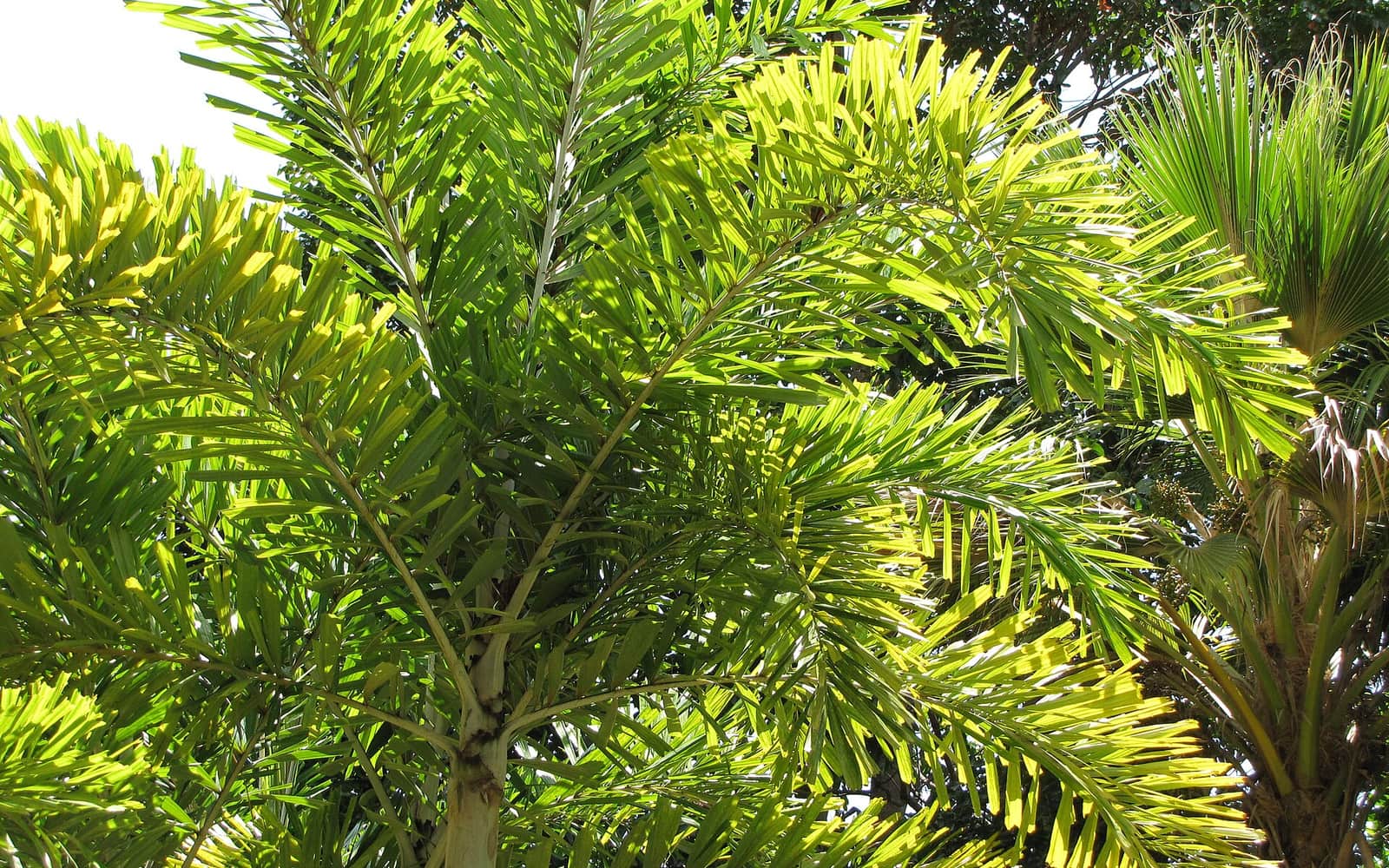
Photo by Forest and Kim Starr on Wikimedia Commons, CC BY 3.0 US

The foxtail palm is a fast-growing sun lover with bushy, plume-like fronds. Give it full sun, deep watering at the base and well-drained, slightly acidic soil, plus a palm fertilizer, because UF/IFAS says it runs short of potassium and manganese easily. It does best where winters stay above 30°F (−1°C). It drops its old leaves by itself. Neither the ASPCA nor NC State rates it for pets.
Not rated for pets
Neither the ASPCA nor NC State rates the foxtail palm. The "foxtail" on the ASPCA’s toxic list (Acalypha hispida) is a different plant. No reputable source lists it as toxic, but none rates it for pets either. Children: No poisoning information found; UF/IFAS lists its fruit as safe to touch, and it has no spines.
Pet poison line: ASPCA (888) 426-4435
Good for: sunny frost-free yards, a fast, self-cleaning palm, gardens near the coast, set back from salt spray · Think twice if: your soil is alkaline, your winters dip below about 30°F (−1°C), you can only offer shade.
Needs at a glance
- Light4 of 4 · Some direct sunFull sun outdoors; your brightest window indoors
- Water2 of 3 · Water deeply, then let it dry a littleWater at the base, never over the leaves; don’t overwater a pot
- Humidity1 of 3 · AverageNo source asks for extra humidity
- Soil when pottedWell-drained, slightly acidicAlkaline soil brings on nutrient shortages
Indoors: best at 70 to 80°F (21 to 27°C). Keep it above 45°F (7°C) and away from drafts and heat vents.
How the rating adds up
0 = easiest · 1 = moderate · 2 = hardest
- Missed waterings1 of 2 · ModerateDrought tolerant once rooted, but grows best with plenty of water
- Light flexibility2 of 2 · HardestWants full sun; indoors, only a brightly lit spot will do
- Humidity0 of 2 · EasiestNo source asks for extra humidity
- Pests and disease1 of 2 · ModerateProne to potassium and manganese shortages and leaf spot; resists lethal yellowing
- Sensitivity to change1 of 2 · ModerateDamaged below about 30°F and unhappy in alkaline soil
Growing outdoors
All year: USDA zones 10 to 11, where the coldest winter nights average 30°F (−1°C) or warmer.
Elsewhere: summer outside in full sun, eased in over a few days. Bring it in before nights drop below 45°F (7°C).
- Specimen palm for sunny frost-free yards
- Roadside and street planting
- Big pot in a very bright room
Sources: Missouri Botanical Garden, UF/IFAS, NParks Singapore, Hawaii weed risk assessment, Fairchild Tropical Botanic Garden, ASPCA plant list, ASPCA, Clemson, Penn State, USDA zone map, FISC, Hawaii noxious weed list, Rojas-Sandoval and Acevedo-Rodríguez, TexasInvasives.org, Cal-IPC, Queensland Government and GISD. Full list below.
Verified · How we rate plants
Is a foxtail palm safe for cats and dogs?
Nobody has rated it. The foxtail palm is on neither ASPCA list, NC State has no page for it, and we found no reputable source that calls it toxic. Hawaii’s weed risk assessment lists no toxicity, and UF/IFAS lists its fruit as safe to touch. Neither is a pet rating, so we can’t call it pet safe. Watch the name: the "foxtail" on the ASPCA’s toxic list is Acalypha hispida, a shrub also called chenille plant, which is a different plant. If your pet chews the palm and seems unwell, call your vet or the ASPCA Animal Poison Control Center at (888) 426-4435. If a child eats some and seems unwell, call Poison Help at 1-800-222-1222.
ASPCA plant list, ASPCA, Hawaii weed risk assessment, UF/IFAS
Foxtail palm or Christmas palm: which is which?
They share a smooth gray trunk, a green crownshaft and red fruit, so look at the leaves. On a foxtail palm the leaflets stick out all around the leaf stem, so each frond looks like a bushy plume, NTBG explains; that is where the name comes from, UF/IFAS says. Its fruit is egg shaped and about 2 inches long, orange to red, and the palm reaches 30 to 40 feet. The Christmas palm’s leaflets lie flatter, its bright red fruit is about 1 to 1.5 inches, and it stays around 20 to 25 feet. UF/IFAS adds that the foxtail looks a bit like a royal palm. Among fan palms, the ruffled fan and Chinese fan palms have round, fan-shaped leaves instead of feathers.
How much sun does a foxtail palm need?
Full sun. NParks Singapore lists full sun, tolerating some partial sun, and Hawaii’s weed risk assessment says it needs full sun and doesn’t tolerate shade. UF/IFAS notes it grows fastest in full sun, though it can handle some shade. Indoors, NParks says it only works in a brightly lit spot, so give it your sunniest window.
How often should I water a foxtail palm?
Deeply, then let it dry a little. UF/IFAS says it is drought tolerant but grows best with plenty of water at its base, and NParks credits its deep roots for its drought tolerance. Water the soil, never the leaves: UF/IFAS warns that watering from above encourages a leaf spot fungus. In a pot, NParks warns against overwatering, so let the top of the mix dry before watering again and empty the saucer.
Why is my foxtail palm turning yellow?
Most often hunger. UF/IFAS lists the foxtail as highly susceptible to potassium and manganese deficiencies and poorly suited to alkaline soil, and Fairchild Tropical Botanic Garden says alkaline soil makes it hard to grow. Feed it a palm fertilizer with micronutrients two or three times in spring and summer, as Clemson advises for palms, and plant it in well-drained, slightly acidic soil. A healthy foxtail drops its old leaves cleanly, UF/IFAS explains; old leaves that hang on half dead point to potassium deficiency. The good news: NParks says it resists lethal yellowing, a disease that kills many palms.
UF/IFAS, Fairchild Tropical Botanic Garden, Clemson, NParks Singapore
How tall does a foxtail palm get, and how fast?
Tall and fairly fast. UF/IFAS puts it at about 30 feet in Florida and lists 40 by 12 feet as a typical landscape size; NParks gives a top height of 15 meters (about 50 feet). NParks calls its growth moderate, and fast when it is fed and watered regularly. The fronds reach 8 to 10 feet long, and the gray trunk bulges a little near the middle, UF/IFAS says.
Can a foxtail palm grow in a pot indoors?
Yes, with enough light and room. UF/IFAS says it grows well indoors as a potted plant when it gets the right soil, light and space, and NParks says indoors it needs a brightly lit spot. It grows fast, so plan for a big pot. General palm advice from Clemson and Penn State is 70 to 80°F (21 to 27°C) by day and above 45°F (7°C) to avoid chill damage. Don’t overwater the pot, NParks adds.
Can a foxtail palm grow outdoors, and how cold can it get?
Yes, in frost-free places. UF/IFAS says it does best where temperatures don’t fall below 30°F (−1°C), which on the USDA map means zones 10 to 11; Hawaii’s weed risk assessment stretches that to 9b. It takes some salt air, but UF/IFAS says to plant it in a protected spot near the ocean. In cooler places, keep it in a pot and bring it in before nights fall to 45°F (7°C), the general palm chill line. No official invasive list names it, and Hawaii’s weed risk assessment rates it low risk.
UF/IFAS, USDA zone map, Hawaii weed risk assessment, Clemson, Penn State, FISC, GISD
How do I grow a foxtail palm from seed?
Sow the seed from ripe orange-red fruit; NParks says it sprouts in 3 to 6 months. UF/IFAS notes that every palm can make fertile seed, so there is no reason to buy wild seed: high demand once led poachers to strip seed from protected areas in Australia. NTBG adds that seed was smuggled out until 1995, when legal exports began.
How Grove helps
Grove schedules deep waterings and palm fertilizer in spring and summer for a palm that runs short of potassium easily. If it grows in a pot, a fall reminder to bring it in before nights hit 45°F (7°C) can go out as one of the tasks you can assign, so whoever is home moves it in time.
Sources
- Missouri Botanical Garden Plant Finder: Wodyetia bifurcata (no record found through search; hand check pending)
- UF/IFAS EDIS FOR242: Wodyetia bifurcata, Foxtail Palm (McKenzie, Andreu, Friedman, Quintana; reviewed April 2025)
- National Parks Board Singapore, Flora & Fauna Web: Wodyetia bifurcata
- Hawaii-Pacific Weed Risk Assessment (Plant Pono): Wodyetia bifurcata, low risk (2006)
- UF/IFAS EDIS ENH21: Ornamental Palms for South Florida (T. K. Broschat and R. J. Black; rev. 2016, reviewed 2017)
- Fairchild Tropical Botanic Garden, Tropical Plants of Lincoln Road: Wodyetia bifurcata (palma cola de zorro)
- ASPCA Animal Poison Control: Toxic and Non-Toxic Plants
- ASPCA Animal Poison Control: Foxtail (Acalypha hispida)
- Clemson Cooperative Extension HGIC 1508: Indoor Palms
- Penn State Extension: Palms as Houseplants (M. L. Smith, 2023)
- USDA ARS Plant Hardiness Zone Map (2023)
- Florida Invasive Species Council: Plant List, Category I and II and Watch List (April 2026)
- Hawaii Administrative Rules 4-68: plant species designated as noxious weeds (Hawaii Department of Agriculture)
- J. Rojas-Sandoval and P. Acevedo-Rodríguez (2015), Naturalization and invasion of alien plants in Puerto Rico and the Virgin Islands, Biological Invasions 17 (supplementary list)
- TexasInvasives.org Invasives Database: plant list (no Licuala, Wodyetia, Livistona or other palm)
- California Invasive Plant Council (Cal-IPC): plant search, "wodyetia" (no listing)
- Business Queensland: Restricted invasive plants (Biosecurity Act 2014)
- IUCN Global Invasive Species Database: Wodyetia bifurcata (no entry)
- National Tropical Botanical Garden, Tropical Plant Database: Wodyetia bifurcata
- Kew WCVP data release (2026-06-04 file), plant_name_id 214814: Wodyetia bifurcata
- NC State Extension Gardener Plant Toolbox: Adonidia merrillii
- UF/IFAS EDIS ENH-815: Adonidia merrillii, Christmas Palm (T. K. Broschat; rev. 2024)
- National Parks Board Singapore, Flora & Fauna Web: Licuala grandis