Plant care card
Hoya
Hoya · Hoya
Also called wax plant, wax vine, porcelain flower or honey plant
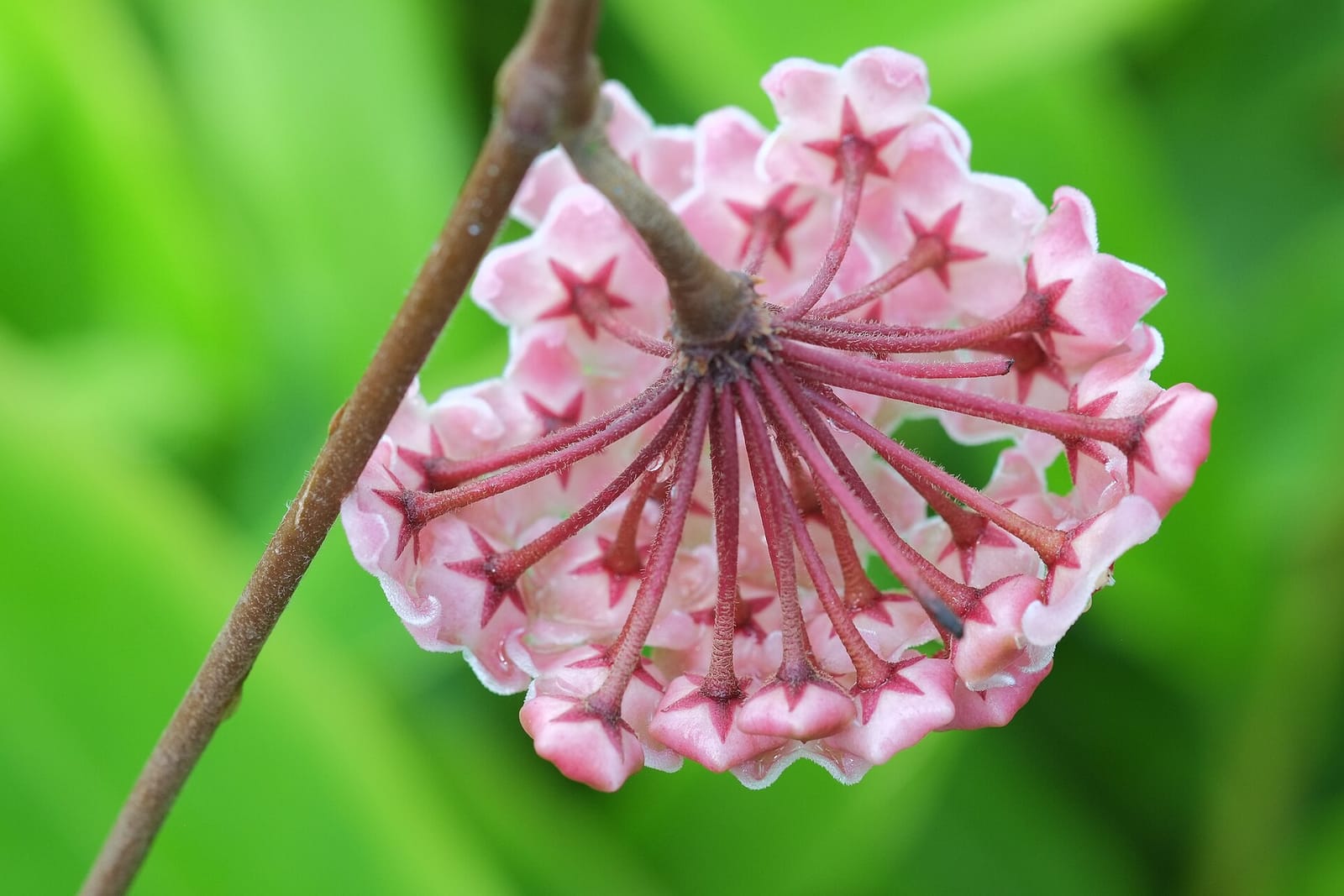
Photo by Pseudopanax on Wikimedia Commons

Hoyas, or wax plants, are forgiving vines with thick leaves that store water. Give them a bright window out of hot sun, soak the pot, then let the mix dry almost completely before you water again. Bright light is also what gets them to flower, and the flowers come back on the same short spurs, so never cut those off. The ASPCA lists the common wax plant and sweetheart hoya as safe for cats and dogs.
Non-toxic to cats, dogs and horses
No signs of poisoning listed. The ASPCA lists wax plant (H. carnosa) and sweetheart hoya (H. kerrii) as non-toxic, and NC State agrees for the common species. The many rarer hoyas aren’t rated. Children: None of the sources lists it as poisonous to people; the milky sap is sticky, so keep it off furniture.
Pet poison line: ASPCA (888) 426-4435
Good for: a bright window, hanging baskets, fragrant flowers · Think twice if: your only spot is a dim room, you like to repot or move plants often.
Needs at a glance
- Light3 of 4 · Bright indirectA bright window; low light stops flowering and hot direct sun can scorch the leaves
- Water1 of 3 · Let it dry outSoak it, then let the mix dry almost completely; water less in winter
- Humidity1 of 3 · AverageHome air is fine; 40 to 60% is ideal, and dry winter air invites spider mites
- Soil when pottedChunky, fast-draining mixPotting soil with orchid bark and perlite, in a pot just big enough for the roots
Indoors: best at 65 to 80°F (18 to 27°C). Keep it above 55°F (13°C) and away from drafts and heat vents.
How the rating adds up
0 = easiest · 1 = moderate · 2 = hardest
- Missed waterings0 of 2 · EasiestLet the mix dry almost completely; thick leaves store water, and soggy soil is the bigger risk
- Light flexibility1 of 2 · ModerateNeeds bright, indirect light; low light means thin growth and no flowers
- Humidity0 of 2 · EasiestAverage home air is fine; 40 to 60% is ideal
- Pests and disease1 of 2 · ModerateMealybugs are common, with spider mites in dry air; root rot if overwatered
- Sensitivity to change1 of 2 · ModerateMoving it or sudden changes can make buds drop; cold water shocks it
Growing outdoors
All year: USDA zones 10b to 11, where the coldest winter nights average 40°F (4°C) or warmer.
Elsewhere: summer outside in partial shade, out of harsh midday sun. Bring it in when nights reach 55 to 60°F (13 to 16°C).
- Hanging baskets
- Pots with a small trellis, hoop or moss pole
Sources: NC State, Clemson HGIC, Iowa State, Penn State, UF/IFAS, ASPCA, ASPCA plant list, RHS, USDA zone map, FISC, Hawaii noxious weed list, GISD, Cal-IPC and Rojas-Sandoval and Acevedo-Rodríguez. Full list below.
Verified · How we rate plants
Is hoya safe for cats and dogs?
Yes, for the hoyas people grow most. The ASPCA lists wax plant (Hoya carnosa), its curly Hindu rope form and sweetheart hoya (H. kerrii) as non-toxic to cats and dogs, and it lists wax plant and sweetheart hoya as non-toxic to horses too. NC State also tags H. carnosa, H. kerrii, H. pubicalyx and H. australis as non-toxic for pets. The genus has hundreds of species, and the rare ones haven't been rated. Hoyas have a milky, sticky sap, so wipe up drips. If a pet chews a lot of any plant and seems unwell, call your vet or the ASPCA Animal Poison Control Center at (888) 426-4435.
How do I get my hoya to bloom?
Start with light. UF/IFAS says too little light is the usual reason a hoya won't flower, and Iowa State puts it in one of the brightest windows you have, out of hot direct sun. Then be patient: NC State says wax plants usually bloom at two or three years old, and Clemson notes that some species take years. Iowa State adds that a slightly snug pot, a small drop in temperature at night and steady care all help. Once buds form, leave the plant where it is, because Penn State and Iowa State both warn that moving it or changing its care can make the buds drop.
Should I cut off old hoya flowers?
No. Let the spent flowers fall on their own and leave the short stalk they grew from. That stalk, called a spur or peduncle, flowers again in later years, so NC State, UF/IFAS and Iowa State all say to keep it. Cutting the spurs off means waiting for new ones to grow. Prune long vines in early spring if you need to, and work around the spurs.
How often should I water a hoya?
Water deeply, then wait. Iowa State says to soak the whole root zone and let the mix dry almost completely, and Clemson says to let it dry out completely between drinks; a pot that feels light is ready. UF/IFAS suggests letting the top third to half of the soil dry from spring to fall and watering very little in winter. Penn State points out that the thick leaves hold more water than you might think, and some growers wait until the leaves pucker slightly. Soggy soil is the real danger: Clemson calls root rot the biggest threat to a hoya. Use room-temperature water, since NC State says cold water can shock it.
How much light does a hoya need?
Bright, indirect light. Iowa State says hoyas thrive in bright light and that too little gives thin, stretched vines with few or no flowers. Clemson suggests a spot close to an east, west or south window, with an LED grow light in a dim home, and says to get it used to a sunny south window slowly to avoid leaf burn. Strong direct sun can scorch the leaves or turn them red, per Iowa State. NC State says many species also take dappled shade or morning sun.
Which hoya do I have?
Most likely a wax plant, Hoya carnosa, which UF/IFAS calls the most widely grown. Hoya is a big genus: Kew accepts about 570 species, all from tropical Asia, the Pacific islands and Australia. Common ones include H. carnosa and its cultivars ('Krimson Queen', and the curly 'Compacta' or Hindu rope), H. kerrii with heart-shaped leaves, H. pubicalyx, H. australis and H. bella. Their care is close to the same. One catch: Penn State and Iowa State warn that a sweetheart hoya sold as a single heart-shaped leaf in a pot usually has no node and will never grow into a vine.
UF/IFAS, Kew WCVP, NC State, Clemson HGIC, Penn State, Iowa State
Why are my hoya leaves yellow or wrinkled?
Check the soil first. Iowa State says yellow leaves with wet soil point to overwatering, and wrinkled leaves usually mean the plant is thirsty. If the leaves wrinkle while the soil is wet, the roots may already be damaged, so check for rot. NC State says soil that is too wet or too dry can make leaves drop, and so can cold water. Look under the leaves and at the joints too: Clemson and Iowa State name mealybugs as the most common pest, with spider mites in dry winter air.
How do I propagate and repot a hoya?
Stem cuttings are the easy way. Iowa State says to take a piece with one or two nodes, strip the lowest leaves and root it in water, moist sphagnum or a light mix; a leaf cutting needs a node at its base. Repot only when the plant has truly outgrown its pot or the mix has broken down, and go up just one size. Hoyas often flower better a little root-bound, and Clemson warns that a pot that is too big stays wet and leads to root rot. Use a chunky mix of potting soil, orchid bark and perlite. NC State says to avoid repotting while it is in bud or flower.
Can hoya grow outdoors, and is it invasive?
Only where winters stay warm. UF/IFAS puts the wax plant in USDA zones 10b to 11 and says it is very sensitive below 40°F (4°C), and NC State gives zones 10a to 11 for H. australis and H. pubicalyx. Elsewhere it can spend summer outside in partial shade. Clemson says to move it out once nights stay above 60°F (16°C), and Iowa State says hoyas won't take temperatures below 55°F (13°C), so bring it in before then. No official invasive list names it: it's absent from Florida's FISC list, Hawaii's noxious weed list, the Global Invasive Species Database and Cal-IPC.
UF/IFAS, NC State, Clemson HGIC, Iowa State, FISC, Hawaii noxious weed list, GISD, Cal-IPC
How Grove helps
Grove sets a watering check based on how dry the mix is, so a hoya that likes to dry out isn't watered on a fixed schedule, and it waters less in winter. You can add a monthly look for mealybugs as a repeating task and assign it, and a note on the plant reminds everyone who helps to leave the flower spurs alone.
Sources
- NC State Extension Gardener Plant Toolbox: Hoya carnosa
- Clemson HGIC 1460: Indoor Plants, Waxflowers (Hoya) (2025)
- Iowa State University Extension, Yard and Garden: All About Hoyas (reviewed 2026)
- NC State Extension Gardener Plant Toolbox: Hoya (genus page)
- Penn State Extension: Hoyas as Houseplants (2026)
- UF/IFAS Gardening Solutions: Hoya
- ASPCA Animal Poison Control: Honey Plant (Hoya carnosa)
- ASPCA Animal Poison Control: Sweetheart Hoya (Hoya kerrii)
- ASPCA Animal Poison Control: Wax Plant (Hoya carnosa 'Krinkle Kurl')
- NC State Extension Gardener Plant Toolbox: Hoya australis (with Hoya pubicalyx, Hoya kerrii and Hoya bella pages)
- ASPCA Animal Poison Control: Toxic and Non-Toxic Plants
- UF/IFAS Fact Sheet FPS-257: Hoya carnosa, Wax Plant (1999)
- RHS: Hoya carnosa (wax plant)
- USDA ARS Plant Hardiness Zone Map (2023)
- Florida Invasive Species Council: Plant List, Category I and II (April 2026)
- Hawaii Administrative Rules 4-68: plant species designated as noxious weeds (Hawaii Department of Agriculture)
- IUCN Global Invasive Species Database: Hoya carnosa (no record)
- California Invasive Plant Council (Cal-IPC): plant search, "hoya" (no listing)
- J. Rojas-Sandoval and P. Acevedo-Rodríguez (2015), Naturalization and invasion of alien plants in Puerto Rico and the Virgin Islands, Biological Invasions 17 (supplementary list)
- Kew WCVP data release (2026-06-04 file), plant_name_id 506572: genus Hoya
- Kew WCVP data release (2026-06-04 file), plant_name_id 506676: Hoya carnosa