Plant care card
Jamaican cherry
Muntingia calabura · Muntingia
Also called Jamaica cherry, Panama berry, Singapore cherry or calabura
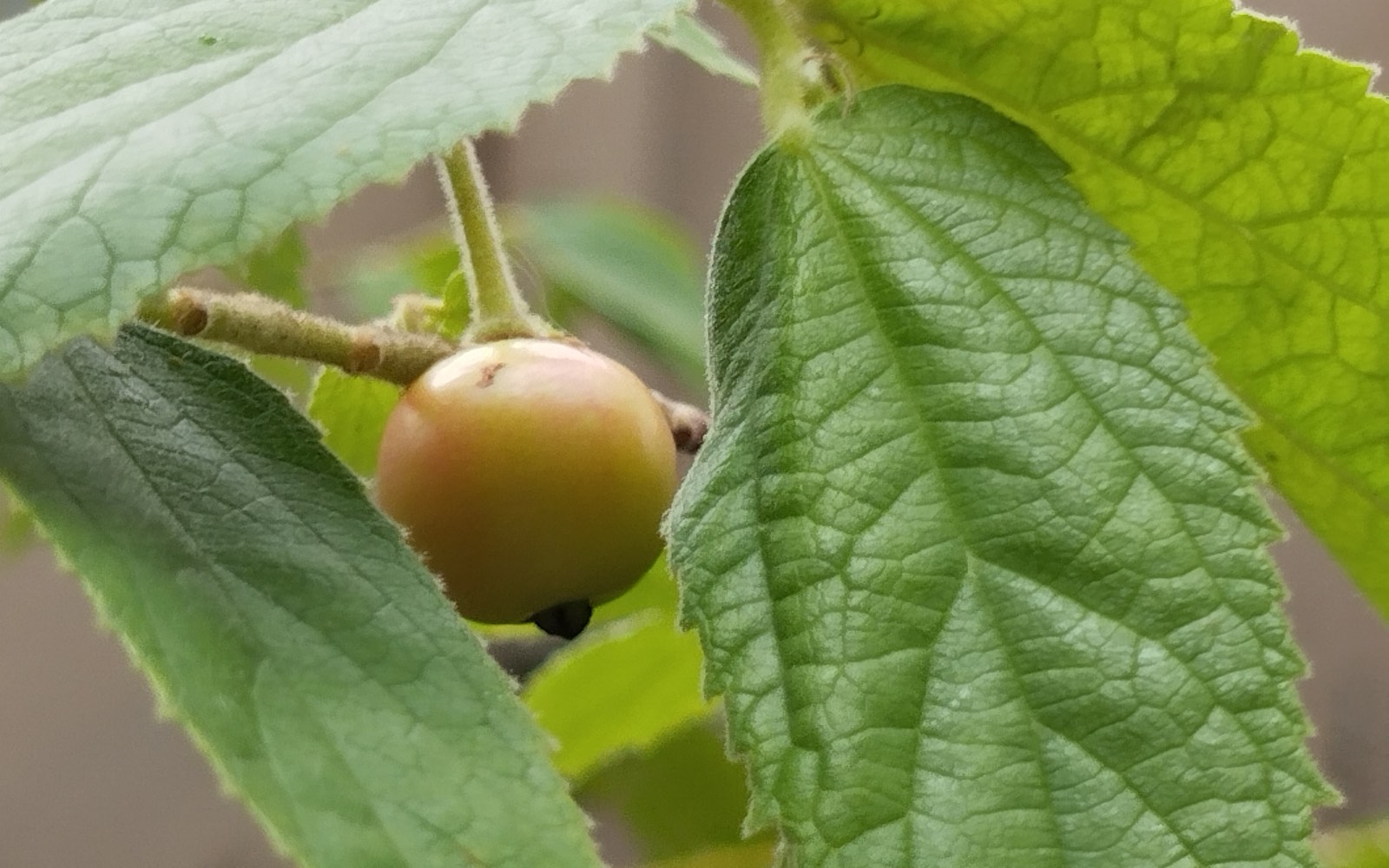
Photo by Flora Nusantara on Wikimedia Commons, CC BY 4.0

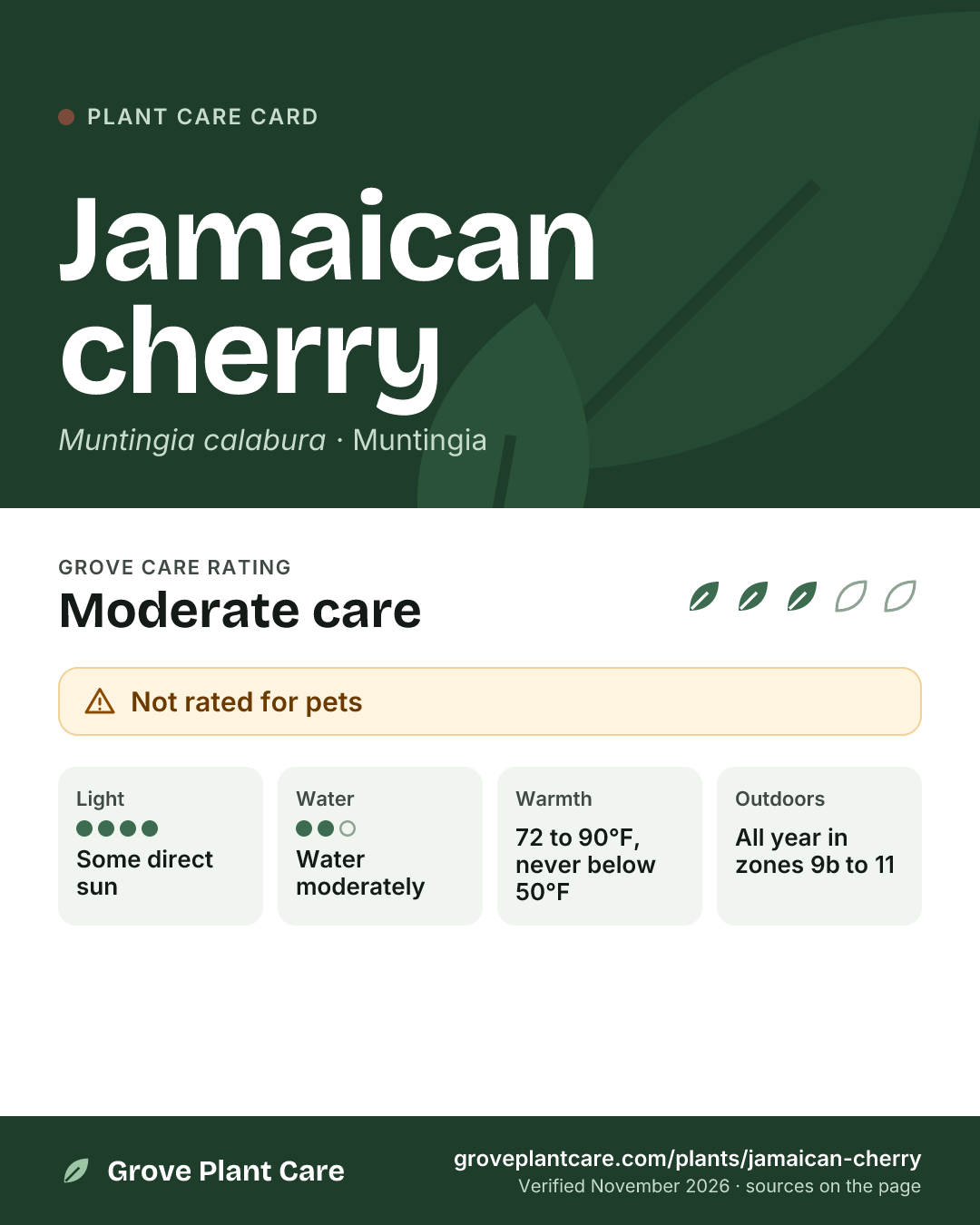
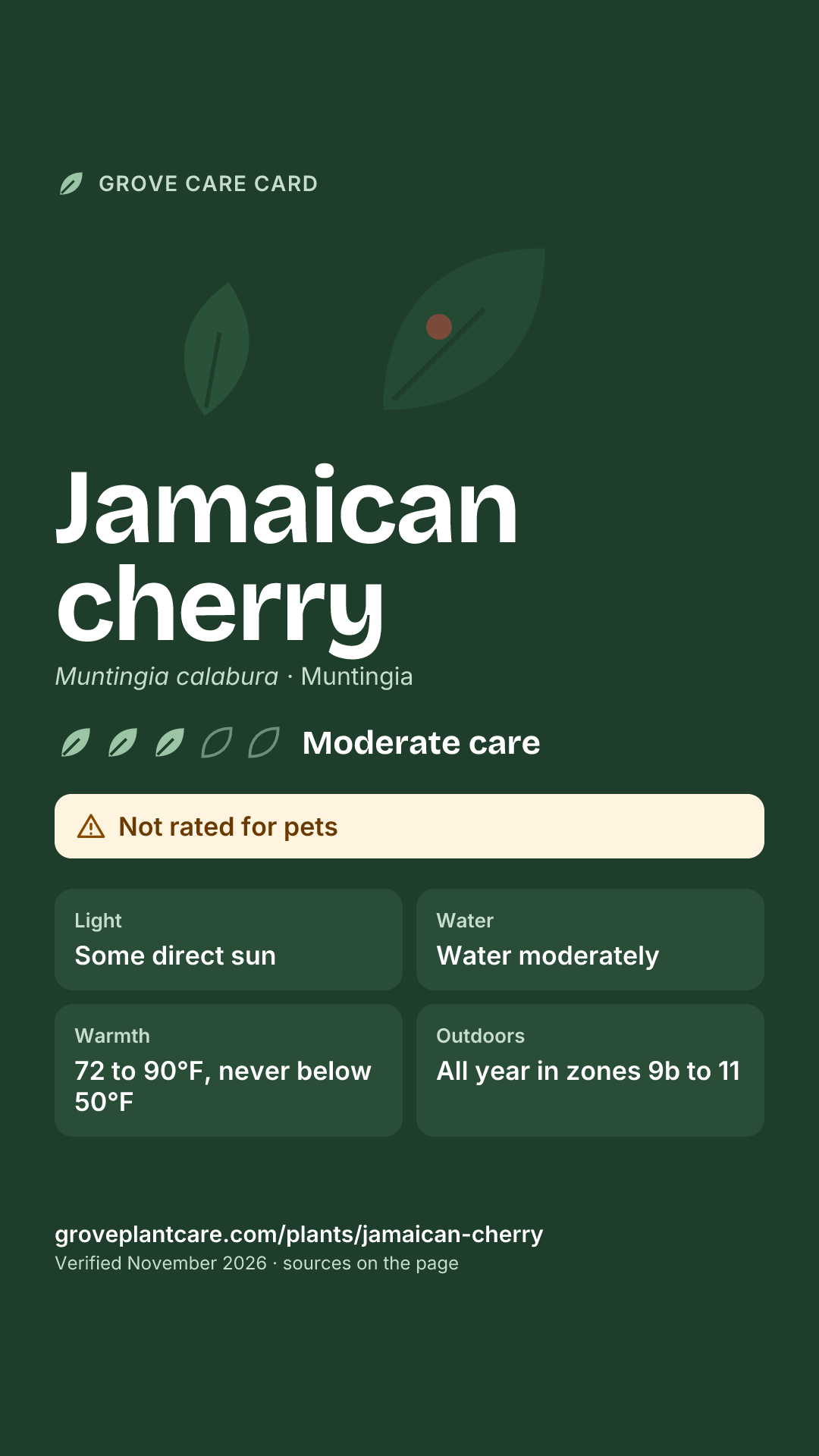
The Jamaican cherry (Muntingia calabura) is a fast tropical tree with soft, toothed leaves, small white flowers and sweet red berries nearly all year. It is the only species in its genus. Give it full sun and regular water while it's young; once settled it handles dry spells and poor soil. Outdoors it grows in USDA zones 9b to 11. A potted tree needs to come inside before nights drop to about 55°F (13°C). No pet toxicity rating exists. No official list calls it invasive, but it spreads by seed in Hawaii and Puerto Rico.
Not rated for pets
Neither the ASPCA nor NC State rates the Jamaican cherry. No reputable source lists it as toxic, but none rates it either. Hawaii's weed risk assessment lists it as non-toxic, which isn't a pet safety rating. Children: The ripe fruit is eaten as food; no poisoning information found.
Pet poison line: ASPCA (888) 426-4435
Good for: sunny, frost-free yards, sweet fruit nearly all year, fast shade · Think twice if: you garden in Hawaii, Puerto Rico or another frost-free island where birds spread it, you have no room for a fast tree with brittle branches.
Needs at a glance
- Light4 of 4 · Some direct sunFull sun, as much as you can give it
- Water2 of 3 · Water moderatelyRegular water while young and in a pot; established trees handle dry spells
- Humidity1 of 3 · AverageNo special humidity needed
- Soil when pottedAny well-drained soilGrows even in poor, acid or alkaline soil; dislikes salt
Indoors: best at 72 to 90°F (22 to 32°C). Keep it above 50°F (10°C) and away from drafts and heat vents.
How the rating adds up
0 = easiest · 1 = moderate · 2 = hardest
- Missed waterings1 of 2 · ModerateRegular water while young; established trees handle dry spells
- Light flexibility2 of 2 · HardestFull sun; seedlings fail in shade
- Humidity0 of 2 · EasiestNo source asks for extra humidity
- Pests and disease1 of 2 · ModerateFruit flies in the fruit; leaf spot now and then
- Sensitivity to change1 of 2 · ModerateCold stops flowering; brittle branches break
Growing outdoors
All year: USDA zones 9b to 11, where the coldest winter nights average 25°F (−4°C) or warmer.
Elsewhere: summer outside in full sun once it has adjusted; start in part shade for a week. Bring it in when nights reach 55 to 60°F (13 to 16°C).
- Fruit tree in frost-free yards
- Quick shade tree
- Large container plant moved in for winter
Sources: Morton, Fruits of Warm Climates, NParks Singapore, FAO Ecocrop, Hawaii weed risk assessment, UF/IFAS Hillsborough County, ASPCA plant list, Clemson, FNAI, USDA zone map, FISC, Hawaii noxious weed list, Global Invasive Species Database, Queensland Government, Cal-IPC and Rojas-Sandoval and Acevedo-Rodríguez. Full list below.
Verified · How we rate plants
Is the Jamaican cherry toxic to cats and dogs?
We can't say for sure. Neither the ASPCA nor NC State rates it, and we found no reputable source that lists it as toxic. Hawaii's weed risk assessment lists it as non-toxic, and people eat the ripe fruit, but neither is a pet safety rating. Keep fallen fruit cleaned up if your pets snack on things. If your pet chewed it and seems unwell, call your vet or the ASPCA Animal Poison Control Center at (888) 426-4435. If a child eats something you're unsure of, call Poison Help at 1-800-222-1222.
ASPCA plant list, Hawaii weed risk assessment, Morton, Fruits of Warm Climates, NParks Singapore
Is this the right plant? Which Jamaican cherry is which?
Probably, if your tree has soft, fuzzy, toothed leaves on long flat branches and small red berries full of tiny seeds. That's Muntingia calabura, which Kew lists as the only species in its genus. A few names overlap. Florida calls it strawberry tree, but Morton's Fruits of Warm Climates says that name belongs to Arbutus unedo, a Mediterranean shrub NC State also calls strawberry tree. The Jamaican cherry fig, Ficus americana, is a fig tree with a similar name, per UF/IFAS. And Morton notes that the Spanish name capulín is better kept for another tree, Prunus salicifolia.
Kew, Morton, Fruits of Warm Climates, NC State, UF/IFAS Assessment
How much sun does a Jamaican cherry need?
Full sun. Singapore's National Parks Board lists full sun, and the FAO crop database gives very bright light as its best. Hawaii's weed risk assessment notes that its seedlings don't tolerate deep shade. If you move a potted tree outside for summer, start it in part shade for about a week, as Clemson suggests for houseplants, then give it the sunniest spot you have.
NParks Singapore, FAO Ecocrop, Hawaii weed risk assessment, Clemson
How often should I water a Jamaican cherry?
Water young trees regularly, and let an established tree ride out dry spells. Singapore's National Parks Board lists moderate water, and Morton calls it drought resistant once it grows up. A pot dries out far faster than garden soil, so check it every few days in summer. Morton adds that it grows in poor soil, acid or alkaline, but doesn't tolerate salt.
NParks Singapore, Morton, Fruits of Warm Climates, FAO Ecocrop
How cold can a Jamaican cherry get?
Not very. UF/IFAS Hillsborough County puts it in USDA zones 9b to 11, the warmest parts of Florida and similar places. No source gives a freezing temperature it survives, so the card uses zone 9b's coldest nights, about 25°F (−4°C), as the limit. Morton says established trees in southern Florida aren't harmed by an occasional cold night, but flowering and fruiting stop in the four coolest months. The FAO crop database lists 50°F (10°C) as the lowest it grows at, and Clemson warns that 50°F or lower damages many tropical plants. Bring a potted tree in at 55 to 60°F (13 to 16°C).
UF/IFAS Hillsborough County, FNAI, USDA zone map, Morton, Fruits of Warm Climates, FAO Ecocrop, Clemson
When does a Jamaican cherry fruit, and can you eat the fruit?
It fruits young and nearly all year. Morton says well-fed seedlings can start fruiting in about 18 months, and UF/IFAS Hillsborough County says the main harvest runs from spring to summer, with fruit coming in daily. The ripe berries are red, sometimes yellow, about half an inch across, and very sweet; people eat them fresh or make jam and tarts, per Morton and Singapore's National Parks Board. The seeds are tiny and can be eaten with the fruit. In Florida, Morton warns that Caribbean fruit fly larvae often get into the fruit.
Morton, Fruits of Warm Climates, UF/IFAS Hillsborough County, NParks Singapore
What pests and problems does a Jamaican cherry get?
Fruit flies, a couple of leaf spots and broken branches. Morton lists Caribbean fruit fly in Florida fruit, leaf spot fungi and crown gall, and Hawaii's weed risk assessment notes that it hosts fruit flies. UF/IFAS Hillsborough County says the branches are weak and break easily, so trim long branches often. Pick up fallen fruit so it doesn't feed flies.
Morton, Fruits of Warm Climates, Hawaii weed risk assessment, UF/IFAS Hillsborough County
How do I grow a Jamaican cherry from seed or cuttings?
Seed is the usual way, and cuttings or air layering work too. Morton describes cleaning the tiny seeds out of the pulp, rinsing off the floating bits and drying them in shade before sowing. UF/IFAS Hillsborough County adds cuttings and air layering. It grows very fast: Morton says seedlings can reach 13 ft (4 m) in two years. Never toss fruit or seedlings into wild areas.
Morton, Fruits of Warm Climates, NParks Singapore, UF/IFAS Hillsborough County, Hawaii weed risk assessment
Can I plant a Jamaican cherry outdoors, and is it invasive?
It grows outdoors in USDA zones 9b to 11. No official invasive list names it: it isn't on the Florida Invasive Species Council list, Hawaii's noxious weed list, Queensland's restricted plants, the California Invasive Plant Council inventory or the Global Invasive Species Database. In Florida, UF/IFAS hasn't assessed it yet, though UF/IFAS Hillsborough County says it has been reported to naturalize. Elsewhere it spreads. Hawaii's weed risk assessment rates it high risk: birds and other animals spread its seeds, it fills sunny gaps and forms thickets, and it is an environmental weed on Christmas Island and in Australia. A peer-reviewed study lists it among the invasive plants of Puerto Rico. In those places, choose another fruit tree.
UF/IFAS Hillsborough County, FISC, FNAI, Hawaii noxious weed list, Queensland Government, Cal-IPC, Global Invasive Species Database, Hawaii weed risk assessment, Rojas-Sandoval and Acevedo-Rodríguez
How Grove helps
Grove sets a watering check based on how dry the soil is, so a young Jamaican cherry gets water before the pot dries out. You can add pruning and a move indoors before cold nights as tasks you can assign to whoever looks after the tree.
Sources
- J. F. Morton, Fruits of Warm Climates (1987): Jamaica Cherry, Muntingia calabura (Purdue University NewCROP)
- National Parks Board Singapore, Flora & Fauna Web: Muntingia calabura (record updated 2025-08-28)
- FAO Ecocrop: Muntingia calabura (temperature, light and soil requirements)
- Hawaii-Pacific Weed Risk Assessment (Plant Pono): Muntingia calabura, high risk, score 12
- UF/IFAS Extension Hillsborough County: Panama Berry Tree, Muntingia calabura (T. Saracino, 2024, updated 2026-04-14)
- ASPCA Animal Poison Control: Toxic and Non-Toxic Plants
- Clemson Cooperative Extension HGIC 1454: Moving Houseplants Indoors and Outdoors
- Florida Natural Areas Inventory (Florida State University): Muntingia calabura, strawberry tree
- USDA ARS Plant Hardiness Zone Map (2023)
- Florida Invasive Species Council: Plant List, Category I and II and Watch List (April 2026)
- Hawaii Administrative Rules 4-68: plant species designated as noxious weeds (Hawaii Department of Agriculture)
- IUCN Global Invasive Species Database: search for Muntingia calabura (no record)
- Business Queensland: Restricted invasive plants (Biosecurity Act 2014)
- California Invasive Plant Council (Cal-IPC): plant search, "muntingia" (no listing)
- J. Rojas-Sandoval and P. Acevedo-Rodríguez (2015), Naturalization and invasion of alien plants in Puerto Rico and the Virgin Islands, Biological Invasions 17 (supplementary list)
- National Tropical Botanical Garden, Tropical Plant Database: Muntingia calabura
- Kew WCVP data release (2026-06-04 file), plant_name_id 2507614: Muntingia calabura (only accepted species of Muntingia, genus id 2507616)
- NC State Extension Gardener Plant Toolbox: Arbutus unedo (strawberry tree)
- UF/IFAS Assessment of Non-Native Plants: Ficus americana (Jamaican cherry fig)