Plant care card
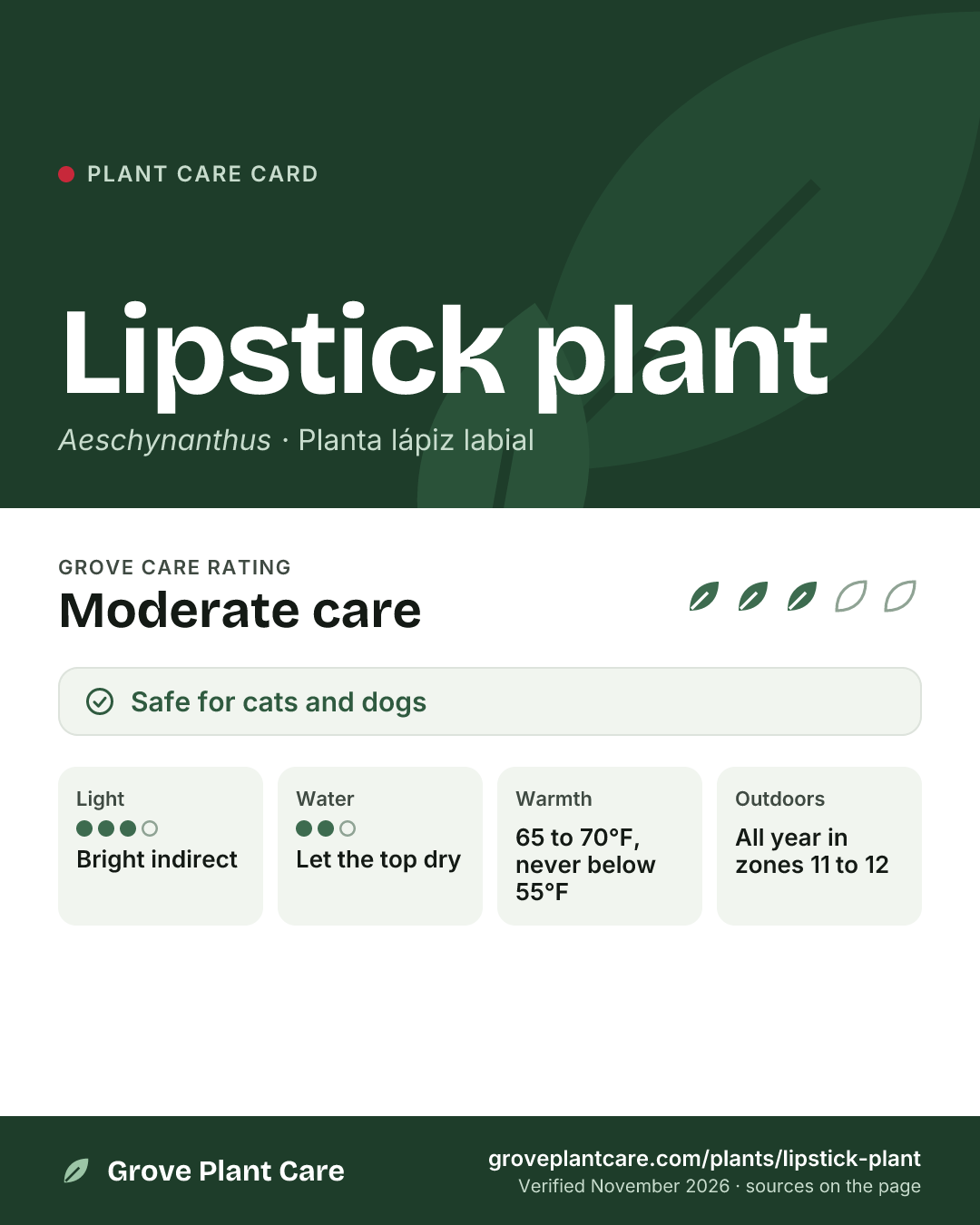
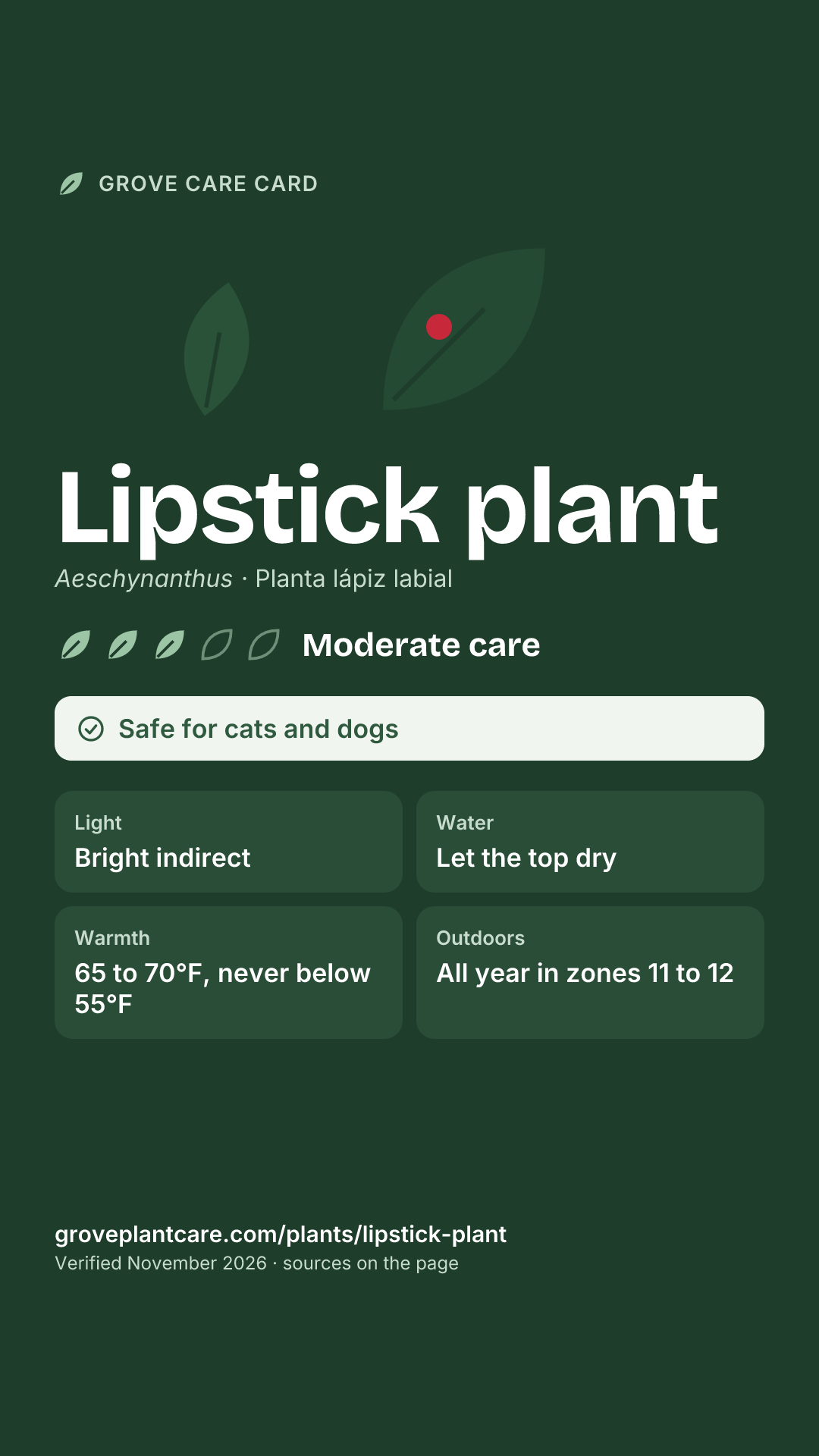
Lipstick plant
Aeschynanthus · Planta lápiz labial
Also called basket vine, lipstick vine or scarlet basket vine
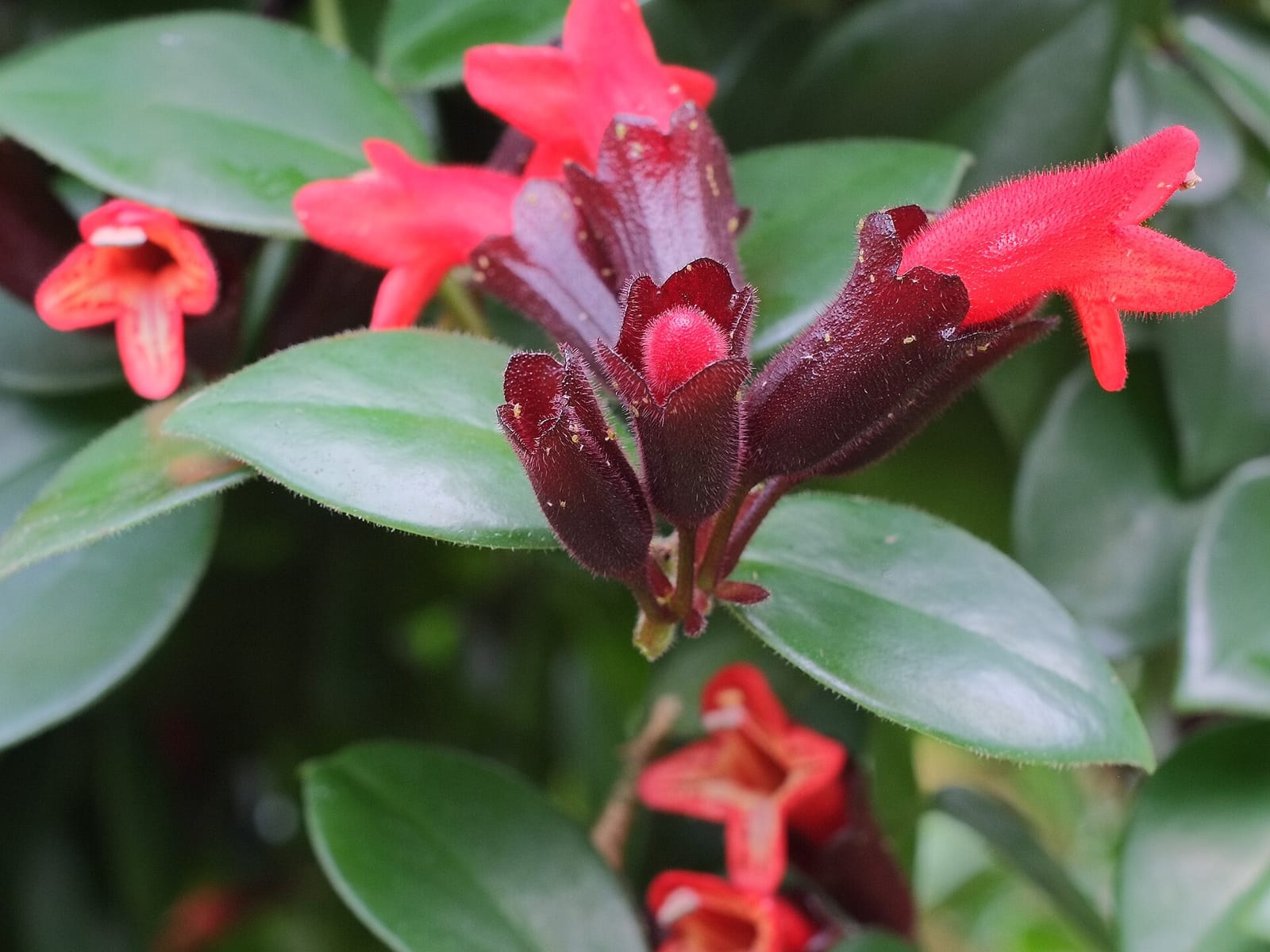
Photo by Pseudopanax on Wikimedia Commons

The lipstick plant is a trailing epiphyte from tropical Asia with red tubular flowers that poke out of dark cups like lipstick from a tube. Give it bright, indirect light, water often in spring and summer and less in winter, and keep it warm and out of drafts: it drops leaves below about 50°F (10°C). The ASPCA lists it as non-toxic to cats, dogs and horses.
Non-toxic to cats, dogs and horses
No signs of poisoning listed. The ASPCA’s lipstick plant entry is Aeschynanthus humilis, and NC State also tags that species non-toxic. No reputable source lists any lipstick plant as toxic. Any plant can still upset a pet’s stomach if it eats enough. Children: No poisoning information found for people; the ASPCA and NC State list it non-toxic to pets.
Pet poison line: ASPCA (888) 426-4435
Good for: hanging baskets in a bright room, flowers on a trailing plant, homes with cats and dogs · Think twice if: your rooms drop below about 55°F (13°C) in winter, your only bright spot gets hot direct sun.
Needs at a glance
- Light3 of 4 · Bright indirectA bright east or west window, out of hot sun; it blooms best in good light
- Water2 of 3 · Let the top dryWater often in spring and summer, as the surface dries; sparingly in winter
- Humidity2 of 3 · Above averageHumid air with a little movement; avoid stale, damp corners
- Soil when pottedLoose, fast-draining mixRich in organic matter, moist but never soggy; a basket or pot with drainage
Indoors: best at 65 to 70°F (18 to 21°C). Keep it above 55°F (13°C) and away from drafts and heat vents.
How the rating adds up
0 = easiest · 1 = moderate · 2 = hardest
- Missed waterings1 of 2 · ModerateWater often in spring and summer, letting the surface dry a little; less in winter
- Light flexibility1 of 2 · ModerateBright, indirect light; hot direct sun burns the leaves
- Humidity1 of 2 · ModerateLikes humid air that still moves; stale, damp air invites fungus
- Pests and disease1 of 2 · ModerateAphids, mealybugs and mites; botrytis and leaf spot
- Sensitivity to change1 of 2 · ModerateDrops leaves below about 50°F (10°C) and in drafts
Growing outdoors
All year: USDA zones 11 to 12, where the coldest winter nights average 40°F (4°C) or warmer.
Elsewhere: summer outside in dappled or part shade, such as under a tree. Bring it in when nights reach 55 to 59°F (13 to 15°C).
- Hanging basket houseplant
- Epiphyte on trees in frost-free gardens
Sources: NC State, RHS, ASPCA, ASPCA plant list, Chicago Botanic Garden, USDA zone map, FISC, Hawaii noxious weed list and GISD. Full list below.
Verified · How we rate plants
Is a lipstick plant safe for cats and dogs?
Yes, as far as the sources go. The ASPCA lists the lipstick plant (Aeschynanthus humilis) as non-toxic to cats, dogs and horses, and NC State also tags that species non-toxic. Neither rates the common Aeschynanthus radicans or A. pulcher by name, but we found no reputable source that lists any lipstick plant as toxic. Any plant can still upset a pet’s stomach if it eats a lot, so hang the basket out of reach of chewers. Watch the name: the lipstick palm is a different plant. If your pet chews it and seems unwell, call your vet or the ASPCA Animal Poison Control Center at (888) 426-4435. If a child eats some and seems unwell, call Poison Help at 1-800-222-1222.
Aeschynanthus radicans, pulcher or lobbianus: which lipstick plant do I have?
Several close cousins share the name, and this card covers them all because their care is the same. Aeschynanthus radicans has leathery leaves often edged in red and scarlet flowers with yellow throats, NC State says. A. pulcher, still sold as A. lobbianus, carries clusters of 6 to 8 hooded red flowers with yellow throats from summer to winter, the RHS says; Kew’s checklist now files A. lobbianus under A. pulcher. A. humilis has shorter stems that trail less. Cultivars add twists: 'Mona Lisa' has orange-red flowers, and 'Rasta' and 'Curly' have curled leaves. The lipstick palm, Cyrtostachys renda, is a red-stemmed palm with its own card.
How much light does a lipstick plant need?
Bright, indirect light. NC State says it needs bright light without full sun. The RHS suggests bright, filtered light for the best growth and flowers, in an east or west window. NC State adds that a south or west window works for A. humilis, but direct sun can burn the leaves, and that it also grows well under grow lights. In dim rooms it grows slowly and blooms little.
How often should I water a lipstick plant?
Often in spring and summer, less in winter. The RHS says to water freely in the growing season and sparingly in winter. NC State says to water often, but the mix must drain well, and to let it get slightly dry between waterings; hanging baskets dry out fastest. Its thick, leathery leaves store some water, so a short dry spell is fine; soggy soil does harm. Water the mix and keep the leaves dry: NC State says wet leaves resting on the soil invite botrytis and leaf spot.
Why isn’t my lipstick plant blooming?
Usually light, food or a missing rest. The RHS says bright, filtered light gives the best flowering. NC State suggests a dilute liquid fertilizer, such as an orchid feed, in the growing season to push leaves and blooms; the RHS uses half strength once a month from mid-spring to late summer. A cooler, drier winter rest helps too: NC State says keeping A. humilis at 55 to 65°F (13 to 18°C) in winter sets buds for spring. Once it blooms, the season is long, from spring through fall on A. radicans.
Why is my lipstick plant dropping leaves?
Cold, drafts or watering, most often. NC State says the leaves fall if it gets colder than 50°F (10°C), and that drafts or the wrong watering make lower leaves drop. Check the soil: soggy or bone dry both cause trouble. Then look closely for pests. NC State lists aphids, mealybugs and mites, and the RHS names aphids and mealybugs. Gray fuzzy mold or spots on the leaves point to botrytis or leaf spot, which NC State links to stale, damp air and wet leaves.
What humidity and temperature does a lipstick plant like?
Warm, humid and airy. NC State says it likes high humidity but needs air to move, because stagnant, moist air encourages fungal disease. It grows best when the soil sits around 65 to 70°F (18 to 21°C) in the growing season, and NC State gives A. humilis nights of 60 to 70°F (16 to 21°C) with days 10 to 15 degrees warmer. In winter, NC State keeps it at 55 to 65°F (13 to 18°C); the RHS is more cautious and grows it above 15°C (59°F) all year. Keep it away from cold windows and doors.
How do I prune and propagate a lipstick plant?
Trim it after flowering and root the pieces. NC State suggests cutting stems back to about 6 inches after flowering to push new growth, and the RHS trims weak or overlong shoots as needed. For new plants, NC State takes a soft stem cutting with three nodes, removes all but the top 2 to 4 leaves, dips the end in rooting hormone and sets it in equal parts vermiculite and perlite, kept moist. Roots appear in about two weeks. The RHS takes softwood cuttings in spring or semi-ripe ones in summer.
Can a lipstick plant grow outdoors?
All year only in frost-free places. NC State lists USDA zones 11 to 12 for A. humilis, and the Chicago Botanic Garden 11 to 13 for the cultivar 'Big Apple'; that means winter nights that stay above about 40°F (4°C). In the wild it grows on tree branches in damp forests, rooted in moss. Elsewhere, a basket can spend summer outside in dappled or part shade, such as under a tree, NC State says. Bring it in before nights drop to 55 to 59°F (13 to 15°C). No official invasive list names any lipstick plant.
NC State, Chicago Botanic Garden, USDA zone map, RHS, FISC, Hawaii noxious weed list, GISD
How Grove helps
Grove sets watering reminders that ease off in winter, when a lipstick plant wants less, and a monthly feeding task for spring and summer. They are tasks you can assign, so whoever is home that week waters the basket and checks under the leaves for mealybugs.
Sources
- NC State Extension Gardener Plant Toolbox: Aeschynanthus radicans
- NC State Extension Gardener Plant Toolbox: Aeschynanthus humilis
- RHS Plants: Aeschynanthus radicans (lipstick plant)
- RHS Plants: Aeschynanthus pulcher (red bugle vine, lipstick plant)
- ASPCA Animal Poison Control: Lipstick Plant (Aeschynanthus humilis)
- ASPCA Animal Poison Control: Toxic and Non-Toxic Plants
- Chicago Botanic Garden Plant Finder (archived before 2022): Aeschynanthus 'Big Apple'
- USDA ARS Plant Hardiness Zone Map (2023)
- Florida Invasive Species Council: Plant List, Category I and II and Watch List (April 2026)
- Hawaii Administrative Rules 4-68: plant species designated as noxious weeds (Hawaii Department of Agriculture)
- IUCN Global Invasive Species Database: Aeschynanthus radicans (no entry)
- IUCN Global Invasive Species Database: Aeschynanthus pulcher (no entry)
- Kew WCVP data release (2026-06-04 file), plant_name_id 2623753: Aeschynanthus (genus)
- Kew WCVP data release (2026-06-04 file), plant_name_id 2623965: Aeschynanthus radicans
- Kew WCVP data release (2026-06-04 file), plant_name_id 2623960: Aeschynanthus pulcher (A. lobbianus is a synonym)