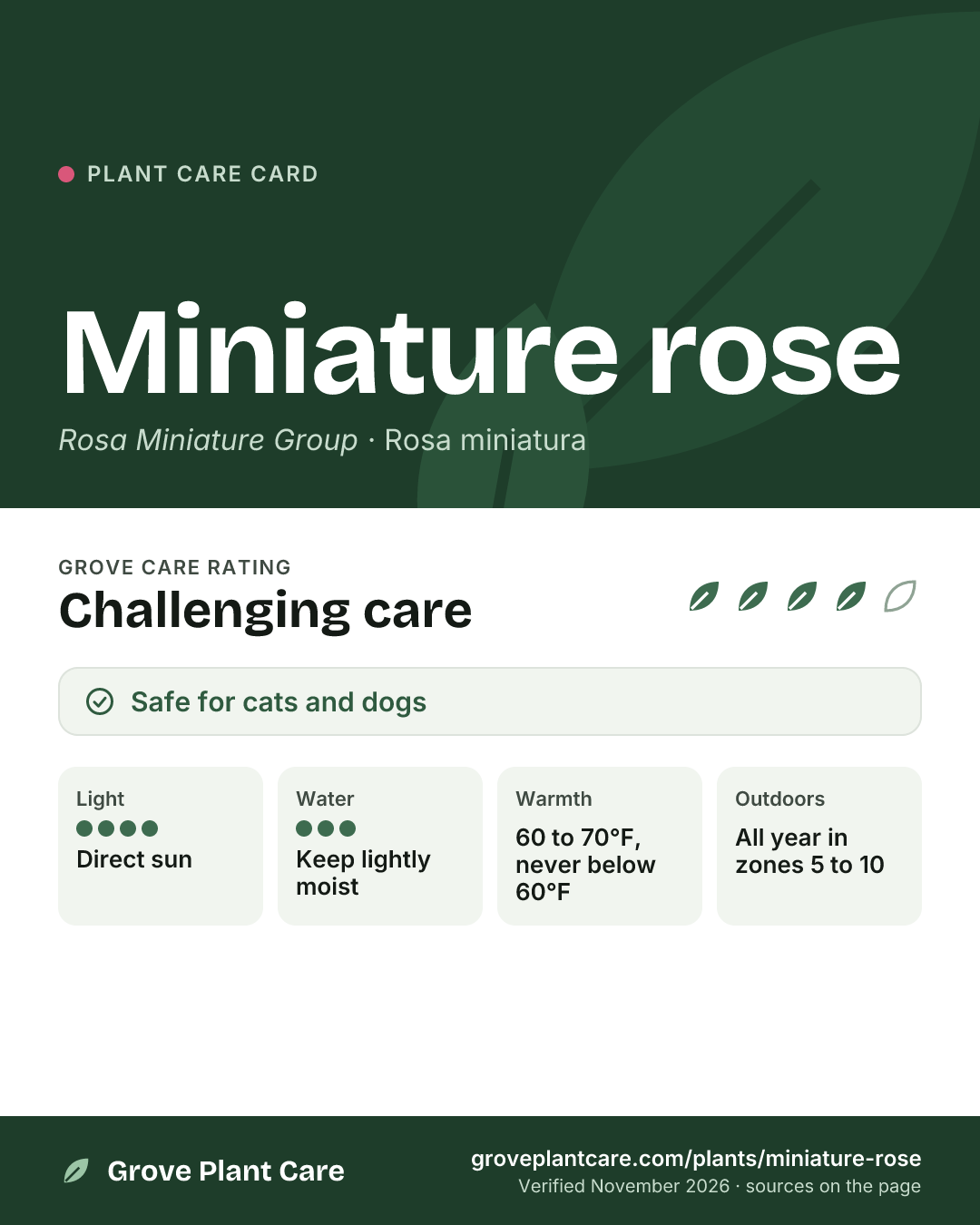
Plant care card
Miniature rose
Rosa Miniature Group · Rosa miniatura
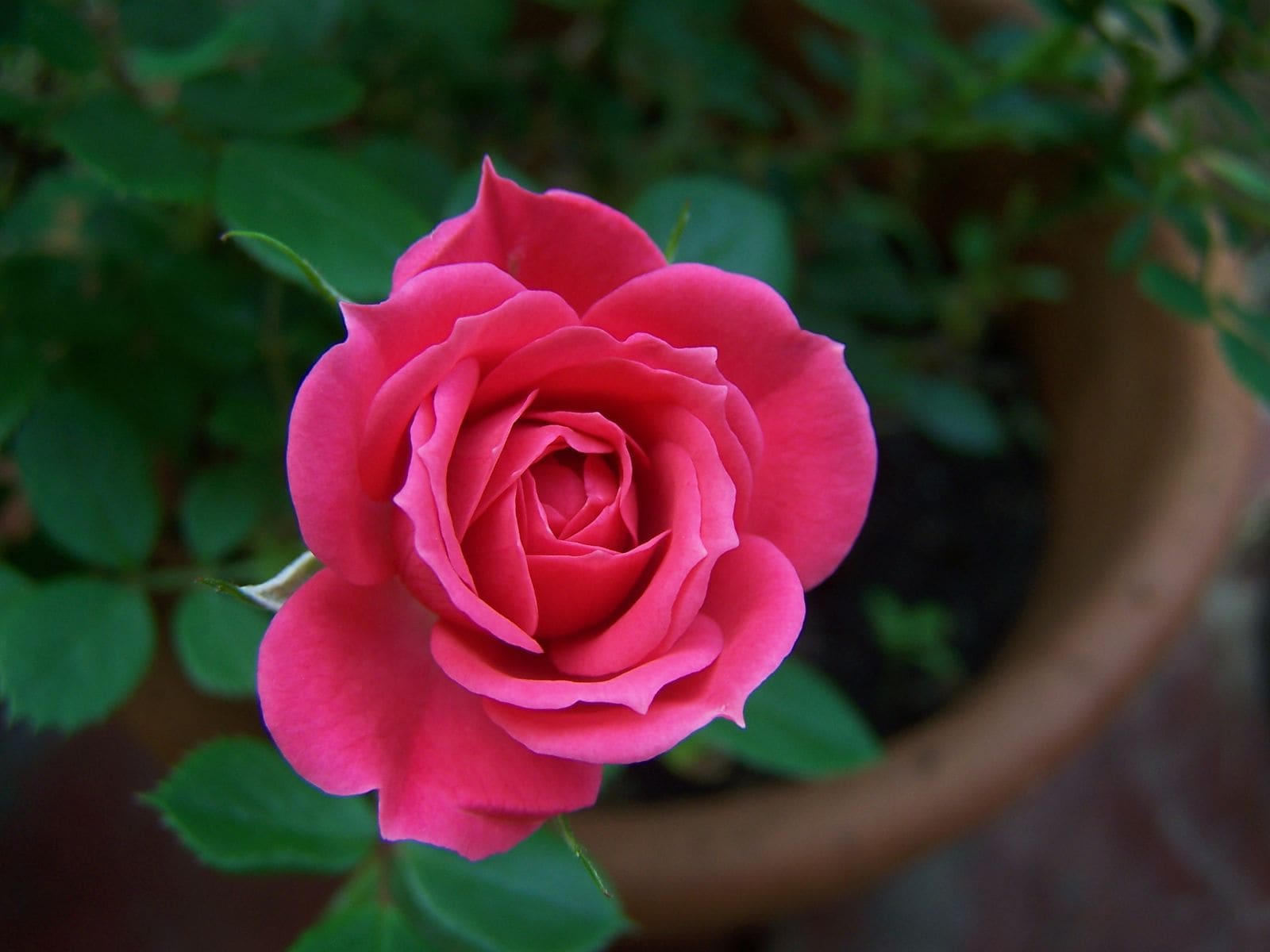
Photo by Gnangarra on Wikimedia Commons, CC BY 2.5 AU

A miniature rose is a real rose in a small size, and it wants what every rose wants: lots of direct sun and soil that never dries out. Indoors that means your sunniest south or west window, a pot you check every few days, and an eye out for spider mites. It's safe for cats and dogs per the ASPCA, though the prickles can hurt. Iowa State suggests moving it outside for the warm months, and it can be planted in the garden.
Non-toxic to cats, dogs and horses
No signs of poisoning listed. The prickles are the risk: chewed or stepped-on stems can hurt and lead to infection. Children: NC State gives no poison rating; it lists prickles as the problem.
Pet poison line: ASPCA (888) 426-4435
Good for: sunny patios and balconies, small spaces, pet-friendly homes · Think twice if: your brightest window gets under 6 hours of sun, nobody can check the soil every few days.
Needs at a glance
- Light4 of 4 · Direct sunA south or west window, 6+ hours; turn the pot weekly
- Water3 of 3 · Keep lightly moistWater when the surface feels dry; empty the saucer
- Humidity2 of 3 · Above averageSet the pot on a tray of wet pebbles indoors
- Soil when pottedRich, well-drained potting mixA pot with drain holes, 1 to 2 times the size of the root ball
Indoors: best at 60 to 70°F (16 to 21°C). Keep it above 60°F (16°C) and away from drafts and heat vents.
How the rating adds up
0 = easiest · 1 = moderate · 2 = hardest
- Missed waterings2 of 2 · HardestKeep the soil evenly moist; small pots dry fast
- Light flexibility2 of 2 · HardestNeeds 6+ hours of direct sun, even indoors
- Humidity1 of 2 · ModerateIndoors, a pebble tray helps; roses like moist air
- Pests and disease1 of 2 · ModerateSpider mites indoors; many minis resist disease
- Sensitivity to change1 of 2 · ModerateEase it into outdoor sun; keep it from drafts and heat
Growing outdoors
All year: USDA zones 5 to 10, where the coldest winter nights average −20°F (−29°C) or warmer.
Elsewhere: summer outside in full sun, after a few days in shade. Bring it in before nights drop below 60°F (16°C).
- Containers, indoors or out
- Front of borders and edging
- Rock gardens
- Hanging baskets
Sources: NC State, Iowa State, NYBG, RHS, UF/IFAS, ASPCA, Illinois Extension, Clemson, Pennsylvania Dept. of Agriculture and Global Invasive Species Database. Full list below.
Verified · How we rate plants
How do I know my rose is a miniature?
Everything is small: the plant, the flowers and the leaves. Iowa State puts miniatures at 6 inches to 3 feet tall, most around 18 inches, and Illinois Extension at 3 to 18 inches. The flowers look like tiny hybrid teas or floribundas, and most bloom over and over. They usually grow on their own roots instead of being grafted, which is why they're sold small in pots. The American Rose Society also has a miniflora class, with flowers and leaves between a miniature and a floribunda. If your rose has big blooms on long stems, see the roses overview to find its group.
Are miniature roses poisonous to cats and dogs?
No. The ASPCA lists roses as non-toxic to cats, dogs and horses. The prickles are still sharp, and the ASPCA warns that a pet that bites, steps on or swallows a prickly stem can get hurt or end up with an infection. Keep the pot where pets can't chew it. NC State gives roses no poison rating and lists the prickles as their problem. If your pet chewed a stem and seems unwell, call your vet or the ASPCA Animal Poison Control Center at (888) 426-4435 (a fee may apply).
Can a miniature rose live indoors?
Yes, with a lot of light. It needs at least 6 hours of direct sun a day, so use a south or west window and turn the pot once or twice a week so it grows evenly. NYBG says fluorescent lights can stand in if they run 6 to 8 hours a day. Keep it near 70°F (21°C) by day and no colder than 60°F (16°C) at night, away from cold drafts and heat vents. NYBG notes roses like moist air, so a tray of wet pebbles under the pot helps. With too little light it gets leggy and stops blooming.
How often should I water a miniature rose?
Often, because a small pot dries out fast. Iowa State says to keep the soil evenly moist: water when the surface feels dry, until water runs out the bottom, then empty the saucer. NYBG says potted roses may need water every other day, and daily if the mix drains fast. UF/IFAS lets the top inch dry once the plant is settled, so check with your finger instead of following a strict schedule. The pot needs drain holes; soggy is as bad as dry.
Why are my miniature rose leaves discolored or webby?
Probably spider mites, the most common pest on roses kept indoors. Look for discolored leaves and fine webbing. Iowa State suggests insecticidal soap, repeated a few times, since one spray rarely gets them all. Long, thin stems and few flowers mean too little light. Many miniatures resist disease well, but outdoors some still get black spot, so pick off spotted leaves.
How do I keep a miniature rose blooming?
Snip off faded flowers, cutting just above the highest leaf with five leaflets, and pull off yellow leaves. Feed it with a weak fertilizer once or twice a month (Iowa State) or monthly (NYBG). Give it as much sun as you can. In late winter, while it rests, cut it back: Illinois Extension treats miniatures like hybrid teas and removes one half to two thirds of the height, and UF/IFAS says never more than two thirds.
Can I plant my miniature rose outside?
Yes. Iowa State suggests moving it out in late spring. Once nights stay above 60°F (16°C), set it in shade for a few days, then move it into more sun bit by bit so it can adjust. You can keep it in its pot on a sunny patio or plant it in the garden in rich soil that drains well. Iowa State says miniatures are hardier than hybrid teas, and Illinois Extension calls them very winter hardy because they grow on their own roots. NC State lists its miniature cultivars for USDA zones 5 or 6 through 9 or 10. In cold areas a thick mulch over winter helps.
Are miniature roses invasive?
No. Garden roses aren't on the official lists we checked. Only a few wild species are, such as multiflora rose, a noxious weed in Pennsylvania that is also in the Global Invasive Species Database.
Pennsylvania Dept. of Agriculture, Global Invasive Species Database
How Grove helps
Grove sets a watering check for your miniature rose, so a small pot that dries out fast gets looked at every few days. You can add turning the pot, feeding and a weekly look under the leaves for spider mites as repeating tasks and assign them to whoever is home.
Sources
- NC State Extension Gardener Plant Toolbox: Rosa 'Beauty Secret' (miniature)
- NC State Extension Gardener Plant Toolbox: Rosa Cupcake 'SPIcup' (miniature)
- NC State Extension Gardener Plant Toolbox: Rosa Starina 'MEIgali' (miniature)
- Iowa State University Extension, Yard and Garden: How do I care for miniature roses? (2025)
- NYBG Mertz Library: Can I keep miniature roses indoors? (2023)
- Royal Horticultural Society: How to grow roses
- UF/IFAS Extension Pasco County: Roses, a care guide (miniature roses, 2026)
- Iowa State University Extension: Rose Types and Cultivars (reviewed 2025)
- ASPCA Animal Poison Control: Rose
- ASPCA: 3 Expert Tips for a Pet-Safe Valentine’s Day (2025)
- ASPCA: Keeping Pets Safe on Valentine’s Day (2016)
- NC State Extension Gardener Plant Toolbox: Rosa
- University of Illinois Extension, Our Rose Garden: Types of Roses
- Clemson Cooperative Extension HGIC 1172: Growing Roses
- Pennsylvania Department of Agriculture: Controlled Plant and Noxious Weed Lists
- Global Invasive Species Database (IUCN ISSG): Rosa multiflora
- Global Invasive Species Database (IUCN ISSG): Rosa bracteata
- Kew WCVP data release (2026-06-04 file), plant_name_id 2902099: Rosa chinensis (incl. R. chinensis var. minima)
- American Rose Society: Rose Classifications (2018)
- University of Illinois Extension, Our Rose Garden: Pruning