Plant care card
Chinese money plant
Pilea peperomioides · Planta del dinero china
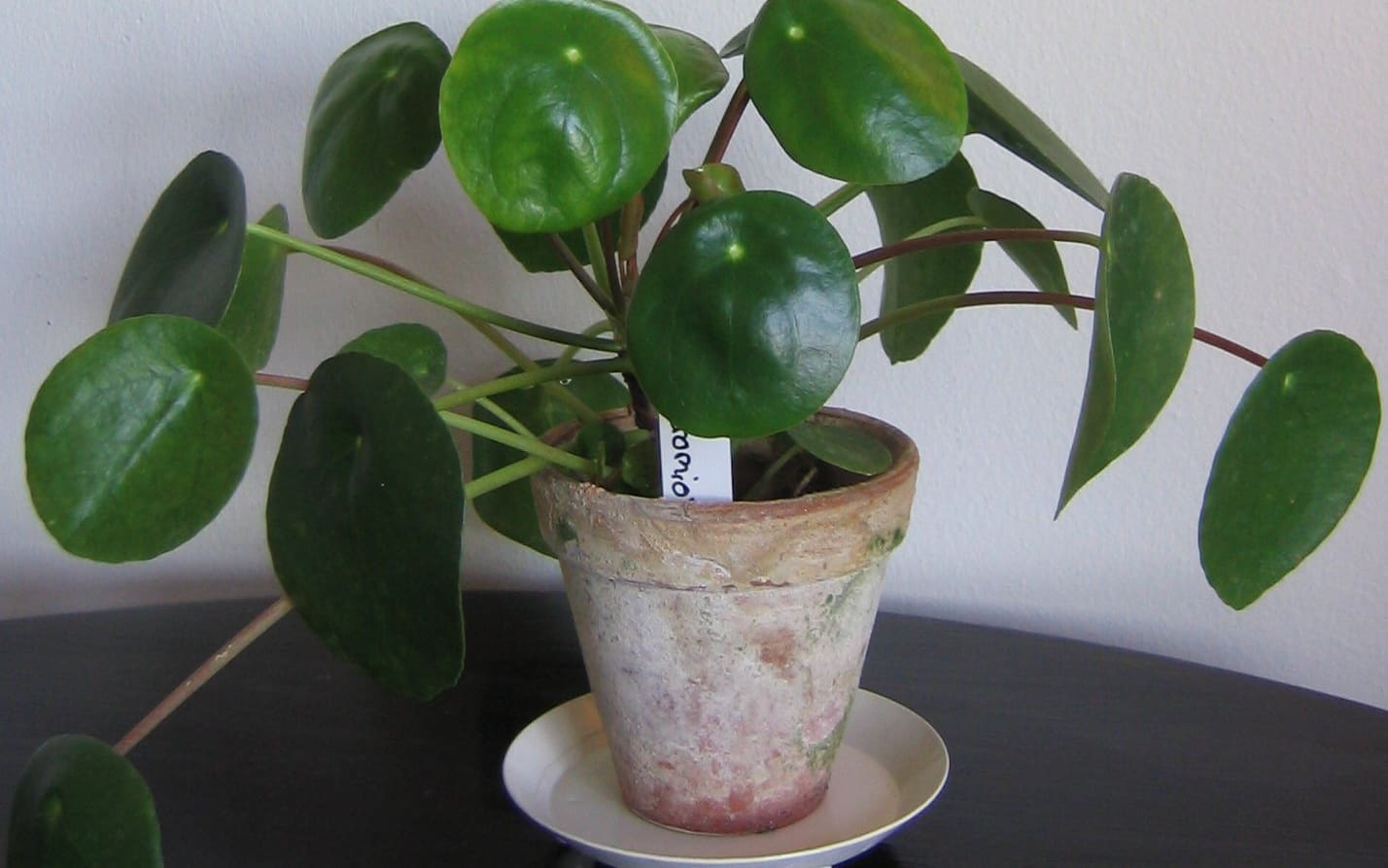
Also called coin plant, missionary plant or pancake plant
Photo by Quackor on Wikimedia Commons, CC BY 3.0

A Chinese money plant wants bright, indirect light and a drink when the top of its mix has dried. Turn the pot a little each time you water so it grows straight, and keep it out of cold drafts. Soggy soil is the classic way to lose one, because the roots rot. Do that and it rewards you with a steady supply of baby plants to share.
Non-toxic to cats and dogs (NC State)
No signs of poisoning listed. The ASPCA’s succulents article also lists it as non-toxic. Any plant can still upset a pet’s stomach if it eats enough. Children: NC State calls it safe for pets and children.
Pet poison line: ASPCA (888) 426-4435
Good for: a bright window out of hot sun, sharing pups with friends, homes with cats and dogs · Think twice if: your only spot gets hours of hot, direct sun, you water on a schedule without checking the soil, you need a plant for a dim corner.
Needs at a glance
- Light3 of 4 · Bright indirectNear an east, west or north window, or set back from a sunny one
- Water2 of 3 · Let the top dryWater when the top of the mix is dry; less in winter; empty the saucer
- Humidity1 of 3 · AverageA normal home is fine
- Soil when pottedFree-draining potting mixA pot with a drain hole, only a little wider than the roots
Indoors: best at 65 to 75°F (18 to 24°C). Keep it above 55°F (13°C) and away from drafts and heat vents.
How the rating adds up
0 = easiest · 1 = moderate · 2 = hardest
- Missed waterings1 of 2 · ModerateWater when the top dries; it curls if left dry and rots if kept wet
- Light flexibility1 of 2 · ModerateBright, indirect light; leggy in dim rooms, flushed red in hot sun
- Humidity0 of 2 · EasiestAverage home air is fine
- Pests and disease1 of 2 · ModerateMealybugs, spider mites, scale and gnats now and then; root rot if wet
- Sensitivity to change0 of 2 · EasiestTakes ordinary room temperatures; keep it out of cold drafts
Growing outdoors
All year: USDA zones 9 to 11, where the coldest winter nights average 20°F (−7°C) or warmer.
Elsewhere: summer outside in bright shade, out of hot sun. Bring it in before nights drop below 55°F (13°C).
- Houseplant
- Container plant
- Patio pot in summer
Sources: NC State, RHS, NYBG, Penn State Extension, ASPCA and USDA zone map. Full list below.
Verified · How we rate plants
How often should I water a Chinese money plant?
Water when the top of the mix has dried, then let the extra drain away. The RHS says to water once the top few centimeters start to dry, and the New York Botanical Garden waits until the top two-thirds of the mix is dry, so check with a finger or by lifting the pot before you pour. Both water less in winter, when growth slows. Never leave the pot standing in a saucer of water: NC State, the RHS and Penn State all name overwatering as the way to rot the roots.
How much light does a Chinese money plant need?
Bright, indirect light. The RHS suggests a north, east or west window, or a spot set back from a south window in summer, and Penn State says a few feet from the glass or behind a sheer curtain. Too little light gives long, leggy stems (NC State), and hot direct sun flushes the leaves red-brown (RHS). Give the pot a quarter turn each time you water so it stops leaning toward the window, a tip from both the RHS and the New York Botanical Garden.
Why are my Chinese money plant’s leaves curling or cupping?
Curled or puckered leaves usually mean something in the routine is off. The RHS names three suspects: too much water, too little water, or too little light. Check the soil first: wet for days points to overwatering, bone dry points the other way. If the watering looks right, move it closer to a bright window, out of direct sun. This cause list comes from the RHS alone, and we found no university source that explains cupped or domed leaves on their own.
Why are the leaves turning yellow or getting spots?
It depends on the pattern. Yellow between the veins suggests the plant is short on nutrients, and the RHS suggests a balanced houseplant feed. A red-brown flush means too much direct sun. Brown to black spots that turn mushy can be bacterial leaf spot, which Penn State links to too much humidity: remove those leaves and improve the air flow. NC State adds that leaves kept wet can get leaf spots, and soggy soil leads to root rot. Tiny white specks under the leaves are usually harmless mineral deposits, says the RHS.
How do I separate Chinese money plant pups?
Wait until a pup is big enough to stand on its own, then detach it and pot it up by itself. That is the RHS and Penn State method for the baby plants that pop up around the base, and NC State says spring or early summer, during active growth, is the best time. Single leaves can root too, in water or in moist compost (RHS). None of these sources gives an exact size, so give the pup a few leaves of its own before you take it.
When should I repot a Chinese money plant?
About every couple of years, in spring. The RHS says a new plant can usually stay put for a year or so; after that, check the roots each spring and move it on when they get crowded. Go only slightly bigger: the RHS says a couple of centimeters, and Penn State says about 2 inches wider than the root ball. An oversized pot holds water too long and rots the roots. Use a free-draining potting mix and a pot with a drain hole.
Is the Chinese money plant safe for cats and dogs?
Yes. NC State calls the Chinese money plant safe for pets and children, and the ASPCA’s article on succulents and pets also lists it as non-toxic. The ASPCA’s plant database has no page for it. Any plant can still upset a pet’s stomach if it eats enough. Watch the name, though: the jade plant, also sold as a money plant, is toxic to cats, dogs and horses, according to the ASPCA.
Can a Chinese money plant grow outdoors?
In summer, yes, and all year only in mild climates. NC State lists USDA zones 9 to 11. The RHS is more cautious: it rates it as a plant that can go outside only in summer, with a minimum of about 5 to 10°C (41 to 50°F), and its growing guide keeps it above 10°C (50°F). Penn State and the New York Botanical Garden keep nights above 55°F (13°C), so bring it in before nights drop that low, and give it bright shade outside, out of hot sun.
Is a Chinese money plant the same as a money tree or jade plant?
No. Money is a popular plant name. The Chinese money plant is Pilea peperomioides, with round leaves held on long stalks attached near the middle of each leaf (NC State). The money tree is Pachira aquatica, a tree often sold with a braided trunk, and NC State lists money plant as one of the jade plant’s names (Crassula ovata, a succulent). The ASPCA lists the jade plant as toxic to cats, dogs and horses, so check the botanical name on the label.
How Grove helps
Grove schedules a check on the soil instead of a fixed watering day, so the pot gets water when the top has dried and nobody soaks it twice. You can add a quarter turn of the pot and a spring root check as tasks you can assign to whoever takes care of the plants that week.
Sources
- NC State Extension Gardener Plant Toolbox: Pilea peperomioides
- RHS: How to grow pilea
- New York Botanical Garden, Mertz Library: Pancake plant (Pilea peperomioides)
- Penn State Extension: Pilea as a houseplant (2025)
- ASPCA: Are succulents safe to have around pets? (2021), non-toxic list
- USDA ARS Plant Hardiness Zone Map (2023)
- RHS plant entry: Pilea peperomioides
- Kew Plants of the World Online: Pilea peperomioides
- Kew: World Checklist of Vascular Plants (June 2026 release), the data behind Plants of the World Online
- ASPCA Animal Poison Control: Jade plant (Crassula argentea)
- NC State Extension Gardener Plant Toolbox: Crassula ovata (jade plant, money plant)
- NC State Extension Gardener Plant Toolbox: Pachira aquatica