Plant care card
Polka dot begonia
Begonia maculata · Begonia maculata
Also called spotted begonia or trout begonia
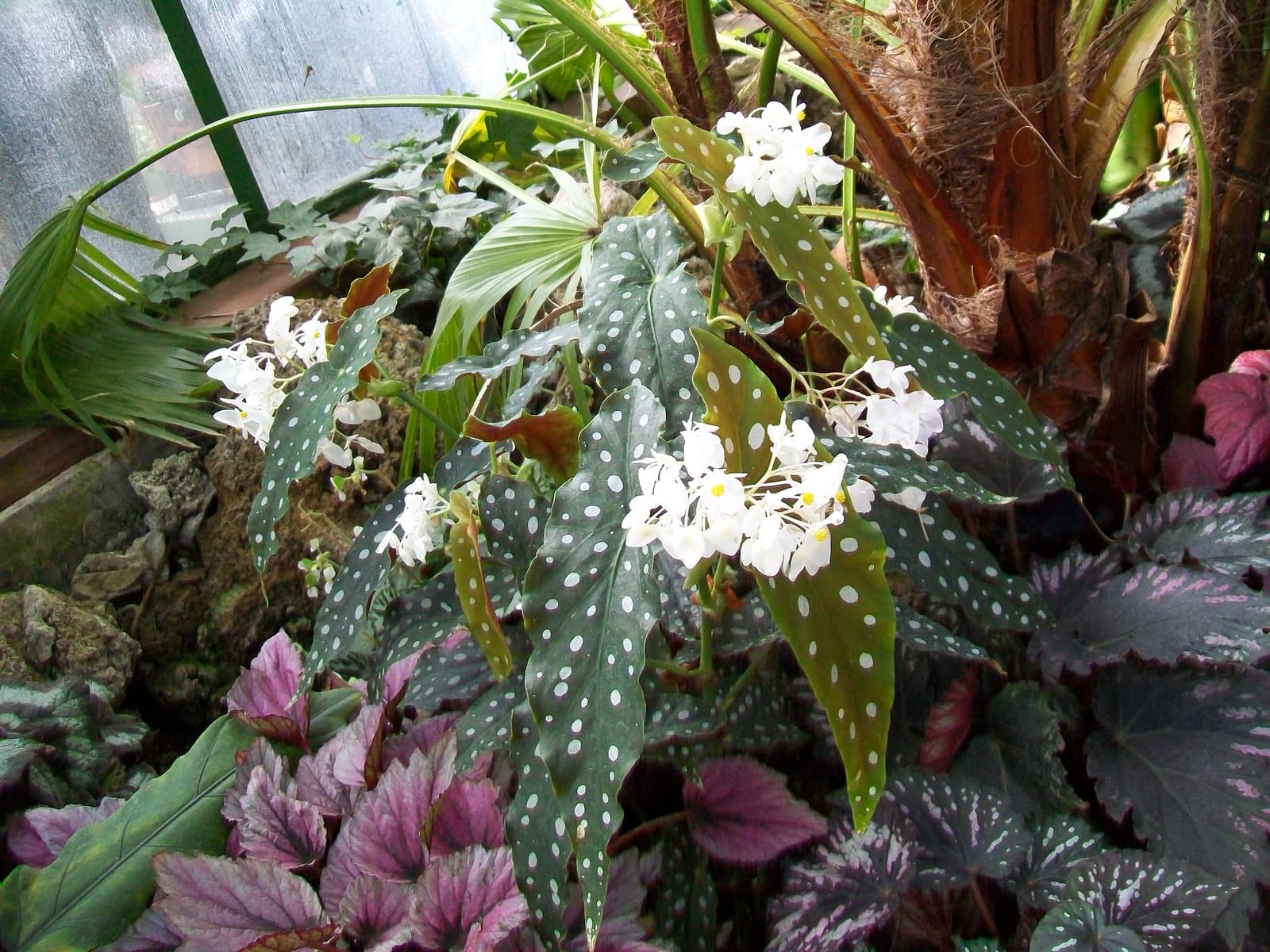
Photo by Antekbojar on Wikimedia Commons, CC0 1.0

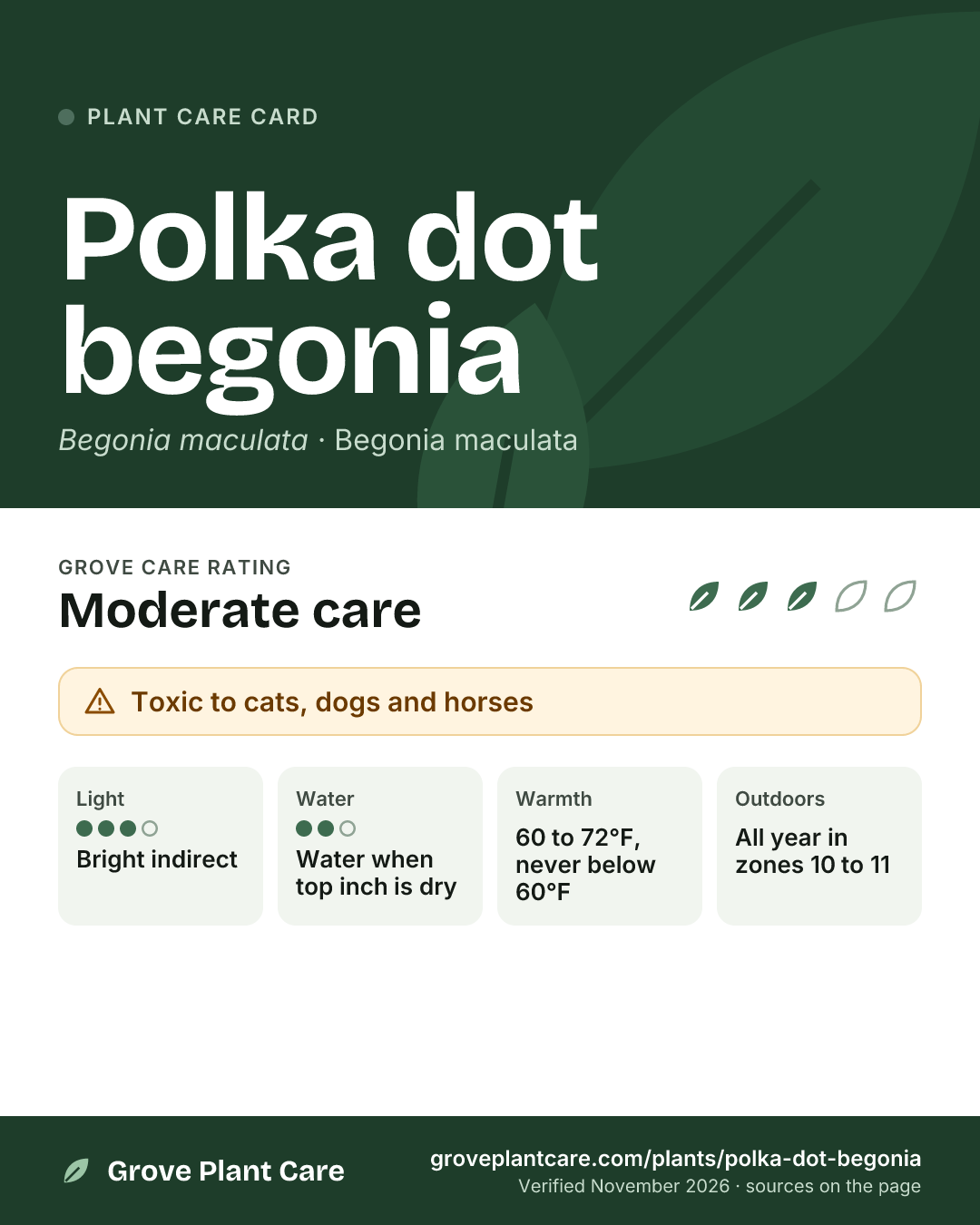
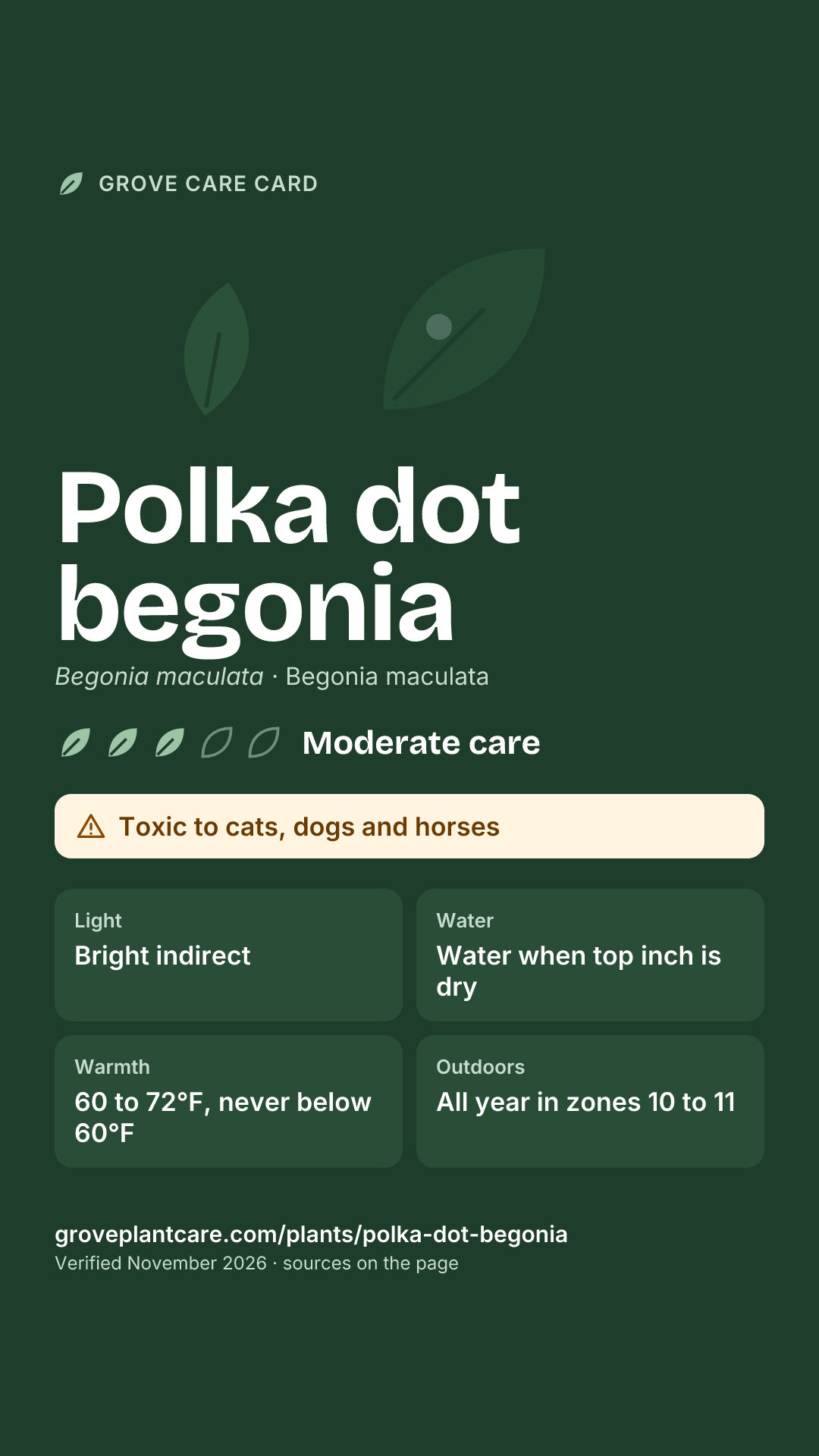
Polka dot begonia (Begonia maculata) is a cane begonia from Brazil with silver-spotted leaves and red undersides. Give it bright, filtered light with no hot direct sun, water when the top inch of soil is dry, and keep it warm, between about 60 and 72°F. It likes moderate humidity with moving air, since soggy soil and stale, damp air are what rot it. Every part is toxic to cats, dogs and horses, so keep it out of reach.
Toxic to cats, dogs and horses · Mild
Vomiting and drooling; the roots are the most toxic part. NC State rates the severity as low. The ASPCA lists all begonias as toxic because of calcium oxalate crystals, and the sap can irritate skin. Children: low severity. NC State lists it as a problem for children with low severity; the sap can irritate skin, so the RHS suggests gloves.
Pet poison line: ASPCA (888) 426-4435
Good for: a bright room with filtered light, pots and hanging baskets, people who want bold leaves and flowers too · Think twice if: pets or small children chew plants, the only free spot gets hot, direct sun, you tend to water a lot.
Needs at a glance
- Light3 of 4 · Bright indirectBright, filtered light with no direct sun from spring to fall; a little more sun in winter
- Water2 of 3 · Let the top inch dryWater well when the top inch is dry and empty the saucer; a bit drier in winter, never bone dry
- Humidity2 of 3 · Above average40 to 60%, with moving air; a pebble tray or a humidifier helps
- Soil when pottedLight, well-drained potting mixPeat-free potting mix rich in organic matter, in a pot with drainage holes
Indoors: best at 60 to 72°F (16 to 22°C). Keep it above 60°F (16°C) and away from drafts and heat vents.
How the rating adds up
0 = easiest · 1 = moderate · 2 = hardest
- Missed waterings1 of 2 · ModerateLet the top inch dry, but never let the pot dry out completely or sit in water
- Light flexibility1 of 2 · ModerateBright, filtered light; hot direct sun scorches the leaves
- Humidity1 of 2 · ModerateLikes 40 to 60% humidity; stale, very humid air invites rot and mildew
- Pests and disease1 of 2 · ModerateMealybugs, spider mites, thrips and whiteflies now and then; powdery mildew and stem rot
- Sensitivity to change1 of 2 · ModerateDrops leaves and flowers near drafts and vents, or after a sudden change in light
Growing outdoors
All year: USDA zones 10 to 11, where the coldest winter nights average 30°F (−1°C) or warmer.
Elsewhere: summer outside in partial shade, out of direct sun. Bring it in before nights drop below 60°F (16°C).
- Houseplant
- Container or hanging basket
- Patio plant in summer
- Garden perennial where frost-free
Sources: NC State, NYBG, RHS, ASPCA, ASPCA plant list, UF/IFAS, USDA zone map, FISC and GISD. Full list below.
Verified · How we rate plants
How often should I water a polka dot begonia?
When the top inch of soil feels dry. The New York Botanical Garden waters thoroughly at that point, in the morning, and empties the saucer after about 15 minutes. The RHS says to keep the mix from drying out completely, to avoid overwatering, and to water less in winter. The RHS plant entry adds that it won’t put up with waterlogged soil, and NC State keeps the soil moist with good drainage. The RHS says most begonias that die at home were overwatered or kept in air that was too dry, so a pot with drainage holes matters as much as the schedule.
How much light does a polka dot begonia need?
Bright, filtered light. The RHS grows it shaded from hot sun, because continuous direct sun scorches the leaves, and says cane begonias need good light for sturdy stems and plenty of flowers. The New York Botanical Garden keeps it out of direct sun from spring to fall, then gives it more sun in winter, near a west or south window. It also suggests changing the light slowly and giving the pot a quarter turn each time you water, so it grows evenly. Outdoors, NC State gives it partial shade.
Does a polka dot begonia need high humidity?
Moderate humidity, with moving air. The New York Botanical Garden aims for 40 to 60% and warns that cane begonias can rot above 60%, so keep air circulating and the leaves dry. NC State says cane begonias do best in high humidity. The RHS stands the pot on a tray of damp gravel with the water just below the surface. Our sources disagree on misting: the New York Botanical Garden lists it as one option, while the RHS says not to mist begonias because damp leaves invite mildew. A pebble tray or a humidifier works for both.
Why is my polka dot begonia dropping leaves?
Usually stress from a change. The New York Botanical Garden says leaves and flowers fall when the plant is stressed, so keep it away from heating and cooling vents and drafty windows or doors, and keep the care routine steady. The RHS names too much humidity, overwatering and low light as causes of leaf drop, and dry air or underwatering as causes of bud drop. Yellow leaves point to low light or watering trouble (RHS). A white powder on the leaves is powdery mildew, which NC State and the RHS both list; better air flow helps prevent it.
How do I propagate a polka dot begonia from cuttings?
With stem cuttings, which NC State calls the easiest way. The RHS takes cuttings 7 to 10 cm (3 to 4 inches) long in April, trims each one just below a leaf joint, and roots them in sandy, peat-free cuttings mix with bottom heat of 18 to 21°C (64 to 70°F). Plants grown from seed come true only for the species; hybrids don’t (NC State).
How do I prune a leggy polka dot begonia?
Cut over-long canes back to 2 or 3 buds in late spring, as both RHS entries for this begonia advise. It grows on upright canes with swollen joints that look like bamboo (NC State), and NC State says stem cuttings are the easiest way to make new plants, so the trimmed pieces need not go to waste. If the whole plant stretches toward the window, it wants more light: the RHS says cane begonias need good light for sturdy stems.
Does a polka dot begonia flower?
Yes. The RHS describes pale pink or white flowers in hanging clusters in summer, and NC State lists white to pink blooms for this species. On the RHS entry for Wightii, the form most often sold, the clusters are pinkish to greenish white with yellow centers. The leaves stay the main show all year: green with silver spots on top and red underneath (RHS, NC State).
Is a polka dot begonia toxic to cats and dogs?
Yes. The ASPCA lists all begonias as toxic to cats, dogs and horses because of soluble calcium oxalates, with vomiting and drooling in cats and dogs, and says the underground parts are the most toxic. NC State rates the severity as low, says the roots are most toxic, and adds that the sap can irritate skin. The RHS suggests gloves when handling it. Keep it where pets and small children can’t chew it. If you think a pet ate some, call your vet or the ASPCA Animal Poison Control Center at (888) 426-4435.
Is a polka dot begonia the same as an angel wing begonia?
It is one kind of angel wing begonia. NC State groups the cane begonias under the names angel wing, polka dot and spotted begonia, and the group includes many hybrids, such as Lucerna and Dragon Wing Red. Polka dot begonia is the species Begonia maculata, with silver spots and red undersides. Its old name Begonia argyrostigma still shows up on labels (RHS), and Wightii is the narrow-leaved form most stores sell. The wax begonia, Begonia cucullata, is a different plant, and it is the begonia on Florida’s invasive plant list (FISC).
Can a polka dot begonia grow outdoors?
Yes, all year in USDA zones 10 and 11, where the coldest nights stay at 30°F (−1°C) or warmer (NC State, UF/IFAS), and in summer anywhere else. NC State says to protect it from frost and from direct sun outdoors, and the RHS rates it as a plant that can go outside in summer. Give it partial shade on a patio or porch, and bring it in before nights fall below 60°F (16°C), the low end of the indoor range the New York Botanical Garden recommends.
How Grove helps
Grove schedules a soil check so you water when the top inch is dry and not before. You can add a quarter turn of the pot, a pebble tray refill and a late-spring cane trim as tasks you can assign, plus a reminder to bring it inside before cool fall nights if it spends the summer outdoors.
Sources
- NC State Extension Gardener Plant Toolbox: Begonia, Cane Types (Begonia maculata, polka dot begonia)
- New York Botanical Garden, Mertz Library: Why are the leaves and flowers falling off my cane begonia?
- RHS: Begonias as houseplants (cane-stemmed begonias)
- RHS plant entry: Begonia maculata
- ASPCA Animal Poison Control: Begonia
- ASPCA Animal Poison Control: Toxic and Non-Toxic Plants
- UF/IFAS Extension Santa Rosa County: Polka Dot Begonia, Cane Types (2025)
- USDA ARS Plant Hardiness Zone Map (2023)
- Florida Invasive Species Council: Plant List, Category I and II and Watch List (April 2026)
- IUCN Global Invasive Species Database: Begonia maculata (no entry)
- Kew WCVP data release (2026-06-04 file), plant_name_id 362239: Begonia maculata
- RHS plant entry: Begonia maculata 'Wightii'