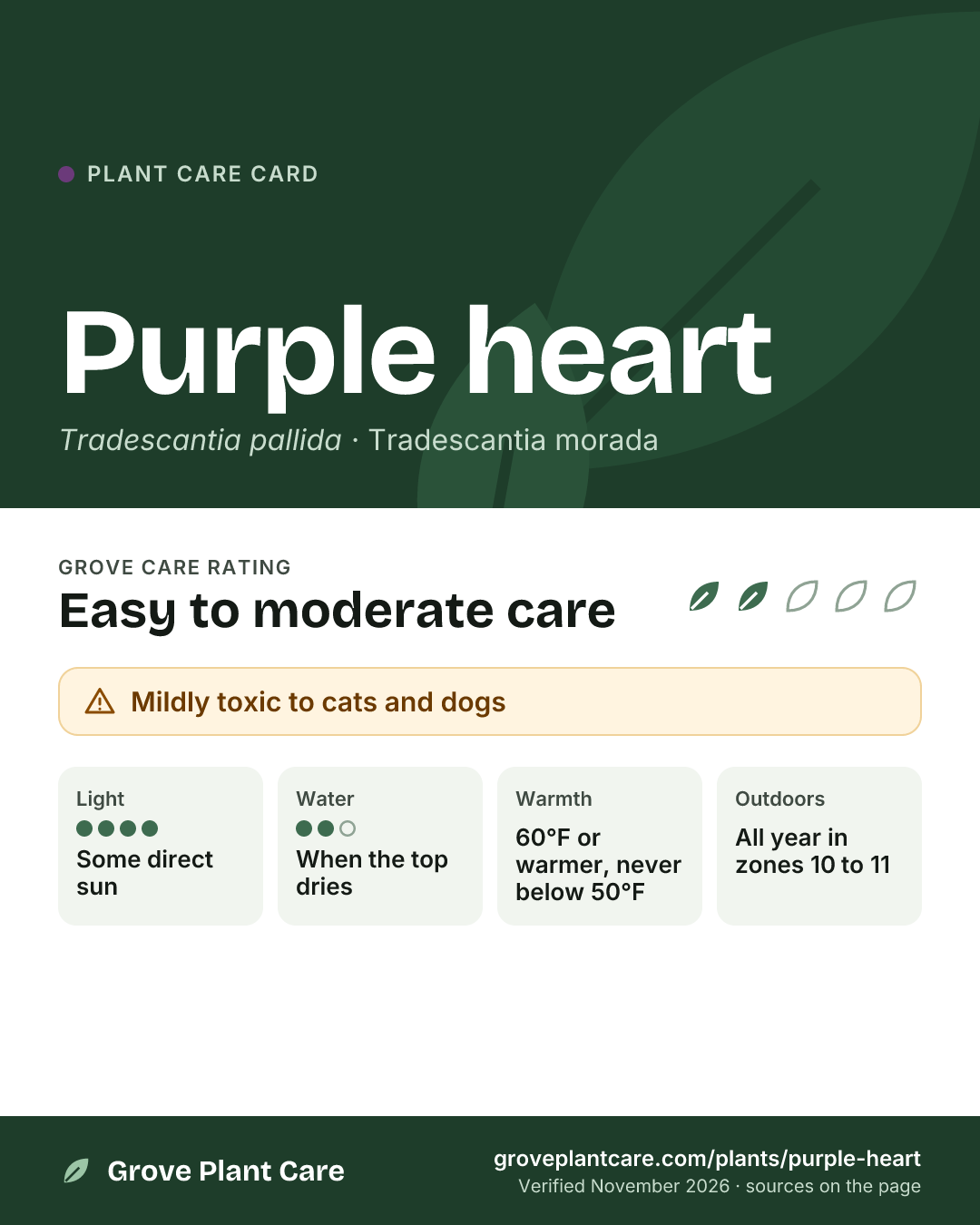
Plant care card
Purple heart
Tradescantia pallida · Tradescantia morada
Also called purple queen, purple spiderwort or setcreasea
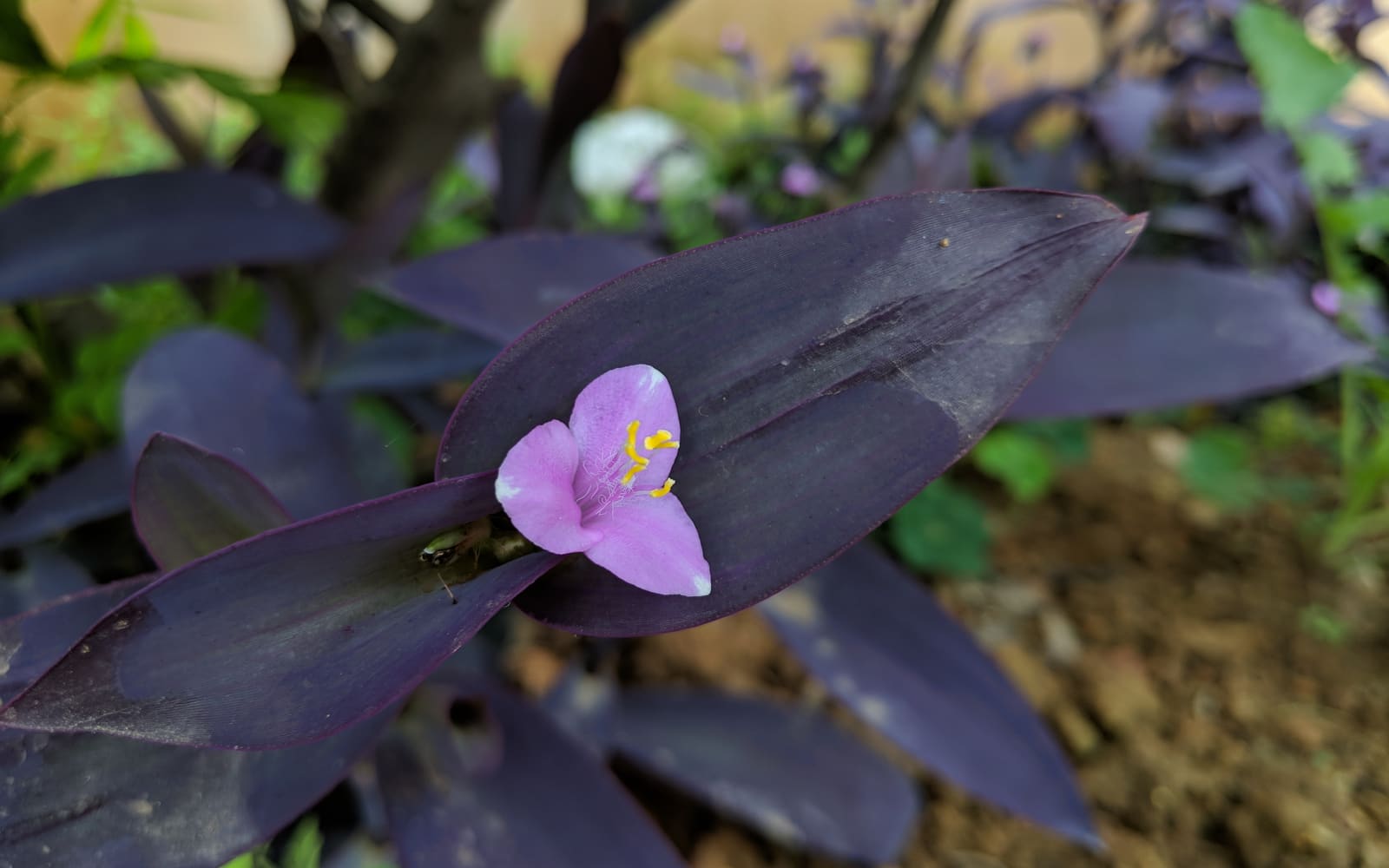
Photo by Sun Jiao (Interaccoonale) on Wikimedia Commons, CC BY 4.0

Purple heart (Tradescantia pallida, once sold as Setcreasea) is a tough, trailing plant with dark purple leaves. Give it sun or the brightest window you have, let the top of the soil dry between waterings, and keep it above 50°F (10°C). In shade it turns green and leggy. NC State lists it as mildly toxic to cats and dogs, and the sap can irritate skin, so wear gloves when you trim it. It spreads fast in the ground, and Queensland lists it as a weed.
Mildly toxic to cats and dogs (NC State)
Mouth and stomach irritation if chewed; the sap can redden skin. The ASPCA list leaves it out but rates two close relatives as toxic; NC State rates it low severity. Children: low severity. NC State rates it low severity; chewing irritates the mouth and stomach, and the sap can cause a skin rash.
Pet poison line: ASPCA (888) 426-4435
Good for: sunny windows, hanging baskets, purple color all year · Think twice if: pets or small children chew plants, your skin reacts to plant sap, you garden where it is listed as a weed, such as Queensland.
Needs at a glance
- Light4 of 4 · Some direct sunSun gives the deepest purple; in shade the leaves turn greener
- Water2 of 3 · Let the top dryWater moderately while it grows, sparingly in winter
- Humidity1 of 3 · AverageCopes with dry indoor air
- Soil when pottedWell-drained potting mixMoist but well-drained, with some organic matter
Indoors: best at 60°F (16°C) or warmer. Keep it above 50°F (10°C) and away from drafts and heat vents.
How the rating adds up
0 = easiest · 1 = moderate · 2 = hardest
- Missed waterings0 of 2 · EasiestDrought tolerant; it shrugs off a missed watering
- Light flexibility2 of 2 · HardestNeeds bright light or some sun; in shade it turns green and leggy
- Humidity0 of 2 · EasiestNormal home air is fine
- Pests and disease1 of 2 · ModerateNow and then scale, mealybugs, aphids or spider mites; few diseases
- Sensitivity to change0 of 2 · EasiestEasygoing; the stems are brittle, so handle it gently
Growing outdoors
All year: USDA zones 10 to 11, where the coldest winter nights average 30°F (−1°C) or warmer.
Elsewhere: summer outside in sun or part shade; more sun, deeper purple. Bring it in before nights drop below 50°F (10°C).
Invasive in: Queensland (Australia). Queensland lists it as an environmental weed, and NC State says it tends to spread through beds. Grow it in pots there and never dump cuttings outdoors. Lists checked .
- Hanging baskets and containers
- Summer bedding, pulled or potted up before frost
- Houseplant in a sunny window
Sources: NC State, UW-Madison Extension, Texas Tech, UF/IFAS Charlotte County, RHS, NParks Singapore, UF/IFAS Nassau County, ASPCA, ASPCA plant list, Clemson, USDA zone map, Queensland Government, Rojas-Sandoval and Acevedo-Rodríguez, UF/IFAS Assessment, FISC, Hawaii noxious weed list, Texas Department of Agriculture and Cal-IPC. Full list below.
Verified · How we rate plants
Is purple heart toxic to cats and dogs?
Mildly. The ASPCA list doesn't include purple heart, but it rates two close relatives, inch plant and Tahitian bridal veil, as toxic to cats and dogs, with skin irritation as a sign. NC State lists purple heart itself as a problem for cats, dogs and children and rates the severity as low: chewing it can irritate the mouth and stomach, and the sap and leaves can cause a skin rash. UW-Madison Extension says the sap may redden the skin of some people and dogs, though that isn't common. Keep it where pets can't chew it. If a pet eats some, call your vet or the ASPCA Animal Poison Control Center at (888) 426-4435. If a child eats some, call Poison Help at 1-800-222-1222.
Does purple heart sap irritate skin?
It can. The RHS lists purple heart as a skin allergen and says to wear gloves when you handle it. NC State says the sap and leaves can cause skin irritation and contact dermatitis, and UF/IFAS Extension in Charlotte County suggests garden gloves for the same reason. UW-Madison Extension adds that it doesn't happen to everyone. Wear gloves when you pinch, prune or take cuttings, and wash your hands afterward.
RHS, NC State, UF/IFAS Charlotte County, UW-Madison Extension
How much sun does purple heart need?
As much as you can give it. NC State and UW-Madison both say full sun brings out the best purple, and in shade the leaves turn greener. It still grows in part shade, so a bed that gets half a day of sun works. Indoors, put it in your sunniest window. The RHS grows it in bright filtered light under glass and warns that direct sun there can scorch the leaves, so move a plant into stronger sun a little at a time. Green, stretched stems are its way of asking for more light.
NC State, UW-Madison Extension, UF/IFAS Charlotte County, RHS, Texas Tech
How often should I water purple heart?
Not often. NC State, Texas Tech and UW-Madison all call it drought tolerant once it's settled, and UF/IFAS Extension says to water beds until they're established, then only during long dry spells. In a pot, water when the top of the soil has dried and let the extra drain away. The RHS says to water moderately while it grows and sparingly in winter, and UW-Madison agrees: cut back in winter. Use a well-drained mix; NC State says it wants moist soil that drains well, never a soggy pot.
NC State, Texas Tech, UW-Madison Extension, UF/IFAS Nassau County, RHS
Can purple heart grow indoors?
Yes. NC State and Texas Tech both list it as a houseplant, and the RHS grows it as a houseplant or in pots brought in for winter. Indoors the light is the hard part: give it your brightest window or it will turn green and lanky. Keep it above 50°F (10°C), the coldest NC State says it tolerates, water sparingly in winter, and skip feeding until new growth starts in spring, as UW-Madison suggests. Dry indoor air doesn't bother it.
NC State, Texas Tech, RHS, UW-Madison Extension, NParks Singapore
How do I keep purple heart full instead of leggy?
Pinch and trim. UW-Madison says pinching the tips keeps it compact and cutting it back after it flowers stops it from getting spindly. The RHS also says to pinch out the growing tips, and to remove any plain green shoots. Its stems are brittle and snap easily, so handle it gently and don't put it where people brush past. Plenty of sun is the other half: shade makes long, weak stems.
How do I propagate purple heart?
From stem cuttings, which root very easily. NC State says the stems root at the nodes, and UF/IFAS Extension calls it extremely easy because the brittle stems root at every node. UW-Madison says to push a node into loose potting mix or root a cutting in water, and the RHS suggests tip cuttings in spring or summer. Seed is rarely available. Put leftover stems in the trash, since pieces dropped on the ground can root.
NC State, UF/IFAS Charlotte County, UW-Madison Extension, RHS
Can purple heart grow outdoors, and is it invasive?
It lives outdoors all year in USDA zones 10 and 11 (NC State; UW-Madison says zone 10). A light frost can kill the tops, but UF/IFAS Extension says it quickly regrows from the roots in spring, and UW-Madison says plants in colder areas die back and return. In colder places it's grown as summer bedding or in pots: bring pots in before nights drop to 50°F (10°C), the point NC State and Clemson give for cold damage. It does spread. NC State says it tends to become invasive in beds, and UF/IFAS Extension calls it aggressive. The Queensland Government lists it as a naturalized environmental weed, and a peer-reviewed study counts it among the invasive plants of Puerto Rico and the Virgin Islands. Florida's invasive plant list, Hawaii's noxious weed list, Texas's noxious plant list and the Cal-IPC Inventory don't name it (checked November 2026). Where it's listed, keep it in pots, and everywhere, bag your trimmings.
NC State, UW-Madison Extension, UF/IFAS Nassau County, USDA zone map, Clemson, UF/IFAS Charlotte County, Queensland Government, Rojas-Sandoval and Acevedo-Rodríguez, FISC, Hawaii noxious weed list, Texas Department of Agriculture, Cal-IPC, UF/IFAS Assessment
Is purple heart the same as wandering jew or Moses in the cradle?
No, though the names get mixed up. UF/IFAS Extension explains that the trailing plant sold as wandering jew is a different species, Tradescantia zebrina: its leaves are striped with silver and it wants shade, while purple heart is solid purple and likes sun. Some lists, including NC State's, also give purple heart the name Moses in the basket, but UW-Madison notes that name usually means another plant, Tradescantia spathacea (Moses in the cradle or oyster plant), which Florida lists as invasive. Check the botanical name on the tag.
How Grove helps
Grove sets a watering check based on how dry the soil is, so purple heart gets water only after the top has dried. You can add pinching back as a repeating task and assign it, and the reminder can say to wear gloves and bag the cuttings.
Sources
- NC State Extension Gardener Plant Toolbox: Tradescantia pallida (purple heart)
- University of Wisconsin-Madison Extension: Purple heart, Tradescantia pallida (S. Mahr, revised 2025-05-18)
- Texas Tech University Plant Database: Purple Heart, Setcreasea (Tradescantia pallida)
- UF/IFAS Extension Charlotte County: A truly purple "evergreen" (R. Mitchell, 2018, updated 2022)
- Royal Horticultural Society: Tradescantia pallida (purple-heart spiderwort)
- National Parks Board Singapore, Flora & Fauna Web: Tradescantia pallida
- UF/IFAS Extension Nassau County: What is the difference between purple heart and wandering jew? (2017, updated 2022)
- ASPCA Animal Poison Control: Inch Plant (Tradescantia fluminensis), toxic, dermatitis
- ASPCA Animal Poison Control: Tahitian Bridal Veil (Tradescantia multiflora), toxic
- ASPCA Animal Poison Control: Toxic and Non-Toxic Plants
- Clemson Cooperative Extension HGIC 1454: Moving Houseplants Indoors and Outdoors
- USDA ARS Plant Hardiness Zone Map (2023)
- Royal Horticultural Society: Tradescantia pallida 'Purpurea' (purple spiderwort)
- Queensland Government WildNet species database: Tradescantia pallida, naturalised in Queensland, environmental weed
- J. Rojas-Sandoval and P. Acevedo-Rodríguez (2015), Naturalization and invasion of alien plants in Puerto Rico and the Virgin Islands, Biological Invasions 17 (supplementary list)
- UF/IFAS Assessment of Non-Native Plants: Tradescantia pallida (assessment incomplete)
- Florida Invasive Species Council: Plant List, Category I (April 2026)
- Hawaii Administrative Rules 4-68: plant species designated as noxious weeds (Hawaii Department of Agriculture)
- Texas Department of Agriculture: Noxious and Invasive Plant List, 4 TAC §19.300(a)
- California Invasive Plant Council: Cal-IPC Inventory
- Kew WCVP data release (2026-06-04 file), plant_name_id 270389: Tradescantia pallida