Plant care card
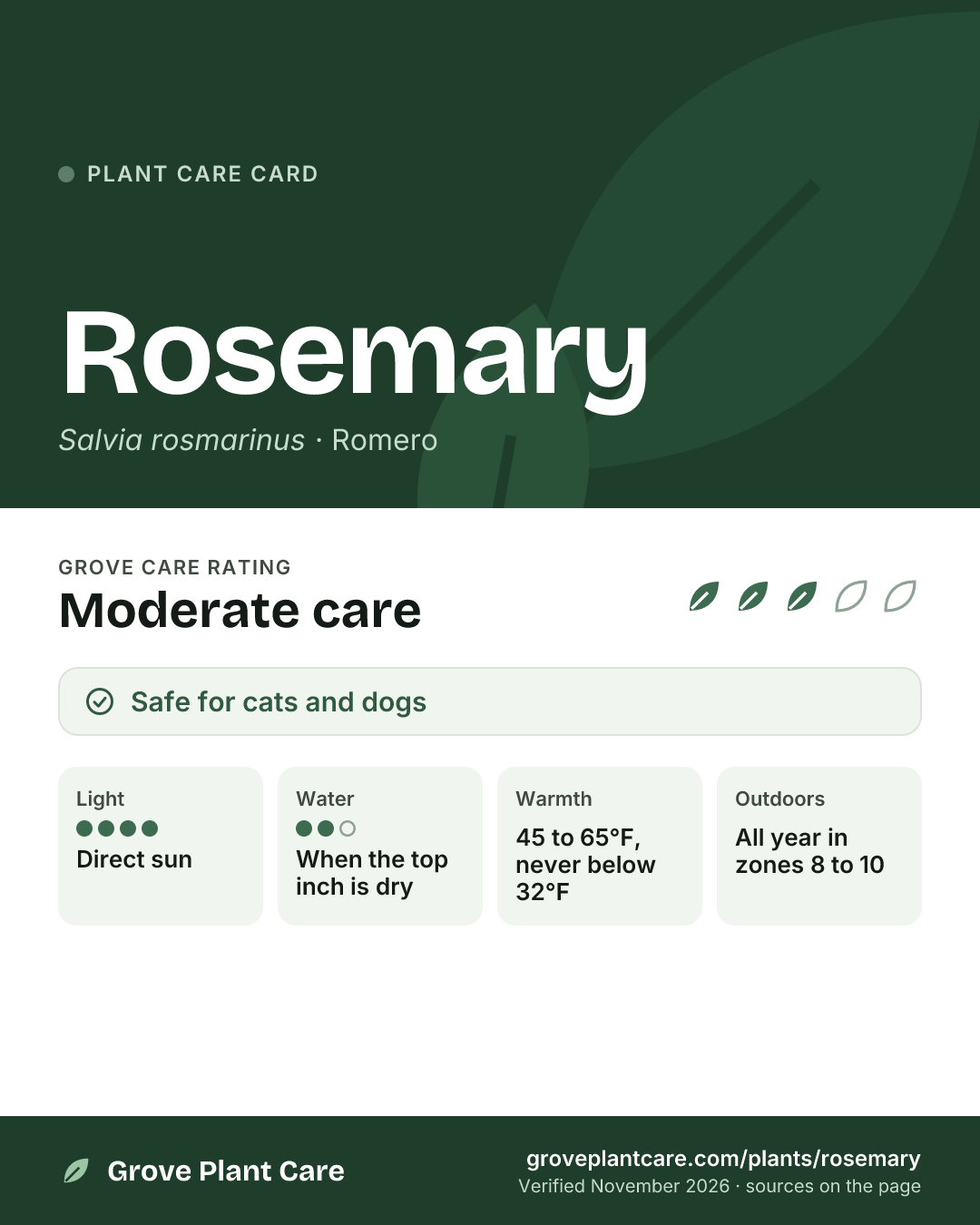
Rosemary
Salvia rosmarinus · Romero
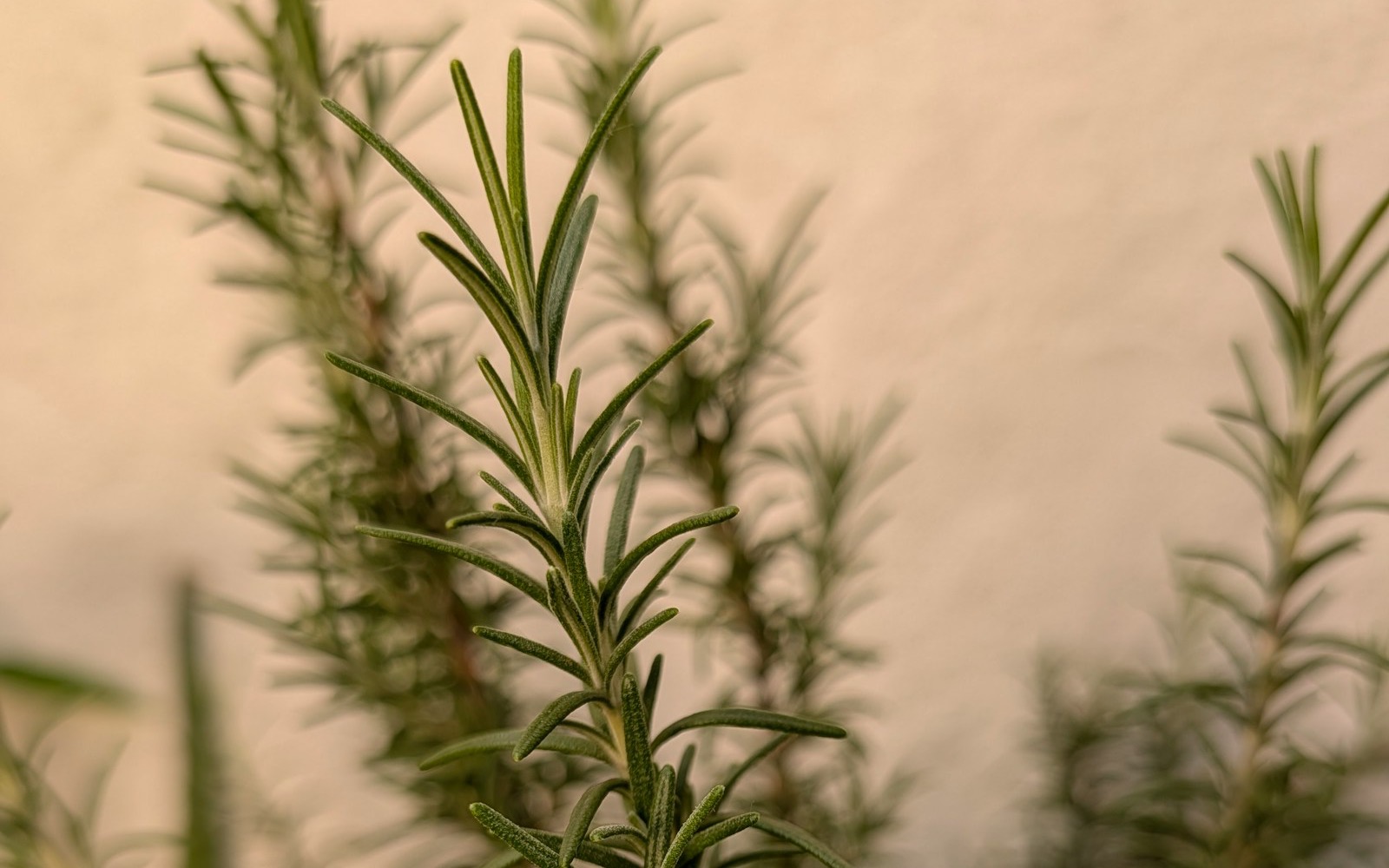
Photo by Sebastian Lopez on Unsplash
Rosemary is a sun-loving Mediterranean shrub, so indoors it wants your sunniest window or a grow light, a cool room and soil that dries a little between waterings. Most potted rosemary that dies indoors in winter gets too little light, too much water or hot, dry air from a heater. Outdoors it grows all year in USDA zones 8 to 10, and the ASPCA lists it as non-toxic to cats, dogs and horses.
Non-toxic to cats, dogs and horses
No signs of poisoning listed. Eating a lot of any plant can still upset a pet’s stomach. Children: A kitchen herb; NC State lists no toxicity.
Pet poison line: ASPCA (888) 426-4435
Good for: snipping for cooking, very sunny kitchen windows, pollinator gardens in mild climates · Think twice if: your sunniest window gets under 6 hours of sun, your home runs warm and dry in winter.
Needs at a glance
- Light4 of 4 · Direct sun6 hours of direct sun, or a grow light
- Water2 of 3 · Let the top inch dryCheck once or twice a week; never soggy
- Humidity2 of 3 · Above averageAway from heaters, with air moving around it
- Soil when pottedFast-draining mixPotting mix with extra perlite or grit; a clay pot helps
Indoors: best at 45 to 65°F (7 to 18°C). Keep it above 32°F (0°C) and away from drafts and heat vents.
How the rating adds up
0 = easiest · 1 = moderate · 2 = hardest
- Missed waterings1 of 2 · ModerateDries fast in a pot, yet rots if kept wet
- Light flexibility2 of 2 · HardestNeeds direct sun or a grow light
- Humidity1 of 2 · ModerateDry heated air browns it; still, humid air brings mildew
- Pests and disease1 of 2 · ModerateMites, aphids and powdery mildew indoors
- Sensitivity to change1 of 2 · ModerateDislikes heat vents and being dug up and potted
Growing outdoors
All year: USDA zones 8 to 10, where the coldest winter nights average 10°F (−12°C) or warmer.
Elsewhere: summer outside in full sun, 6+ hours. Bring it in before nights drop below 32°F (0°C).
- In the ground
- Containers
- Low hedges and borders
- Deer resistant
Sources: NC State, UNH Extension, Illinois Extension, UW Extension, Penn State, UF/IFAS, ASPCA, RHS, USDA zone map and USDA PLANTS. Full list below.
Verified · How we rate plants
Is rosemary safe for cats and dogs?
Yes. The ASPCA lists rosemary as non-toxic to cats, dogs and horses, and NC State tags it non-toxic for all three. Non-toxic means low risk: eating a lot of any plant can still upset a pet's stomach. If your pet seems unwell after chewing a plant, call your vet.
How often should I water rosemary indoors?
Check the soil once or twice a week instead of watering on a schedule. Push a finger about an inch down, and when it feels dry, water until it runs out the bottom. Take off any foil wrap and empty the saucer so the roots never sit in water. Too much water is the most common way rosemary dies, but a pot that dries out completely suffers too, and curled leaves are the sign. In a cool room it drinks less.
How much light does rosemary need indoors?
Lots. Think of me as a plant from a sunny Mediterranean hillside: I want about 6 hours of direct sun a day, which usually means a south-facing window. If you don't have that, a grow light works. Penn State Extension's general herb advice is to set plants 6 to 12 inches below fluorescent tubes for 14 to 16 hours a day. Turn the pot every week so each side gets light. Too little light gives thin, floppy stems with small leaves.
What temperature does rosemary like indoors in winter?
Cool. UNH Extension found that a room around 45 to 55°F (7 to 13°C) helps it survive, and UW Extension suggests keeping a gift plant at 65°F (18°C) or below. Keep it away from heat vents and radiators, because hot, dry air shrivels the leaves. A bright, unheated porch or garage can work as long as it stays above freezing (32°F, 0°C).
Why is my rosemary dying indoors?
Usually one of four things. Soggy soil rots the roots, and browning tips can be the first sign, so let the top dry before you water again. Too little light makes it weak and thin, so move it to your sunniest window or add a grow light. Hot, dry air from a heater browns the tips and dries out twigs, so move it somewhere cooler; a humidifier or a tray of wet pebbles helps if the air is very dry. Last, check under the leaves for spider mites, aphids and mealybugs. UNH Extension suggests spraying spider mites off with a strong stream of water every day or so.
NC State, Penn State, Illinois Extension, UW Extension, UNH Extension
What is the white powder on my rosemary?
Most likely powdery mildew, a fungus that shows up as a white dusting on the leaves. It thrives in humid, still air, which is easy to create indoors in winter. NC State and Penn State both point to air circulation as the fix: give the plant space, don't crowd it with other pots, and keep air moving around it.
Can I plant my rosemary outside?
Yes, all year in USDA zones 8 to 10, where the coldest winter nights average 10°F (−12°C) or warmer. NC State lists zones 8a to 10b and Penn State 8 to 10. A few hardier types, such as 'Arp' and 'Madeline Hill', are rated to zone 7a by UW Extension, and the RHS says established plants take about 18°F (−8°C). Plant it in spring in full sun and soil that drains fast; on heavy soil, use a raised bed, because wet roots in winter kill it. In colder places, keep it in its pot, set it outside in full sun for the summer, and bring it in before nights reach 32°F (0°C), ideally 2 to 3 weeks before the first frost. Rosemary dug out of the ground and potted in fall often doesn't survive the move.
NC State, Penn State, UW Extension, RHS, UNH Extension, Illinois Extension
How do I propagate rosemary?
Take 4 to 6 inch tip cuttings from shoots without flowers in late spring or summer. Strip the lower leaves, dip the ends in rooting hormone if you have it, and root them in perlite or a light, soilless mix. With gentle bottom heat they can root in 10 to 20 days. Seed is slow and unreliable, so cuttings are the better bet.
How Grove helps
Grove sets a watering check instead of a fixed schedule, so nobody waters a pot that is still damp. You can add a weekly turn-the-pot task and a fall reminder to bring it in before the first frost, and assign them to whoever is home.
Sources
- NC State Extension Gardener Plant Toolbox: Salvia rosmarinus
- UNH Extension: Houseplant Winter Care Q&A (2020)
- Illinois Extension: Herb Gardening, Rosemary
- UW-Madison Extension Kenosha County: Holiday Rosemary (2020)
- Penn State Extension: Herb Garden Plants: Rosemary (2026)
- Penn State Extension: Growing Herbs Indoors (2024)
- UF/IFAS Gardening Solutions: Rosemary
- University of Wisconsin-Madison Extension: Rosemary (2026)
- ASPCA Animal Poison Control: Rosemary
- Royal Horticultural Society: How to grow rosemary
- USDA ARS Plant Hardiness Zone Map (2023)
- USDA PLANTS Database: Rosmarinus officinalis
- University of Maryland Extension: Rosemary
- Folger Shakespeare Library: Hamlet, Act 4, Scene 5