Plant care card
Shield aralia
Polyscias scutellaria · Polyscias
Also called dinner plate aralia or Fabian aralia
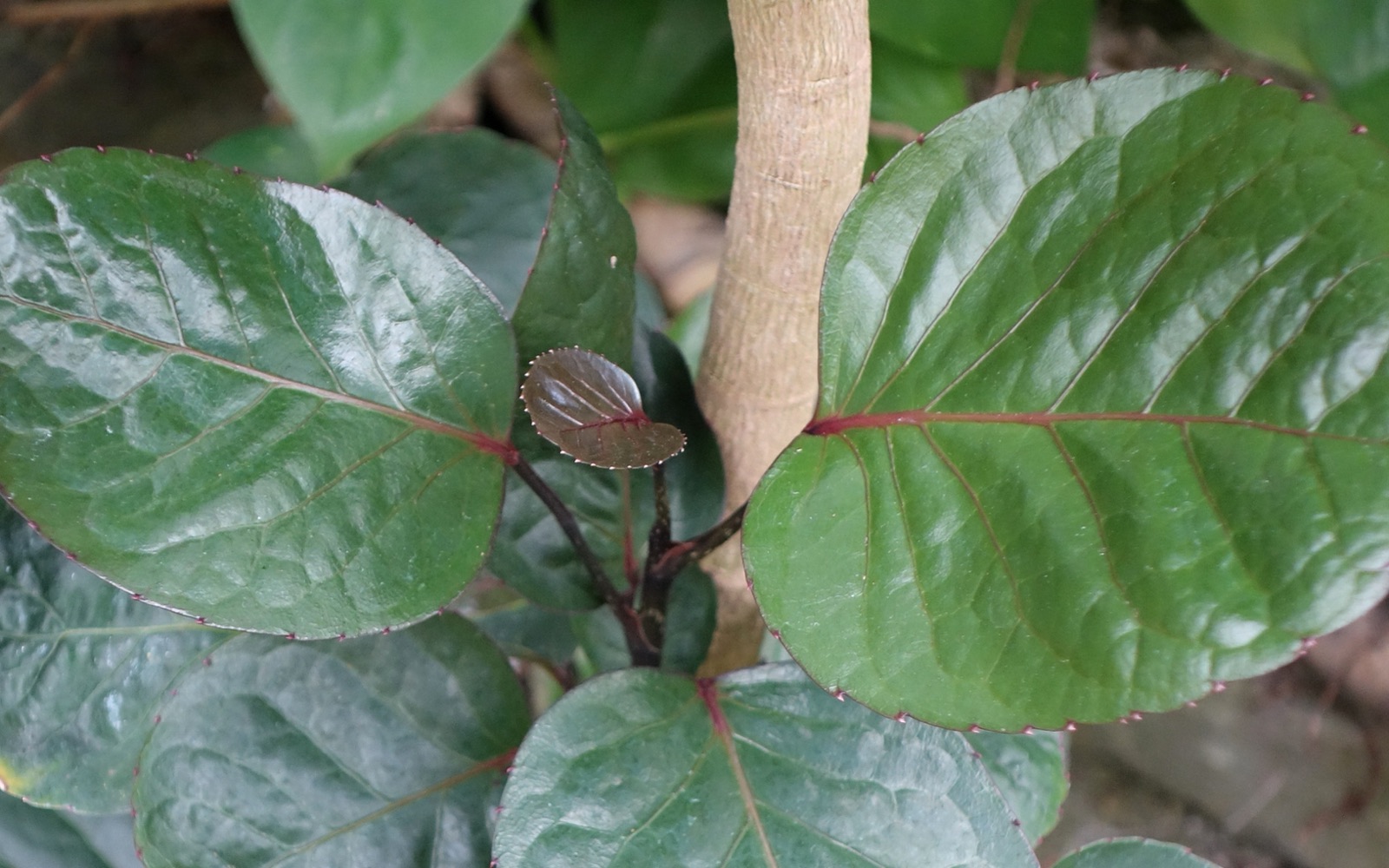
Photo by Daderot on Wikimedia Commons

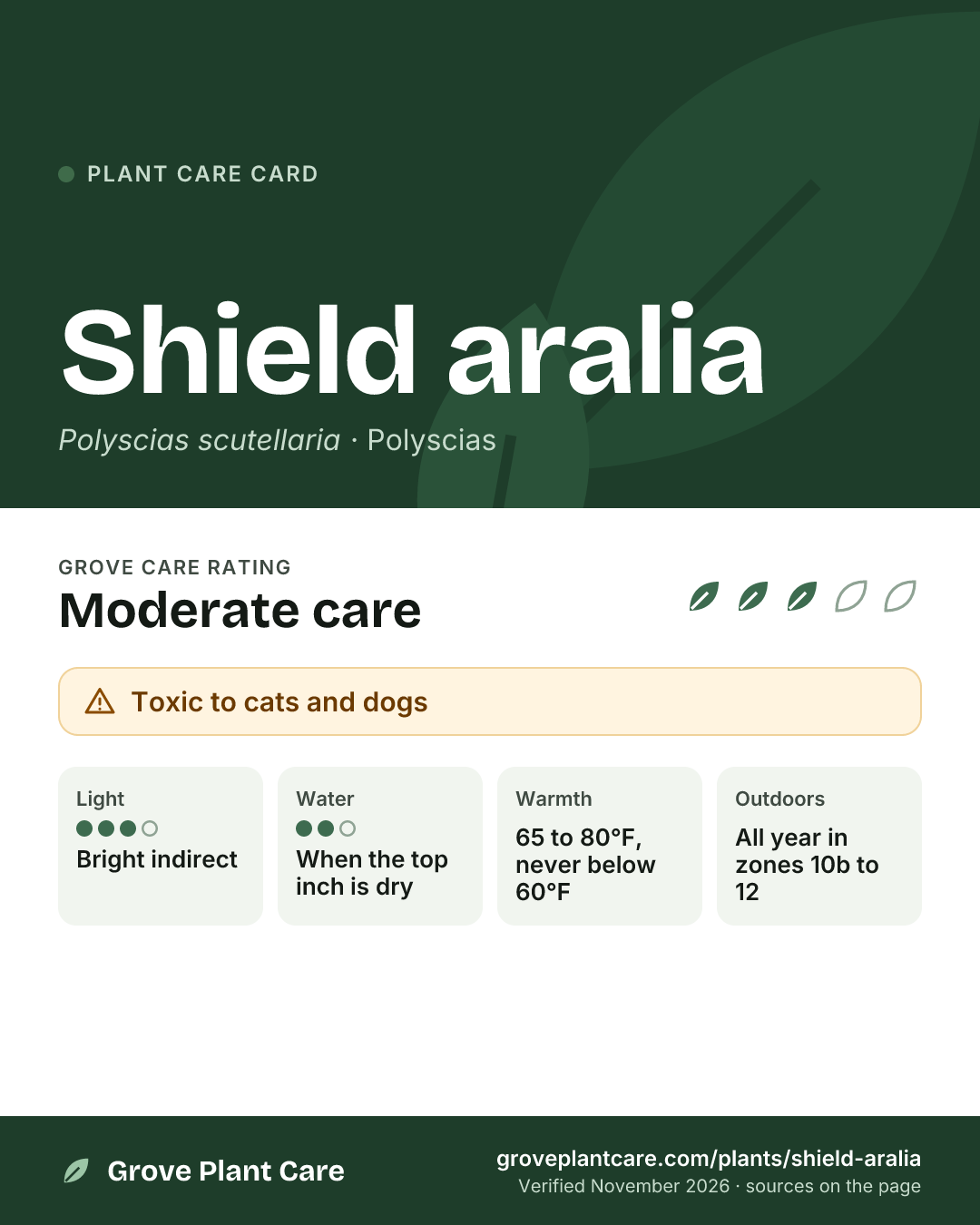
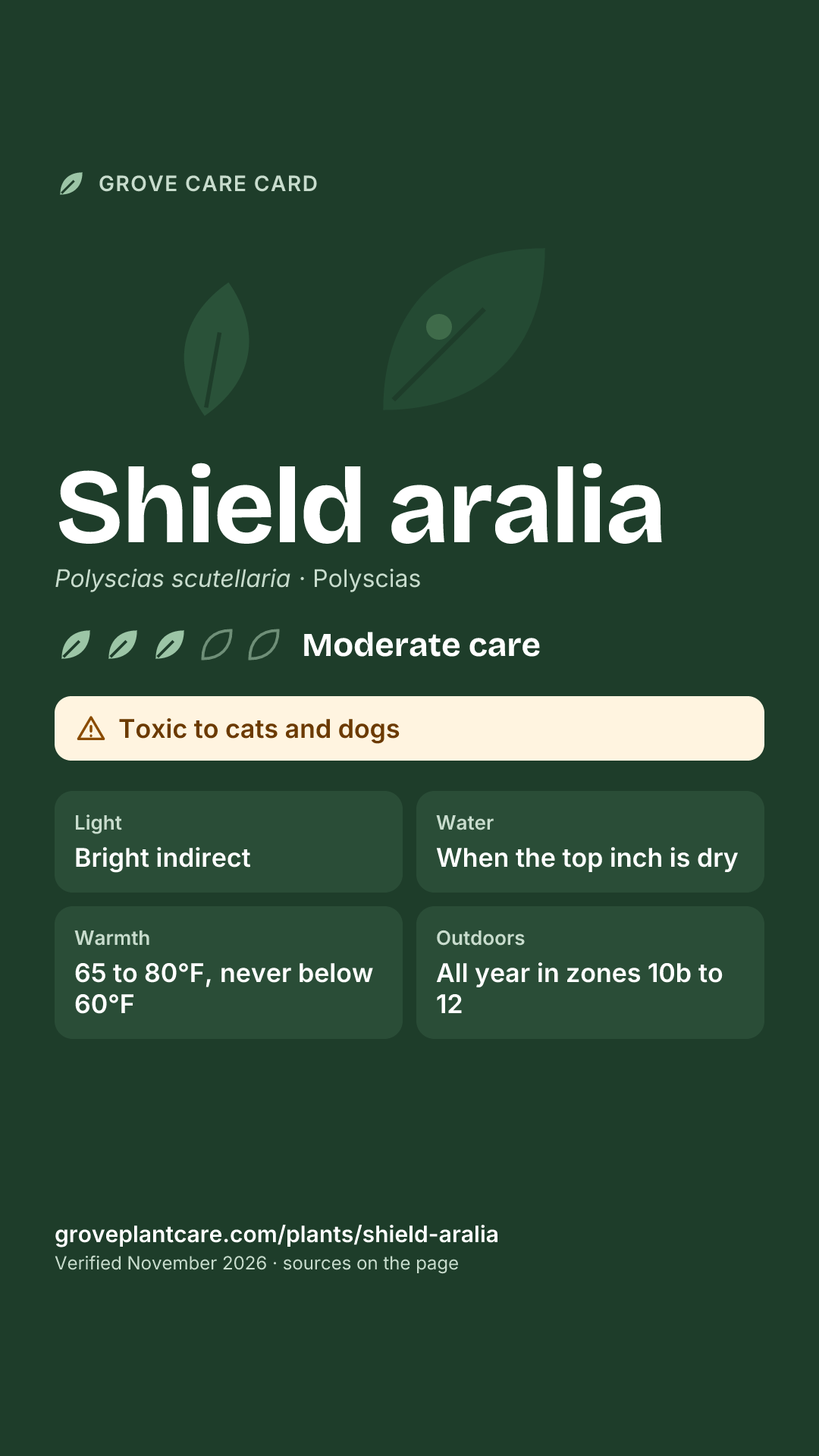
A shield aralia wants bright, indirect light, deep watering once the top of the soil dries, humid air and steady warmth above 60°F (16°C). Dry air, cold drafts and a dried-out pot all make it drop leaves. NC State lists every Polyscias as poisonous to pets, so keep it away from cats and dogs. The compact, dark-leaved Fabian aralia is sold as a form of this plant.
Toxic to cats, dogs and horses · Mild
Vomiting, diarrhea, loss of appetite and depression; the sap can irritate skin. NC State lists every Polyscias as poisonous to pets (saponins), and the ASPCA lists its close relative, geranium-leaf aralia, as toxic. Children: low severity. NC State rates the genus low severity: chewing irritates the mouth and can cause nausea and vomiting, and the sap can irritate skin.
Pet poison line: ASPCA (888) 426-4435
Good for: bright rooms with steady warmth, a bold, round-leaf look, hedges in frost-free gardens · Think twice if: pets or children chew plants, your home is cool or very dry in winter, your only spot gets hours of hot sun through glass.
Needs at a glance
- Light3 of 4 · Bright indirectNear a bright window, out of long hours of hot sun
- Water2 of 3 · When the top inch is dryWater deeply, then let the top dry; less in winter
- Humidity2 of 3 · Above averageMist it, or set the pot on a tray of wet pebbles
- Soil when pottedWell-drained, rich potting mixSlightly acidic, with peat and sand mixed in
Indoors: best at 65 to 80°F (18 to 27°C). Keep it above 60°F (16°C) and away from drafts and heat vents.
How the rating adds up
0 = easiest · 1 = moderate · 2 = hardest
- Missed waterings1 of 2 · ModerateLet the top dry between deep waterings; the lower soil should stay moist
- Light flexibility1 of 2 · ModerateBright indirect light indoors
- Humidity1 of 2 · ModerateHigh humidity helps; dry air can make leaves drop
- Pests and disease1 of 2 · ModerateSpider mites, scale and mealybugs now and then
- Sensitivity to change1 of 2 · ModerateDrops leaves when the air turns dry or cold
Growing outdoors
All year: USDA zones 10b to 12, where the coldest winter nights average 35°F (2°C) or warmer.
Elsewhere: summer outside in bright shade or morning sun, eased in over a week. Bring it in before nights drop below 60°F (16°C).
- Hedge or screen in frost-free gardens
- Specimen or patio container
- Handles salt spray
Sources: NC State, RHS, UF/IFAS, ASPCA, ASPCA plant list, NYBG, USDA zone map, Clemson, NParks Singapore, Hawaii weed risk assessment, FISC, Hawaii noxious weed list, Rojas-Sandoval and Acevedo-Rodríguez, Cuba invasive plant checklist, Queensland Government, Cal-IPC and GISD. Full list below.
Verified · How we rate plants
Is a shield aralia toxic to cats and dogs?
Yes, mildly. The ASPCA has no entry for shield aralia itself, but NC State lists every Polyscias as poisonous to cats, dogs and horses, and the ASPCA lists its close relative, geranium-leaf aralia, as toxic to all three. The plants contain saponins. Chewing can cause vomiting, diarrhea, loss of appetite and depression, and the sap can irritate skin. For people, NC State rates the genus low severity, with mouth irritation, nausea and vomiting, and the RHS warns the leaves can cause a skin allergy, so wear gloves when you prune. If your pet chewed it and seems unwell, call your vet or the ASPCA Animal Poison Control Center at (888) 426-4435. If a child eats some, call Poison Help at 1-800-222-1222.
Shield aralia, Fabian or Balfour aralia: which is which?
The names are tangled, so here is what each source says. Shield aralia is Polyscias scutellaria, a shrub with round, glossy leaves that are often cupped. The dark-leaved Fabian aralia is sold as a form of it, though the RHS lists Fabian under Polyscias alone. Balfour aralia, with three round leaflets per leaf, is Polyscias balfouriana in Kew’s checklist, a separate species; the RHS and Singapore’s NParks list it as Polyscias scutellaria ‘Balfourii’, and UF/IFAS calls it Polyscias pinnata. Two other relatives look quite different: ming aralia has fine, fern-like leaves, and geranium-leaf aralia has toothed leaflets. NC State gives them all much the same care.
Why is my shield aralia dropping leaves?
Usually dry air, cold or a pot that dried out. NC State says leaf drop can come from too little humidity, and keeps Polyscias rooms at 60°F (16°C) or warmer; it notes its relative, geranium-leaf aralia, drops its leaves below 50°F (10°C). Keep it away from cold windows, doors and heating or air conditioning vents. Soil that stays too dry also invites spider mites, which make leaves fall too. Once you fix the cause, new leaves grow from the stems.
How often should I water a shield aralia?
Water deeply, then wait until the top of the soil has dried before you water again. NC State says to let the mix dry between deep waterings without letting it get too dry, and warns that soggy soil causes root rot. The RHS waters freely while it grows and sparingly in winter. Outdoors in the ground, UF/IFAS rates Balfour aralia, its close relative, as quite drought tolerant, and says it grows well as a houseplant if you don’t overwater it.
How much light does a shield aralia need?
Bright, indirect light. NC State keeps indoor Polyscias in bright, indirect sun or light shade and avoids long hours of direct sun. The RHS grows it in full or bright, filtered light under glass. Outdoors it takes more sun: NC State says full sun to part shade, and UF/IFAS grows Balfour aralia in anything from full sun to deep shade. Turn the pot now and then so it grows evenly.
What pests attack a shield aralia?
Spider mites, scale and mealybugs are the usual ones. NC State also lists aphids, whiteflies and nematodes for the genus, and says mites show up when the soil and air are too dry. UF/IFAS calls mites a serious leaf problem on Balfour aralia and says to check for scale too. The RHS adds that it is generally free of disease. Check under the leaves every couple of weeks, and rinse mites off with water.
Can a shield aralia grow outdoors?
Yes, all year in frost-free places. No source gives zones for shield aralia by name: UF/IFAS puts Balfour aralia in USDA zones 10b to 11, and NC State puts the genus in zones 11 to 12. Zone 10b’s coldest nights average about 35°F (2°C), but leaves can drop well before that. In warm climates it makes a hedge, screen or specimen shrub 6 to 10 feet tall, and UF/IFAS says Balfour aralia handles salt spray. Across the Pacific islands it is grown mostly as trimmed hedges near homes. No official invasive list names it. Cuba’s national checklist watches Balfour aralia as potentially invasive, while Hawaii’s weed risk assessment rates Balfour aralia low risk, since it rarely makes fruit.
UF/IFAS, NC State, USDA zone map, Hawaii weed risk assessment, Cuba invasive plant checklist, FISC, GISD
When should I bring a shield aralia inside?
Before nights drop to 60°F (16°C), the lowest room temperature NC State gives for Polyscias. Clemson says to move houseplants outside only once nights stay above 60°F, and to ease them into brighter light over about a week so the leaves don’t scorch. The RHS rates it able to spend summer outside in mild climates. Check under the leaves for pests before you bring it back in.
How do I prune or propagate a shield aralia?
Pinch or cut the branch tips to make it bushier; NC State says tip pruning brings denser leaves and more branches. UF/IFAS cuts a few of the oldest stems to the ground when Balfour aralia gets bare at the bottom. Wear gloves, since the sap can irritate skin. To make new plants, root stem cuttings: the RHS takes them in early summer, or roots pieces of bare stem with warmth from below.
How Grove helps
Grove sets a watering check based on how dry the soil is, so the shield aralia gets a deep drink once the top has dried, and not before. You can add a weekly humidity and pest check as a task you can assign, so whoever is home catches dry air before the leaves fall.
Sources
- NC State Extension Gardener Plant Toolbox: Polyscias (genus)
- NC State Extension Gardener Plant Toolbox: Polyscias guilfoylei (geranium aralia)
- RHS: Polyscias scutellaria 'Marginata' (v)
- NC State Extension Gardener Plant Toolbox: Polyscias balfouriana (Balfour aralia)
- UF/IFAS EDIS FPS489: Polyscias pinnata, Balfour Aralia (Gilman; reviewed 2023)
- ASPCA Animal Poison Control: Geranium-Leaf Aralia (Polyscias guilfoylei)
- ASPCA Animal Poison Control: Toxic and Non-Toxic Plants
- NYBG Plant Information: Is 80 degrees too warm for a ming aralia plant? (2021)
- USDA ARS Plant Hardiness Zone Map (2023)
- Clemson Cooperative Extension HGIC 1454: Moving Houseplants Indoors and Outdoors
- National Parks Board Singapore, Flora & Fauna Web: Polyscias scutellaria 'Balfourii'
- Hawaii-Pacific Weed Risk Assessment (Plant Pono): Polyscias balfouriana, low risk, score 0 (2023)
- Florida Invasive Species Council: Plant List, Category I and II and Watch List (April 2026)
- Hawaii Administrative Rules 4-68: plant species designated as noxious weeds (Hawaii Department of Agriculture)
- J. Rojas-Sandoval and P. Acevedo-Rodríguez (2015), Naturalization and invasion of alien plants in Puerto Rico and the Virgin Islands, Biological Invasions 17 (supplementary list)
- Checklist of Invasive Plants in Cuba 2022 (GBIF dataset): Polyscias balfouriana and P. guilfoylei potentially invasive
- Business Queensland: Restricted invasive plants (Biosecurity Act 2014)
- California Invasive Plant Council (Cal-IPC): plant search, "polyscias" (no listing)
- IUCN Global Invasive Species Database: Polyscias scutellaria (no entry)
- Integrated Taxonomic Information System (ITIS): Polyscias scutellaria, TSN 504526 (shield aralia)
- Catalogue of Life names via GBIF: Polyscias scutellaria (dinnerplate-aralia; aralia escudo)
- RHS: Polyscias 'Fabian'
- Kew WCVP data release (2026-06-04 file), plant_name_id 162576: Polyscias scutellaria
- Kew WCVP data release (2026-06-04 file), plant_name_id 162447: Polyscias balfouriana (Balfour aralia)
- RHS: Polyscias balfouriana (synonym Polyscias scutellaria 'Balfourii')