Plant care card
Staghorn fern
Platycerium bifurcatum · Helecho cuerno de alce
Also called elkhorn fern or common staghorn fern
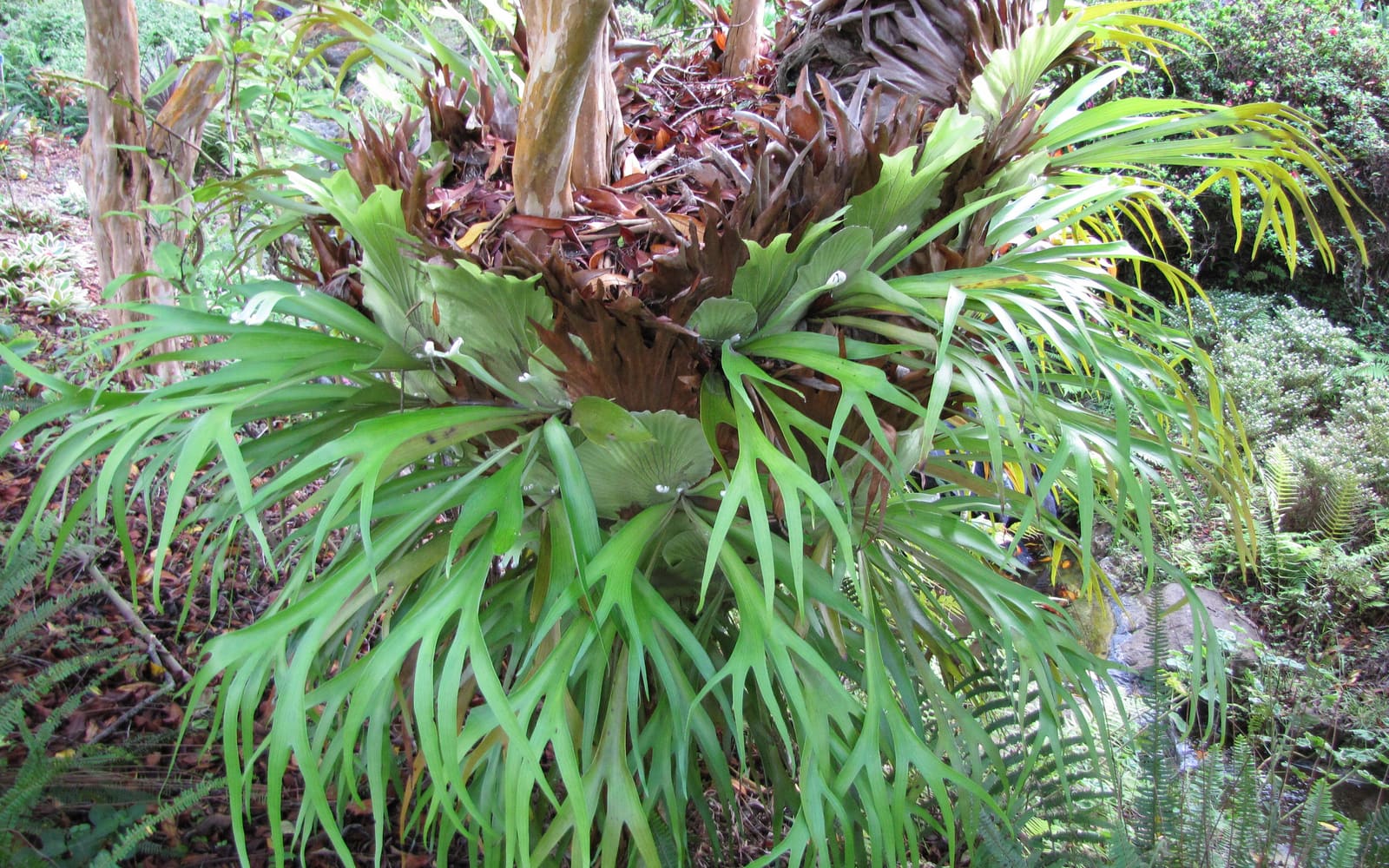
Photo by Forest and Kim Starr on Wikimedia Commons, CC BY 3.0 US

The staghorn fern grows on trees in the wild, so it's happiest mounted on a board or in a basket. Give it bright indirect light and humid air, then soak the mount when it feels light or the antler fronds droop a little. Leave the flat brown shield fronds at the base alone: they hold the plant on and feed it. The ASPCA lists it as non-toxic to cats, dogs and horses.
Non-toxic to cats, dogs and horses
No signs of poisoning listed. Any plant can still upset a pet’s stomach if it eats enough. Children: No source lists it as poisonous to people.
Pet poison line: ASPCA (888) 426-4435
Good for: a living wall display, bright bathrooms, pet-friendly homes · Think twice if: you want a plant you can leave alone for weeks, you garden in South Florida, where it spreads to trees.
Needs at a glance
- Light3 of 4 · Bright indirectStrong light without direct sun, which bleaches the fronds
- Water2 of 3 · Let it dry a littleSoak the mount when it feels light or the fronds droop slightly; less in winter
- Humidity2 of 3 · Above averageHumid air; a bright bathroom suits it
- Soil when pottedMounted on a board or bark with sphagnum mossOr a very airy, orchid-type mix in a basket
Indoors: best at 55 to 75°F (13 to 24°C). Keep it above 55°F (13°C) and away from drafts and heat vents.
How the rating adds up
0 = easiest · 1 = moderate · 2 = hardest
- Missed waterings1 of 2 · ModerateLet it dry a little, never bone dry; a mount dries fast
- Light flexibility1 of 2 · ModerateBright indirect light; sun bleaches it, deep shade invites pests
- Humidity1 of 2 · ModeratePrefers humid air; dry, heated rooms are hard on it
- Pests and disease0 of 2 · EasiestFew pests; watch for scale and mealybugs
- Sensitivity to change0 of 2 · EasiestTolerates crowding; move it to brighter light slowly
Growing outdoors
All year: USDA zones 10 to 13, where the coldest winter nights average 30°F (−1°C) or warmer.
Elsewhere: summer outside in shade or part shade; ease it into brighter light. Bring it in before nights drop below 55°F (13°C).
Invasive in: Florida. A Category II invasive in Central and South Florida, where UF/IFAS says to plant it with caution and keep it from spreading. Lists checked .
- Mounted on a board or tree trunk
- In a hanging wire basket
Sources: NC State, UF/IFAS, NYBG, Wisconsin Extension, Arkansas Extension, RHS, ASPCA, ASPCA plant list, Hawaii weed risk assessment, USDA, FISC, UF/IFAS Assessment and Global Invasive Species Database. Full list below.
Verified · How we rate plants
How do I mount a staghorn fern?
Pick a slab of wood, bark or tree fern fiber a bit bigger than the plant. UF/IFAS suggests shaping a mound of sphagnum moss on it and setting the fern so its flat shield fronds touch the moss. Tie it on with plastic strips, nylon hose, fishing line or plastic-coated wire, never copper. Wisconsin Extension says to wrap the ties over the old brown shield fronds and keep them off the green ones; new shields grow over the ties in time. A wire basket hung on its side and packed with moss works too. When the shields reach the edge of the mount, you can move it to a bigger one, though UF/IFAS says it doesn't mind crowding.
How do I water a mounted staghorn fern?
Soak it. NYBG says to dip the brown base in a sink or tub until it's soaked through, then let it drain before you hang it back up. Wisconsin Extension says to wet the shield fronds and the moss and let them dry somewhat in between, with rainwater if you can. The tricky part is timing: UF/IFAS suggests waiting until the fern wilts slightly, since a thirsty staghorn bounces back fast and an overwatered one rots. As a rule of thumb, that's about once a week in warm, dry weather and less in cool or cloudy weather. NC State adds that the roots should never dry out completely.
How much light does a staghorn fern need?
Bright indirect light. Wisconsin Extension and NYBG both say strong light without direct sun, and NYBG warns that direct sun bleaches the fronds and leaves blotches. Too little light is a problem too: UF/IFAS says very low light invites disease and pests. Outdoors, it does best in shade or part shade, per UF/IFAS and NC State. A bright bathroom is a classic spot, since it is humid as well.
Wisconsin Extension, NYBG, UF/IFAS, NC State, Arkansas Extension
Why are the bottom fronds on my staghorn fern turning brown?
That's normal. The flat, round fronds pressed against the mount are shield fronds. They start green and turn papery tan or brown with age, as NC State and Wisconsin Extension describe. Leave them on: Wisconsin says they anchor and protect the plant, and UF/IFAS says they collect water and fallen debris that feed it. New green shields grow over the old ones. Brown, dried-up antler fronds are another story; Wisconsin says you can trim those. The fuzzy brown patches under the antler tips are spores, also normal, per UF/IFAS.
Is a staghorn fern safe for cats and dogs?
Yes. The ASPCA lists the common staghorn fern as non-toxic to dogs, cats and horses, and NC State marks it non-toxic for all three. Any plant can still upset a pet's stomach if it eats enough,. If a pet eats some and seems unwell, call your vet or the ASPCA Animal Poison Control Center at (888) 426-4435. No source lists it as poisonous to people, but if a child eats any plant, Poison Help is at 1-800-222-1222.
Can I grow a staghorn fern in a pot?
Small ones, yes. Wisconsin Extension says young plants can grow in a container of rich, very well-drained mix, and NC State suggests an orchid mix or sphagnum moss. NYBG says boards and baskets are much preferred, because they let air reach the roots. Skip regular potting soil: Arkansas Extension warns that a mix that holds too much water rots the roots.
How do I propagate a staghorn fern?
Divide off the pups. This species makes small offsets around the main plant, which is how it forms clusters. NC State and Wisconsin Extension both say division is the way to go: cut off a pup with a sharp knife, making sure it has roots and both kinds of fronds, and mount it. Wisconsin says to keep new divisions warm and moist, and they can take a while to settle in. Spores work, but very slowly.
Can a staghorn fern grow outdoors?
Yes, where winters are mild. UF/IFAS says this species is one of the most cold-tolerant staghorns and takes about 30°F (−1°C), which matches USDA zones 10 to 13. Hang it under a tree or a porch roof for frost protection, and bring it in when a hard freeze is coming. In colder places it can spend summer outside in shade: Wisconsin Extension says to ease it into brighter light and bring it back in before nights get chilly; this card uses 55°F (13°C), its indoor minimum. Where it grows well, it can escape: the Florida Invasive Species Council lists it as a Category II invasive in Central and South Florida, and UF/IFAS says to plant it with caution and keep it from spreading. Fairchild Tropical Botanic Garden notes its wind-blown spores colonize trees across South Florida. In Hawaii, where it has gone wild on several islands, the weed risk assessment says to keep an eye on it.
UF/IFAS, USDA, Wisconsin Extension, NYBG, FISC, UF/IFAS Assessment, Fairchild, Hawaii weed risk assessment
Is my staghorn fern Platycerium bifurcatum or superbum?
Look for pups. Platycerium bifurcatum, the common staghorn, makes offsets and grows into a cluster, and its antler fronds are forked and felted grey-green. Platycerium superbum grows as a single large, upright nest of wide, lobed shield fronds with long hanging antlers, and Wisconsin Extension says it never makes pups, so it can only be grown from spores. It is also fussier: Wisconsin says it is sensitive to cold, heat and overwatering, and the RHS keeps it above 15°C (59°F). Plants sold as Platycerium grande are often superbum, per the RHS; Kew treats the true grande as a separate species from the Philippines.
How Grove helps
Grove can remind you to check the mount on a schedule you set, so the staghorn fern gets a soak when it needs one. You can add feeding as a repeating task for the warm months and assign it.
Sources
- NC State Extension Gardener Plant Toolbox: Platycerium bifurcatum
- UF/IFAS Gardening Solutions: Staghorn Ferns
- New York Botanical Garden LibGuides: Staghorn Fern
- University of Wisconsin-Madison Extension: Staghorn Fern, Platycerium bifurcatum (S. Mahr)
- University of Arkansas Extension, Plant of the Week: Staghorn Fern (G. Klingaman, 2001)
- Royal Horticultural Society: Platycerium bifurcatum (common staghorn fern)
- ASPCA Animal Poison Control: Common Staghorn Fern (Platycerium bifurcatum)
- ASPCA Animal Poison Control: Toxic and Non-Toxic Plants
- Hawaii-Pacific Weed Risk Assessment (Plant Pono): Platycerium bifurcatum, evaluate, score 4
- USDA ARS Plant Hardiness Zone Map (2023)
- Florida Invasive Species Council: Plant List, Category I and II (April 2026); Platycerium bifurcatum, Category II, Central and South
- UF/IFAS Assessment of Non-Native Plants: Platycerium bifurcatum (caution, manage to prevent escape)
- IUCN Global Invasive Species Database: Platycerium bifurcatum (no record)
- Fairchild Tropical Botanic Garden: Platycerium bifurcatum (staghorn fern)
- Kew WCVP data release (2026-06-04 file), plant_name_id 3153569: Platycerium bifurcatum
- Royal Horticultural Society: Platycerium superbum (synonym Platycerium grande hort.)
- Kew WCVP data release (2026-06-04 file), plant_name_id 3153582: Platycerium superbum
- Kew WCVP data release (2026-06-04 file), plant_name_id 3153575: Platycerium grande