Plant care card
Orchid
Phalaenopsis · Orquídea mariposa
Also called moth orchid or moon orchid
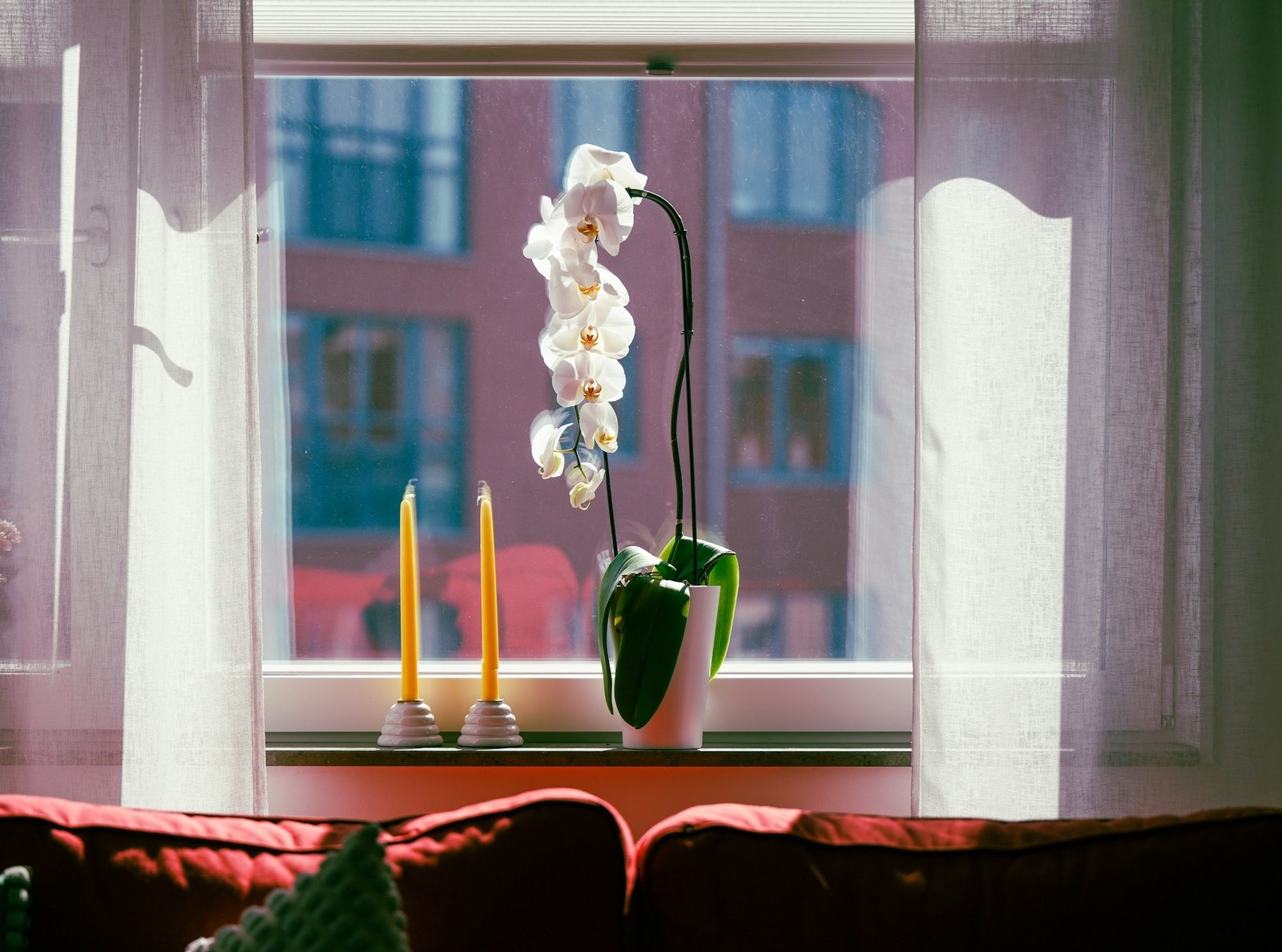
Photo by Damir Korotaj on Unsplash
This page covers the moth orchid (Phalaenopsis), the orchid sold in grocery stores and garden centers. It's one of the easiest orchids to keep: give it bright, indirect light, water about once a week when the pot feels light, and never let it sit in water. Getting it to bloom again takes more light and a few weeks of cooler temperatures in fall.
Non-toxic to cats, dogs and horses
No signs of poisoning listed. Any plant can still upset a pet’s stomach if it eats enough. Children: No poison risk listed.
Pet poison line: ASPCA (888) 426-4435
Good for: a first orchid, homes with cats and dogs, an east window · Think twice if: your only spot is a hot, unshaded south window, you water everything on a schedule.
Needs at a glance
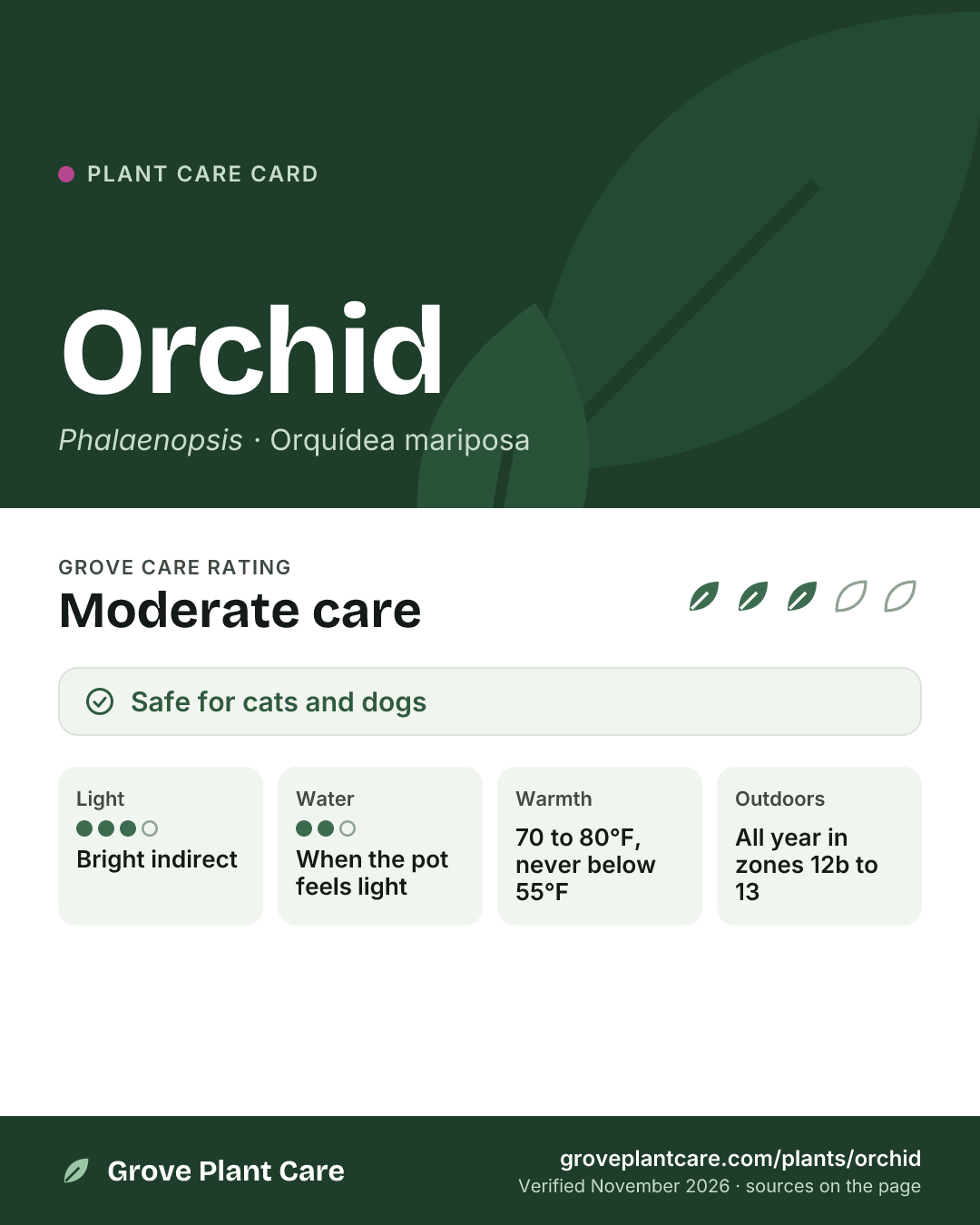
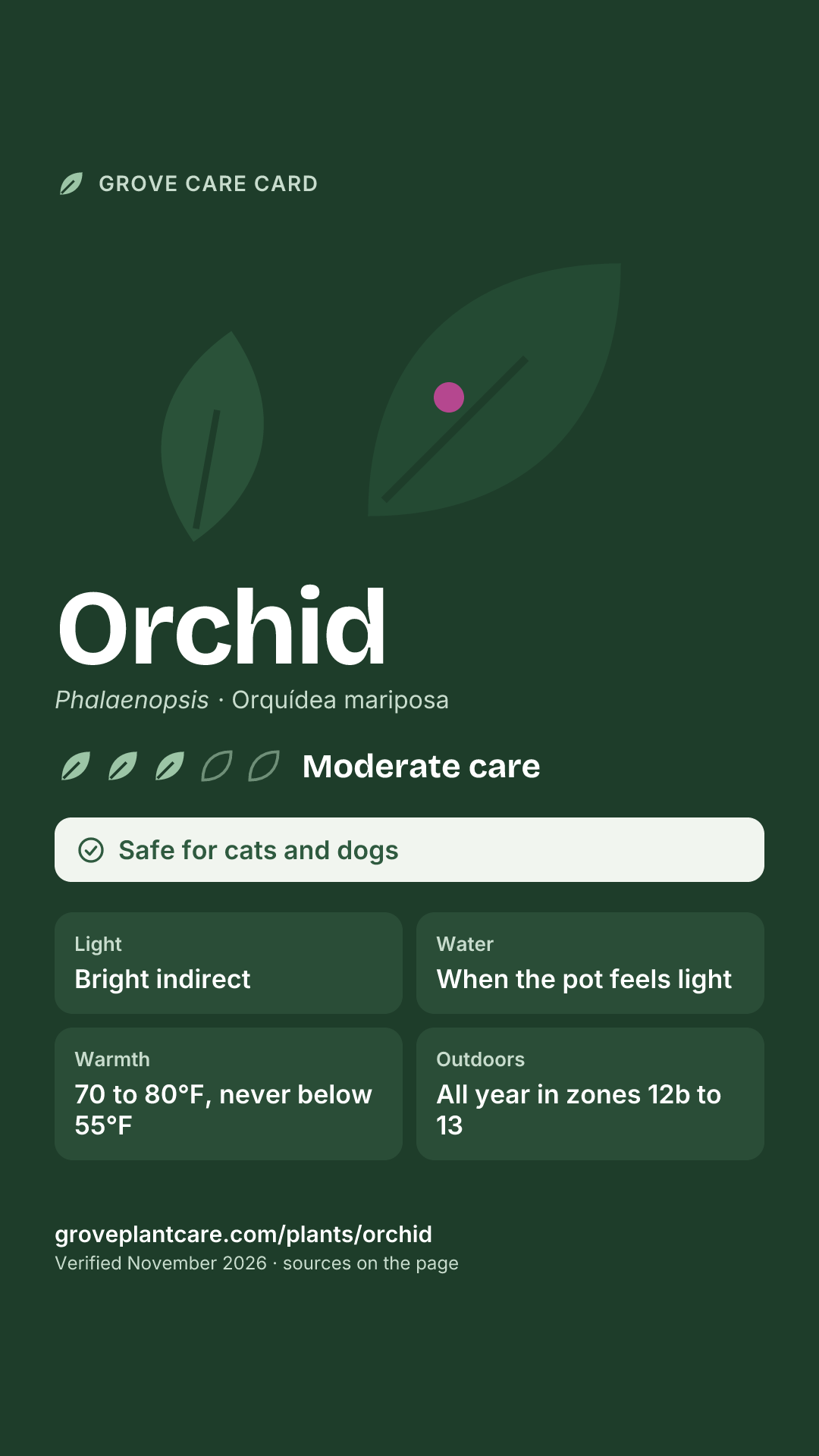
- Light3 of 4 · Bright indirectAn east window, or south or west behind a sheer curtain
- Water2 of 3 · Let it dry a littleWater when the pot feels light and the roots look silvery
- Humidity2 of 3 · Above average40 to 70%; a pebble tray helps more than misting
- Soil when pottedOrchid bark mixNever regular potting soil
Indoors: best at 70 to 80°F (21 to 27°C). Keep it above 55°F (13°C) and away from drafts and heat vents.
How the rating adds up
0 = easiest · 1 = moderate · 2 = hardest
- Missed waterings1 of 2 · ModerateDries a little between waterings, never bone dry
- Light flexibility1 of 2 · ModerateNeeds bright, indirect light; hot sun scorches it
- Humidity1 of 2 · ModeratePrefers 40 to 70% humidity
- Pests and disease1 of 2 · ModerateMealybugs, scale; rot if water sits in the crown
- Sensitivity to change1 of 2 · ModerateBuds drop with drafts, moves or temperature swings
Growing outdoors
All year: USDA zones 12b to 13, where the coldest winter nights average 55°F (13°C) or warmer.
Elsewhere: summer outside in shade. Bring it in when nights reach 55 to 60°F (13 to 16°C).
- Containers
- Mounted on trees in the tropics
Sources: NC State, Clemson, American Orchid Society, Iowa State, RHS, RHS trial, University of Maryland, ASPCA, ASPCA plant list, Fairchild Garden, Wisconsin, Colorado State, NYBG, Chicago Botanic Garden and UF/IFAS. Full list below.
Verified · How we rate plants
Where it grows wild
About 83 species (Kew)
- Native range
- Tropical and subtropical Asia, from India and China to the Philippines, New Guinea and northeastern Australia
- Habitat
- On tree trunks and branches in warm, humid tropical forests, with its roots out in the open air
- Why it matters for care
- Roots that grow on bark in the wild want air around them, so a pot needs a chunky bark mix that dries out between waterings
How often should I water an orchid?
About once a week, when the pot feels light. Run lukewarm water through the bark in the morning for about a minute, let it drain completely, and never leave the pot standing in water. Dry roots look silvery, and they turn green right after watering. Orchids potted in moss stay wet longer, so water those only when the top feels dry. What about ice cubes? They aren't a great way to water, and they don't seem to cause harm either. Missouri Botanical Garden calls them a poor practice, because a few cubes often don't wet the whole pot, and an Ask Extension expert also advises against them. A 2017 study from Ohio State and the University of Georgia gave moth orchids in bark three ice cubes a week for up to six months and found no harm to the flowers, leaves or roots, though it didn't test orchids in moss, longer periods or ice resting on the leaves. A thorough soak is still the better habit.
American Orchid Society, University of Maryland, Clemson, Missouri Botanical Garden, Ask Extension, Ohio State
What do I do when the flowers fall off?
Keep watering and feeding it as usual, then decide about the flower spike. If the spike is still green, cut it just above a node, one of the small bumps on the stem, partway down, and a side branch may flower in about 8 to 12 weeks. If it's brown or yellow, cut it off at the base. A cut at the base means a longer wait, and the next spike is usually stronger. This is also a good time to repot if the bark has broken down.
American Orchid Society, NC State, University of Maryland, RHS, Wisconsin
How do I get my orchid to bloom again?
Give it more light and a few weeks of cooler temperatures in fall. Too little light is the most common reason a moth orchid won't rebloom, so move it to a bright east window. Then let it feel cooler nights, around 55 to 65°F (13 to 18°C): NC State says about a week is enough, and Iowa State suggests several weeks. Michigan State research found that cooler days, below about 79°F (26°C), matter more than the night drop, so keep it out of warm spots too. Keep lamps off it at night, feed it weakly, and be patient, because some hybrids rebloom more readily than others.
University of Maryland, Iowa State, NC State, Michigan State, American Orchid Society, RHS trial
How much light does an orchid need?
Bright, indirect light, such as an east window, or a south or west window behind a sheer curtain. Direct midday sun can scorch the leaves. Leaf color tells you whether the light is right: olive or light green is good, dark green means too little light, and a reddish or yellow-green tinge means too much. One source disagrees: Chicago Botanic Garden’s plant finder lists full sun, while every other source we checked, including Iowa State, Clemson and the RHS, says to keep it out of direct midday sun.
American Orchid Society, Iowa State, Clemson, University of Maryland, RHS trial, Chicago Botanic Garden
Why are my orchid's leaves yellow or wrinkled?
One old leaf at the bottom turning yellow is normal: moth orchids grow one or two new leaves a year and drop old ones at about the same rate. Wrinkled, limp leaves mean the plant isn't getting water, either because it's too dry or because rotted roots can't take it up. Check the roots: firm green or silvery roots mean it's thirsty, and brown, mushy roots mean rot from too much water. Leaves that turn yellow-green all over can mean too much light.
What are the roots growing out of the pot?
They're aerial roots, and they're normal. In the wild, moth orchids grow on trees and their roots reach into the air. Leave them alone, and only trim roots that are dead and hollow when you repot. Like the roots in the pot, they look silvery when dry and turn green after watering.
When and how do I repot an orchid?
Every one to two years, after it finishes flowering, or sooner when the bark breaks down and starts to look like soil. Soak the roots to loosen them, remove the old bark, trim dead or mushy roots, set the plant at the same height in fresh orchid bark, and water it in. Use a pot with drainage and never regular potting soil. Wait a few weeks before you feed it again.
University of Maryland, NC State, UF/IFAS, American Orchid Society
Is an orchid safe for cats and dogs?
Yes. The ASPCA lists the moth orchid as non-toxic to cats, dogs and horses, and NC State agrees. That covers Phalaenopsis only, so check other orchids on their own. Any plant can still upset a pet’s stomach if it eats enough, so keep a determined chewer away from the leaves.
Can an orchid live outdoors?
Only all year where nights stay warm, and sources disagree on which zones that means. NC State lists USDA zones 10 to 11 for moth orchids, while Chicago Botanic Garden and NC State's page for the wild species Phalaenopsis schilleriana list 10 to 13. Clemson, Colorado State, NYBG and Iowa State all say to keep moth orchids above about 55°F (13°C), and the American Orchid Society says some drop their buds below 60°F (16°C). Only zones 12b and 13, where the coldest winter nights average 55°F (13°C) or warmer, stay that warm, so those are the zones on the card. In zones 10 and 11, cover it or bring it in on cold nights. Elsewhere, it can spend summer outside in shade and come back in before nights drop below 55°F. In South Florida, people tie moth orchids to tree trunks in dappled shade, where they grow the way they do in the wild.
NC State, Chicago Botanic Garden, Clemson, Colorado State, NYBG, Iowa State, American Orchid Society, University of Maryland, Fairchild Garden
How Grove helps
Grove turns watering into a weekly check of the pot instead of a fixed pour, so nobody drowns the bark. In fall, you can add a reminder to move the orchid somewhere cooler and brighter, and assign it to whoever is home.
Sources
- NC State Extension Gardener Plant Toolbox: Phalaenopsis schilleriana
- Clemson Cooperative Extension HGIC: Orchids
- American Orchid Society: Novice Culture Sheet, Phalaenopsis
- NC State Extension Gardener Plant Toolbox: Phalaenopsis
- Iowa State University Extension: proper care for a moth orchid
- Royal Horticultural Society: Growing Phalaenopsis orchids
- Royal Horticultural Society: Phalaenopsis trial results 2024 to 2025
- University of Maryland Extension: Care of Phalaenopsis Orchids
- Iowa State University Extension: How to Get Orchids to Rebloom
- ASPCA Animal Poison Control: Phalaenopsis orchid
- ASPCA Animal Poison Control: Toxic and Non-Toxic Plants
- Fairchild Tropical Botanic Garden: Phalaenopsis moth orchid
- University of Wisconsin-Madison Extension: Orchids
- Clemson Cooperative Extension HGIC: General Care for Phalaenopsis Orchids
- Colorado State University Extension PlantTalk: Orchid, Phalaenopsis
- New York Botanical Garden: How to Be a Phalaenopsis Pro
- Chicago Botanic Garden Plant Finder: Phalaenopsis (moth orchid)
- American Orchid Society: Cold Tolerance of Warm Growing Orchids (2024)
- UF/IFAS Gardening Solutions: Orchids
- University of Arkansas Cooperative Extension: Phalaenopsis, Moth Orchids
- American Orchid Society: Phalaenopsis, the Genus
- Kew Plants of the World Online: Phalaenopsis
- Kew: World Checklist of Vascular Plants (June 2026 release), the data behind Plants of the World Online
- Iowa State University Extension: Growing Orchids Indoors
- American Orchid Society: Top Ten Uncommonest Questions about Phalaenopsis
- Blanchard and Runkle, Michigan State University: temperature and flowering of Phalaenopsis (J. Exp. Bot., 2006)
- Missouri Botanical Garden: Should I water my orchid plant with ice cubes?
- Ask Extension: Phalaenopsis watered with ice cubes
- Ohio State University: Watering Phalaenopsis orchids with ice cubes (HortScience, 2017)
- UF/IFAS Master Gardener Plant ID: Moth orchid