Orchid care: the complete guide to growing orchids
Most orchids want bright light without hot midday sun, and an east window is the safe default. They grow in chunky bark instead of soil, and they like a thorough soak followed by a chance to dry out a little before the next one. Give them ordinary room temperatures with a cooler night, 40 to 70% humidity and a weak fertilizer while they're growing.
Start with your question
- My orchid's flowers fell off. Now what?After the flowers fall
- How often do I water my orchid?Watering
- Why are my orchid leaves turning yellow?Yellow leaves
- How do I get my orchid to bloom again?Getting it to bloom again
- What are these roots growing out of the pot?Aerial roots and root colors
- Which orchid do I have?On this page
What do most orchids need?
Read moreShow less
These basics fit the common home orchids that Iowa State, the RHS and the U.S. Botanic Garden cover: the moth orchid, Dendrobium, dancing lady (Oncidium), Cattleya, slipper orchids (Paphiopedilum) and Cymbidium.
Light. Bright light without hot direct sun at midday is the shared baseline. Iowa State Extension and Chicago Botanic Garden point to east or south windows, and Chicago adds that north windows are too dark and west windows too hot. The orchids differ, though. The U.S. Botanic Garden and the New York Botanical Garden put moth and slipper orchids in the lower light group, dancing ladies in the middle, and Cattleya and Dendrobium in the high light group. Clemson Extension says those last two want about twice the light of a moth orchid. The leaves tell you how you're doing: very dark green means too little light, according to Clemson, Iowa State and the NYBG, and a reddish tinge means too much, per the American Orchid Society and NC State. To measure your window, see our guide to bright indirect light.
Watering. Water thoroughly, let it drain completely, and never leave the pot standing in water. Then let the mix dry somewhat before the next soak. The U.S. Botanic Garden says far more orchids die from too much water than too little. How dry depends on the plant: orchids with pseudobulbs (thick, swollen stems that store water) can go drier, while moth and slipper orchids, which have none, want more even moisture (Iowa State, Clemson, AOS). Our watering guide covers how often, bark versus moss, and the ice cube question.
Potting mix. Most orchids grow on trees in the wild, so they go in coarse bark or a similar chunky mix, never garden soil (Clemson, Iowa State, University of Wisconsin Extension). Bark drains fast and forgives a heavy hand with the watering can, but it breaks down over time. Sphagnum moss holds more water, which raises the risk of rot (Iowa State). Our repotting guide covers when to change it and which mix suits each orchid.
Humidity. Iowa State puts the comfortable range at 40 to 70%, and Clemson at 40 to 60%, adding that most homes are drier than that. A pebble tray, a humidifier or a cluster of plants all help (Iowa State, Wisconsin, AOS). Sources split on misting: Wisconsin and the RHS suggest it, while Iowa State and the RHS's own moth orchid guide say it does little for humidity. A tray or humidifier does more.
Temperature. Most orchids are happy with days of 18 to 27 °C (65 to 80 °F) and nights about 6 to 8 °C (10 to 15 °F) cooler (Iowa State, Clemson, Chicago Botanic Garden). Iowa State sorts orchids into three groups by daytime temperature: cool, 16 to 24 °C (60 to 75 °F), for Cymbidium, slipper orchids and some Dendrobium; intermediate, 21 to 27 °C (70 to 80 °F), for Cattleya, dancing ladies and some moth orchids; and warm, 24 to 29 °C (75 to 85 °F), for many moth orchids. Not sure which group yours is in? Iowa State says to treat it as intermediate. Cymbidium is the cool one: it needs cool nights to set flower spikes, per the AOS and the RHS. For the moth orchid's coldest safe night, see its care card.
Feeding. Orchids need less fertilizer than most houseplants. Iowa State's rule is "weakly, weekly": a quarter strength or less while the plant grows, and the AOS culture sheets agree. Once a month, water with plain water to rinse out leftover salts (Iowa State, Clemson, AOS). A balanced orchid fertilizer is the simple choice. More isn't better: too much feed can mean fewer flowers, per University of Maryland Extension and UF/IFAS. Our rebloom guide covers feeding for flowers.
Going deeper
Why bark? Most orchids are epiphytes: plants that grow on other plants, usually trees, without taking anything from them. Iowa State, Clemson, Wisconsin, UConn Extension and Fairchild Tropical Botanic Garden all describe thick roots that cling to bark and soak up water and nutrients from rain, air and debris. Fairchild adds that those roots wear a spongy coat called velamen. Roots like that need air as much as water, which is why they rot in dense soil (Clemson, Iowa State, UConn). Some orchids do grow in the ground, and slipper orchids mostly do (NC State, RHS). The U.S. Botanic Garden calls orchids one of the largest groups of plants: UConn and Fairchild both count more than 25,000 species, and Fairchild adds over 100,000 registered hybrids.
Orchids also grow in two basic ways, as the American Orchid Society explains. Some grow upward from a single crown, like the moth orchid. If that crown dies, the plant can't make a new one. Others creep sideways along a stem and send up new shoots, which swell into pseudobulbs on many types. Those orchids keep adding new growths over the years.
Are orchids hard to grow?
Read moreShow less
Iowa State says orchids look difficult but aren't: they just need different care from ordinary houseplants, and watering is the main challenge. Clemson, the AOS and the RHS all call the moth orchid easy to grow. The U.S. Botanic Garden adds the key warning: far more orchids die from too much water than too little.
So the habits that kill orchids are usually kind ones. Watering on a fixed schedule, potting in regular soil or leaving the pot in a saucer of water all keep the roots wet with no air. Check the pot before you water, use bark, and let it drain. That covers most of it.
Which orchids are easiest for beginners?
| Orchid | What the sources say |
|---|---|
| Moth orchid (Phalaenopsis) | Easiest. The RHS calls it probably the easiest to grow at home, and Clemson, Wisconsin, Penn State, Iowa State, Fairchild and the AOS agree. |
| Slipper orchid (Paphiopedilum) | A good second orchid. Penn State Extension says it suits home conditions, and the AOS compares its care to an African violet's. The RHS rates it moderate, though still not too difficult. |
| Dendrobium | Sources disagree. Iowa State, Clemson and UConn call it a good home orchid. Wisconsin says it's harder indoors, and NC State rates it high maintenance, though it says hard-cane types make easy houseplants. |
| Dancing lady (Oncidium) | Sources disagree. Iowa State lists it as a good home orchid, and the RHS says Cambria types are the easiest oncidiums as houseplants. Wisconsin says harder indoors, and NC State rates it medium. |
| Cattleya | Sources disagree. Wisconsin, Clemson and Iowa State call it a good home orchid, and the AOS says miniature types grow well on a windowsill. NC State rates it high maintenance. It needs a lot of light. |
| Cymbidium | Best for cool rooms or homes where it can spend summer outside. UConn suggests it for cooler spaces, and the AOS and RHS say it needs cool nights to flower. |
Where the sources disagree, the light and temperature you can offer decide it. A bright, warm south window suits a Cattleya or a hard-cane Dendrobium. A cool sunroom suits a Cymbidium. An ordinary east window suits a moth or slipper orchid best.
Which orchid do I have?
Read moreShow less
The leaves and stems tell you more than the flowers, and they're there all year. Start with one question: does it have pseudobulbs, the swollen stems that store water and food (Clemson, NC State, Fairchild)?
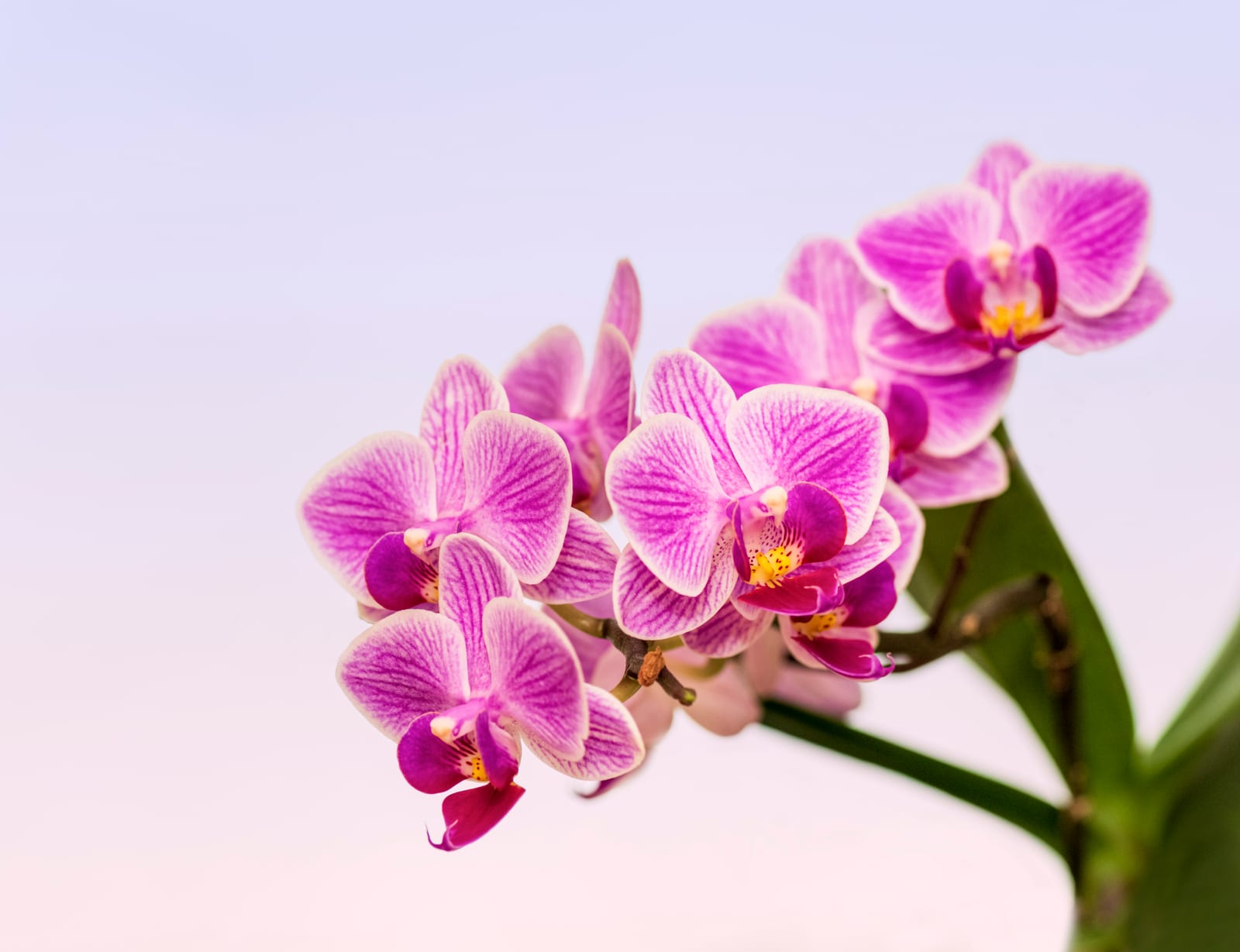
- Moth orchid (Phalaenopsis): no pseudobulbs. Its leaves grow from a single crown in the center, and it keeps growing upward from there (AOS). Its name means "moth-like", because the flowers look like moths in flight, per the AOS and UF/IFAS. It's the orchid sold in most grocery stores and garden centers. Our moth orchid care card has everything about it.
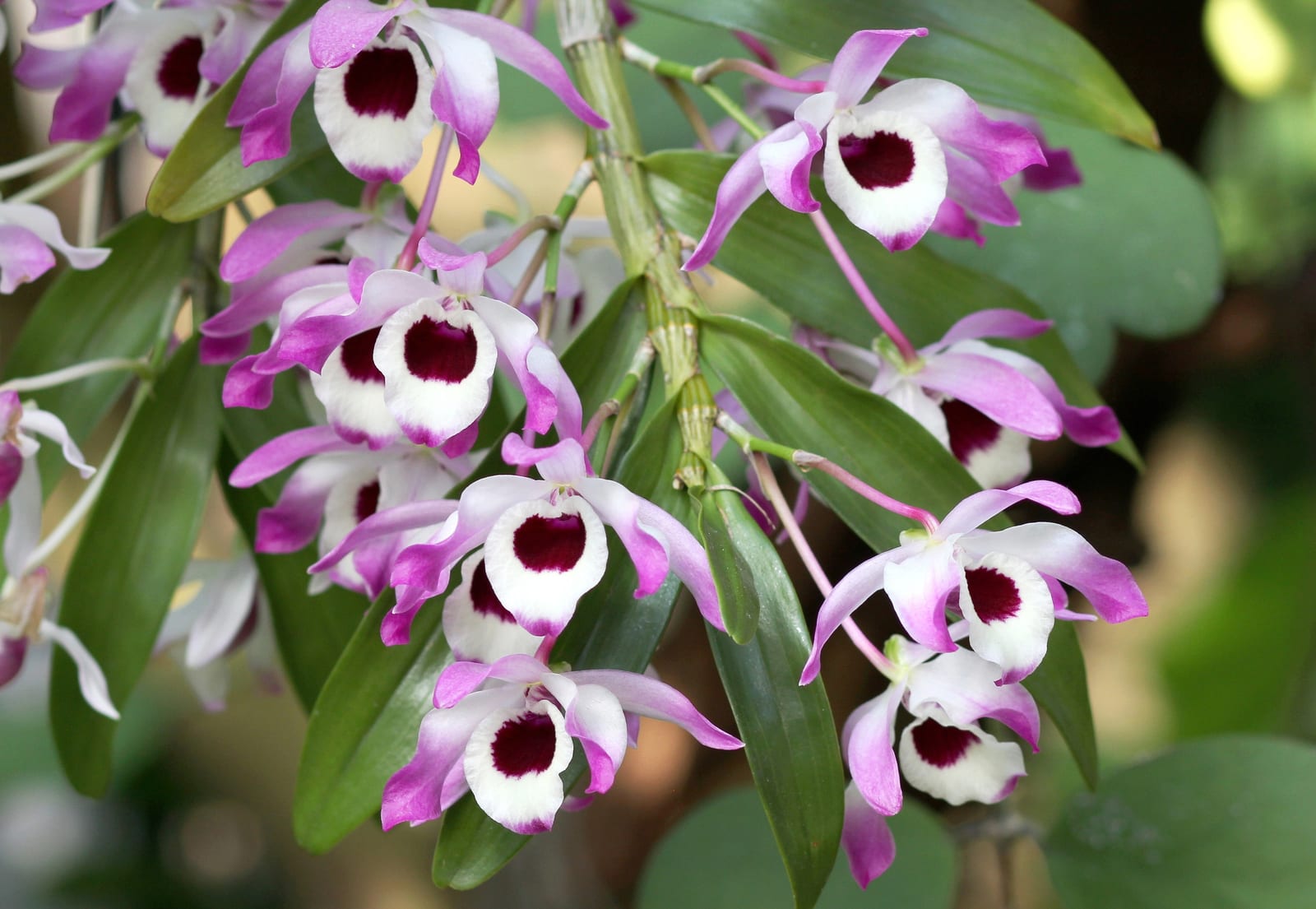
- Dendrobium: tall, thin canes, which are its pseudobulbs (AOS, RHS). On hard-cane types the flowers come on spikes near the top of the canes. On soft-cane types, such as Dendrobium nobile, they open along the canes, according to NC State.
- Dancing lady (Oncidium): pseudobulbs, and each one carries a flower stem as it matures (RHS). The RHS adds that Cambria types are the ones best suited to life as houseplants.
- Cattleya: swollen, upright pseudobulbs with one or two leaves on top, as NC State describes them, and Clemson notes they store water. Old pseudobulbs shrivel after their leaves fall, which is normal (NC State).
- Slipper orchid (Paphiopedilum): no pseudobulbs. It grows in fans of leaves, and new fans appear at the edge of the clump (NC State, RHS). Unlike most orchids, it mostly grows in the ground in the wild (NC State, RHS). The RHS separates types with plain green leaves from types with mottled leaves.
- Cymbidium: NC State lists it as the boat orchid. It spreads sideways with new shoots (UConn), and it's the orchid that needs cool nights to flower (AOS, RHS).
Are orchids safe for cats and dogs?
The ASPCA's plant list for cats and its list for dogs put these orchids in the non-toxic section, under the names the ASPCA uses:
| Orchid group | Non-toxic on the ASPCA list |
|---|---|
| Moth orchid | Phalaenopsis (moth orchid, moon orchid), the whole genus |
| Cattleya | Christmas orchid or winter Cattleya (Cattleya trianae; the ASPCA lists it as C. trianaei), Easter orchid (C. mossiae), cocktail orchid (C. forbesii), Cattleya labiata |
| Dancing lady (Oncidium) | Dancing doll orchid (Oncidium flexuosum), golden shower orchid (O. sphacelatum) |
| Dendrobium | Leopard orchid or tiger orchid (Dendrobium gracilicaule) |
| Others | Pansy orchid (Miltonia roezlii alba), lace orchid (Odontoglossum crispum), lily of the valley orchid (O. pulchellum), spice orchids (Epidendrum atropurpeum, E. ibaguense), rainbow orchid (E. prismatocarpum), Florida butterfly orchid (Epidendrum tampense, also Encyclia tampensis), Old World orchid (Bulbophyllum appendiculatum), Brazilian orchid (Sophronitis), tailed orchid (Masdevallia), ghost leafless orchid (Polyrrhiza lindenii), jewel orchid (Ludisia discolor; the ASPCA lists it under its old name, Haemaria discolor), king of the forest (Anoectuchilus setaceus) |
Notice that, apart from moth orchids, the ASPCA names single species. The Dendrobium and dancing lady hybrids sold in stores aren't those species, and Cymbidium, slipper orchids (Paphiopedilum), Vanda and Zygopetalum aren't on the list at all. NC State gives Dendrobium, Oncidium, Paphiopedilum and Cymbidium no toxicity rating either. So any orchid not named above isn't rated. We found no reputable source that lists an orchid as toxic. Even so, nobody has confirmed that an unrated orchid is safe.
Any plant can still upset a pet's stomach if it eats enough, so keep a determined chewer away from the leaves. If a pet eats part of an orchid and seems unwell, call your vet or the ASPCA Animal Poison Control Center at (888) 426-4435.
How long do orchid flowers last?
| Orchid | How long the flowers last | Sources |
|---|---|---|
| Moth orchid | At least a month with good care (University of Maryland), several months (Clemson), four months or more (NC State) | UMD, Clemson, NC State |
| Slipper orchid | One to two months (NC State), up to three months (RHS) | NC State, RHS |
| Cattleya | Two to six weeks (Clemson); several weeks to a month or more (AOS) | Clemson, AOS |
For orchids in general, Wisconsin Extension says flowers last anywhere from several weeks to several months. Flowers on other types, like Dendrobium, dancing lady and Cymbidium, last weeks too, but we found only one source for each number, so we leave the numbers out. When the last flower drops, our after-blooming guide shows what to cut and what to keep.
From first orchid to expert
New to orchids? Read these in order. Each one builds on the last.
- Moth orchid care card: the easiest orchid, rated and explained.
- How often to water an orchid: the one skill that matters most.
- Aerial roots and root colors: what healthy roots look like and what rot looks like.
- What to do when the flowers fall: cut the spike or keep it.
- Getting it to bloom again: light, a cooler spell and patience.
- Repotting and potting mix: when the bark breaks down, and what to use for each type.
- Yellow leaves: normal aging or a problem.
- Wrinkled or limp leaves: thirst or root trouble.
Once a moth orchid reblooms for you, try a second type that suits your light: a slipper orchid for an east window, a Cattleya or hard-cane Dendrobium for a bright south window, or a Cymbidium if you have a cool room.
Frequently asked questions (FAQ)
What do I do when my orchid's flowers fall off?
Nothing drastic. Flowers dropping at the end of a bloom is normal, and the plant takes a rest afterward, according to Chicago Botanic Garden and Clemson. A brown, dry flower spike can come off, per the American Orchid Society. A green moth orchid spike gives you choices. Our after-blooming guide walks through each one.
Is my orchid dead?
Often it's just resting. Check the roots first: on a moth orchid, healthy roots look silvery when dry and green when wet, per University of Maryland Extension and Fairchild. Brown spikes, a yellow bottom leaf now and then, and shriveled old pseudobulbs are all normal. A rotted crown on a moth orchid is real trouble, because that's its only growing point (AOS). See our root guide and after-blooming guide.
How often do orchids bloom?
Most bloom about once a year, and some twice or more, according to Chicago Botanic Garden. Iowa State adds that some flower almost nonstop, and Penn State says a store-bought moth orchid will likely bloom once a year. If yours skips a year, our rebloom guide has the usual reasons.
Can an orchid grow in a north window?
Usually it won't flower there. The U.S. Botanic Garden and Chicago Botanic Garden say north windows are generally too dark for orchids to bloom. If a north window is all you have, Iowa State and Clemson say grow lights can make up the difference.
Sources
- Growing Orchids Indoors and How to Get Orchids to Rebloom : Iowa State University Extension and Outreach
- Orchids : Clemson Cooperative Extension, Home and Garden Information Center
- Orchids : University of Wisconsin-Madison Extension
- Orchids as Houseplants : Penn State Extension
- Care of Phalaenopsis Orchids (Moth Orchids) : University of Maryland Extension
- A Beginner's Guide to Orchids : UConn Home and Garden Education Center (D. Pettinelli, March 2024)
- Phalaenopsis, Cattleya, Dendrobium, Oncidium, Paphiopedilum and Cymbidium : NC State Extension Gardener Plant Toolbox
- Orchids and Moth orchid : UF/IFAS Gardening Solutions
- Orchid care : Chicago Botanic Garden
- Orchid Home Care : U.S. Botanic Garden
- Orchid FAQs : New York Botanical Garden
- Orchid Varieties, Identification and Care and Orchid Basics: How and When to Water Orchids : Fairchild Tropical Botanic Garden
- Top tips for growing orchids at home, Growing Phalaenopsis orchids, How to grow Dendrobium, Cool growing oncidium orchids, Paphiopedilum growing guide and How to grow cymbidium orchids : Royal Horticultural Society
- Novice Culture Sheet: Phalaenopsis, Dendrobium, Cattleya, Cymbidium and Paphiopedilum : American Orchid Society
- Phalaenopsis, the Genus, Shoots and Spikes and Where do I cut the spike? : American Orchid Society
- Toxic and Non-Toxic Plant List: Cats and Dogs, with the entries for Phalaenopsis orchid, Christmas orchid, dancing doll orchid, golden shower orchid and leopard orchid : ASPCA Animal Poison Control