Orchid glossary: plain definitions of the words orchid growers use
Orchid care has its own vocabulary, and a guide or a plant tag can lose you in one word. This glossary explains each term in a sentence or two, says where the definition comes from, and points to the guide where the word matters most. The terms are grouped by topic: the plant, the flower, how orchids grow, what they grow in, and names and rules. Every term has its own link, so you can jump straight to it.
Jump to a word: aerial root, Appendix I, Appendix II, artificially propagated, back bulb, bark, cane, CITES, column, cool, intermediate and warm growers, crown, cultivar, epiphyte, flask, genus and species, grex, hybrid, intergeneric hybrid, keiki, lip, lithophyte, monopodial, mount, mycorrhiza, node, petal, potting medium, pseudobulb, rhizome, sepal, sheath, sphagnum moss, spike, sympodial, terrestrial, trade name, velamen
Plant parts
Aerial root
A root that grows in the open air, above the potting mix or out over the rim of the pot. On a moth orchid it's normal and healthy: the plant grows on trees in the wild, and its roots reach for air. University of Maryland Extension says to leave them on, and Iowa State Extension describes orchids clinging to trees with coarse aerial roots. Read more: orchid roots.
Back bulb
An older pseudobulb toward the back of a plant that grows sideways, often without leaves. The American Orchid Society says back bulbs still feed the plant while they stay green and can be used to start new plants, and the New York Botanical Garden says older bulbs shrivel with age and keep supporting the plant. Read more: wrinkled pseudobulbs.
Cane
The tall, jointed stem of many Dendrobium orchids. It's a pseudobulb shaped like a stick: NC State calls canes narrow, segmented pseudobulbs, and the RHS says to keep them after flowering unless they're completely shriveled and brown. Read more: after blooming.
Crown
The center of a moth orchid, where the leaves meet the short stem and new leaves come from. Water left standing there can rot it, and a moth orchid whose crown rots can't make new leaves from it, per the AOS and Maryland Extension. Read more: crown rot and yellow leaves and how to water.
Keiki
A baby plant that grows on the mother plant, from a node on a flower spike or along a cane. The word is Hawaiian, and the AOS uses it for a plantlet that sprouts from a mature plant. Moth orchids can grow one on an old spike (AOS), and Dendrobium on older canes (RHS). Leave it attached until it has its own roots. Read more: orchid keikis.
Node
A small joint on a flower spike or stem. On a moth orchid spike, each node sits under a little papery sheath and holds a dormant bud that can grow a new flower branch or a keiki (AOS, Agriculture and Natural Resources, 1981). On the main stem of a moth orchid or Vanda, nodes are where leaves, roots and spikes come out, per the AOS. Read more: where to cut the spike.
Pseudobulb
A swollen stem that stores water and food, found on orchids like Cattleya, Oncidium and Cymbidium. The AOS compares it to a camel's hump, and Clemson Extension and NC State also describe it as a store of water. The moth orchid has none (Clemson). Read more: does my orchid have pseudobulbs?
Rhizome
The creeping stem that sideways-growing orchids grow along, sending up a new shoot from its tip each season. The AOS explains that those shoots swell into pseudobulbs, and its parts guide says to keep the rhizome at or just above the mix when you repot, because burying it raises the risk of rot. Read more: repotting.
Sheath
A thin, papery covering. On pseudobulbs it wraps and protects new growth, and the AOS says you can peel it off once it's dry, so it can't hide scale insects. On a moth orchid spike, a tiny sheath covers each node's bud (Agriculture and Natural Resources, 1981). Where leaves wrap around each other, water caught in the leaf sheaths can cause rot, per Maryland Extension. Read more: after blooming.
Spike
The stem that carries an orchid's flowers, also called the flower spike. A young moth orchid spike is solid green with no silvery coat and a rounded, mitten-like tip, which is how Maryland Extension tells it from a new root; on these orchids spikes grow from nodes on the stem, per the AOS. Read more: spike or root? and cutting the spike.
Velamen
The spongy, silvery outer layer on the roots of orchids that grow on trees. It's made of dead, hollow cells that soak up water fast, hold it, and give helpful fungi a home (AOS, Plant Diversity, 2018). It looks silvery white when dry and green when wet (Maryland Extension). Read more: healthy roots and why orchids like a soak.
Flower parts
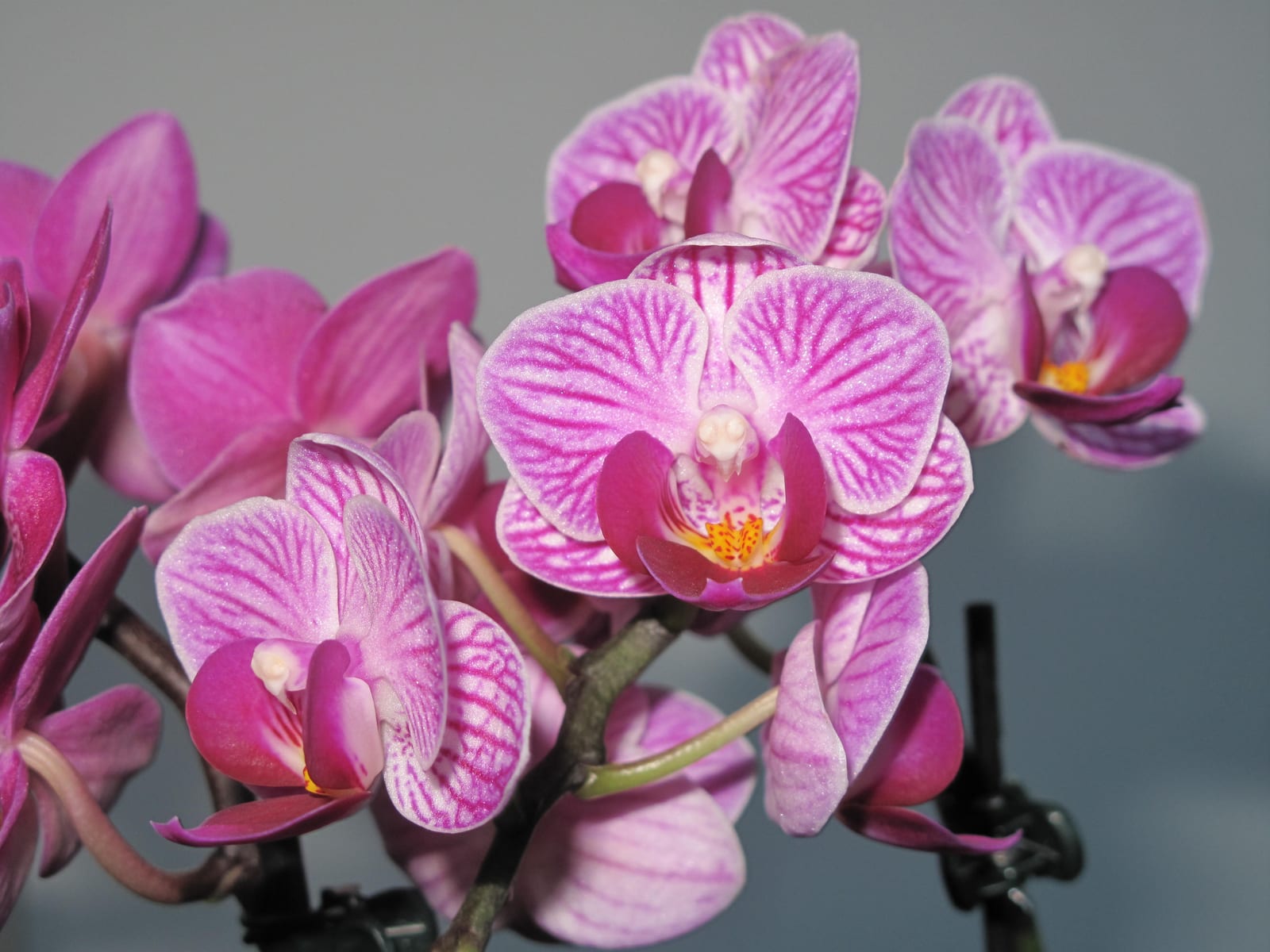
An orchid flower has three sepals, three petals and a column. The New York Botanical Garden and Brooklyn Botanic Garden both describe it this way.
Sepal
One of the three outer parts of the flower, which protect the bud before it opens. On many orchids they look like petals. On Masdevallia, NC State says the sepals join at the base and stretch into long tails. Read more: what the flowers tell you.
Petal
One of the three inner parts of the flower, set between the sepals. Two usually match, and the third is shaped into the lip (Brooklyn Botanic Garden, NYBG). Read more: orchid types.
Lip (labellum)
The special third petal, opposite the column, often a different shape or color from the rest. Brooklyn Botanic Garden says it often works as a landing pad for pollinating insects, and in slipper orchids like Paphiopedilum it forms a pouch. The frilly lip of Oncidium is why it's called the dancing lady (NC State). Read more: orchid types.
Column
The part that sticks out from the center of the flower, where the male and female parts are joined into one. The NYBG calls this joining the feature that sets orchids apart most from other flowers, and Brooklyn Botanic Garden notes that in most other plants these parts stay separate. Read more: orchid types.
How orchids grow
Monopodial
Growing upward from one stem and one crown, adding leaves at the top. Moth orchids and Vanda grow this way (AOS, UConn). If the crown dies, the plant can't regrow from anywhere else. Read more: one crown or a row of shoots?
Sympodial
Growing sideways along a rhizome, sending up a new shoot each season, which often swells into a pseudobulb. Cattleya, Dendrobium, Oncidium and Cymbidium grow this way, per the AOS and UConn. These orchids keep adding new growths, and their next flowers usually come from them. Read more: one crown or a row of shoots?
Epiphyte
A plant that grows on another plant, usually a tree, without taking anything from it. Its roots grip the bark and take water and nutrients from rain, air and debris (Iowa State, Wisconsin Extension). Most orchids sold for homes are epiphytes, including the moth orchid. Read more: where orchids grow.
Lithophyte
A plant that grows on rocks. Wisconsin Extension and NC State both use the term, and Kew's World Checklist of Vascular Plants records many Cattleya species growing on rock. Read more: where orchids grow.
Terrestrial
Growing in the ground. Most slipper orchids grow this way (NC State), and so does the jewel orchid, Ludisia, which creeps along the ground (NC State). In a pot, the NYBG gives terrestrial orchids a finer mix that holds more moisture. Read more: where orchids grow and potting mixes.
Mycorrhiza
A partnership between a plant's roots and a fungus. In orchids, the AOS says the fungus helps the plant take up water and minerals and gets sugars in return, and the velamen houses these fungi. Some orchids depend on one fungus completely: ghost orchid seeds need a particular Ceratobasidium to sprout (US Fish and Wildlife Service, Annals of Botany, 2016). Read more: rare orchids.
Cool, intermediate and warm growers
Three groups that sort orchids by the temperatures they like. Iowa State gives daytime ranges of about 16 to 24 °C (60 to 75 °F) for cool growers like Cymbidium and slipper orchids, 21 to 27 °C (70 to 80 °F) for intermediate ones like Cattleya, and 24 to 29 °C (75 to 85 °F) for warm growers like many moth orchids, and suggests treating an unknown orchid as intermediate. The RHS and NC State use the same labels. Read more: what orchids need.
Potting and mounting
Potting medium
What an orchid's roots grow in, used in place of soil: usually chunky bark, moss or a mix. Orchids that grow on trees need a mix that drains fast and lets air reach the roots, and regular potting soil stays too wet (AOS, Clemson, RHS). Read more: which mix is best?
Bark
Chunks of fir or pine bark, the base of most orchid mixes. It drains fast and dries quickly, then breaks down into fine crumbs in one to two years, which is a sign it's time to repot (AOS, NYBG). Read more: bark or moss?
Sphagnum moss
A long-fibered moss that holds a lot of water and stays wet in the center after the edges dry (NYBG). Many supermarket moth orchids come packed in it, and Clemson links it to root rot over time. Read more: watering in moss.
Mount
A piece of cork, wood or branch an orchid is tied to and grown on, with its roots in the open air. Nothing holds water around the roots, so a mounted orchid needs water more often than one in a pot (Iowa State). Read more: watering a mount and mounted plants.
Names, buying and rules
Genus and species
The two-part botanical name of a wild orchid, both words in italics, like Dendrobium bigibbum. The first word is the genus, the group it belongs to, and on most plant tags it's the most useful word (NYBG, RHS). Read more: reading an orchid tag.
Hybrid
A plant raised by crossing two different parents. Its tag carries a grex name, and often a cultivar name too (NYBG). Fairchild Tropical Botanic Garden counts more than 100,000 registered orchid hybrids. Read more: reading an orchid tag.
Grex
The registered name shared by every seedling from one pair of parents, whichever parent carried the seed. It's capitalized and written in plain letters, as in Dendrobium Spring Bird, and the RHS keeps the register (NYBG, RHS). Read more: reading an orchid tag.
Cultivar
One selected plant within a grex or species, written in single quotes, as in Dendrobium Spring Bird 'Kurashiki'. Copies of it are made by cloning, so every plant with that name is the same plant (NYBG, RHS). Read more: reading an orchid tag.
Intergeneric hybrid
A hybrid between two or more related genera, something orchids do more readily than most plants. It gets a blended name: Brassocattleya is Brassavola crossed with Cattleya, and crosses of four or more genera often get a name ending in "-ara" (AOS, NYBG). Read more: orchid types.
Trade name
A name in ALL CAPITALS on a tag, used for marketing. The NYBG explains that it isn't registered and says nothing about the plant's parents. Read more: reading an orchid tag.
Lady slipper
A name shared by three groups of orchids with a pouch-shaped lip: Cypripedium, the wild lady slippers of northern woods such as the pink lady slipper; Paphiopedilum, the Asian slipper orchid sold as a houseplant; and Phragmipedium, from Mexico to South America, such as Phragmipedium kovachii (NYBG, NC State). Read more: which orchids are called lady slippers.
CITES
The international treaty that controls trade in wild plants and animals across borders. Every orchid species is covered by it (Hinsley and colleagues, 2018; CITES appendices). It governs trade between countries only, and many countries protect their wild orchids under their own laws too (US Fish and Wildlife Service). Read more: rare orchids.
Appendix II
The CITES list that holds nearly every orchid. They can cross borders with export permits and a check that the trade won't harm wild populations, as Hinsley and colleagues explain. Read more: rare orchids.
Appendix I
The strictest CITES list. For orchids it includes every species of the slipper orchids Paphiopedilum and Phragmipedium and a few others. International commercial trade is banned unless the plants were artificially propagated from legally obtained parents (Hinsley and colleagues; US Department of Justice). Read more: rare orchids.
Artificially propagated
Grown by people under controlled conditions, as opposed to collected from the wild. CITES gives the phrase a specific meaning for trade, and Hinsley and colleagues found that more than 99.9% of live orchids in reported legal trade from 1996 to 2015 were raised this way. Read more: buying rare orchids responsibly.
Flask
A sealed, sterile lab container that tiny orchid seedlings grow in. Seedlings in sterile flasks are exempt from many CITES rules, with tighter conditions for Appendix I species, per Hinsley and colleagues. Read more: rare orchids.
Frequently asked questions (FAQ)
Do I need to learn these words to grow an orchid?
No. A moth orchid needs bright indirect light, a good soak when it's nearly dry, and a chunky mix, and you can give it all three without the vocabulary. The words help when you read a tag, follow a guide or ask someone for help. Start with the orchid care guide and come back here when a word stops you.
Is a pseudobulb a real bulb?
No. It's a thickened stem that stores water and food above the potting mix, per the AOS and Clemson. That's why a shriveled pseudobulb is a sign of thirst or root trouble. See why pseudobulbs shrivel.
How is a grex different from a cultivar?
A grex covers every seedling from one cross, so plants with the same grex name can look different. A cultivar is one chosen plant from that group, copied by cloning, so plants with the same cultivar name match. The NYBG and the RHS both explain it this way.
Sources
- Orchid Parts and Why They Matter : American Orchid Society, Orchids magazine (Sue Bottom, June 2024)
- Shoots and Spikes, Orchid Roots, Where do I cut the flower spike when it is finished?, Repotting, What is the best potting media? and Intergeneric Hybrids : American Orchid Society
- Growing Phalaenopsis. What Can Go Wrong? : American Orchid Society, Orchids magazine (Sue Bottom, June 2025)
- What Makes an Orchid Different from Other Flowers? : New York Botanical Garden, Plant Talk (Jessica Blohm, March 2010)
- Orchids and Their Pollinators : Brooklyn Botanic Garden (David Horak, April 2004)
- Understanding Orchid Names (updated February 2026), Orchid FAQs and Why does my orchid have a wrinkled pseudobulb? (updated October 2025) : New York Botanical Garden
- How orchids are named: an introduction : Royal Horticultural Society, Plant Registration
- How to grow Dendrobium, How to grow Phalaenopsis and Cool growing oncidium orchids : Royal Horticultural Society
- Dendrobium, Cattleya, Cymbidium, Masdevallia, Oncidium, Paphiopedilum and Ludisia discolor : NC State Extension Gardener Plant Toolbox
- Care of Phalaenopsis Orchids (Moth Orchids) and Q&A: What causes orchid leaves to turn yellow and shrivel? : University of Maryland Extension
- Ask Extension answers on a flower spike or a root (August 2023) and yellowing orchid leaves (April 2024) : University of Maryland Extension, Home and Garden Information Center
- Growing Orchids Indoors : Iowa State University Extension and Outreach
- Orchids : University of Wisconsin-Madison Extension
- Orchids : Clemson Cooperative Extension, Home and Garden Information Center
- A Beginner's Guide to Orchids : UConn Home and Garden Education Center (March 2024)
- Orchid Varieties, Identification and Care : Fairchild Tropical Botanic Garden
- Physiological diversity of orchids : Zhang and colleagues, Plant Diversity 40(4) (2018)
- Induction of plantlets on inflorescence of Phalaenopsis by application of N-6-benzyl adenine : Sahavacharin, Agriculture and Natural Resources 15(2), 1981
- A review of the trade in orchids and its implications for conservation : Hinsley and colleagues, Botanical Journal of the Linnean Society (2018)
- CITES Appendices I, II and III : CITES Secretariat (checked November 12, 2026)
- What's in a Name? Paphs, Cyps, and Phrags : New York Botanical Garden, Plant Talk (Katherine Wagner-Reiss, March 9, 2017)
- Endangered and Threatened Wildlife and Plants; Endangered Species Status for Ghost Orchid (proposed rule, 90 FR 23869) : US Fish and Wildlife Service (June 5, 2025)
- Comparative seed germination and seedling development of the ghost orchid, and molecular identification of its mycorrhizal fungus : Hoang and colleagues, Annals of Botany (2016)
- Marie Selby Botanical Gardens, Inc. and employee charged with violating the Endangered Species Act : US Department of Justice (December 18, 2003)
- World Checklist of Vascular Plants, version 16 (extracted June 4, 2026, doi:10.34885/egs6-cp24) : Royal Botanic Gardens, Kew