Plant care card
Vanda
Vanda · Orquídea vanda
Also called vanda orchid or ascocenda
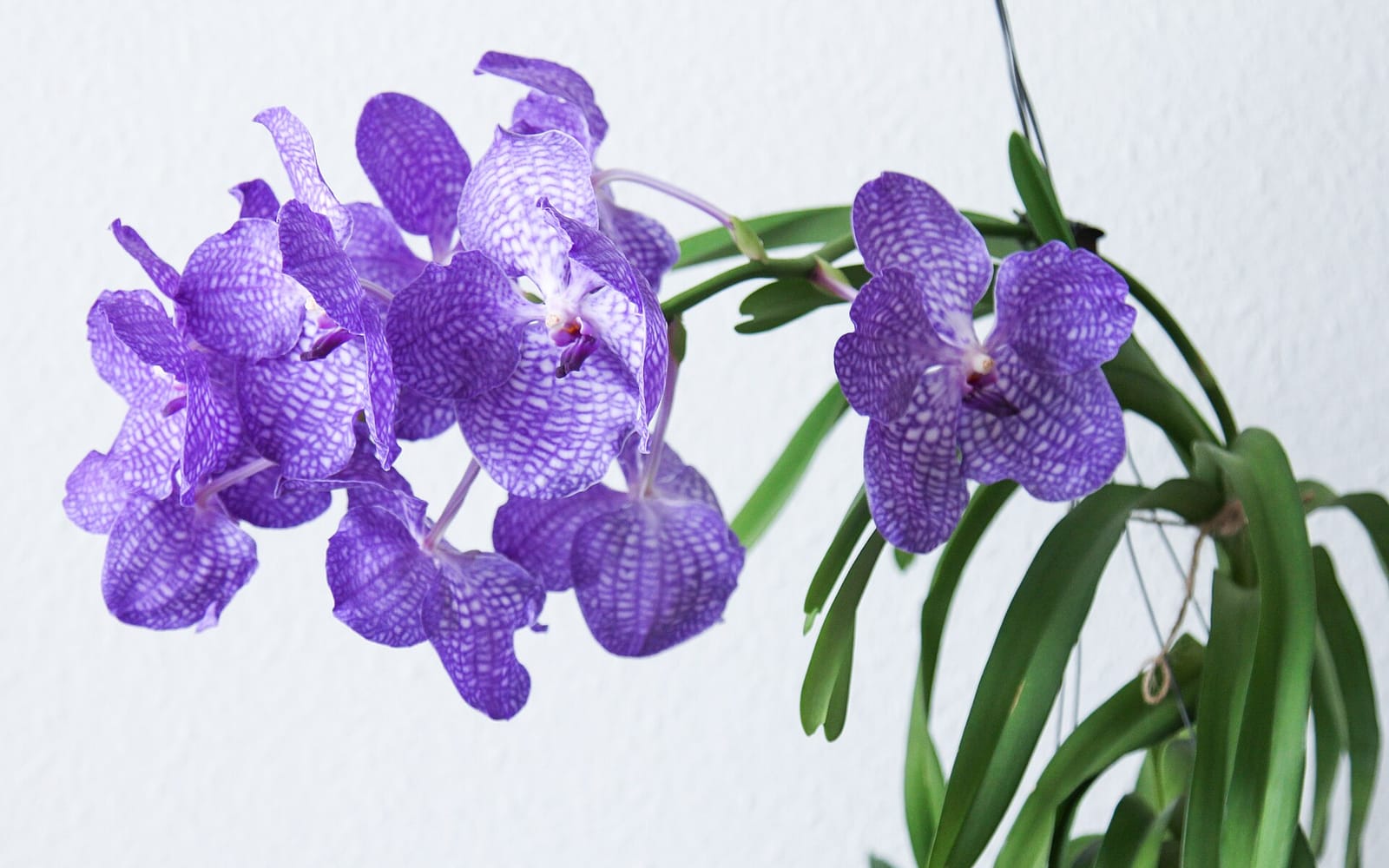
Photo by Maja Dumat on Wikimedia Commons, CC BY 2.0

Vandas are sun-loving orchids that grow with their roots hanging in the air, which is why they’re usually sold in an open basket with little or no potting mix. Give one your sunniest window with shade from hot midday sun, soak the roots until they turn green as often as every day in summer, and keep the air at 65% humidity or more. That humidity is the hard part in most homes, so a sunroom or greenhouse suits it best.
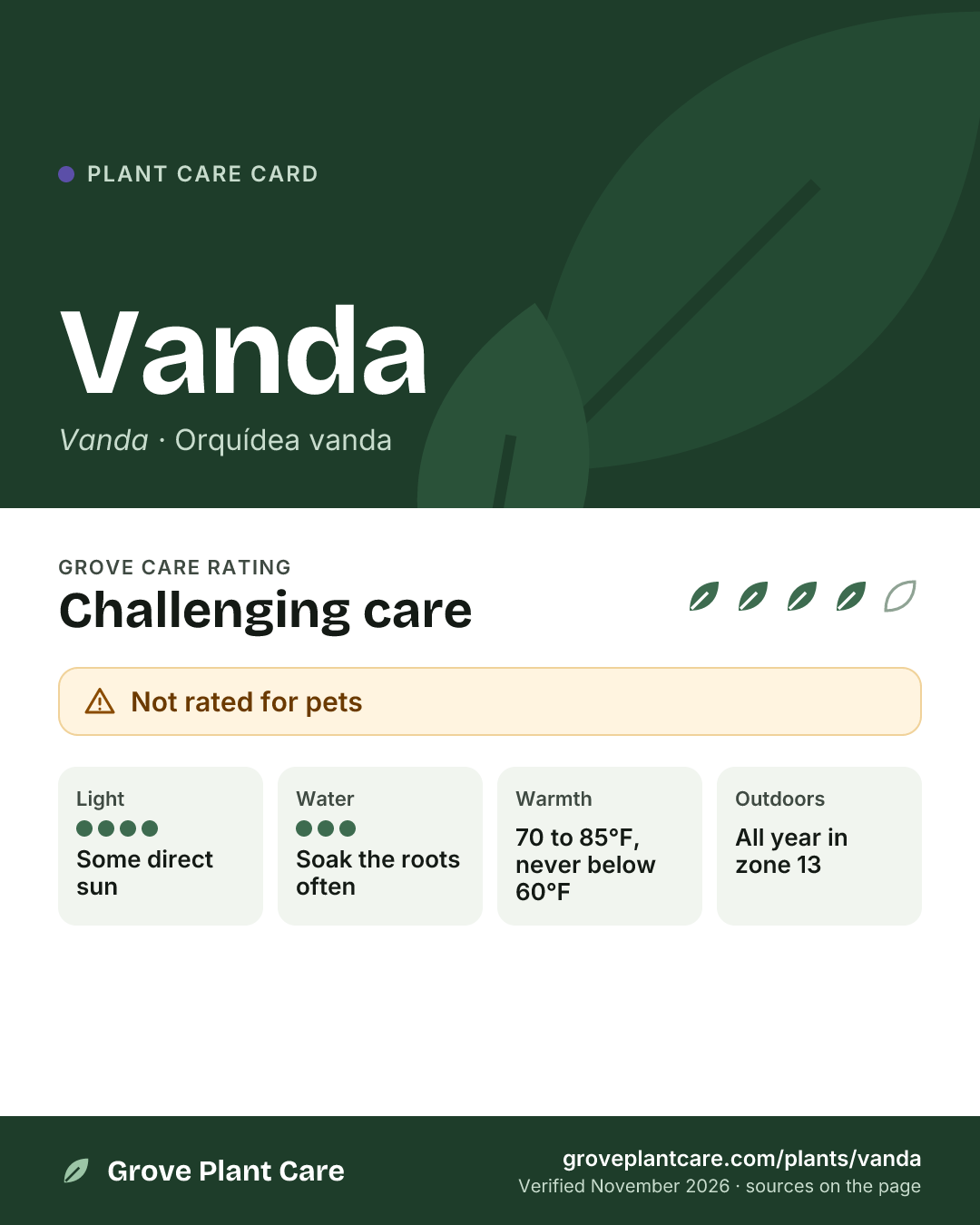
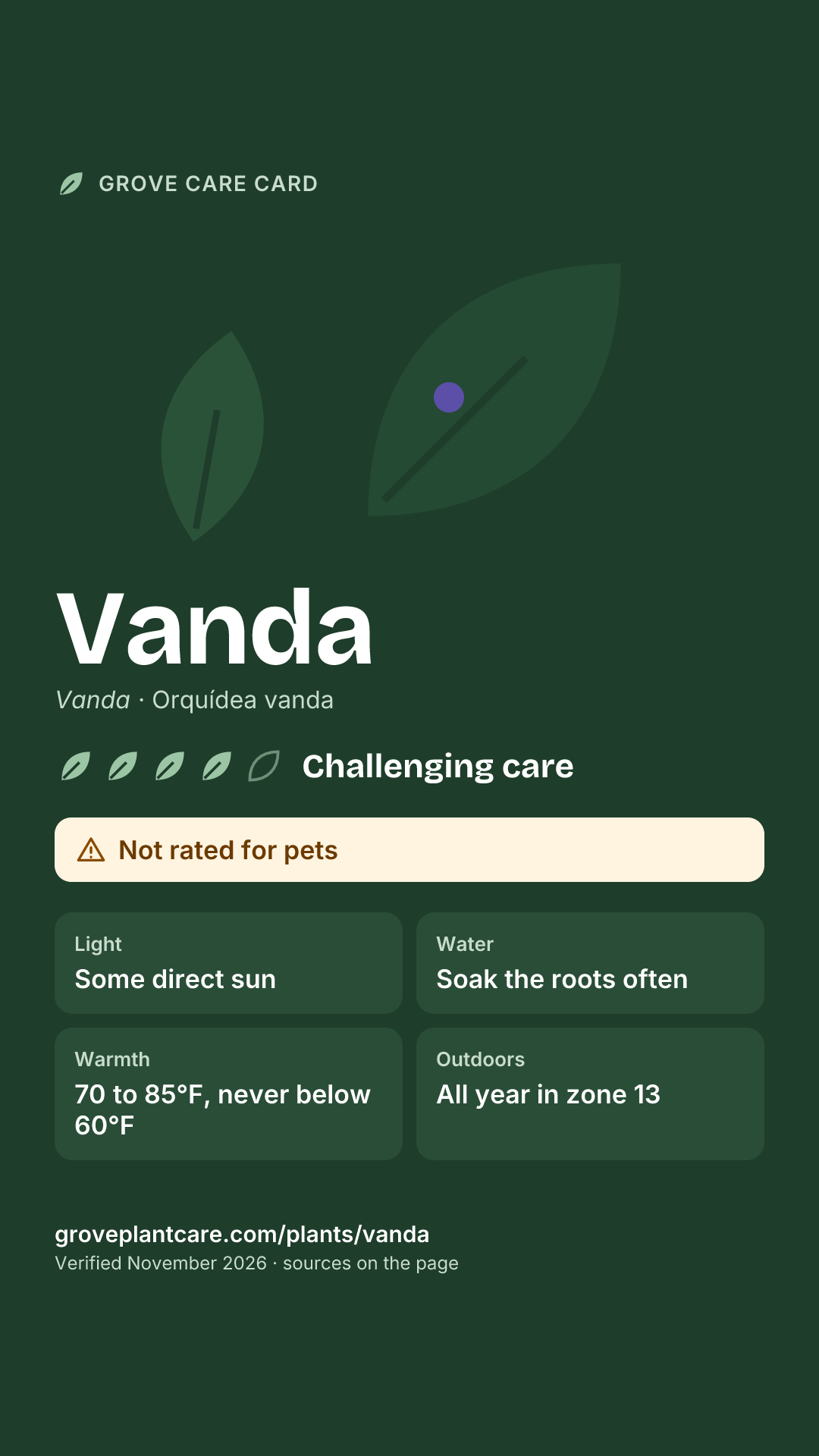
Not rated for pets
Neither the ASPCA nor NC State rates Vanda. We found no trusted source that calls it toxic. No trusted source rates it, so keep it out of reach of pets that chew plants until one does. Children: No source rates it for people; NC State lists no poison information.
Pet poison line: ASPCA (888) 426-4435
Good for: a sunroom or greenhouse, a bright spot you can keep humid, people who like to water often · Think twice if: your home has dry air in winter, you can’t water often, even daily in summer, your pets chew plants.
Needs at a glance
- Light4 of 4 · Some direct sunYour sunniest window, shaded from hot midday sun
- Water3 of 3 · Often, even dailySoak the roots until they turn green, then let them dry; less in winter
- Humidity3 of 3 · High65 to 80%, with air moving around the roots
- Soil when pottedOpen basket, little or no mixOr chunky bark, lava rock or charcoal in a small pot
Indoors: best at 70 to 85°F (21 to 29°C). Keep it above 60°F (16°C) and away from drafts and heat vents.
How the rating adds up
0 = easiest · 1 = moderate · 2 = hardest
- Missed waterings2 of 2 · HardestNo water storage; often needs water every day in summer
- Light flexibility2 of 2 · HardestNeeds high light, with some sun
- Humidity2 of 2 · HardestNeeds 65 to 80% humidity
- Pests and disease1 of 2 · ModerateThrips, scale, mealybugs; rot when air is still
- Sensitivity to change1 of 2 · ModerateDrops lower leaves with cold or uneven watering
Growing outdoors
All year: USDA zone 13, where the coldest winter nights average 60°F (16°C) or warmer.
Elsewhere: summer outside in dappled shade. Bring it in before nights drop below 60°F (16°C).
- Hanging baskets
- Mounted
- Pots of chunky mix
Sources: NC State, Fairchild Garden, American Orchid Society, NYBG, RHS, ASPCA plant list, USDA zone map and UF/IFAS. Full list below.
Verified · How we rate plants
Why is my vanda in a basket with no soil?
Because that’s how it grows best. In the wild, vandas grow on tree branches with their roots hanging free in moist air, and the roots need air around them. UF/IFAS describes vandas sold hanging in garden centers in simple baskets with very little mix, and Fairchild Garden says they’re usually kept in open baskets or with minimal mix. The American Orchid Society says most prefer an open basket with no potting mix at all. Leave it in the basket. If you want a pot, NYBG suggests a small one with chunky bark, lava rock or charcoal.
UF/IFAS, Fairchild Garden, American Orchid Society, NYBG, NC State
How often should I water a vanda?
Often: in warm months, as often as every day. Vandas have no pseudobulbs to store water, so Fairchild Garden says to water just before the roots dry out, and the American Orchid Society and NYBG both say daily watering is normal for healthy roots. Soak the roots in the morning until they turn from silvery white to green. Fairchild suggests two short waterings a few minutes apart. It also warns against dunking several baskets in one bucket, which spreads disease. Use lukewarm water, never colder than 50°F (10°C), and skip softened water. Water less in the short days of winter, about every other day, according to NYBG. Root tips that dry out and seal over mean it needs water more often.
How much light does a vanda need?
More than almost any other orchid you can buy. The American Orchid Society calls light the most important thing for growing and flowering vandas. Indoors, NYBG says a south window is best. Shade strap-leaf vandas, the common kind, from hot summer sun, as NYBG and the RHS advise, though the AOS culture sheet allows half to full sun in a greenhouse. Pencil-leaf (terete) vandas take full sun.
Can I grow a vanda indoors?
It’s hard, and we’d rather say so up front. The American Orchid Society says true vandas shouldn’t be grown indoors, because most homes are too dark and too dry and the plants get big. NYBG gives indoor advice, but asks for a south window and at least 65% humidity, when an average home in winter can drop to about 25%. The RHS treats them as greenhouse plants that need at least 15°C (59°F). A sunroom, a greenhouse, or a very bright spot with a humidifier gives you the best chance.
Should I cut the long roots?
Mostly, leave them. The roots soak up water and food and even make food from light, so NC State says not to trim them. The American Orchid Society is more relaxed: it says you can trim aerial roots back to about 2 ft (60 cm) with a sterile tool. Healthy roots turn green when wet and have growing tips. When it outgrows its basket, NYBG says to set the whole basket inside a bigger one instead of pulling the roots out, and UF/IFAS suggests wetting the roots first so they bend instead of snapping.
NC State, American Orchid Society, NYBG, Fairchild Garden, UF/IFAS
Why won’t my vanda bloom?
Too little light is the first thing to check, since the American Orchid Society calls light the most important factor. Next is humidity: NYBG says a vanda may not flower without at least 65%. It also wants warmth and nights about 10°F (5°C) cooler than days. In cool climates with short winter days, the RHS says it may stop and rest for a while. When it’s happy, NC State says it can bloom every few months, and each flower lasts a little over a month.
American Orchid Society, NYBG, RHS, NC State, Fairchild Garden
Why is my vanda losing its lower leaves?
Usually from cold or uneven care. The American Orchid Society says swings in temperature or watering make vandas drop their lower leaves, and too much cold can leave a bare stem with leaves only at the top, like a palm tree. Keep it above 60°F (16°C) and water on a steady rhythm. The RHS adds that it shouldn’t stay dry for long, even in winter.
How warm should I keep a vanda?
Warm: days of 70 to 85°F (21 to 29°C) and nights of 60 to 70°F (16 to 21°C), according to NYBG, and the American Orchid Society says days up to 95°F (35°C) are fine with enough humidity and air. For nights, the AOS cold guide says to stay above 60°F (16°C) if you don’t know your plant’s background, and the RHS says above 15°C (59°F). NYBG and UF/IFAS draw the line at 55°F (13°C). Small-flowered vandas sold as Ascocenda handle down to 50°F (10°C).
Is a vanda safe for cats and dogs?
We can’t say yet. The ASPCA doesn’t list Vanda, NC State gives no toxicity rating, and we found no trusted source that calls it toxic. Until a trusted source rates it, hang it where pets that chew plants can’t reach it, which a hanging basket makes easy. If your pet ate some and seems unwell, call your vet or the ASPCA Animal Poison Control Center at (888) 426-4435 (a fee may apply).
Can a vanda live outdoors?
In summer, yes, in dappled shade: NC State and UF/IFAS both describe vandas spending the warm months outside. Bring it in before nights drop to about 60°F (16°C), the night floor the American Orchid Society and the RHS give. All year, only in the warmest places. No source we found lists USDA zones for vandas, and the 60°F night floor from the American Orchid Society and the RHS is met only in zone 13, so that’s the zone on the card. In Florida, UF/IFAS keeps them outside and covers or brings them in when nights drop below 55°F.
NC State, UF/IFAS, American Orchid Society, RHS, USDA zone map
How Grove helps
Grove can remind you to soak the roots as often as every day in summer and less in winter, and you can assign the job to whoever is home, so the basket never goes a weekend without water.
Sources
- NC State Extension Gardener Plant Toolbox: Vanda
- Fairchild Tropical Botanic Garden: Orchid basics, how and when to water orchids
- American Orchid Society: Vanda
- New York Botanical Garden LibGuides: Vanda orchid
- American Orchid Society: Vanda Culture Sheet
- Royal Horticultural Society: Vanda Rothschildiana plant details
- New York Botanical Garden Plant Information Service: How do I care for the orchid Ascocenda, Vanda hybrid?
- American Orchid Society: Cold Tolerance of Warm Growing Orchids (2024)
- ASPCA Animal Poison Control: Toxic and Non-Toxic Plants
- USDA ARS Plant Hardiness Zone Map (2023)
- UF/IFAS Extension Charlotte County: Vanda orchids at a glance (2021)
- UF/IFAS Gardening Solutions: Orchids
- Kew Plants of the World Online: Vanda
- Fairchild Tropical Botanic Garden: Types of Orchids, Identification and Care Guide