How often to water an orchid: by pot, season and type
Most orchids want a thorough soak when the potting mix is almost dry, then nothing until it's almost dry again. In bark, that's often about once a week. In moss it's less often, and on a mount it's more. There's no fixed calendar: the pot, the room and the season set the pace, so check before you water. Unsure? Wait a day. An orchid forgives a late drink far more easily than soggy roots.
How do I know when my orchid needs water?
Read moreShow less
Three quick checks work for almost every orchid:
- Weight. Lift the pot right after watering so you know how heavy "wet" feels. As the mix dries, it gets noticeably lighter. The American Orchid Society, Chicago Botanic Garden and the RHS all use this test.
- Feel. Push a finger about 2.5 cm (1 inch) into the mix, as the New York Botanical Garden suggests, or leave a dry wooden chopstick in the pot for a few minutes, as Iowa State Extension does. Damp wood or a damp finger means wait.
- Root color. Moth orchid roots turn dull silvery white as they dry and pale green after watering, per University of Maryland Extension and Fairchild Tropical Botanic Garden. A clear pot makes this easy to see.
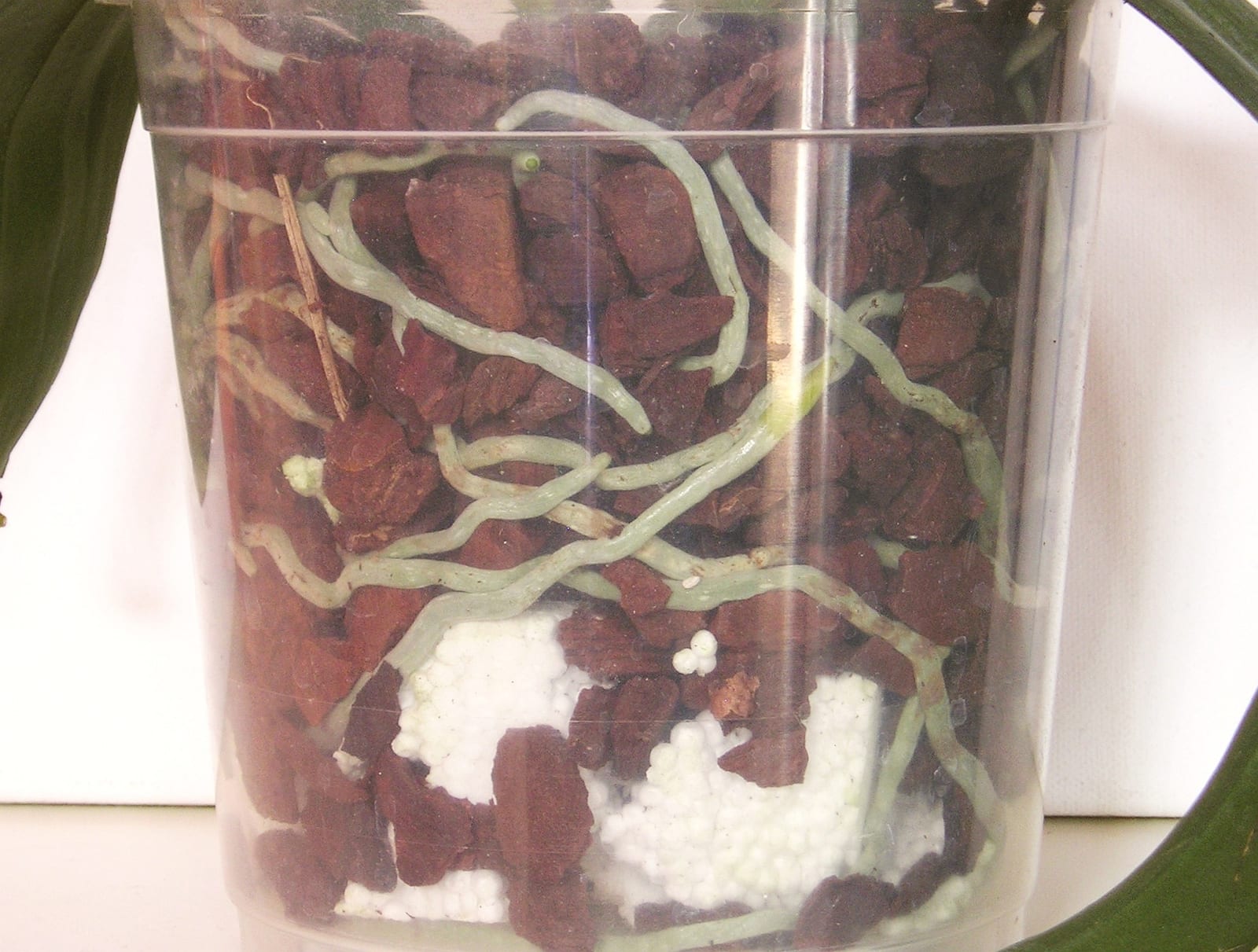
Still unsure? The AOS and Iowa State both say to wait a day or two. If the leaves look wrinkled, don't just water more: wrinkled leaves can mean too little water or roots that have rotted and can't drink. Our wrinkled leaves guide shows how to tell.
How do I water an orchid?
- Water in the morning, so any water on the plant dries by night (NYBG, RHS).
- Use lukewarm or room-temperature water. The AOS warns that water colder than 10 °C (50 °F) can injure Cattleya and pansy orchids.
- At the sink, pour water slowly through the mix until it runs freely out of the drainage holes (Clemson Extension, Iowa State).
- Wait a few minutes and water again. Dry bark sheds water at first, and the second pass soaks it through and rinses out built-up fertilizer salts (Iowa State, AOS).
- Let the pot drain completely. Never leave it standing in water: Iowa State says to empty any saucer within 30 minutes.
- If water lands in the crown (where the leaves meet) or between leaves, blot it with a paper towel. Water that sits there can cause rot (Clemson, AOS).
Why so much water at once? Orchid roots soak up water fast, then need air. A full soak followed by a dry spell gives them both, and the run-through flushes out salts too (AOS). The Going deeper box below explains why.
Some sources soak the whole pot instead. Wisconsin Extension stands it in water for a couple of hours, while Maryland drenches it three or four times over about ten minutes. Either way, drain it fully afterward. A long soak is riskier for an orchid in moss, which already holds a lot of water.
Going deeper
Orchids that grow on trees in the wild, like the moth orchid, have roots wrapped in a spongy coat called velamen, a layer of empty cells just behind the growing tip. The American Orchid Society and a 2018 review in Plant Diversity describe how it works. Water clings to the cell walls and gets drawn in without the plant spending energy, much like a paper towel wicking up a spill. The same review cites research showing dry velamen can fill within seconds, which is why a quick, thorough soak works. The catch: roots also need air. When velamen stays soaked for days, the root suffocates and rots, as the AOS and Chicago Botanic Garden both explain. That's the whole reason for the wet, then dry, rhythm.
How often should I water an orchid in bark or moss?
| Potting medium | How often to start | Why |
|---|---|---|
| Bark | About once a week (AOS, Clemson) | Bark drains fast and dries quickly. Clemson says open bark, small pots or clay pots may need water twice a week. |
| Sphagnum moss | Less often than bark: water when the top feels dry (AOS, NYBG) | Moss stays wet much longer. Iowa State calls it easier for beginners but riskier for rot. |
| Mounted on cork or a branch | More often than any pot (Iowa State, RHS) | Nothing holds water around the roots. In hot weather a mount may need water every day, per Fairchild. |
| Clay pot | Sooner than the same mix in plastic (Chicago Botanic Garden, Clemson) | Unglazed clay pulls water out of the mix. |
Many supermarket moth orchids come packed in moss, and that's where most overwatering starts. Moss can look dry on top and stay wet underneath, so lift the pot and feel deeper before you water. No source we checked gives a number of days for moss, and we won't invent one.
Old mix changes the math. Bark breaks down over a year or two into fine, soil-like crumbs that hold water and drain slowly. If your orchid suddenly stays wet much longer than it used to, Chicago Botanic Garden and the AOS say it's time to repot. Mounted plants are their own skill: see our mounted plants guide.
Should I water less in winter?
Read moreShow less
Every source we checked agrees on the direction. Fairchild says most orchids need water less often in winter. The RHS and NC State Extension say to start cutting back on moth orchids from mid to late November in the Northern Hemisphere, or mid to late May in the Southern Hemisphere. In summer, the RHS says a Dendrobium may need water several times a week, and Iowa State notes that orchids outdoors in summer usually need more.
Water less after flowering, too, until new leaves or roots appear (Clemson, Chicago Botanic Garden). And if you live where there's no real winter, the checks above matter more than any calendar: a warm, bright spot dries the mix faster all year.
A few orchids take a real winter rest. The common cane Dendrobium (Dendrobium nobile) gets very little water for a couple of months to set its flower buds. Our rebloom guide covers that.
Which water is best for orchids?
Read moreShow less
- Tap water: Iowa State says most city and well water that's safe to drink is fine, and the NYBG says moth orchids handle tap water well in most cases.
- Rainwater: Iowa State calls it the best choice, and the RHS recommends rain or filtered water where tap water is hard. UF/IFAS Extension agrees for Cattleya.
- Softened water: skip it. The AOS, Iowa State and Fairchild all warn against water from a salt-based softener, because the sodium builds up in the mix.
- Salt-sensitive orchids: pansy orchids (Miltoniopsis) get brown leaf tips from mineral salts, per NC State Extension and the NYBG. Rainwater helps them most.
A thorough watering at least once a month, with plain water and no fertilizer, rinses out salts that build up between feedings (AOS, Clemson, Iowa State).
Can I water my orchid with ice cubes?
Read moreShow less
A 2017 study at Ohio State, summarized on its greenhouse blog, gave moth orchids in bark three ice cubes a week and found no harm over six months. It only tested moth orchids, and the AOS warns that water colder than 10 °C (50 °F) can injure Cattleya and pansy orchids. The full story, including why Missouri Botanical Garden and Iowa State still advise against it, is in our plant myths guide.
Do all orchids need the same watering?
| Orchid | How dry before watering | Sources |
|---|---|---|
| Moth orchid (Phalaenopsis) | Nearly dry, never bone dry | Clemson, NYBG, Iowa State, AOS |
| Slipper orchid (Paphiopedilum) | Evenly moist, never soggy; don't let it dry out fully | AOS, Penn State |
| Pansy orchid (Miltoniopsis) | Evenly moist, like a wrung-out sponge | AOS, NYBG, NC State |
| Cattleya | Dry, then a thorough soak | AOS, UF/IFAS, Iowa State |
| Dancing lady (Oncidium) | Let it dry partway: about the top half (AOS, RHS); Iowa State says fully dry | AOS, RHS, Iowa State |
| Dendrobium | Water freely while growing; cane types get a dry winter rest | RHS, NYBG |
| Cymbidium | Evenly damp in spring and summer, barely moist in winter | AOS, RHS |
The rule of thumb behind the table, from Iowa State and the AOS: pseudobulbs and thick leaves are water tanks. An orchid that has them can wait. One without them, like the moth orchid, depends on its roots and the mix staying lightly damp. On a dancing lady, the RHS says wrinkled pseudobulbs are its way of asking for more water. On a slipper orchid, the AOS says cold, wet leaves invite rot, so keep water off them.
Frequently asked questions (FAQ)
How many times a week should I water an orchid?
Usually once. In bark indoors, about once a week is the starting point the AOS and Clemson give. In moss it's often less, and on a mount or in a small clay pot it can be twice a week or more in summer. Check the pot's weight before you water.
How much water does an orchid need?
Enough to soak the whole pot: water until it pours out the bottom, wait a few minutes, and do it again. Then let every drop drain. The amount matters less than the rhythm of a full soak and a dry spell.
Is it better to water an orchid from the top or the bottom?
Both work if the whole pot gets wet and drains fully. Most sources water from the top at the sink, which also rinses out salts. Wisconsin Extension soaks the pot from the bottom instead. Never leave it sitting in a saucer of water.
Why is my orchid wilting even though I water it?
Too much water can cause it. Roots that stay wet rot, and a rotted root can't drink, so the leaves go limp and wrinkled. Check the roots before you water again, using our wrinkled leaves guide and root guide.
Sources
- Novice Culture Sheet: Phalaenopsis : American Orchid Society
- Watering: Techniques for Success : American Orchid Society, Orchids magazine (R. McHatton, November 2024)
- Orchid Basics: How and When to Water Orchids : Fairchild Tropical Botanic Garden (R. McHatton)
- Paphiopedilum, Miltoniopsis, Cattleya, Oncidium and Cymbidium culture sheets : American Orchid Society
- Orchid Roots : American Orchid Society
- Growing Orchids Indoors : Iowa State University Extension and Outreach (reviewed January 2026)
- Orchids : Clemson Cooperative Extension, Home and Garden Information Center
- Orchids as Houseplants : Penn State Extension
- Orchids : University of Wisconsin-Madison Extension
- Care of Phalaenopsis Orchids (Moth Orchids) : University of Maryland Extension
- Phalaenopsis and Miltoniopsis roezlii : NC State Extension Gardener Plant Toolbox
- How do I water Phalaenopsis orchid? : New York Botanical Garden, Plant Information Service (updated April 2024)
- The Magnetic Appeal of Pansy Orchids : New York Botanical Garden, Plant Talk (March 2013)
- Orchid care : Chicago Botanic Garden
- Growing Phalaenopsis orchids, How to grow Dendrobium, How to grow cymbidium orchids and How to grow oncidium orchids : Royal Horticultural Society
- Cattleya: hard to go wrong with this orchid : UF/IFAS Extension Charlotte County (March 2026)
- Watering Phalaenopsis orchids with ice cubes : The Ohio State University greenhouse blog (summary of South and Jones, HortScience, 2017)
- Physiological diversity of orchids : Zhang and others, Plant Diversity 40(4), 2018