Orchid pests and how to get rid of them
Most orchid pests are small sap feeders that hide where you rarely look: under leaves, in the joints where leaves meet, deep in the flowers and even on the roots. The usual suspects are scale, mealybugs, spider mites, thrips and aphids. Catch them early and a cotton swab, a rinse and a few rounds of insecticidal soap usually solve it. Isolate the plant first, read the label of anything you spray, and plan on repeating treatments for a few weeks, because eggs and young insects survive the first round.
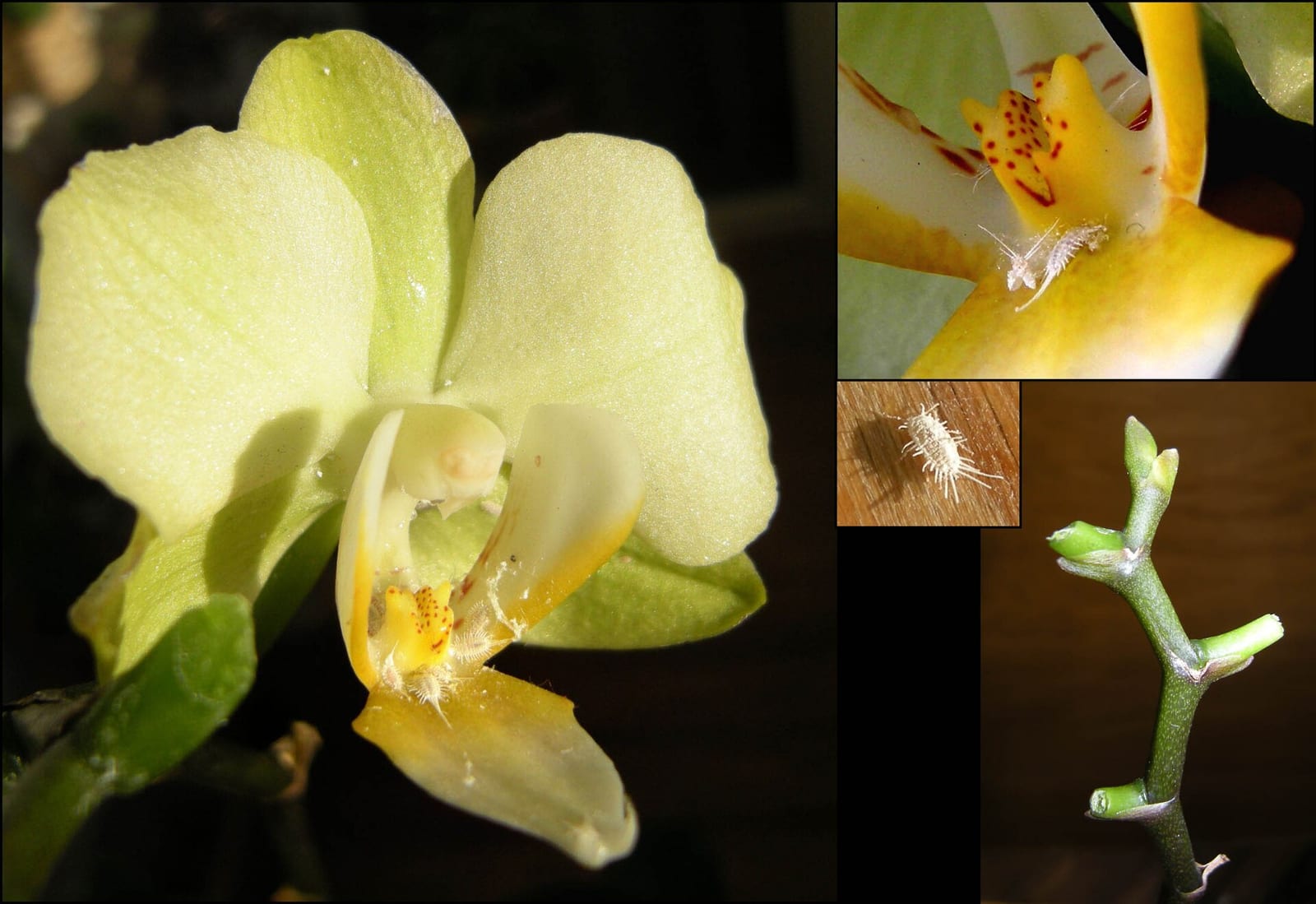
Which pests attack orchids?
NC State, Clemson and UF/IFAS Extension all name the same core group for orchids, and the RHS says moth orchids are generally untroubled, with mealybugs the one to watch.
| Pest | What you see | Where it hides | Sources |
|---|---|---|---|
| Scale | Hard or waxy bumps that don't move; yellow speckles on top of the leaf over them | Leaf undersides, leaf sheaths, pseudobulbs, sometimes roots | AOS, Clemson, NC State |
| Mealybugs | White, cottony or waxy insects, sticky leaves, sometimes black sooty mold | Leaf joints, new growth, flowers, roots | AOS, UC IPM, NC State |
| Spider mites | Fine pale stippling, silvery patches, fine webbing underneath | Leaf undersides, thin-leaved orchids | AOS, UC IPM, Clemson |
| Flat mites (false spider mites) | Small pits on the top of the leaf, no webbing | Leaf surfaces | AOS, NC State |
| Thrips | Pale scratch marks, deformed flowers, black specks | Buds and flowers first | AOS, UC IPM, NC State |
| Aphids | Clusters of small soft insects, sticky honeydew, curled or twisted new growth | New shoots, buds, flower stems | AOS, UC IPM, Connecticut |
| Slugs and snails | Chewed buds, flowers and tender growth | Outdoors and in greenhouses | Clemson, RHS, Connecticut |
Ants are a clue. The American Orchid Society (AOS) says ants rarely hurt an orchid themselves. They come for the sweet honeydew of aphids, scale and mealybugs, so ants on an orchid mean it's time to look closer.
Yellow speckles on a leaf can be the first sign of scale feeding on the underside. Our yellow leaves guide shows how to tell that from other yellowing.
Going deeper
The AOS scale page counts at least 27 scale species on orchids. Brown soft scale is the one that most often lasts indoors, with oval shells from light yellowish to dark brown. Boisduval scale is an armored scale: the females are round and pale, and the males gather in cottony clusters that look a lot like mealybugs. A generation takes about a month, sometimes only two to three weeks in warm conditions. Only the tiny yellow-pink crawlers are easy to kill. The AOS adds that a dead, dark shell can still hide eggs, which is why one treatment is never enough.
Mites run on temperature. The AOS mite page puts a spider mite's life cycle at about 40 days at 13 °C (55 °F) and about 5 days at 24 °C (75 °F), with up to 200 eggs from one female. A warm, dry room in winter suits them perfectly.
The same pests turn up wherever orchids grow. A survey of wild and cultivated orchids in Costa Rica, published in the journal Lankesteriana in 2007, found Boisduval scale, the long-tailed mealybug and a flat mite among the most frequent pests, and noted that plants in collections are at higher risk.
How do I get rid of scale on an orchid?
- Isolate it. Move the plant away from your other orchids right away. The AOS says crawlers spread easily between plants that touch.
- Test the alcohol on one leaf. Wait a day or two before treating the whole plant, as UC IPM advises. The AOS warns that alcohol can damage some soft-leaved orchids, such as some Oncidiums.
- Rub off what you can see. Use a soft toothbrush, your fingers or a cotton swab with 70% isopropyl alcohol. Work along the midrib, the veins, the leaf edges and inside the leaf sheaths. The AOS, the New York Botanical Garden and Clemson all start with removing them by hand. Use isopropyl only: the AOS says other alcohols can burn the leaf.
- Wipe off the extra. On a warm, dry or breezy day, the AOS says alcohol can evaporate fast enough to chill and damage the leaf, so wipe it off.
- Repeat to catch the crawlers. The AOS suggests two or three treatments 10 to 16 days apart; the NYBG suggests every 7 to 10 days for 3 to 4 weeks. Either way, keep at it for about a month and keep checking.
- Check the roots. If scale is on the roots or the base, the AOS says to repot into fresh mix and throw the old mix away. Our repotting guide shows how.
- Step up if needed. If scale keeps returning, insecticidal soap or horticultural oil labeled for your plant is the next step (AOS, UC IPM). See the spray section below before you use either.
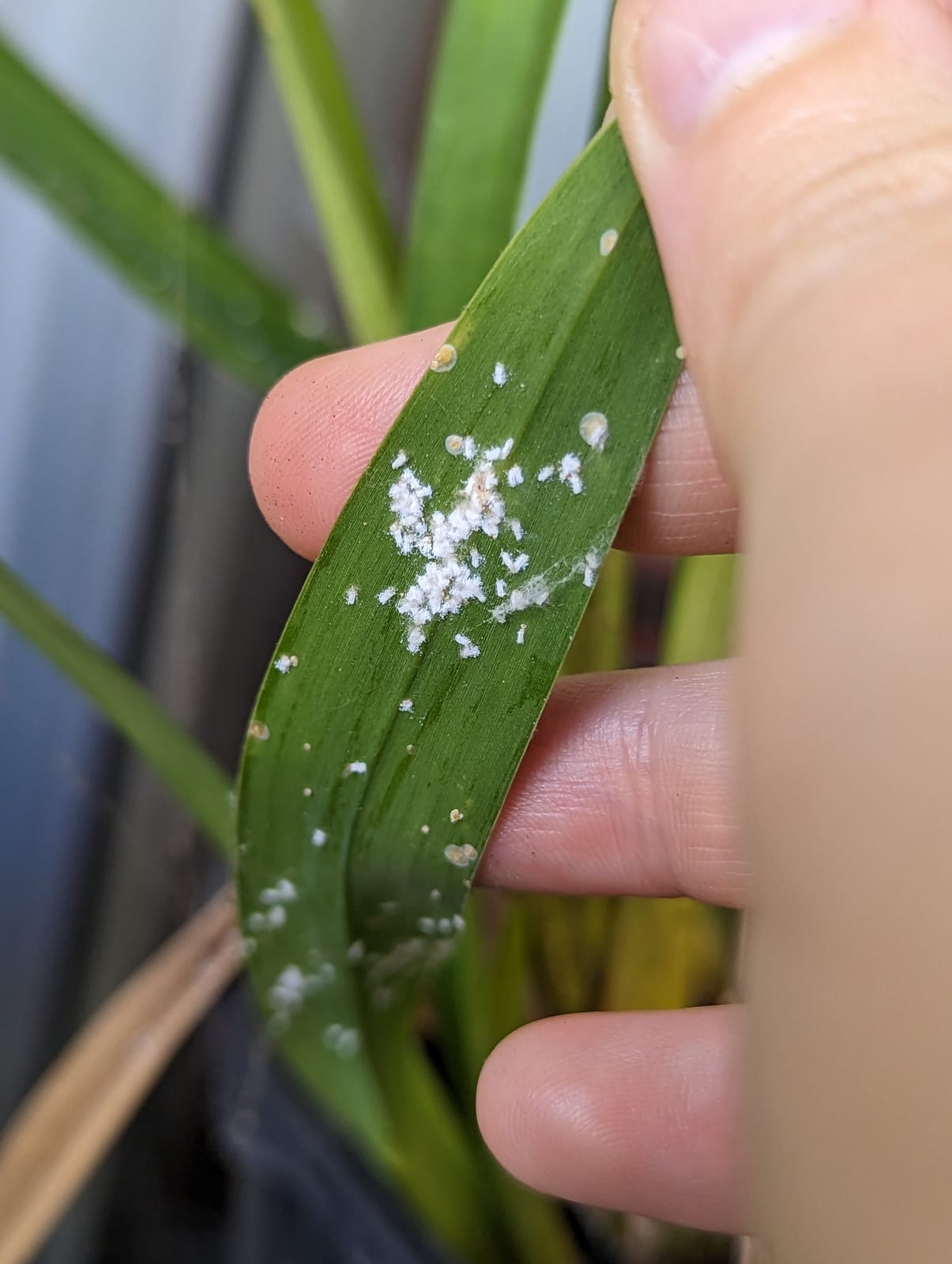
Clemson says a plant that's heavily covered in scale is better thrown out, and the AOS suggests weighing whether a badly declining plant is worth the effort. Bag it before you carry it through the house.
How do I get rid of mealybugs on an orchid?
- Isolate the plant and look everywhere: leaf joints, under leaves, in the flowers, along the flower stem and on the roots. UC IPM says mealybugs are common on orchids and can live on the roots too.
- Remove them by hand. Wipe or wash them off, or crush them with a cotton swab. Cut off badly infested flowers.
- Follow with insecticidal soap. The AOS mealybug page says removing them by hand and then spraying soap almost always clears them, and calls soap and horticultural oil the most effective contact sprays.
- Repeat. Indoors, the AOS says three or four treatments a few days apart can get rid of them. Their waxy coat sheds sprays, so each round matters.
- Check the roots at repotting. If you find them in the mix, repot into fresh mix.
About rubbing alcohol. Here the sources split. The AOS mealybug page says alcohol isn't very effective on mealybugs and can strip the protective wax from the orchid's own leaves. The NYBG, other AOS pages and UC IPM all use a cotton swab dipped in 70% (or weaker) isopropyl alcohol for a small number of mealybugs, and UC IPM says to test it on a small area first. A fair middle path: use alcohol only to dab a few bugs, after a test leaf, and rely on washing and soap for the rest.
UC IPM says that if mealybugs are heavy or keep coming back, discarding the plant may be the best choice.
How do I treat spider mites, thrips and aphids on orchids?
Read moreShow less
Spider mites. The AOS says regular showers or sprays of water help control them, and that insecticidal soap and predatory mites work best. Plan on three or four soap treatments a few days apart. Mites drink from single leaf cells, so the AOS notes that systemic insecticides don't reach them. They favor thin-leaved orchids and warm, dry rooms. Mites can ride on clothes, so the AOS suggests shaking out your sleeves after handling an infested plant.
Flat mites. These leave small pits on the top of the leaf without webbing. The AOS treats them like spider mites, with sprays that cover both sides of the leaf, repeated because a new generation can mature in about six days in warm weather.
Thrips. The AOS thrips page says thrips resist most pesticides and that systemic products don't work on them, because they slash plant tissue instead of drinking sap. Insecticidal soap helps with repeated sprays, and predatory mites released in a few rounds about a week apart are the AOS pick for indoor collections. Thrips spend part of their life in the potting mix, where soap can't reach. Cut off damaged flowers and buds, as UC IPM advises for damaged parts.
Aphids. Wash them off with water, cut off badly infested shoots, and use insecticidal soap or horticultural oil if they return (UC IPM). The AOS says to control the ants that tend them too.
Slugs and snails. Mostly an outdoor or greenhouse problem. The Connecticut Agricultural Experiment Station suggests picking them off by hand in small collections.
Our general guide to spider mites and thrips goes deeper on predatory mites, other sprays and the home remedies that don't work.
Which sprays are safe to use on orchids?
Read moreShow less
The label comes first. UC IPM says to choose a product labeled for indoor use, for your plant and for the pest you have, and to follow its directions and safety steps. The AOS adds that you should confirm the product is approved for orchids, and Clemson and the Connecticut station repeat: follow the label.
What the extension services and the AOS agree on:
- Start gentle. Insecticidal soap and horticultural oil come first; UC IPM says to try them before other insecticides. They're safer for people, pets and plants, though the AOS says they don't wipe out a big infestation in one go.
- Test on one plant. Orchids vary in how they react, says the AOS. Wait a day or two before treating the rest.
- Spray outdoors if you can. UC IPM suggests it, with gloves, covering the undersides of the leaves. Keep the plant out of sun and heat until it dries: the AOS says not to use oils above about 29 °C (85 °F).
- Skip household cleaners. The AOS warns that strong detergents and ammonia-based cleaners can damage buds and flowers.
- Mind the water. The AOS notes that insecticidal soap mixed with hard water can damage plants, and that some people get allergies or breathing trouble from soap sprays.
- Don't spray just in case. Spraying with no pests wastes product and helps pests build resistance, says the AOS. Rotate methods when you do treat.
- Systemic products. Some products are taken up through the roots. The AOS and the Connecticut station list them as an option for scale and mealybugs, and UC IPM treats them as a later step. They don't work on mites or thrips (AOS).
Pets and sprays. The moth orchid itself is non-toxic to cats and dogs, according to the ASPCA. The products are the risk. Keep cats and dogs away from treated plants until the leaves are fully dry, and store products out of reach. The National Pesticide Information Center reports harmful reactions in cats treated with neem oil, so be extra careful with neem around cats. If your pet chews a treated plant and seems unwell, call your vet. Our orchid hub covers orchids and pets.
How do I keep pests off my orchids?
Read moreShow less
- Inspect before you buy. The AOS says scale most often comes in on a purchased plant, and the Connecticut station advises checking plants before buying. Our beginner's guide shows what to look for.
- Quarantine new arrivals. The AOS suggests keeping new plants apart for one to two months. Check them a few times before they join the others.
- Give plants room. Crawlers move between plants that touch, and the AOS says fan drafts can carry them to quiet corners.
- Look regularly. The RHS says the earlier you spot mealybugs, the easier they are to remove. Check leaf undersides, leaf joints and buds as part of watering.
- Keep leaves clean. UC IPM links mites to dusty, dry conditions; a gentle rinse helps.
Frequently asked questions (FAQ)
What are the white fuzzy bugs on my orchid?
Most likely mealybugs, which look like bits of cotton in leaf joints, flowers or roots. Male Boisduval scale also forms cottony clusters, the AOS notes, so look under the fluff: scale females are flat, round shells that stay put.
Can I use dish soap on my orchid?
The NYBG suggests a few drops of dish soap in water for aphids. Colorado State University Extension says household soaps and detergents shouldn't be used as pesticides, and the AOS warns that strong detergents harm buds and flowers. A labeled insecticidal soap is the safer choice.
Should I throw out an orchid with pests?
Only if the infestation is heavy or keeps coming back after steady treatment. Clemson and UC IPM both say discarding can be the best choice then, to protect your other plants.
Can pests live in the potting mix?
Yes. Mealybugs and scale can feed on roots, and thrips spend part of their life in the mix, say the AOS and UC IPM. Repotting into fresh mix helps when pests keep returning.
Sources
- Scale : American Orchid Society (P. J. Johnson, reprinted in Orchids, September 2003)
- Mealybugs on Orchids, Mites and Thrips : American Orchid Society, Orchid Pests and Diseases
- What's wrong with my orchid?, Bud Blast and Phyllosticta Leaf Spot : American Orchid Society
- Growing Phalaenopsis. What Can Go Wrong? : American Orchid Society, Orchids magazine (S. Bottom, June 2025)
- Troubleshooting Orchids : New York Botanical Garden
- Houseplant Problems : University of California Statewide Integrated Pest Management Program
- Orchids : Clemson Cooperative Extension, Home and Garden Information Center
- Phalaenopsis and Vanda : NC State Extension Gardener Plant Toolbox
- Orchids : UF/IFAS Gardening Solutions
- How to grow Phalaenopsis (moth orchids) : Royal Horticultural Society
- Orchid (Orchidiceae) : Connecticut Agricultural Experiment Station, Plant Pest Handbook
- Insect Control: Soaps and Detergents : Colorado State University Extension
- Neem Oil General Fact Sheet : National Pesticide Information Center
- Phalaenopsis Orchid : ASPCA Animal Poison Control
- Problemas fitosanitarios que amenazan la conservación de las orquídeas en Costa Rica : G. Rivera-Coto and G. Corrales-Moreira, Lankesteriana 7(1-2), 2007