Orchid facts: eight true stories about the world's showiest plants
Orchids are one of the two biggest groups of flowering plants on Earth, and they're full of surprises. They shared the planet with dinosaurs. One of them let Darwin predict a moth nobody had seen. Some fire their pollen like a spring, some dress up as female bees, and one gives us vanilla. Every fact here comes from a botanical garden, a museum, a university or a scientific paper, named next to it.
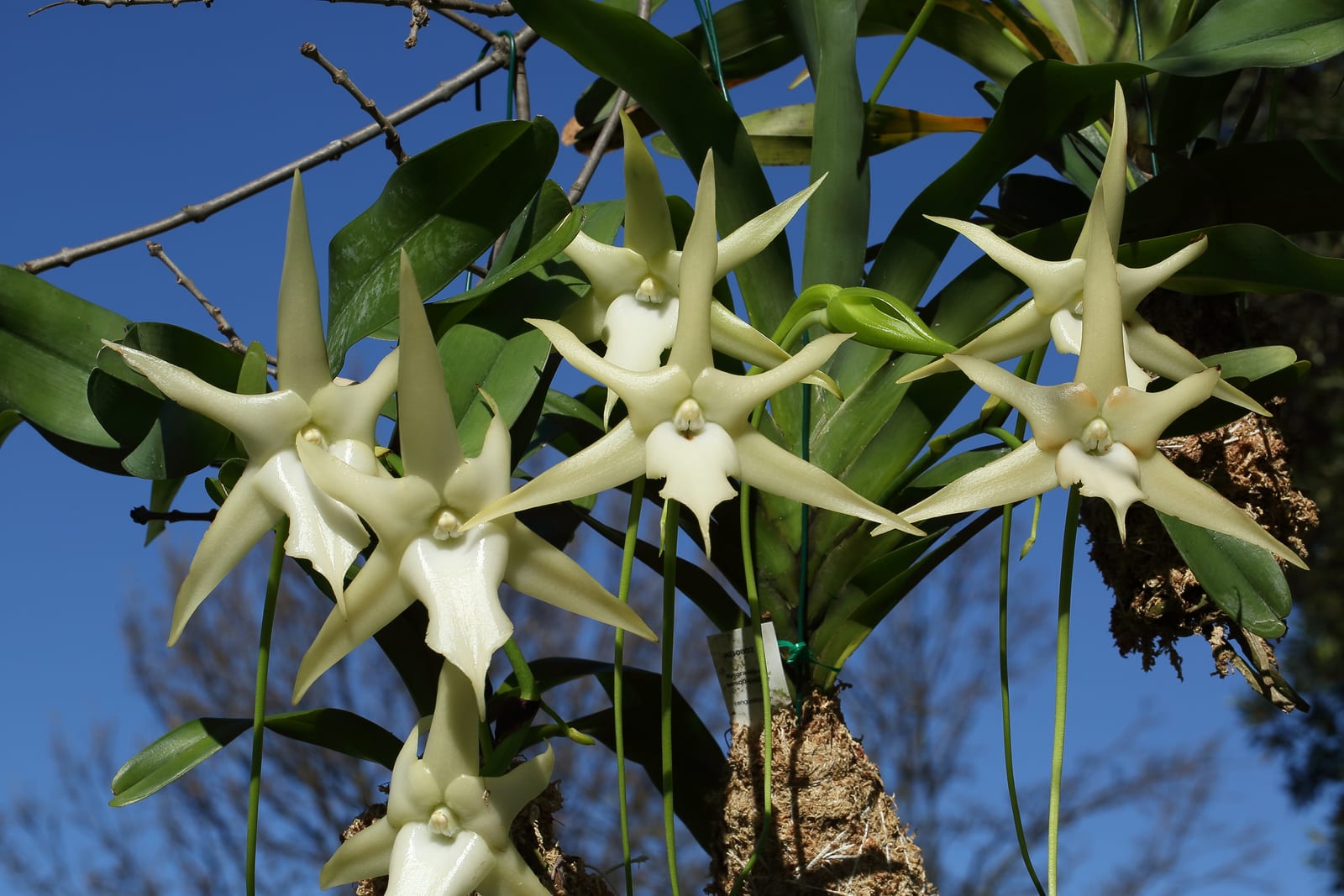
Are orchids the biggest group of flowering plants?
Read moreShow less
The U.S. Botanic Garden calls orchids one of the largest groups of plants, and Kew's checklist puts a number on it. Its June 2026 release, the data behind Plants of the World Online, lists 31,892 accepted orchid species in 728 genera, about 900 of them natural hybrids. Only the daisies (Asteraceae) have more, with 35,483. Next come the peas and beans, far behind at about 22,800.
That's just the wild ones. Growers have made many thousands more hybrids on top: NC State Extension says the moth orchid alone has more than 34,000 registered. Where all those wild species grow is on our orchid origins page.
How old are orchids?
Read moreShow less
For a long time, botanists thought orchids began in what is now Australia. Then a team led by Kew built the most detailed orchid tree of life so far and published it in New Phytologist in 2024. Their answer: the common ancestor of all orchids likely grew on Laurasia, an ancient supercontinent in the north, about 85 million years ago, as Kew's announcement put it.
That means orchids shared the planet with dinosaurs. The twist is that most of the orchid species alive today are young. Kew's release says most of their diversity arose in the last 5 million years.
How did Darwin predict a moth from an orchid?
Read moreShow less
In January 1862, Charles Darwin opened a box of orchids from a grower and found Darwin's comet orchid (Angraecum sesquipedale), also called the Madagascan star orchid. Its nectar sits at the bottom of a spur "a foot long", he wrote to his friend Joseph Hooker, according to the Darwin Correspondence Project. Only an insect with a matching tongue could drink it, so Darwin predicted a moth with an enormous one. Some scientists laughed, says the New York Botanical Garden. Alfred Russel Wallace backed him in 1867.
In 1903, two scientists described a Madagascar hawk moth with just such a tongue, and named it praedicta, a nod to the prediction. Darwin had died in 1882. In 2021 a study made it a species of its own, Xanthopan praedicta, reports the Natural History Museum in London, and the tongues of the moths measured ran from 15 to 28.5 cm (6 to 11.2 in).
Going deeper
Proof that the moth actually pollinates the orchid took even longer. A 2012 review in the Botanical Journal of the Linnean Society says scientists assumed it for over a century without seeing it. Observations, infrared films and photos published from 1993 to 1997, and a video from 2004, finally showed the moth visiting the flowers and carrying off their pollen.
Which orchid fires its pollen at insects?
Read moreShow less
Catasetum flowers come in separate male and female forms that look quite different, the American Orchid Society explains. The male flower is loaded. Touch one of its triggers and the pollen packet springs away "with great force", with quick-drying glue that sticks it to whatever touched the trigger.
Darwin was hooked. In an 1861 letter to Hooker, he described how the pollen shoots out sticky end first and lands on the head of an insect that brushes the triggers, which he called "antennae". He thought the plant would never set seed without this trick. The Darwin Correspondence Project notes that he gave it a whole chapter of Orchids (1862) and called Catasetum "the most remarkable of all Orchids".
Do some orchids pretend to be insects?
Read moreShow less
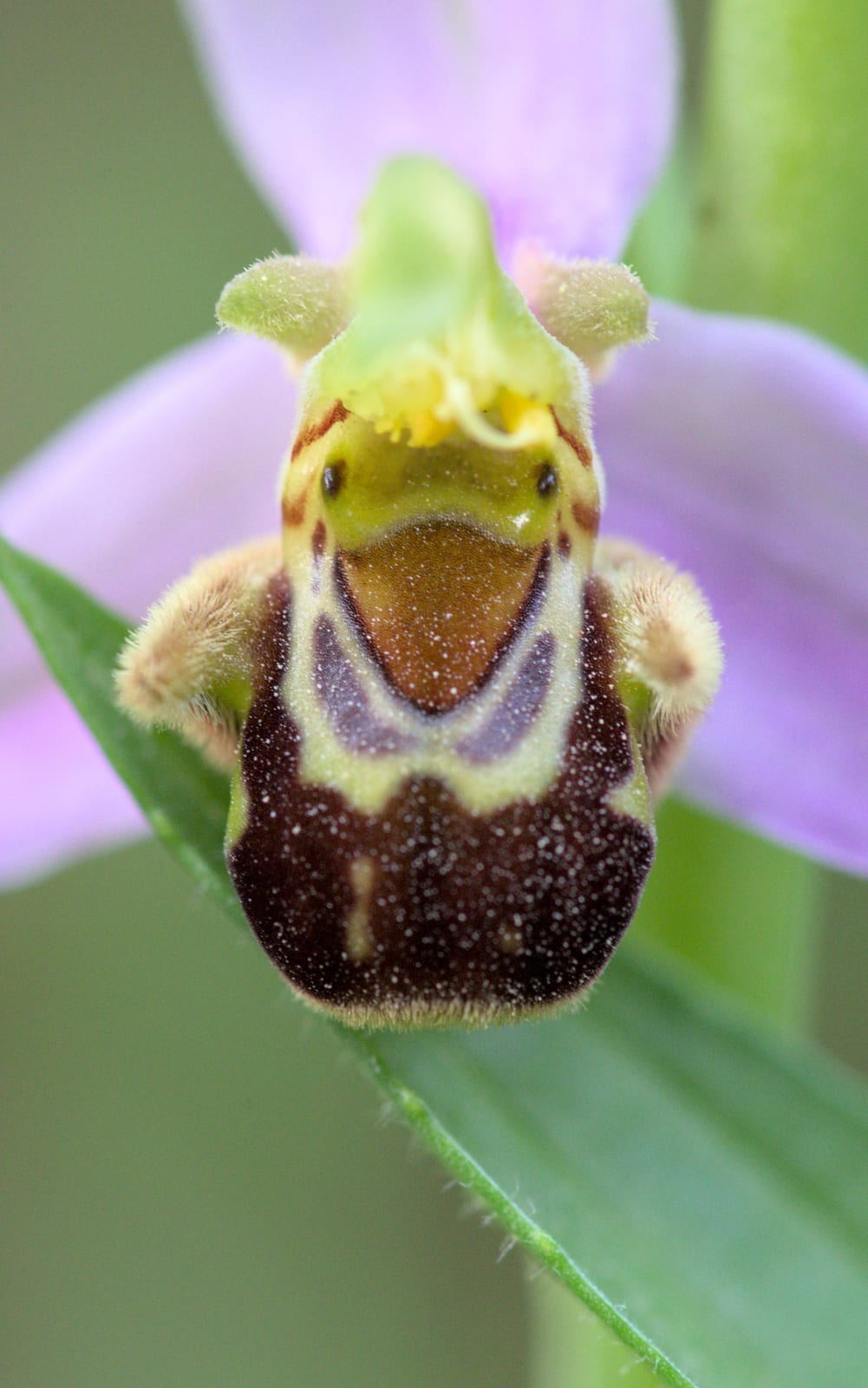
Many of these mimics are European Ophrys orchids, like the one in the photo (Ophrys apifera), and they often target one particular kind of wasp or bee.
Botanists call this sexual deception. A 2020 study in the International Journal of Molecular Sciences explains that these orchids copy a female insect's shape and scent so well that males try to mate with the flower, picking up pollen as they go. It has evolved several separate times, with several hundred confirmed cases. The same study found that the fly orchid (Ophrys insectifera) makes two scent chemicals also found in the female wasps it imitates, and the male wasps' antennae respond to both.
Why are orchid seeds as fine as dust?
Read moreShow less
Most orchid seeds are the size of dust particles, says the American Orchid Society: you'd need a microscope to count 50 to 100 of them. A ripe pod bursts and scatters up to millions of seeds on the wind, depending on the species. They're so small because they skip the packed lunch most seeds carry (the endosperm).
Instead, an orchid seed borrows food from a fungus. The Smithsonian Environmental Research Center says no orchid can sprout and grow without a fungal partner, and the young seedling uses the fungus itself as its energy source. Some orchids are so picky about their fungus that they're nearly impossible to grow, like the ghost orchid on our rare orchids page. Growers get around it by sowing seed in sterile flasks on a nutrient jelly called agar, the AOS explains.
Does vanilla come from an orchid?
Read moreShow less
The vanilla in your kitchen comes from a climbing orchid native from Mexico through Central America to Brazil, according to Cornell University. Each flower lasts just one day, and a tiny flap inside keeps its pollen from reaching the part that sets the pod, explains UF/IFAS Extension. Where the plant's native pollinators are missing, almost nothing happens on its own.
So growers do it by hand, flower by flower. The method still used today was worked out in 1841 on the island of Réunion by Edmond Albius, per UF/IFAS and Cornell. A pollinated flower takes 8 to 9 months to become a ripe pod. Most commercial vanilla is grown in Mexico and Madagascar, says Purdue Extension. Want to try it at home? Our vanilla orchid care card walks you through it.
What was orchidelirium?
Read moreShow less
The New York Botanical Garden describes orchidelirium as a Victorian craze in which collectors spent astronomical sums, and explorers went on ever more daring, dangerous expeditions to feed it. Orchids became a luxury for the rich, says Lewis Ginter Botanical Garden, and the craze created a new job: the professional orchid hunter.
It was a messy business. More than half of the plants died on the way back, Lewis Ginter says, and some hunters stripped whole areas so rivals couldn't collect there, wrecking wild populations. The happier ending came from nurseries that learned to grow orchids in large numbers, which slowly made them affordable. Today wild orchids are protected, and the ones in shops are grown in nurseries: see how to buy orchids responsibly.
Frequently asked questions (FAQ)
Which country has the most orchid species?
Colombia. Kew's World Checklist of Vascular Plants counts about 4,600 orchid species native to Colombia, more than any other country, and the Jardín Botánico de Bogotá also ranks it first. Our Colombia orchid page tells that story.
Are blue orchids a real orchid fact?
The blue moth orchids in shops are usually white flowers that were dyed. That one sits on our orchid myths page, along with other popular mix-ups.
Can I grow an orchid from seed at home?
It's a lab job. Orchid seeds have no stored food, so growers sow them in sterile flasks on a nutrient jelly (agar), as the American Orchid Society explains. Buying a young plant, or raising a baby plant (keiki) from your own orchid, is the easier path.
Why was Darwin so interested in orchids?
Orchid flowers are built in clever ways that guide insects to carry pollen from one flower to another. Darwin wrote a whole book on it, Orchids (1862), with chapters on the comet orchid and Catasetum, according to the Darwin Correspondence Project.
Sources
- World Checklist of Vascular Plants, version 16 (June 2026; Govaerts R., ed.), the data behind Plants of the World Online : Kew, World Checklist of Vascular Plants (Royal Botanic Gardens, Kew, June 2026)
- Orchid Home Care : U.S. Botanic Garden
- Phalaenopsis : NC State Extension Gardener Plant Toolbox
- The origin and speciation of orchids : Pérez-Escobar and colleagues, New Phytologist (2024)
- Study shows orchid family emerged in northern hemisphere and thrived alongside dinosaurs for 20 million years : Royal Botanic Gardens, Kew, press release via Phys.org (February 2024)
- Letter to J. D. Hooker, 25 and 26 January 1862 and Letter to J. D. Hooker, 15 October 1861 : Darwin Correspondence Project, University of Cambridge
- The Case for Coevolution : New York Botanical Garden, C. V. Starr Virtual Herbarium
- Moth predicted to exist by Darwin and Wallace becomes a new species : Natural History Museum, London (September 2021)
- "Good Heavens what insect can suck it": Charles Darwin, Angraecum sesquipedale and Xanthopan morganii praedicta : Arditti and colleagues, Botanical Journal of the Linnean Society (2012)
- Darwin's funeral : Darwin Online (J. van Wyhe)
- Catasetum and Understanding Orchid Seeds : American Orchid Society
- Identification of (Z)-8-heptadecene and n-pentadecane as electrophysiologically active compounds in Ophrys insectifera and its Argogorytes pollinator : Bohman and colleagues, International Journal of Molecular Sciences (2020)
- Orchid fungi and bacteria relationships: it's complicated : Smithsonian Environmental Research Center (July 2014)
- Vanilla Growing in South Florida : UF/IFAS Extension (EDIS HS1348)
- Vanilla planifolia : Cornell University, Liberty Hyde Bailey Conservatory
- The Vanilla Orchid : Purdue Extension, Indiana Yard and Garden
- This Weekend: A World of Orchids Arrives at the Conservatory : New York Botanical Garden, Plant Talk (February 2016)
- By Hook or by Crook: The Plunder of Orchids from the New World : Lewis Ginter Botanical Garden (April 2012)