Pink lady slipper orchid: why you can't buy one or dig one up
The pink lady slipper (Cypripedium acaule), also called the moccasin flower, is a wild orchid of the woods of eastern North America. Leave it where it grows. It's hardly ever raised in nurseries, so a plant offered for sale was almost certainly dug from the wild, and dug-up plants usually die within a couple of years because they can't live without a particular soil fungus. Enjoy it in the woods, in spring, and grow a different orchid at home.
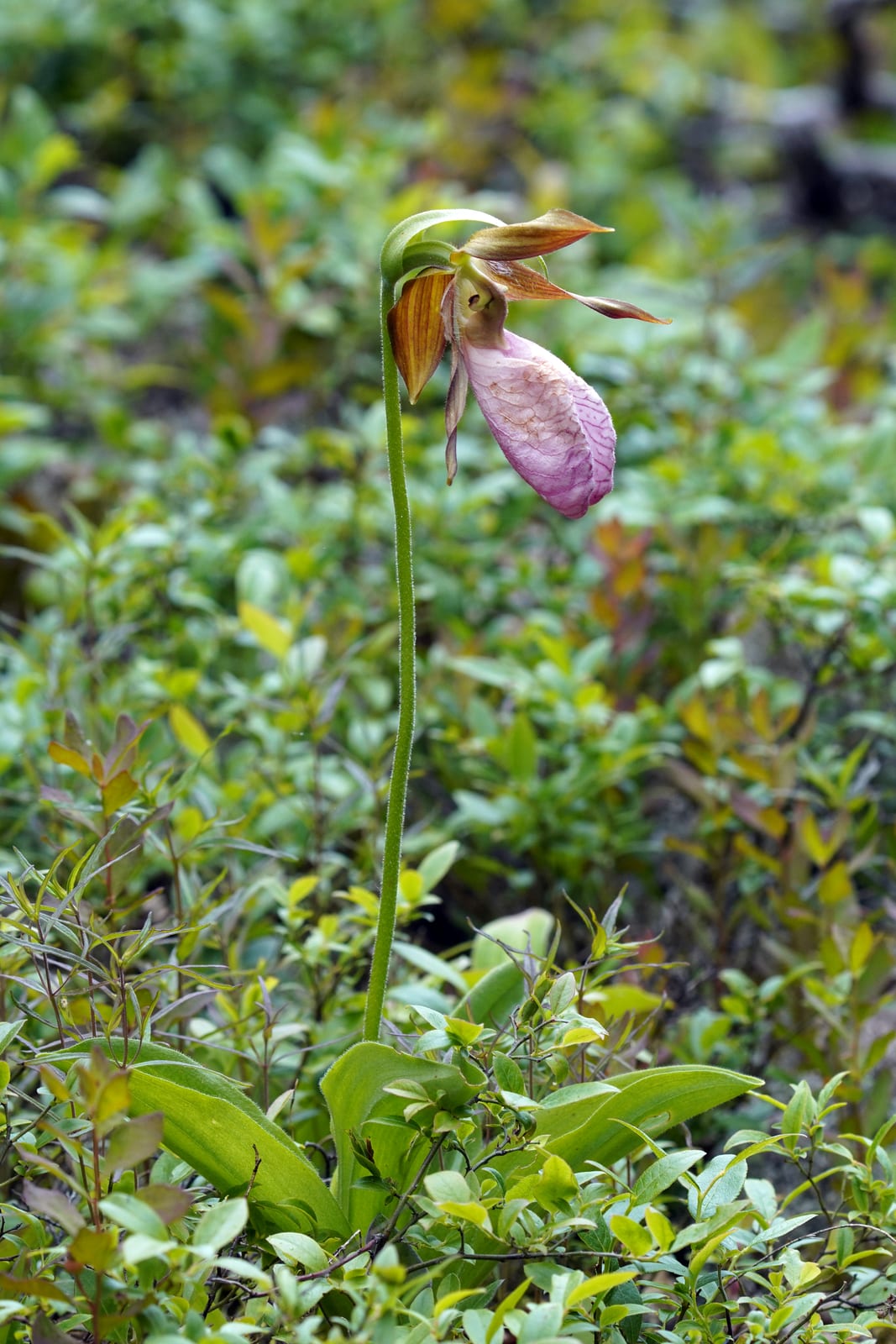
Can you buy a pink lady slipper orchid?
Read moreShow less
You'll see them listed for sale. Here's why to skip them:
- They're rarely propagated. UNH Extension says pink lady slippers are seldom grown commercially, so any plant you see for sale was almost certainly collected from the wild, and cheap ones most of all.
- Growing them from seed is slow. The seeds don't sprout easily, and UNH says a plant can take a decade or more to bloom for the first time. At Longwood Gardens, botanists who hand-pollinated wild plants needed about 18 months in their lab, then at least a year in the nursery, before seedlings were ready to plant out.
- They're picky about soil. Longwood calls it common in the wild but rare in gardens, because it needs strongly acidic soil (pH below 4.5) with little competition from other plants. NC State Extension puts the line at pH below 6.0. Either way, that's far more acidic than most garden beds.
- Collecting has hurt lady slippers before. The USDA Forest Service says collecting for their beauty and for the medicinal trade, failed transplants and lost habitat have sharply cut wild lady slipper numbers.
Want a slipper orchid for a windowsill? That's a different plant: the Asian slipper orchid on our Paphiopedilum card, sold nursery-raised. Our types guide explains how the names overlap.
Can you dig up or transplant a pink lady slipper?
It's tempting when a patch is about to be bulldozed or you just love them. The sources agree on what happens next:
- It's usually legal on your own land. UNH Extension says digging one on your own property in New Hampshire and moving it to a garden is legal. It still discourages it.
- Moved plants rarely make it. UNH says dug-up plants are very unlikely to thrive, especially in rich garden soil, which is nothing like the sandy, acidic soil they grow in. Without their fungus they fail, usually within a couple of years. NC State calls it difficult to transplant and grow and best left where it is.
- The fungus is the reason. University of Maine Extension says transplanting rarely works unless enough of the right fungus is already in the new spot.
- On public land, the rules are stricter. The USDA Forest Service says it's illegal to dig or pick lady slippers on US federal lands, because they so rarely survive being moved. Prince Edward Island's government asks people to neither pick nor move them, for the same reason.
So the kind thing is to leave them, and to tell whoever owns the land that the plants won't survive a move.
Why does it need a fungus to grow?
Read moreShow less
Most orchids have this kind of partnership, called mycorrhiza. The pink lady slipper leans on it hard:
- Seeds with no lunch packed. UNH Extension explains that the seeds have no stored food, so the fungus has to break the seed open and feed the embryo. Longwood Gardens adds that the fungus keeps feeding the seedling until it can make its own food from light.
- A partner for life. NC State says the seeds need a specific Rhizoctonia fungus to sprout, and the relationship turns two-way as the plant matures. Maine Extension says the fungus supplies the plant with nutrients.
- Why moving it fails. Lift the plant and you tear it away from that underground network. Put it somewhere the fungus isn't, and the plant slowly starves.
Think of me as a roommate who can't cook: I brought the flowers, the fungus brings dinner. Take me out of the house and I'm in trouble.
Going deeper
In the lab, special growing media stand in for the fungus, Longwood Gardens explains, and its team tried slices of russet potato to help the seeds along. That's how its botanists raised 78 seedlings in test tubes from three seed capsules. It's careful, slow work aimed at restoring wild populations, and it's one reason nursery-grown pink lady slippers are so scarce.
How do you recognize a pink lady slipper?
Read moreShow less
- Leaves: just two, at the base, with parallel veins, about 9 to 30 cm (3.5 to 12 in) long, per the North American Orchid Conservation Center. The flower stalk itself has no leaves (NC State, Forest Service).
- Flower: one per stalk, rarely two. The pouch is about 3 to 7 cm (1.2 to 2.6 in) long, usually pink with darker veins, sometimes deep magenta and, rarely, white (Maine Extension, the Conservation Center). Unlike the round opening of other lady slippers, it has a slit down the front, the Forest Service notes. The narrow petals and sepals above it are greenish to purplish brown.
- When: April to June in North Carolina (NC State), late May to mid July in New England (Maine Extension), late May and June on Prince Edward Island (Government of Canada).
- Where it grows: acidic woods and woodlands, often under pines, other conifers or oaks, on mossy slopes or in deep leaf litter (NC State, Forest Service).
Going deeper
The flower is a trick. Bumblebees are drawn by its color and scent, push in through the slit, and find no reward. The only way out is a narrow exit at the back, past the part that receives pollen and then the part that loads new pollen onto the bee. The North American Orchid Conservation Center and NC State both note that bees learn fast and start avoiding the flowers, which is why so few set seed. Maine Extension adds that seed pods are rare.
Where does the pink lady slipper grow wild?
Read moreShow less
Kew's World Checklist of Vascular Plants lists it as native to:
- Eastern Canada: New Brunswick, Newfoundland, Nova Scotia, Ontario, Prince Edward Island and Quebec.
- Western and northern Canada: Alberta, Manitoba, Saskatchewan and the Northwest Territories.
- North-central United States: Illinois, Minnesota and Wisconsin.
- Northeastern United States: Connecticut, Indiana, Maine, Massachusetts, Michigan, New Hampshire, New Jersey, New York, Ohio, Pennsylvania, Rhode Island, Vermont and West Virginia.
- Southeastern United States: Alabama, Delaware, the District of Columbia, Georgia, Kentucky, Maryland, North Carolina, South Carolina, Tennessee and Virginia.
How common it is depends on where you are. The North American Orchid Conservation Center calls it globally secure and common across much of its range, yet Illinois and Indiana list it as endangered, and Alberta, Alabama and Manitoba as a species of concern. Maine lists it as a species of "special concern" (Maine Extension).
Which places chose it as their official flower?
Read moreShow less
- Prince Edward Island. The PEI government says the lady's slipper (Cypripedium acaule) became the official provincial flower on April 25, 1947. The Government of Canada adds that a 1965 amendment to the province's Floral Emblems Act wrote in that exact botanical name. Why 1965? The Canadian Encyclopedia says the province first chose the showy lady's slipper and swapped it for the pink one in 1965 because the showy kind is rare. The Missouri Department of Conservation tells the same story: PEI picked the showy lady's slipper first, then had to choose another orchid because of its rarity. Two lady slipper flowers also appear at the foot of the province's coat of arms, the Government of Canada notes.
- New Hampshire. A 1991 state law names the pink lady's slipper the official state wildflower of New Hampshire (RSA 3:17), and UNH Extension gives the same year.
Its showy cousin has its own title: the Minnesota Legislature's Legislative Reference Library says the pink and white showy lady's slipper (Cypripedium reginae) became Minnesota's state flower in law in 1967.
How is it related to the showy and yellow lady slippers?
Read moreShow less
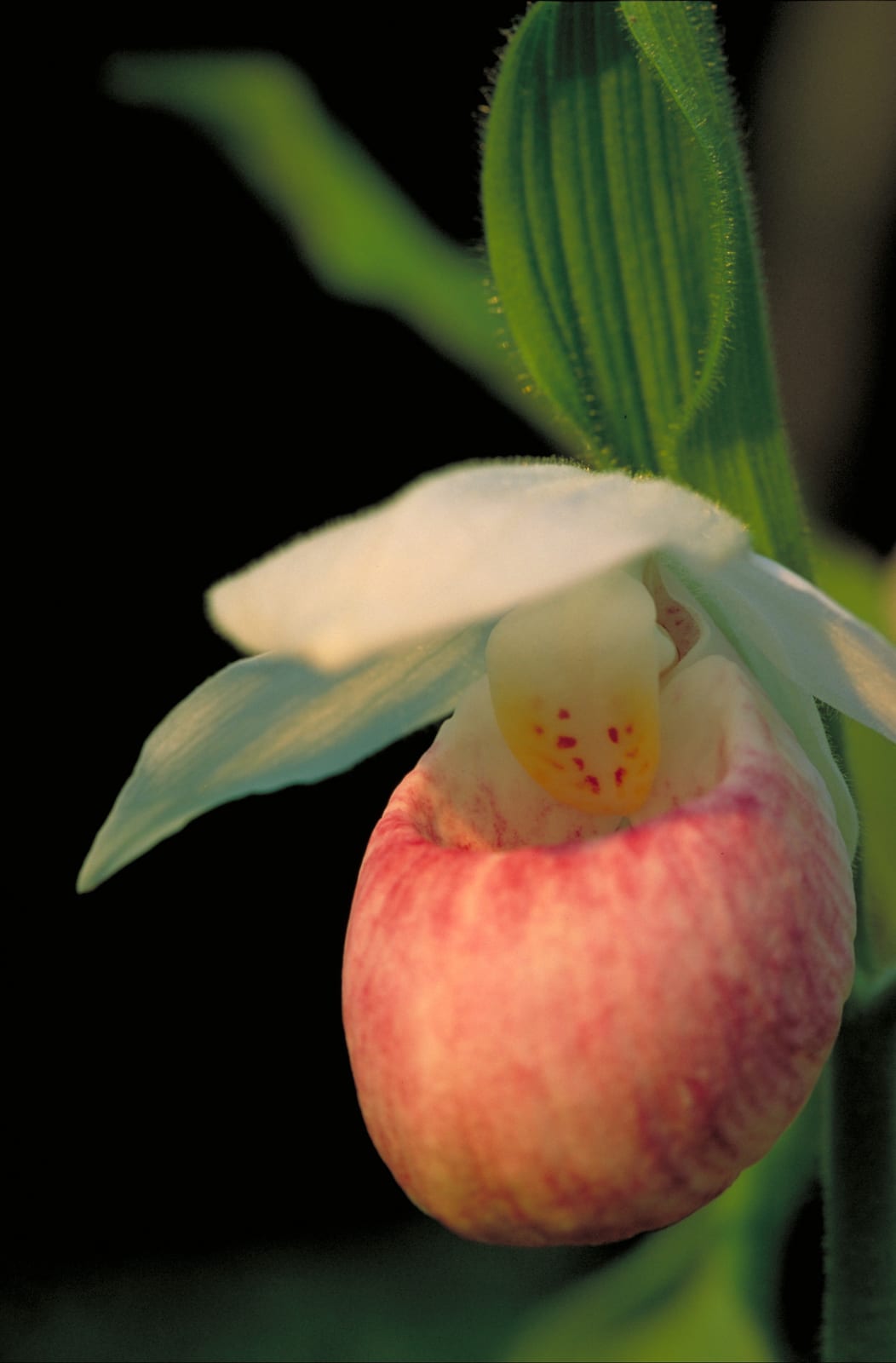
The Forest Service counts about 50 lady slipper (Cypripedium) species across Europe, Asia and North America, a dozen of them in the US. Its name comes from Cypris, a name for the goddess Aphrodite, and the Greek word for sandal, after the pouch-shaped lip. Two of the pink lady slipper's closest neighbors:
- Showy lady's slipper (Cypripedium reginae). White petals over a pink-streaked pouch. Kew gives it a range much like the pink lady slipper's: central and eastern Canada to the north-central and eastern US.
- Yellow lady's slipper (Cypripedium parviflorum). A yellow pouch. Kew's range for it is the widest of the three, from Alaska and the Yukon across Canada and most of the United States.
If you want one of these in a garden, UNH Extension points to the showy and the greater yellow lady's slipper (C. parviflorum var. pubescens) as better choices than the pink, while warning that both are still hard to grow. Buy only plants a seller can show were raised from seed, as our rare orchids guide explains.
Frequently asked questions (FAQ)
Is it illegal to pick a pink lady slipper?
It depends on where you are. On US federal lands it's illegal to dig or pick lady slippers, says the USDA Forest Service. In New Hampshire, UNH Extension calls the idea that it's rare and illegal to pick a long-standing myth. Prince Edward Island's government asks people to leave them be, because they rarely survive a change of home.
Is the pink lady slipper endangered?
Overall, no. Longwood Gardens notes the IUCN lists it as least concern, and the North American Orchid Conservation Center calls it globally secure. Some states and provinces at the edges of its range protect it: Illinois and Indiana list it as endangered, and Maine as a species of special concern.
Is the pink lady slipper poisonous?
NC State Extension rates it as having medium toxicity, with the leaves as the problem part: touching them can cause skin irritation. The toxic compound hasn't been identified.
Can I grow a pink lady slipper from seed?
Not easily at home. The seeds need their fungus or a sterile lab setup to sprout, and UNH says a plant can take a decade or more to flower. Botanical gardens such as Longwood do it to restore wild populations.
Is the pink lady slipper the same as the lady slipper orchid sold as a houseplant?
No. Houseplant lady slippers are Paphiopedilum, tropical Asian orchids raised in nurseries. Our types guide explains the three groups that share the name, and the Paphiopedilum card covers their care.
Sources
- Can you dig up pink lady's slippers? : UNH Extension, Yard and Garden Infoline (March 29, 2021)
- Cypripedium acaule : NC State Extension Gardener Plant Toolbox
- Pink Lady Slipper Fact Sheet : University of Maine Cooperative Extension, Signs of the Seasons (2018)
- The Power of Local Conservation : Longwood Gardens (Peter Zale, April 22, 2020)
- Cypripedium acaule, Moccasin Flower, Pink Lady's Slipper : North American Orchid Conservation Center, Go Orchids (checked November 12, 2026)
- Meet the Ladies: The Slipper Orchids and Cypripedium acaule: moccasin flower, pink lady's slipper : USDA Forest Service, Celebrating Wildflowers (archived copies, 2012)
- Cypripedium acaule, Cypripedium reginae and Cypripedium parviflorum : Kew, World Checklist of Vascular Plants, version 16 (Royal Botanic Gardens, Kew, June 2026)
- Provincial Flower : Government of Prince Edward Island (March 15, 2023; archived copy, July 2026)
- Prince Edward Island (PE): Facts, Flags and Symbols and Prince Edward Island's provincial symbols : Government of Canada
- Lady's Slipper : The Canadian Encyclopedia (Céline Arseneault, 2006, edited 2015)
- RSA 3:17, State Wildflower : New Hampshire General Court (1991; archived copy)
- Minnesota State Symbols : Minnesota Legislative Reference Library, Minnesota Legislature
- Showy Lady's Slipper : Missouri Department of Conservation, Field Guide