My orchid's flowers fell off. Now what?
Relax: it isn't dying. Flowers fall when a bloom is done, and the plant starts a rest. What you do with the old flower spike depends on the orchid. A moth orchid can be cut above a node for a chance at more flowers in a couple of months, or cut at the base for a stronger bloom later. Most other orchids flower from new growth, so their spent stem comes off at the base. Keep the leaves, roots, canes and pseudobulbs: that's where the next flowers come from.
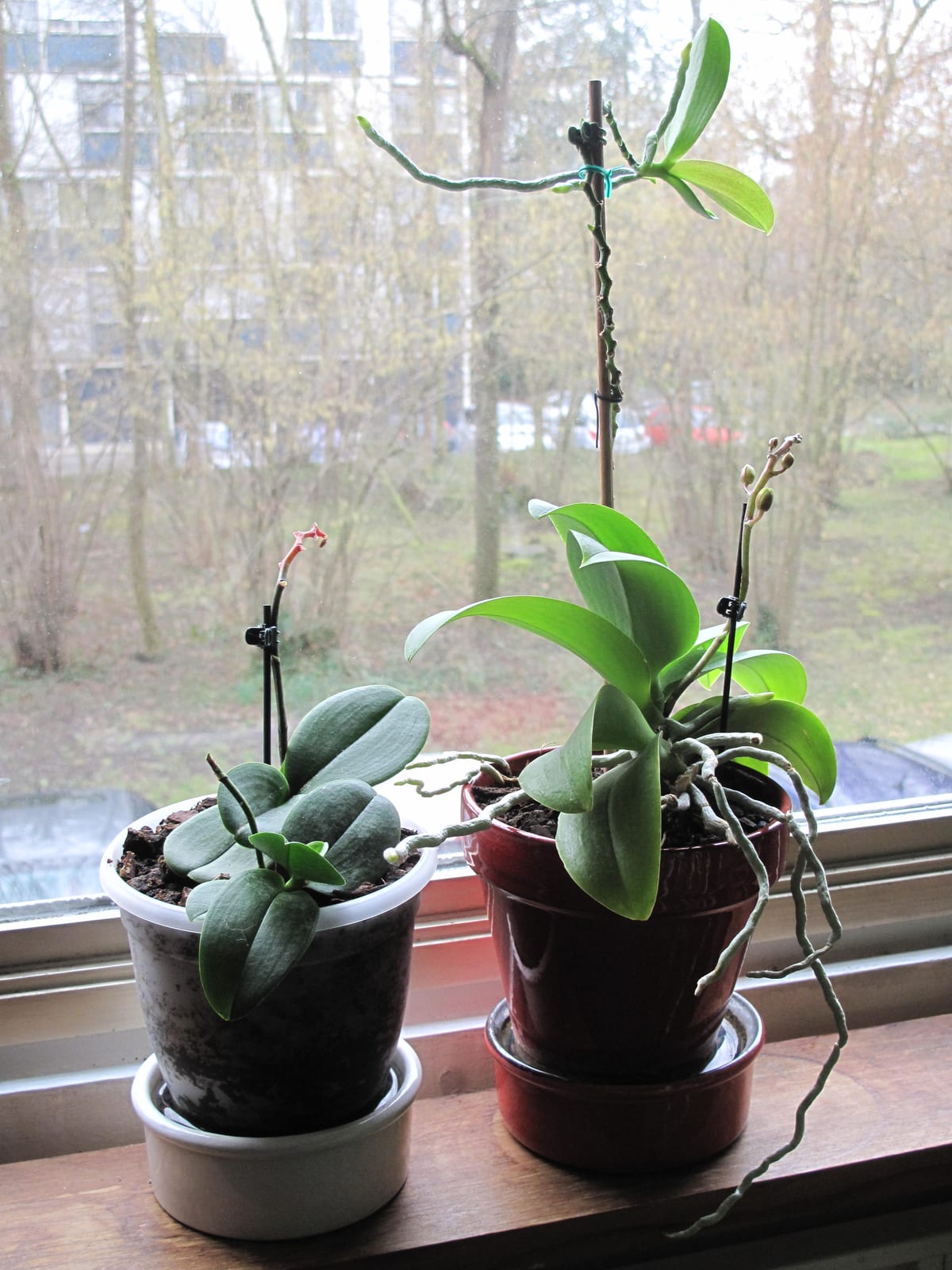
Should I cut the flower spike?
Read moreShow less
A node is one of the small bumps along the spike, each wrapped in a little papery sheath. Each one holds a sleeping bud.
Option 1: cut above a node. The American Orchid Society, the New York Botanical Garden and Iowa State Extension all cut just above the second node, below any dried part of the spike. A new branch may bloom in about 8 to 12 weeks, though none of them promises it. Other sources pick a slightly different node: NC State cuts above the first node below the faded flowers, and the RHS above the highest node. What they share: cut above a healthy, green node partway down. The AOS adds that the repeat bloom is usually smaller, so try it only on a strong plant.
Option 2: cut at the base. The AOS and the RHS both say a base cut means waiting longer, but the next spike is stronger with bigger flowers. The AOS also says a weak plant, one with poor roots or a young one should get the base cut, so its energy goes into leaves and roots.
Brown and dry? Once the spike browns, it's finished. Cut it off as low as you can.
One exception: novelty moth orchids. The AOS says some moth orchids with star-shaped flowers and short, sometimes branched spikes keep flowering from the same spike for a long time. Leave those spikes on while they're green.
Use clean, sanitized pruners or scissors for every cut, as Chicago Botanic Garden and Iowa State advise.
Going deeper
Why can a moth orchid spike flower twice? Each node carries a dormant bud under its sheath. In a 1981 study in the Thai journal Agriculture and Natural Resources, researchers treated those buds with a plant hormone and grew baby plants from them, with the lower nodes responding best. Under the right conditions, the same bud can grow a new flower branch or a keiki (a baby plant), as the AOS and NC State describe. That's also why the moth orchid is the odd one out. The AOS explains that moth orchids grow from a single crown (monopodial growth), so the old spike is their main way to flower again. Most other orchids (sympodial growth) send out a new shoot each season, and the new shoot carries the next flowers.
Where do I cut the spike on other orchids?
| Orchid | Cut | Keep | Next flowers come from | Sources |
|---|---|---|---|---|
| Moth orchid (Phalaenopsis) | Above a node, or at the base | Leaves and roots | A node on the old spike, or a new spike | AOS, NYBG, Iowa State, NC State, RHS |
| Dendrobium | The flower stem, where it leaves the cane | The canes, unless fully shriveled and brown | The canes and new growth | AOS, RHS |
| Dancing lady (Oncidium, Cambria types) | At the base, once the stem is dry | The pseudobulbs | The next new pseudobulb | RHS, Iowa State, Wisconsin |
| Cattleya | At the base, where it meets the plant | The pseudobulbs | A new pseudobulb | AOS, Wisconsin |
| Slipper orchid (Paphiopedilum) | Down to the leaves | The leaves | A new fan of leaves | AOS, NC State |
| Cymbidium | At the base | The pseudobulbs | New growth after cool autumn nights | AOS, RHS |
Dendrobium. The AOS and the RHS say to cut the spent flower stem back to the cane and leave the cane alone, because the plant's next flowers and new growth come from it. The RHS removes a cane only when it's completely shriveled and pale brown.
Dancing lady. The RHS explains that each pseudobulb makes one flower stem once it matures, so the old stem won't flower again. Smithsonian Gardens suggests waiting until the stem is fully dead before you cut it. Cutting at the base once it dries works for both.
Slipper orchid. NC State says each growth usually makes one flower, and the AOS says the next spike comes from a new growth. So the next bloom will come from a new fan of leaves.
What should I do after my orchid blooms?
Read moreShow less
A rest after flowering is normal. Chicago Botanic Garden and Clemson Extension both say orchids often make no new roots, leaves or flowers for a while after blooming, and suggest less water and fertilizer until new growth starts. The AOS keeps watering and feeding as usual. In practice, both lead to the same habit: water when the mix is nearly dry, which will be less often while the plant rests, and feed lightly. Our watering guide shows how to check.
Watch for new growth: a new leaf from the center of a moth orchid, a new shoot at the base of a Cattleya or dancing lady, or a new fan on a slipper orchid. Once you see it, return to regular care.
After blooming is also when the AOS, the RHS and NC State repot most orchids, if the mix has broken down or the plant has outgrown its pot.
Is my orchid dead or just resting?
Read moreShow less
Signs that are normal:
- A brown, dry flower spike. Most spikes bloom once, then dry up (AOS, University of Maryland Extension).
- One old bottom leaf turning yellow. A moth orchid grows one or two new leaves a year and loses old ones at about the same rate, per UF/IFAS. Maryland says to remove the old yellow leaf.
- Old pseudobulbs shriveling, or Dendrobium canes dropping leaves. NC State says older Cattleya pseudobulbs shrivel after their leaves fall, and the RHS says some Dendrobiums lose leaves in winter. Keep them: they still store food.
Signs to look closer:
- Roots. Healthy moth orchid roots are silvery white when dry and green when wet (University of Maryland Extension). Mushy brown roots are a problem. See our root guide.
- Wrinkled, limp leaves. Too little water, or roots that rotted and can't drink. Our wrinkled leaves guide shows how to tell.
- A soft, rotting crown. A moth orchid grows from one crown in the center. The AOS says that if water sits there and the crown rots, the plant can't grow a new one. That's the one sign that usually means it's gone.
How long until it blooms again?
| Orchid | When to expect flowers | Sources |
|---|---|---|
| Moth orchid, node cut | About 8 to 12 weeks, if it reblooms | AOS, NYBG, Iowa State |
| Moth orchid, base cut | Usually within a year | AOS, Penn State |
| Dendrobium | Usually within a year | AOS, Smithsonian Gardens |
| Cattleya | Usually within a year | AOS |
| Slipper orchid | About once a year | AOS, Penn State |
| Dancing lady | When the next new pseudobulb matures | RHS, NC State |
| Cymbidium | Late autumn to spring, after a summer with cool nights | AOS, RHS |
Divisions take longer: the RHS says a newly divided Cymbidium or dancing lady can take two to three years. If a mature plant hasn't bloomed in over a year, Chicago Botanic Garden says to check light, temperature and watering. Our rebloom guide walks through each one.
Frequently asked questions (FAQ)
Why did my orchid's flowers fall off?
If they lasted weeks, the bloom simply ended. Moth orchid flowers last a long time, but not forever. Flowers or buds that drop early are a different problem: our guide to orchid buds falling off covers it.
What is the baby plant growing on my orchid's spike?
A keiki, a small new plant that grows from a node on the spike. Leave it attached until it has its own roots. The AOS suggests removing it once the roots are about 2.5 to 5 cm (1 to 2 inches) long. Our keiki guide walks through potting it up.
Should I repot my orchid after it blooms?
Only if it needs it: broken-down mix, mushy roots, or a plant spilling out of its pot. Right after blooming is the usual time, per the AOS and the RHS.
Do I cut off the old leaves after blooming?
Only an old leaf that has turned fully yellow or dry, as University of Maryland Extension suggests. Leave the green ones alone.
Sources
- Where do I cut the flower spike when it is finished? : American Orchid Society
- Basic Orchid Growth Habits and Shoots and Spikes : American Orchid Society
- Novice Culture Sheet: Phalaenopsis, Dendrobium, Cattleya, Cymbidium and Paphiopedilum : American Orchid Society
- Top Ten Uncommonest Questions Asked about Phalaenopsis : American Orchid Society (G. Woodward)
- Phalaenopsis, Dendrobium, Cattleya, Oncidium, Paphiopedilum and Cymbidium : NC State Extension Gardener Plant Toolbox
- Care of Phalaenopsis Orchids (Moth Orchids) : University of Maryland Extension
- Growing Orchids Indoors and How to Get Orchids to Rebloom : Iowa State University Extension and Outreach
- Orchids : University of Wisconsin-Madison Extension
- Orchids : Clemson Cooperative Extension, Home and Garden Information Center
- Orchids as Houseplants : Penn State Extension
- Orchid care : Chicago Botanic Garden
- Orchid FAQs : New York Botanical Garden
- Growing Phalaenopsis orchids, Top tips for growing orchids at home, How to grow Dendrobium, Cool growing oncidium orchids, How to grow cymbidium orchids and Paphiopedilum growing guide : Royal Horticultural Society
- Oncidium and Dendrobium care sheets : Smithsonian Gardens
- Induction of plantlets on inflorescence of Phalaenopsis by application of N-6-benzyl adenine : Sahavacharin, Agriculture and Natural Resources 15(2), 1981