Spots on orchid leaves: fungal or bacterial?
A spot that looks wet, spreads in a day or two and smells bad is usually bacterial, and it needs action today. A dry spot that grows slowly over weeks is more often fungal. Either way the first steps are the same: move the plant away from the others, cut out the spot with a clean blade, and keep the leaves dry. Some spots aren't disease at all: sunburn, cold damage and a few harmless marks can look similar, so start by checking which one you have.
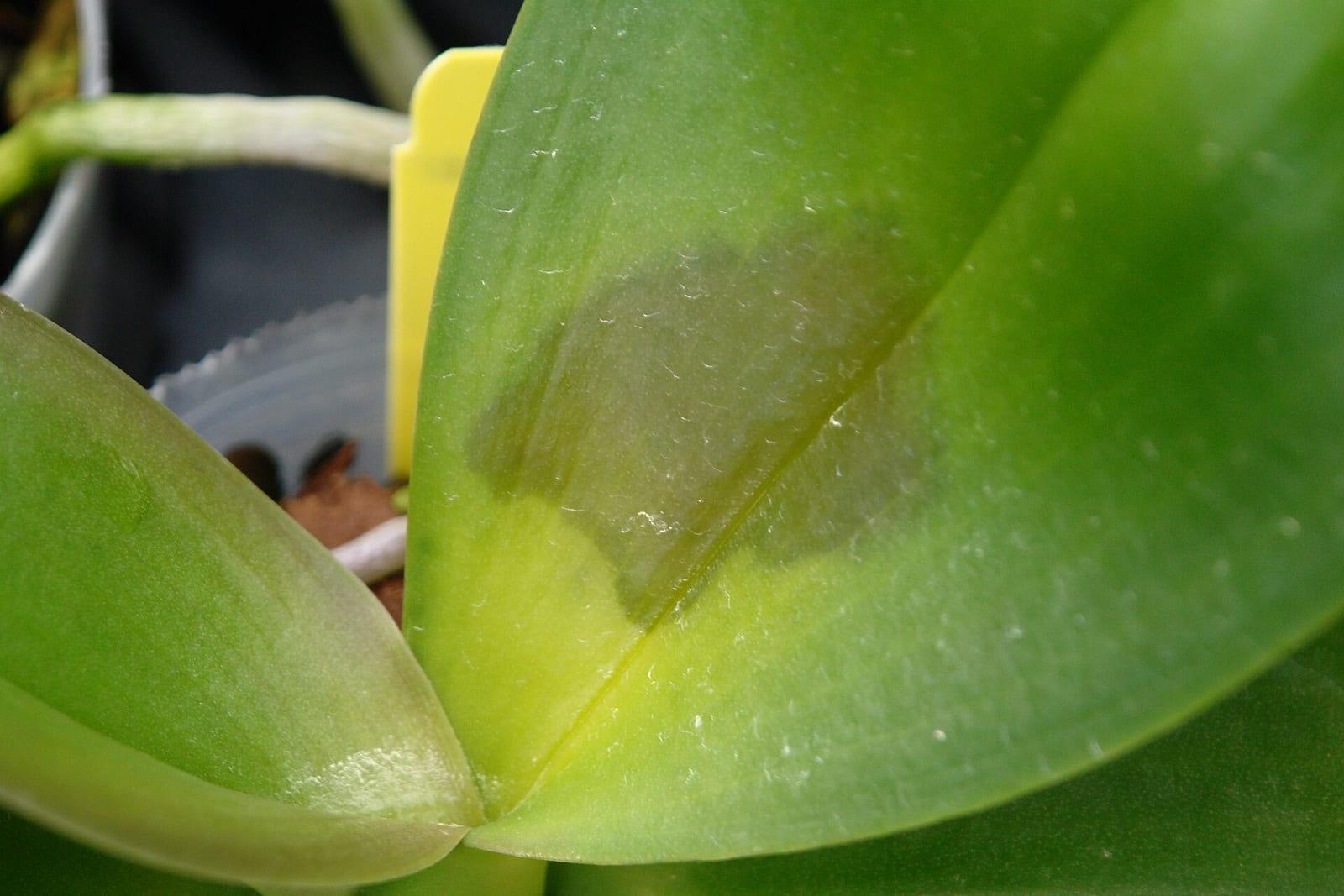
What causes spots on orchid leaves?
Read moreShow less
Not every spot is an infection. Rule these out first:
- Sunburn. A pale or bleached patch on the side facing the window, turning brown or black, after a move into stronger light. Our yellow leaves guide shows how it looks.
- Cold damage. Pitted, sunken or water-soaked patches after cold nights, cold water or cold window glass. See cold damage.
- Scale insects. Small yellow speckles on top of the leaf, with insects underneath. See our orchid pests guide.
- Harmless speckles. The New York Botanical Garden (NYBG) says some Oncidiums get tiny black speckles when cold water hits their leaves, and they're nothing to worry about. The AOS says black spots on older Zygopetalum leaves aren't infectious, and NC State ties them to poor airflow.
Infections come from bacteria, fungi and water molds. The American Orchid Society (AOS) says both bacterial and fungal diseases spread in splashing water, and that wet leaves and high humidity help them along. The two need different treatment, which is why telling them apart matters.
Is it a bacterial or a fungal spot?
| Spot | What it looks like | How fast | Cause | Sources |
|---|---|---|---|---|
| Bacterial brown spot | Small, soft, water-soaked blisters, often with a yellow or pale green halo, turning brown or black and sunken; may ooze | Days; fastest in warm weather | Bacteria (Acidovorax) | AOS, Pacific Northwest Handbook, Connecticut |
| Soft rot | Wet, spreading patch with a foul smell, often with a yellow edge | Hours to days: a moth orchid can rot in 2 to 3 days | Bacteria (Pectobacterium) | AOS, Connecticut |
| Phyllosticta leaf spot | Tiny purplish or black specks along the veins, growing into dark eyespots with a tan center (Vanda); yellow circles turning black (Dendrobium) | Weeks: three to six weeks to show | Fungus | AOS |
| Anthracnose | Roughly round, sunken, yellowish to light brown spots, sometimes with pinkish-orange rings | Slow | Fungus (Colletotrichum) | Connecticut |
| Leaf spot | Yellow areas on the underside that become brown or black spots seen from both sides | Slow | Usually a fungus | AOS |
| Black rot | Purplish-brown, then black, soft patches with a yellowish edge, spreading toward the roots | Fast | Water molds (Pythium, Phytophthora) | AOS |
Bacterial spots are the urgent ones. In the AOS's words, bacterial infections spread in hours to days and fungal ones over days to weeks. Moth orchids are especially prone to bacterial brown spot, which the AOS calls the most common moth orchid disease. If a spot reaches the crown, the center where new leaves grow, the plant can die.
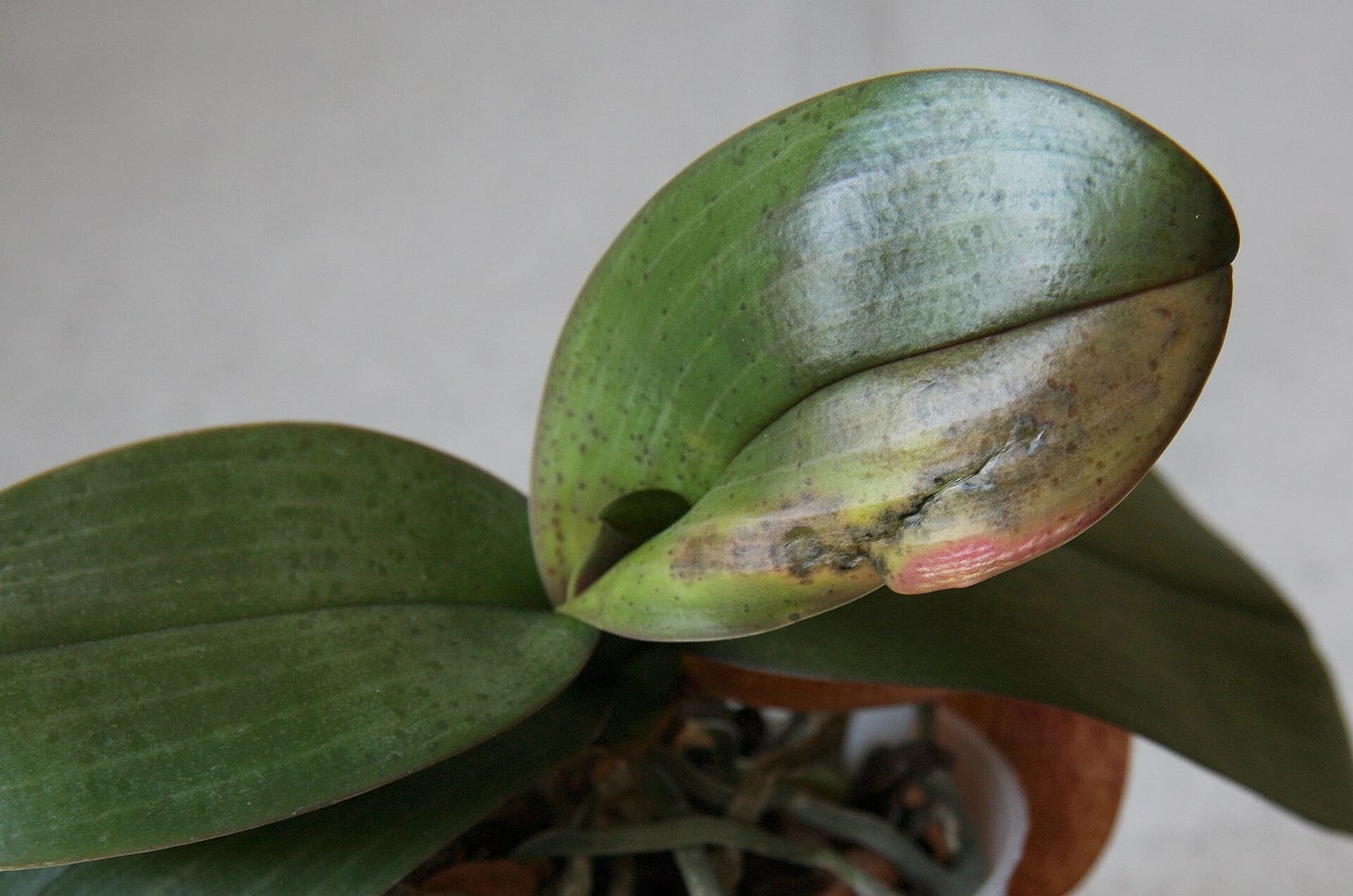
Looks overlap, so don't worry if you can't be sure. The first steps below are the same for both.
Going deeper
Orchid books and forums still use old names. The AOS notes that the soft rot bacterium long called Erwinia is now Pectobacterium, and the brown spot bacterium called Pseudomonas is now Acidovorax. The Pacific Northwest Plant Disease Management Handbook adds that brown spot enters young plants through their leaf pores and older ones through wounds, and spreads on splashing water, infected plants and dirty tools. Warm, wet conditions and lots of nitrogen favor it. The fungus behind Phyllosticta leaf spot also goes by a second name, Guignardia, for its other life stage, per the AOS.
These diseases follow orchids everywhere. A 2007 survey of wild and cultivated orchids in Costa Rica, published in Lankesteriana, found 18 genera of fungi, including those behind anthracnose and Phyllosticta, plus water molds and soft rot bacteria that can kill a plant in days.
What should I do about a spotted orchid leaf?
- Isolate the plant. The AOS, the Pacific Northwest Handbook and the Connecticut Agricultural Experiment Station all start here. Bacteria spread in the fluid that oozes from a rotting spot.
- Clean your blade. Wipe it with 70% alcohol or soak it in 10% bleach, as Connecticut and UC IPM advise. Clean it again between cuts and between plants.
- Cut out the spot. The AOS says to remove the infected area plus about 2.5 cm (1 inch) of healthy tissue around it. If most of the leaf is affected, remove the whole leaf.
- Let the cut dry. The AOS suggests a fungicide on the cut, or cinnamon as a milder option, and the NYBG also dusts cinnamon on cut fungal spots. Other sources find little evidence that cinnamon works, as our general leaf spot guide explains.
- Keep leaves dry. Water the mix, never the leaves, early in the day so the plant is dry before night (AOS). Stop misting.
- Give it air. Space plants apart and keep air moving gently, as the AOS and the Pacific Northwest Handbook advise.
- Watch the crown. Keep checking the center of the plant. If a spot spreads into it, the plant may not survive: see crown rot.
About hydrogen peroxide. One AOS writer suggests pouring hydrogen peroxide on bacterial spots. A University of Connecticut plant diagnostician, writing in The Conversation, explains that peroxide breaks down on contact and can't reach bacteria inside the leaf. Cutting out the spot and drying the plant do more.
Which sprays help with orchid leaf spots?
Read moreShow less
The Pacific Northwest Handbook is clear that chemicals alone don't control bacterial brown spot: dry leaves, airflow and clean tools come first. With that said, here's what the sources list:
- For bacterial spots, the AOS suggests spraying the rest of the plant, and nearby plants, with a bactericide after you cut out the infection. The Connecticut station lists copper products among those registered there. One AOS writer warns against using copper on Dendrobiums or on plants in bloom.
- For fungal spots, the AOS says repeated fungicide sprays can slow Phyllosticta and protect healthy plants, though getting rid of it completely is very hard. The Connecticut station advises a fungicide as soon as anthracnose shows.
Whatever you use, read the whole label. It should list orchids or ornamentals and indoor use, and it tells you the dose, how often to repeat and any safety steps. Spray outdoors in the shade if you can, and keep the plant out of sun until it dries.
Pets. The moth orchid itself is non-toxic to cats and dogs, per the ASPCA. Fungicides and bactericides are the risk. Keep pets away from treated plants until the leaves are fully dry, store products out of reach, and if your pet chews a treated plant and seems unwell, call your vet.
How do I prevent leaf spots on orchids?
Read moreShow less
- Dry by nightfall. Water before noon so the plant dries before the evening cool-down, says the AOS. Tilt the plant if water collects in the crown. Our watering guide shows how.
- Skip misting and overhead watering. The AOS and the Pacific Northwest Handbook both link them to bacterial disease.
- Keep air moving. Space plants so their leaves don't touch.
- Clean your tools. Disinfect blades between plants (Pacific Northwest Handbook, Connecticut).
- Quarantine new plants. The AOS suggests one to two months apart from your collection, since Phyllosticta is highly contagious.
- Go easy on nitrogen. The Pacific Northwest Handbook says high nitrogen favors bacterial brown spot.
- Avoid repotting in a heat wave. The AOS links repotting in very hot weather to soft rot.
- Clean the pebble tray. The NYBG suggests scrubbing humidity trays with 10% bleach every two months.
- Clear away dead leaves and flowers. The AOS advises removing dead plant material to keep fungi in check.
What are the spots on my orchid flowers?
Read moreShow less
The AOS and the Connecticut station describe petal blight, caused by Botrytis, as small round spots on petals and sepals that spread, sometimes with gray fuzz in cool, damp air. The AOS says it isn't fatal to the plant and spreads on airborne spores. One AOS writer notes that the fungus is common everywhere and can't be wiped out, so the goal is to make conditions less friendly:
- Cut off spotted flowers.
- Improve airflow and lower humidity around the plant.
- Keep flowers dry: water the mix, early in the day.
- Keep nights a little warmer: the AOS suggests above about 17 to 18 °C (mid-60s °F) for moth orchids.
Frequently asked questions (FAQ)
Should I cut off a spotted orchid leaf?
Cut out the spot with a margin of healthy tissue, as the AOS advises, or remove the whole leaf if most of it is affected.
Will the spot heal?
No. The damaged tissue stays, so the goal is to stop the spot from spreading and protect the healthy leaves.
Can a virus cause spots?
Yes. The AOS and the Connecticut station describe viruses causing mottled or ringed leaves, pitting and color-streaked flowers. There's no cure, and Connecticut often advises discarding infected plants. Use a fresh blade for each plant to avoid spreading them, as the AOS recommends.
When should I throw the orchid out?
When rot has reached the crown or the roots and is still spreading, or when a virus is confirmed. The NYBG advises discarding houseplants with serious disease to protect the rest. For rot that starts in the roots, see our root guide.
Sources
- Bacteria, Phyllosticta Leaf Spot and Viruses : American Orchid Society, Orchid Pests and Diseases
- What's wrong with my orchid? : American Orchid Society
- Growing Phalaenopsis. What Can Go Wrong? : American Orchid Society, Orchids magazine (S. Bottom, June 2025)
- Leaf Yellowing in Orchids : American Orchid Society, Orchids magazine (S. Bottom, July 2024)
- Top Ten Uncommonest Questions Asked about Phalaenopsis and Zygopetalum culture sheet : American Orchid Society
- Orchid: Bacterial Brown Spot : Pacific Northwest Plant Disease Management Handbook
- Orchid (Orchidiceae) : Connecticut Agricultural Experiment Station, Plant Pest Handbook
- Troubleshooting Orchids : New York Botanical Garden
- Houseplant Problems : University of California Statewide Integrated Pest Management Program
- Zygopetalum : NC State Extension Gardener Plant Toolbox
- 4 misguided plant health trends on social media : N. Goltz, University of Connecticut, The Conversation
- Phalaenopsis Orchid : ASPCA Animal Poison Control
- Problemas fitosanitarios que amenazan la conservación de las orquídeas en Costa Rica : G. Rivera-Coto and G. Corrales-Moreira, Lankesteriana 7(1-2), 2007