Plant care card
Dendrobium
Dendrobium · Orquídea dendrobium
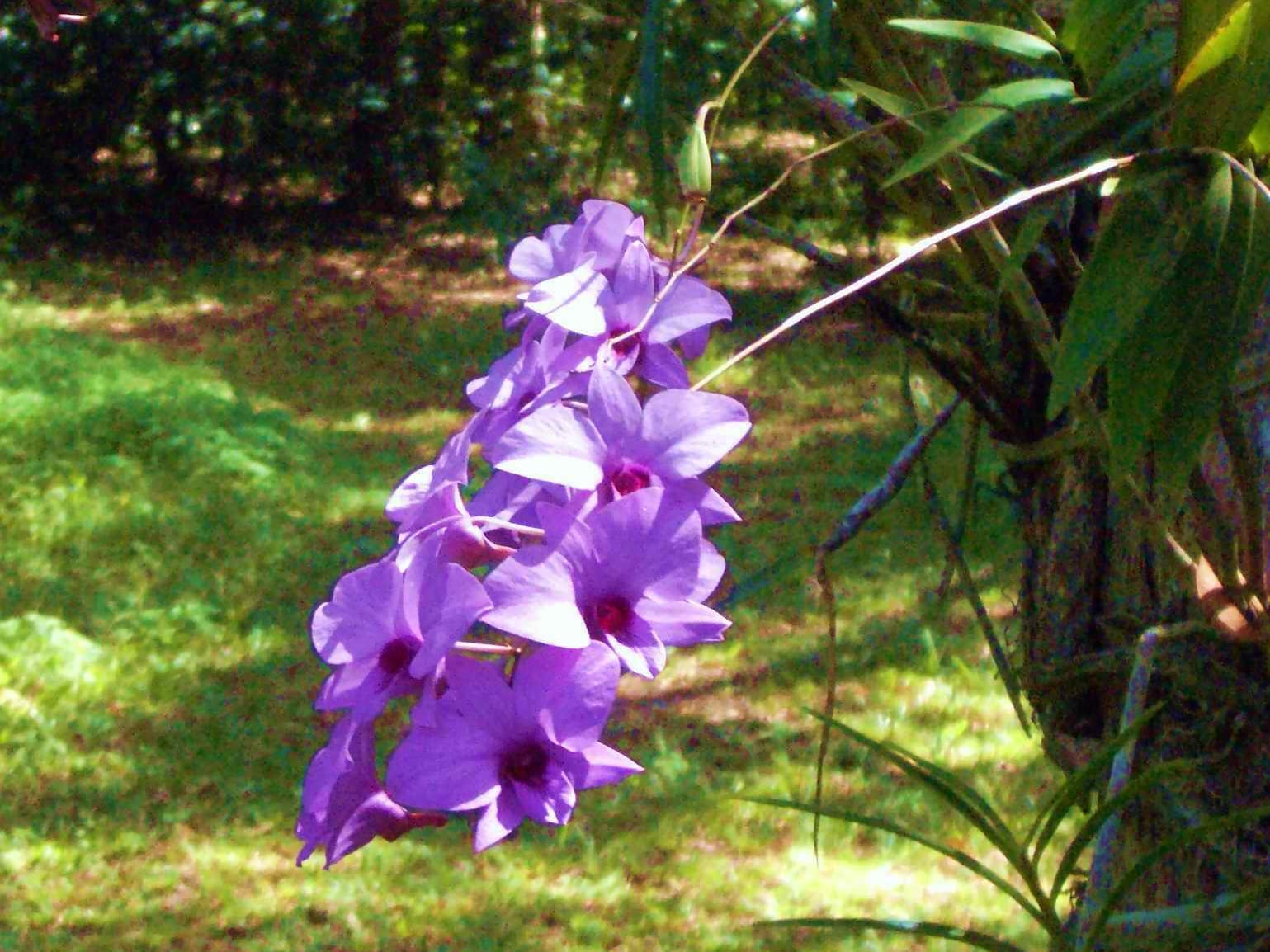
Also called nobile dendrobium or phalaenopsis-type dendrobium
Photo by John Hill on Wikimedia Commons

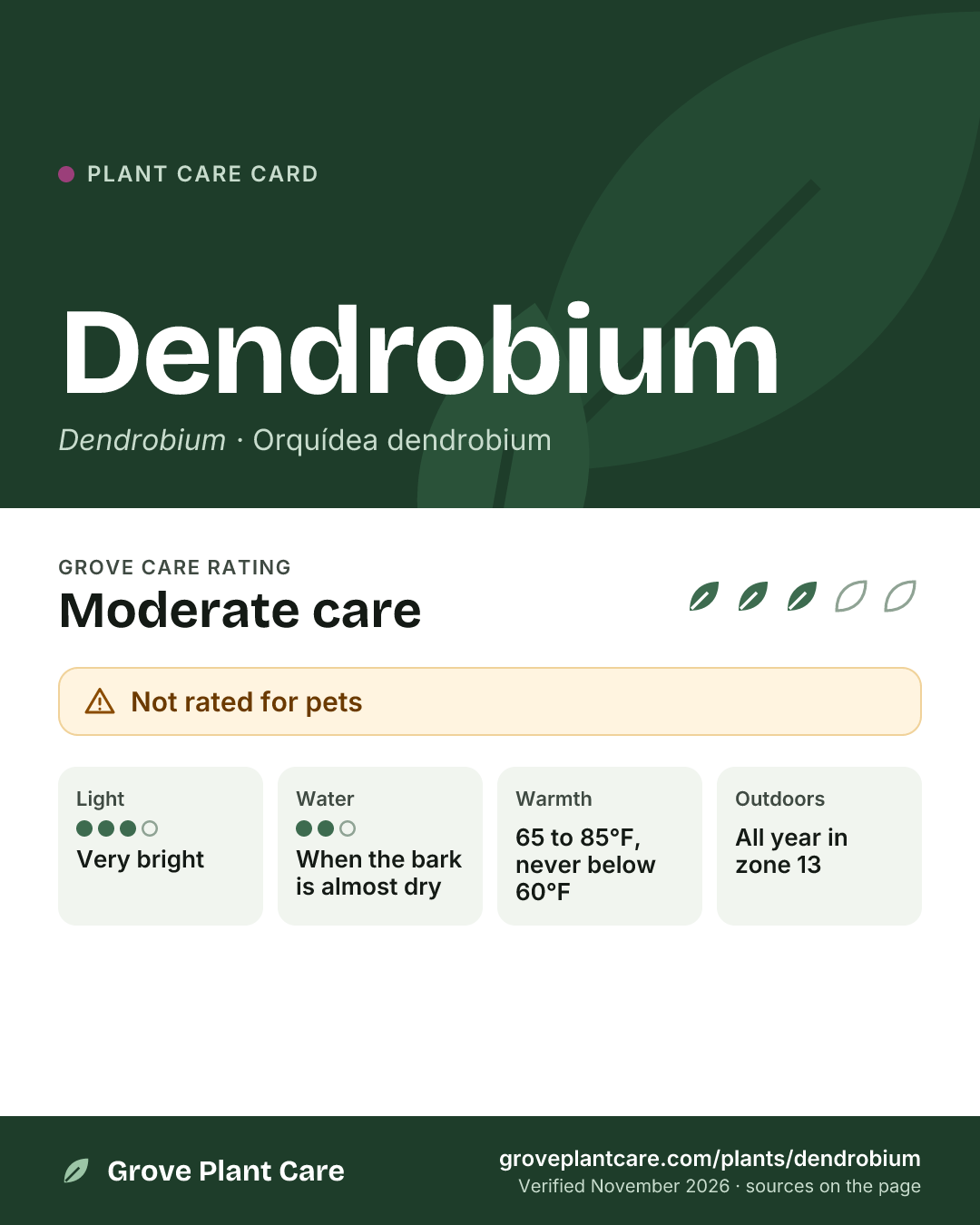
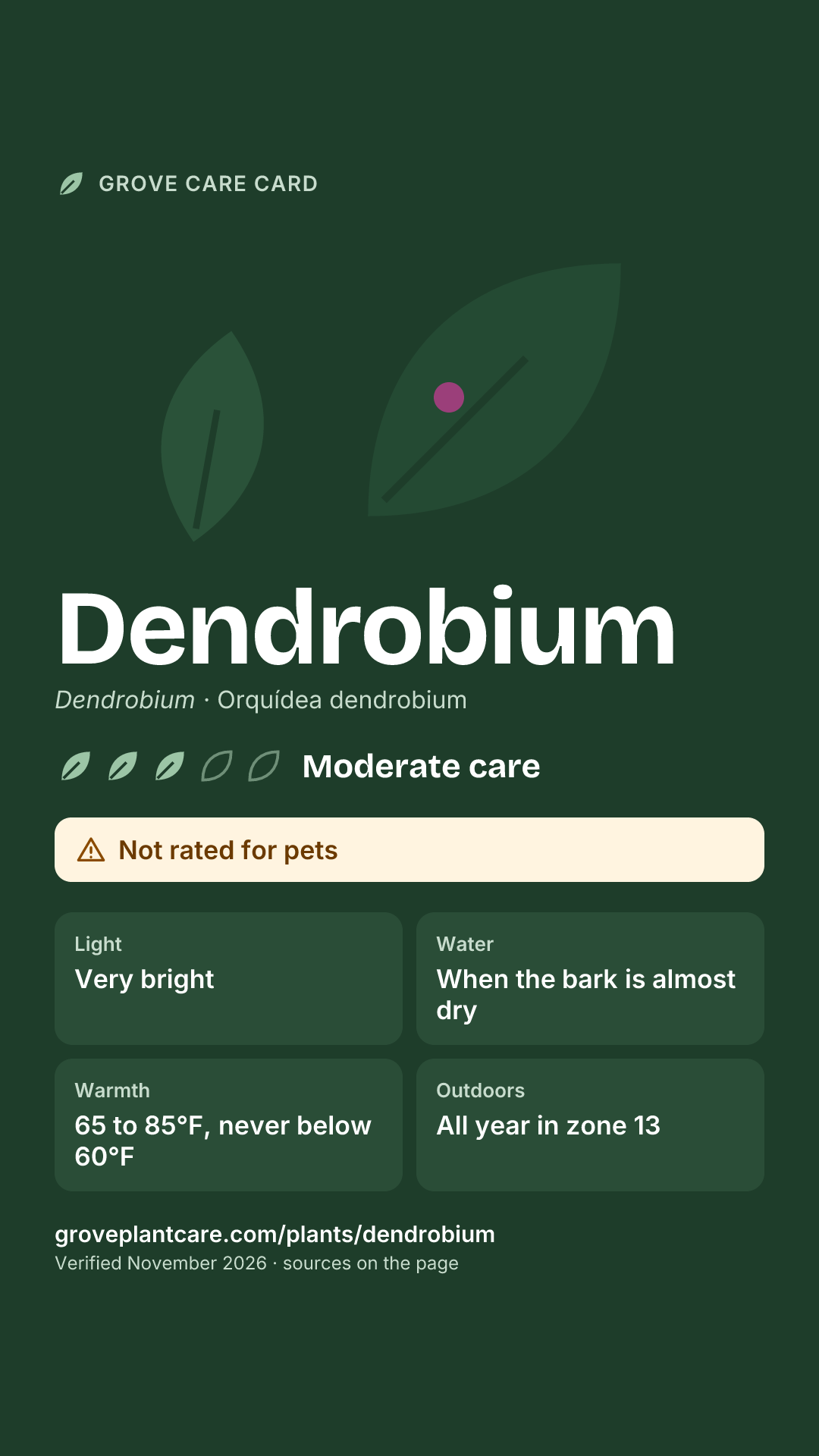
Dendrobiums are cane orchids that want more light than a moth orchid: give them a bright south or west window, water when the bark is almost dry, and keep the air at 50% humidity or more. Check which kind you have first. Phalaenopsis types stay warm all year and can flower more than once, while nobile types need a cool, nearly dry winter rest or they won’t bloom.
Not rated for pets
The ASPCA lists only Dendrobium gracilicaule (leopard orchid) as non-toxic to pets. It names cats, dogs and horses. Store hybrids aren’t that species, and NC State gives no toxicity rating. No trusted source rates the whole genus, so keep it out of reach of pets that chew plants until one does. Children: No source rates it for people; NC State lists no poison information.
Pet poison line: ASPCA (888) 426-4435
Good for: a bright south or west window, a cool, bright room in winter (nobile types), a summer outdoors in partial shade · Think twice if: your brightest window faces north or sits in shade, your home stays warm all winter and you want nobile flowers, your pets chew plants.
Needs at a glance
- Light3 of 4 · Very brightA south or west window behind a sheer curtain; no hot midday sun
- Water2 of 3 · Let it almost dryWater when the bark is nearly dry; nobile types get almost none in winter
- Humidity2 of 3 · Above average50% or more; NC State says 60%
- Soil when pottedOrchid bark mixIn a small pot, snug around the roots
Indoors: best at 65 to 85°F (18 to 29°C). Keep it above 60°F (16°C) and away from drafts and heat vents.
How the rating adds up
0 = easiest · 1 = moderate · 2 = hardest
- Missed waterings1 of 2 · ModerateLet it almost dry, never bone dry while it grows
- Light flexibility2 of 2 · HardestNeeds about twice a moth orchid’s light
- Humidity1 of 2 · ModeratePrefers 50% humidity or more
- Pests and disease1 of 2 · ModerateMealybugs, aphids and spider mites now and then
- Sensitivity to change1 of 2 · ModerateCold drops the leaves of warm types; sudden swings drop buds
Growing outdoors
All year: USDA zone 13, where the coldest winter nights average 60°F (16°C) or warmer.
Elsewhere: summer outside in bright, partial shade. Bring it in before nights drop below 60°F (16°C).
- Containers
- Baskets
- Mounted on bark
Sources: NC State, American Orchid Society, RHS, Clemson, NYBG, ASPCA, ASPCA plant list, USDA zone map, Wisconsin and UF/IFAS. Full list below.
Verified · How we rate plants
Which kind of dendrobium do I have?
Look at the canes and flowers. Phalaenopsis types, the hard-cane kind, keep their leaves for years and carry sprays of flowers from the top of tall canes. Nobile types, the soft-cane kind, lose some leaves in winter and carry clusters of flowers along the length of the cane. NC State, the RHS and NYBG all split the genus this way, and the care differs mostly in winter: nobile types need a cool, dry rest, and phalaenopsis types want warmth all year.
How often should I water a dendrobium?
When the bark is almost dry. Dendrobiums are usually tall plants in small pots, so the American Orchid Society says about twice a week is typical, and the RHS says several times a week in a warm summer and about every 10 to 12 days in winter. Run lukewarm water through the pot in the morning and let it drain fully. Skip softened or distilled water. Nobile types are different in winter: from about mid-November (May in the Southern Hemisphere) give them almost no water for 2 to 3 months, just enough to keep the canes from shriveling.
How much light does a dendrobium need?
A lot: Clemson says about twice what a moth orchid wants. A south window behind a sheer curtain is best, and a bright west or east window can work, as long as hot midday sun doesn’t hit the leaves. NYBG says floppy canes are a sign of too little light. Nobile types need that bright light all winter too, even while they rest.
How do I get my dendrobium to bloom again?
It depends on the type. Nobile types need a winter rest: cut back water in fall, then from about mid-November keep them nearly dry for 2 to 3 months, with days below 70°F (21°C), nights around 55°F (13°C), no fertilizer and bright light. Start watering normally again once buds show along the cane. NYBG says a nobile that makes baby plants instead of buds in spring usually had too warm a winter. Phalaenopsis types need no rest: keep them warm and bright, and the American Orchid Society says a new growth starts the next bloom cycle within a year. NYBG adds that cutting water and fertilizer by about a quarter in winter helps them set buds.
What do I do when the flowers fall off?
Cut only the flower stem, where it comes out of the cane, and keep the cane. The next flowers and new shoots grow from the canes, so the RHS says to remove one only when it’s completely shriveled and pale brown. Keep watering and feeding as usual. If the plant has filled its pot, this is a good time to repot it into a small pot of fresh bark, every two to three years.
Why is my dendrobium losing its leaves?
First, check which type it is. A nobile type dropping some leaves in winter is normal: it’s semi-deciduous, and NYBG says it may look bare while it rests. A phalaenopsis type dropping leaves usually got too cold. The American Orchid Society and NYBG both say warm dendrobiums drop leaves quickly below about 60°F (16°C). Move it somewhere warmer and new leaves will grow. Black spots on the leaves can come from cold water splashing on them.
What are the little plants growing on the canes?
They’re keikis, baby plants that grow from the joints of older canes. You can leave them, or the RHS says to detach one once it’s about a third the size of the mother plant and has its own roots, then pot it in bark. Expect one to two years before a keiki flowers. On a nobile type, lots of keikis and no flowers usually means the winter was too warm.
How warm should I keep a dendrobium?
Phalaenopsis types like warm days, 65 to 75°F (18 to 24°C) in the American Orchid Society’s beginner sheet and 70 to 85°F (21 to 29°C) at NYBG. Keep their nights at 60°F (16°C) or warmer: the AOS cold guide and NYBG agree on that floor, and the RHS says 16 to 18°C. The AOS beginner sheet allows nights down to 55°F (13°C), and Clemson puts the dendrobium minimum at 52°F (11°C), so give the warm types the warmer end. Nobile types grow at 70 to 80°F (21 to 27°C) by day and rest cooler: NYBG suggests nights around 55°F (13°C), and the American Orchid Society says the nobile group handles the low to mid 40s°F (5 to 8°C) while it rests dry.
Is a dendrobium safe for cats and dogs?
We can’t say yet. The ASPCA lists one species, Dendrobium gracilicaule (the leopard orchid), as non-toxic to cats, dogs and horses, but the nobile and phalaenopsis hybrids sold in stores aren’t that species. NC State gives no toxicity rating for the genus, and we found no trusted source that calls any dendrobium toxic. Until a trusted source rates the genus, keep it where pets that chew plants can’t reach it. If your pet ate some and seems unwell, call your vet or the ASPCA Animal Poison Control Center at (888) 426-4435 (a fee may apply).
Can a dendrobium live outdoors?
In summer, yes. NC State says hard-cane types can spend summers outside, and the RHS says a summer outdoors helps buds form. Give it bright, partial shade, and bring phalaenopsis types in before nights drop below 60°F (16°C). All year, sources differ: NC State lists USDA zones 9a to 12b for the genus, which fits the cooler nobile types. Phalaenopsis types drop leaves below 60°F, and only zone 13 stays that warm, so that’s the zone on the card.
How Grove helps
Grove lets you set watering checks that change with the season, so a nobile gets its dry winter rest instead of the summer routine. Add a fall reminder to move it somewhere cool and bright, and assign it to whoever is home.
Sources
- NC State Extension Gardener Plant Toolbox: Dendrobium
- American Orchid Society: Novice Culture Sheet, Dendrobium (phalaenopsis-type)
- Royal Horticultural Society: How to grow Dendrobium
- Clemson Cooperative Extension HGIC: Orchids
- New York Botanical Garden LibGuides: Hard Cane Dendrobium
- New York Botanical Garden LibGuides: Nobile Dendrobium Hybrids
- American Orchid Society: Cold Tolerance of Warm Growing Orchids (2024)
- New York Botanical Garden Plant Information Service: My nobile Dendrobium hybrid grew only keikis
- ASPCA Animal Poison Control: Leopard Orchid (Dendrobium gracilicaule)
- ASPCA Animal Poison Control: Toxic and Non-Toxic Plants
- USDA ARS Plant Hardiness Zone Map (2023)
- University of Wisconsin-Madison Extension: Dendrobium lindleyi
- UF/IFAS Gardening Solutions: Orchids
- Kew Plants of the World Online: Dendrobium
- American Orchid Society: Shoots and Spikes
- Kew: World Checklist of Vascular Plants (June 2026 release), the data behind Plants of the World Online
- UConn Home & Garden Education Center: A Beginner’s Guide to Orchids (2024)