How to get an orchid to bloom again
Most orchids rebloom on their own once two things line up: enough light, and a few weeks of cooler weather in autumn. For the moth orchid, that means days that stay below about 26 °C (79 °F) and nights around 13 to 18 °C (55 to 65 °F). After that it's patience: a healthy moth orchid usually flowers about once a year. If yours hasn't, the reason is almost always one of a short list, and most of them are easy to fix.
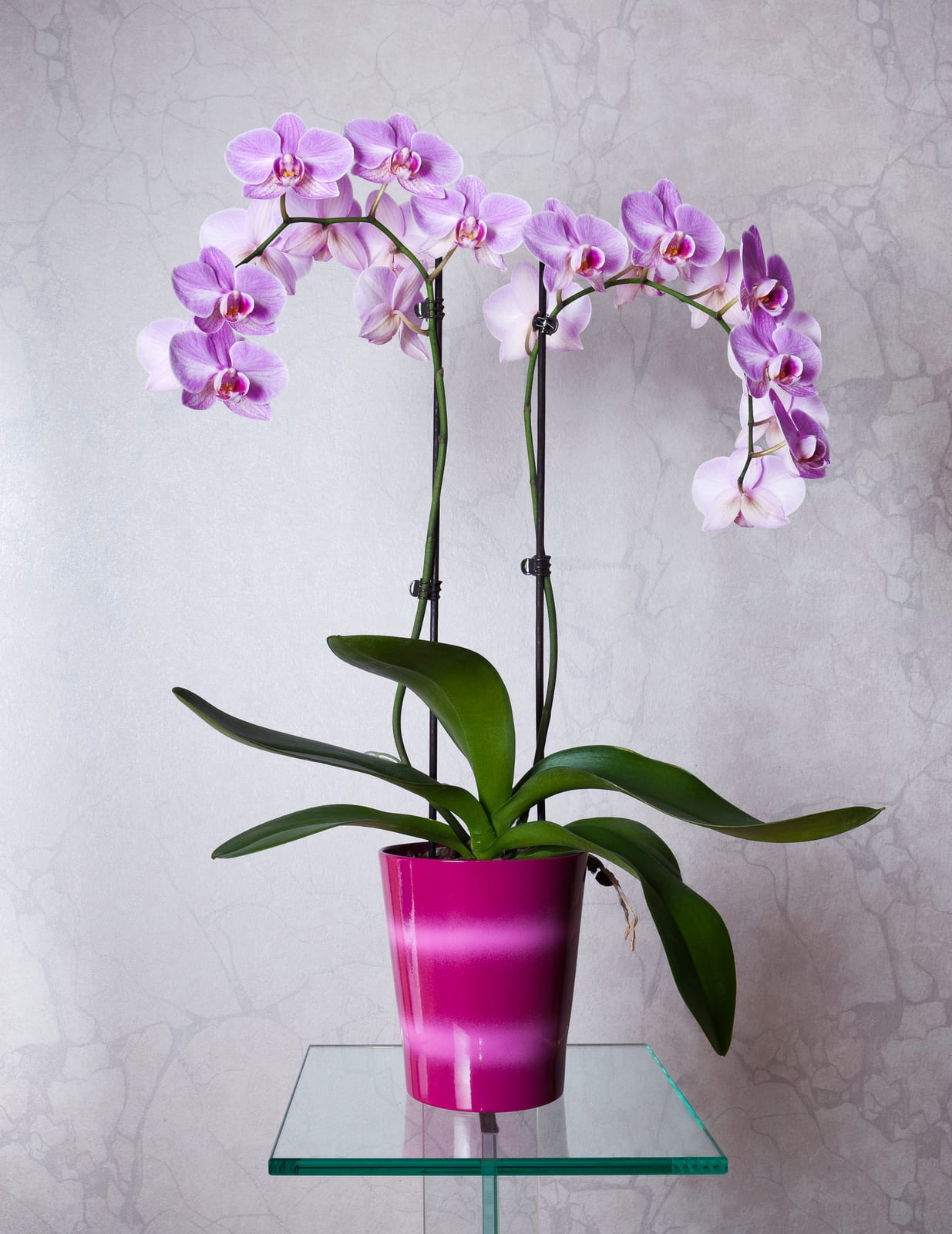
How do I get my orchid to bloom again?
- Start with light. Too little light is the most common reason an orchid won't rebloom, say the American Orchid Society, Clemson Extension and Iowa State Extension. Medium, grassy green leaves mean the light is right; very dark green leaves mean it needs more (Iowa State, Chicago Botanic Garden).
- Give it a cooler spell in autumn. For a moth orchid, a few weeks of nights around 13 to 18 °C (55 to 65 °F) and days below about 26 °C (79 °F). The RHS says an ordinary house in winter often gives that by itself. The next section explains why the day matters as much as the night.
- Feed lightly while it grows. Use a weak fertilizer, as the AOS and Iowa State describe. Too much feed, especially nitrogen, gives you leaves and no flowers, per University of Maryland Extension and the RHS.
- Keep it dark at night. The AOS notes that lamps on a moth orchid at night can delay flowering, and Chicago Botanic Garden says even streetlight through a window can be enough to hold some orchids back.
- Keep it healthy. An orchid with poor roots puts its energy into roots and leaves first. Fix watering and roots before you expect flowers: see our watering guide and root guide.
- Wait. A new spike can take a few months to appear, and longer to open, especially in a cool room.
About "bloom booster" fertilizers: some sources suggest one in autumn, but none of them says it's required, and they disagree on what it should contain. Clemson and the AOS use a high-phosphorus mix, while the RHS uses a high-potassium feed for Cymbidium. A regular orchid fertilizer at weak strength is enough.
Does my orchid need cold nights to bloom?
Read moreShow less
The everyday advice from NC State Extension, Iowa State and the New York Botanical Garden is a cooler autumn: nights near 13 °C (55 °F) per NC State, or 13 to 18 °C (55 to 65 °F) per Iowa State, which also suggests a day-to-night drop of about 6 to 8 °C (10 to 15 °F). Sources differ on how long: about a week (NC State), two to three weeks (the AOS) or several weeks (Iowa State, NYBG). The RHS points out that an ordinary house in winter usually gives that drop by itself.
Don't go colder than that. Iowa State says to keep moth orchids above about 13 °C (55 °F).
"Autumn" here means about September to November in the Northern Hemisphere, and March to May in the Southern Hemisphere. Where days stay hot all year, the research below suggests that the coolest spot in the house gives a moth orchid its best chance.
Going deeper
Researchers at Michigan State University tested what actually starts a moth orchid spike. In a 2006 study in the Journal of Experimental Botany, Blanchard and Runkle grew plants at different day and night temperatures for 20 weeks. At steady temperatures from 14 to 23 °C (57 to 73 °F), at least 80% of plants spiked, even with no night drop at all. At 29 °C (84 °F) days, none did, even when nights were cool. Their conclusion: the warm day blocks the spike, and a night drop isn't required. The AOS and a 2018 review in Plant Diversity agree that moth orchids need temperatures below about 28 °C (82 °F) to spike.
So why does the "cool nights" advice work? A cooler autumn brings cooler days too. Commercial growers use the same finding to time flowering: they keep plants at 28 °C or warmer so they grow leaves, then cool them down to start spikes. That's why a supermarket orchid arrives in bloom right on schedule.
How long does it take an orchid to rebloom?
Read moreShow less
- From a cut stem: if you cut the old spike just above a node, a side spike often flowers in about 8 to 12 weeks, according to the AOS and Iowa State. Our after-blooming guide shows where to cut.
- From the base: cutting the old spike all the way down means a stronger new spike that comes later. The AOS says usually within a year, and the RHS agrees it takes longer.
- Once a year is normal. Penn State Extension says moth orchids usually bloom once a year, and Clemson says most flower in winter or early spring.
- Young plants need time. Clemson says seedlings can take up to five years to flower. The RHS says a new Cymbidium division often takes two to three years, and a Dendrobium keiki (baby plant) one to two. Buy a plant that has already flowered if you want blooms soon.
A spike grows faster in a warmer room and slower in a cooler one, so the wait between a new spike and open flowers varies.
Why won't my orchid bloom?
| Reason | What to do | Sources |
|---|---|---|
| Too little light | Move it to a brighter window; check that leaves are medium green | AOS, Iowa State, Clemson, Maryland, Chicago Botanic Garden |
| Warm all autumn | Give it a few weeks in a cooler room or by a cool window | Blanchard and Runkle, AOS, Iowa State, RHS |
| Lamps on it at night | Move it out of rooms lit late into the evening | AOS, Chicago Botanic Garden |
| Too much fertilizer | Feed weakly; skip high-nitrogen feeds | Maryland, RHS |
| Weak roots | Fix watering and roots first | AOS, Clemson |
| Too young, or just divided | Give it a year or two | Clemson, RHS |
| It just bloomed | A rest after flowering is normal | Chicago Botanic Garden, Clemson |
Some hybrids are just reluctant. In its 2024 to 2025 windowsill trial, the RHS found that some moth orchid varieties rebloomed much more easily than others.
What does each type of orchid need to bloom?
| Orchid | What gets it to bloom | Sources |
|---|---|---|
| Moth orchid (Phalaenopsis) | Bright indirect light and a few weeks of cooler autumn days and nights | NC State, Iowa State, AOS, Blanchard and Runkle |
| Cane Dendrobium (Dendrobium nobile and similar) | A cool, bright, dry rest in winter: little water and no feed until buds show along the canes | NYBG, RHS |
| Cymbidium | Summer outdoors in light shade, then cool autumn nights around 10 to 14 °C (50 to 57 °F) with good light | AOS, RHS |
| Cattleya | Strong light (more than 4 hours of direct sun in a window, per the AOS) and a night drop of about 5.5 to 8 °C (10 to 15 °F) | AOS, Clemson, Iowa State |
| Dancing lady (Oncidium) | Blooms as each new pseudobulb matures, up to three times a year; more light means more flowers | AOS, RHS |
| Slipper orchid (Paphiopedilum) | Enough light, water and feed; about once a year | Penn State, AOS |
| Pansy orchid (Miltoniopsis) | Stays cool: heat above about 27 °C (80 °F) stops flowering | NYBG, NC State, AOS |
Cane Dendrobium, in more detail. The NYBG says to cut back water from about mid-November (mid-May in the Southern Hemisphere) and give little or none for two to three months, just enough to keep the canes from shriveling, with days below 21 °C (70 °F) and nights near 13 °C (55 °F). The RHS agrees on a cool, bright, much drier rest. Both warn that a plant kept wet and fed through autumn grows keikis (baby plants) along the canes instead of flowers. Check which Dendrobium you have first: the RHS says the evergreen kind sold as "Den-Phal" takes no rest and stays warm all year.
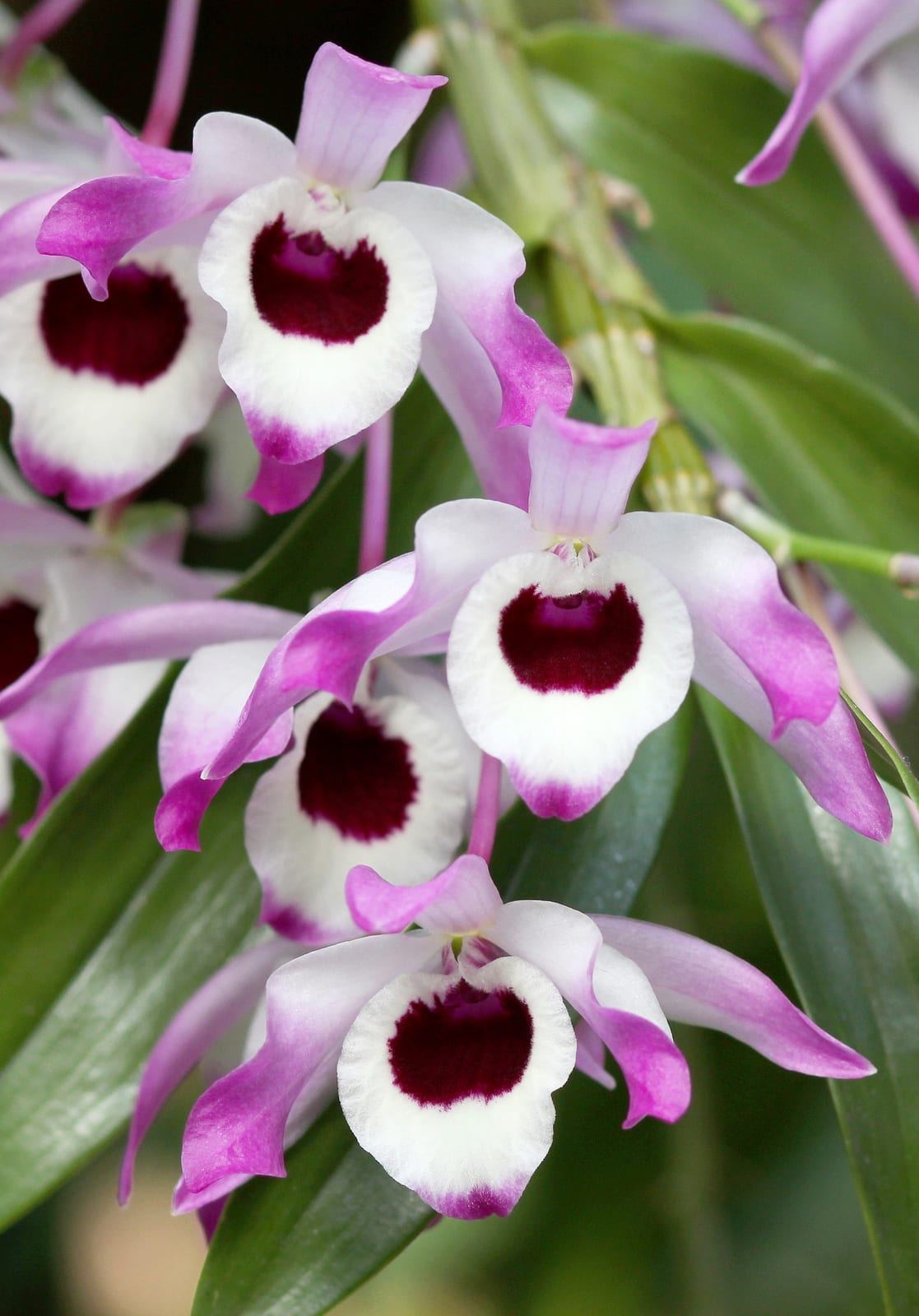
Cymbidium, in more detail. The RHS puts plants outdoors from about June to mid-September in the Northern Hemisphere (about December to mid-March in the Southern), in a sheltered, lightly shaded spot. The AOS says to bring them in before nights drop to about 4 °C (40 °F). The two disagree on heat: the AOS says a standard Cymbidium may refuse to bloom if it gets above 24 °C (75 °F), while the RHS keeps summer temperatures under 30 °C (86 °F). Keep yours as cool as you can while spikes form.
Frequently asked questions (FAQ)
Will my orchid bloom again on the same stem?
A moth orchid often can. Cut the finished spike just above a node and a side spike may flower in 8 to 12 weeks, per the AOS and Iowa State. Our after-blooming guide explains when to cut lower instead.
Do orchids need sunlight to bloom?
They need bright light. Moth orchids do best in bright indirect light, and Cattleyas want some direct sun. Too little light is the top reason orchids don't rebloom.
Sources
- Temperature during the day, but not during the night, controls flowering of Phalaenopsis orchids : Blanchard and Runkle, Journal of Experimental Botany 57(15), 2006
- Physiological diversity of orchids : Zhang and others, Plant Diversity 40(4), 2018
- Novice Culture Sheet: Phalaenopsis : American Orchid Society
- Phalaenopsis, the Genus : American Orchid Society, Beginner's Handbook
- Top Ten Uncommonest Questions Asked about Phalaenopsis : American Orchid Society (G. Woodward)
- Cold Tolerance of Warm Growing Orchids : American Orchid Society, Orchids magazine (S. Bottom, December 2024)
- Cattleya, Oncidium, Cymbidium and Miltoniopsis culture sheets : American Orchid Society
- Phalaenopsis and Miltoniopsis roezlii : NC State Extension Gardener Plant Toolbox
- How to Get Orchids to Rebloom, Growing Orchids Indoors and What is the proper care for a moth orchid? : Iowa State University Extension and Outreach
- Care of Phalaenopsis Orchids (Moth Orchids) : University of Maryland Extension
- Orchids : Clemson Cooperative Extension, Home and Garden Information Center
- Orchids as Houseplants : Penn State Extension
- How to Be a Phalaenopsis Pro : New York Botanical Garden (C. Patterson, February 2024)
- My nobile Dendrobium hybrid grew only keikis : New York Botanical Garden, Plant Information Service (updated January 2023)
- The Magnetic Appeal of Pansy Orchids : New York Botanical Garden, Plant Talk (March 2013)
- Orchid care : Chicago Botanic Garden
- Growing Phalaenopsis orchids, Phalaenopsis windowsill trial 2024 to 2025, How to grow Dendrobium, How to grow cymbidium orchids and How to grow oncidium orchids : Royal Horticultural Society