What are these orchid roots? Aerial roots and healthy root colors
The roots climbing out of your orchid's pot are aerial roots, and they're normal. The moth orchid grows on trees in the wild, so its roots reach into the air. Leave them alone and don't bury them. Healthy roots feel firm: silvery white when dry and green when wet. Roots that are brown or black and mushy are rotting, and roots that are flat, papery or hollow are dead. Trim those and give the plant fresh mix.
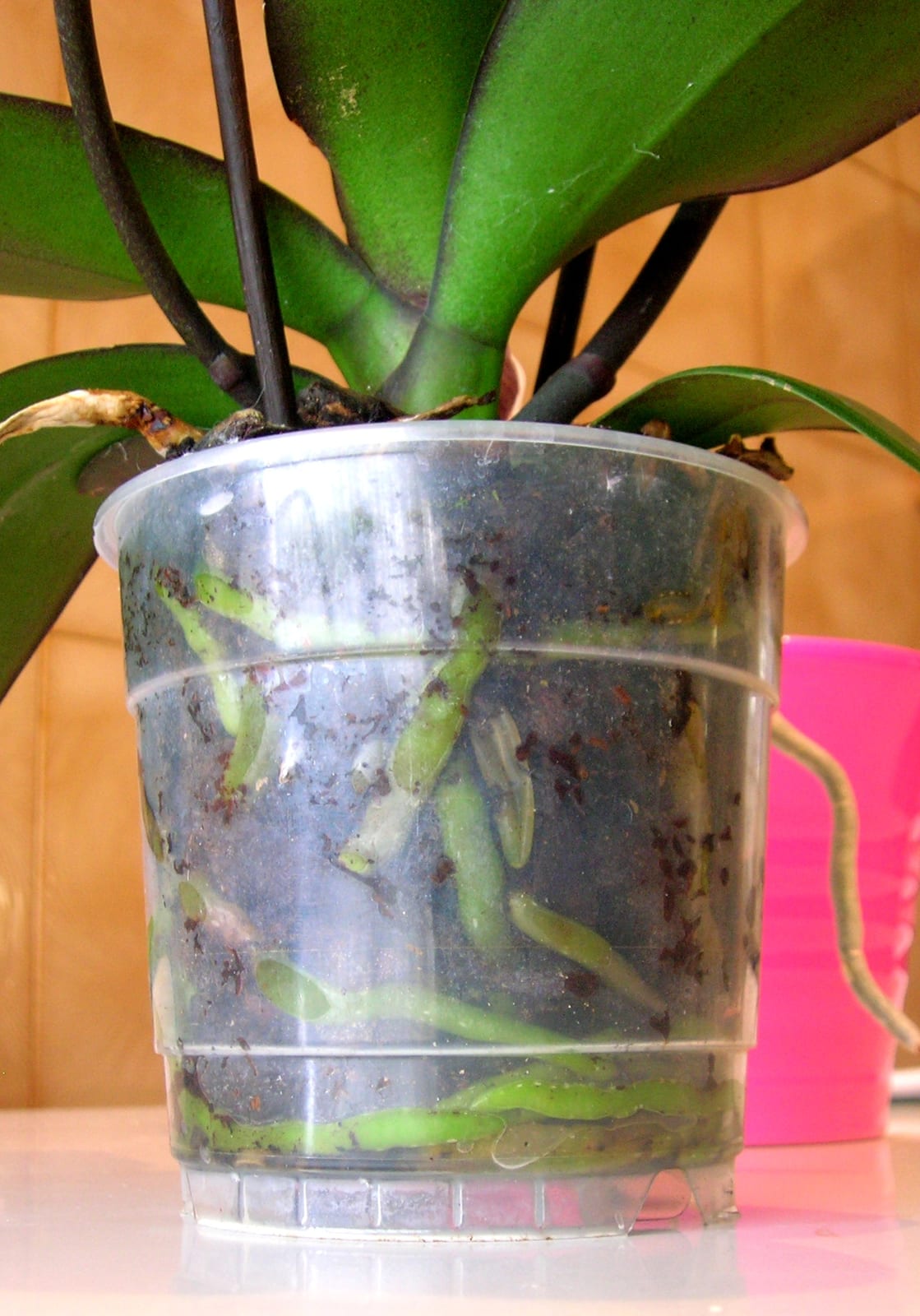
What are the roots growing out of the pot?
Read moreShow less
An orchid that grows on trees in the wild clings to bark with thick roots that hang in the open air (Iowa State Extension). In a pot, some of those roots still head for the air. University of Maryland Extension, the RHS, the New York Botanical Garden and Penn State Extension all call this normal. The NYBG adds that these roots take up moisture from the air. Roots growing out of the top of the pot are the same thing: no source we checked treats them any differently.
What to do with them:
- Leave healthy ones alone. Maryland and the RHS both say not to cut them off.
- Don't bury them. The RHS warns that burying aerial roots in the mix can make them rot, so keep them above it when you repot. Maryland Extension says there's no need to force them back into the pot, and the NYBG says you can tuck some in when repotting, but you don't need to plant them all.
- Remove only dead ones. Cut away dead, brown aerial roots with clean pruners (Iowa State). The NYBG asks for patience first, because a root can keep working while it looks rough.
One thing worth a look: if lots of roots suddenly head out of the pot and the mix inside has turned dark and crumbly, the NYBG says the plant may be stressed. Check whether it needs fresh mix after it flowers. Our repotting guide shows how.
What do healthy orchid roots look like?
Squeeze a root gently. That one test sorts most of them out: healthy roots feel firm, almost hard (AOS, RHS, NYBG).
| What you see | What it means | Sources |
|---|---|---|
| Firm and silvery white | Healthy, and dry: water soon | Maryland (two pages), Fairchild |
| Firm and green | Healthy, and wet | Maryland (two pages) |
| Firm and white or beige, inside the pot | Healthy | NYBG, Clemson, RHS |
| A green, pink, orange, red or purple tip | A root that's growing. The color varies by orchid | AOS (two articles), Clemson, RHS |
| White or gray, dry, flat or papery | Dried out or dead | AOS, NYBG, RHS |
| An outer layer that slides off a thin thread | Dead: the outer layer has rotted away | AOS, RHS, Iowa State |
| Brown or black and mushy | Rotting | AOS, NYBG, RHS, Desert Botanical Garden, Iowa State |
Silvery white or papery white? Both look pale, so squeeze. A firm, plump silvery root is just thirsty. A flat, papery or hollow one has died, and you can trim it off. The AOS says a long green tip means a root is growing fast.
Root color also tells you when a moth orchid needs water. Our watering guide covers that.
Going deeper
That silvery coat is called velamen. The AOS describes it as a spongy layer of dead cells that soaks up and holds water and gives helpful fungi a home, wrapped around a thin, wiry core that is the living root. A 2018 review in Plant Diversity adds that velamen covers the whole root except the growing tip, and is found on the roots of most orchids that grow on trees.
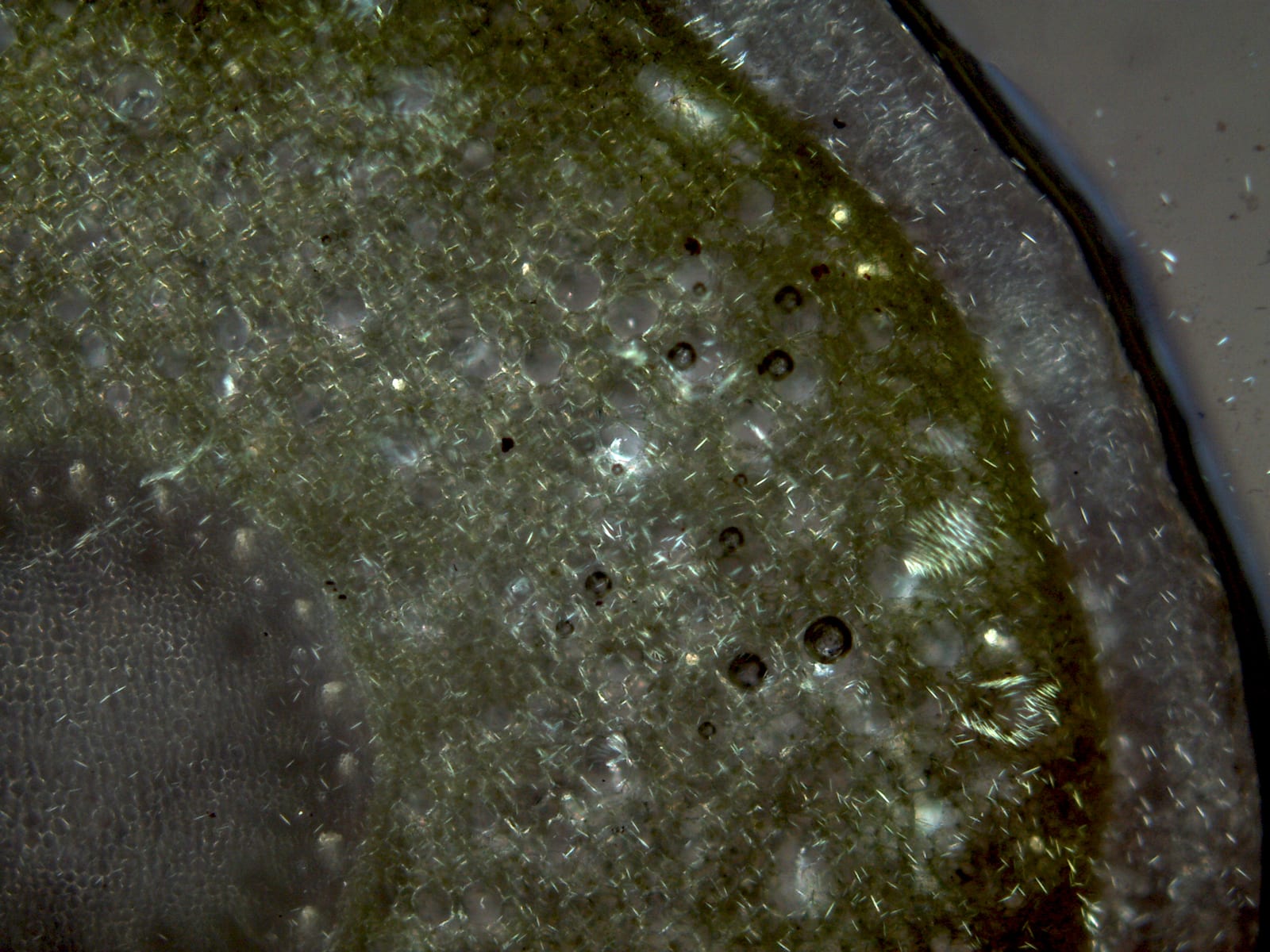
How fast does it fill? Zotz and Winkler, writing in Oecologia in 2013, measured velamen taking up water within seconds, while it took hours to dry out again. The 2018 review notes that an older study from 1957 found filling took over an hour, so the measurements differ. Zotz and Winkler also point out how much is still unproven: for most other jobs people credit velamen with, like protecting the root or keeping it cool, hard evidence is rare or missing.
Orchid roots can also photosynthesize in the light, as the RHS and Iowa State note. A 2024 study in Functional Plant Biology found that moth orchid roots in light make oxygen, which helps roots short on air. How much that matters to the whole plant is still debated.
How do I know if my orchid has root rot, and what do I do?
Read moreShow less
What causes it. Mix that stays wet and stale. The AOS explains that a root kept soaked too long suffocates, and rot can spread from the roots into the rest of the plant. Old mix breaks down into a waterlogged mass (NYBG), and roots kept soggy rot (UConn, Wisconsin Extension). The AOS says keeping the mix fresh and letting it dry between waterings is the key to prevention.
Signs above the pot. Leaves go limp, wrinkled or yellow (NYBG, NC State). The tricky part: the AOS says too much water and too little water make the leaves look alike, so check the roots before you water more. Our wrinkled leaves guide and yellow leaves guide help you read the leaves.
What to do:
- Slide the plant out and remove all the old mix, which holds damp pockets (NYBG).
- Cut every rotten root back to firm tissue, using sterile tools (NYBG, Iowa State, RHS, Clemson).
- Repot in fresh orchid mix, in a pot sized to the roots that are left (NYBG, Iowa State).
- Water less often from now on: wait until the mix is nearly dry. Our watering guide shows how to check.
Some gardens add a dip after trimming: the NYBG disinfects with a fungicide, and Desert Botanical Garden soaks the roots for 10 minutes in water with a bactericide. If you use a product, follow its label. Our repotting guide walks through every step, and our general root rot guide covers rescue and recovery for any houseplant.
When it's too far gone. If the rot has spread from the roots into the base of the plant, the AOS says it can kill the orchid. The NYBG says a plant with serious disease or damage from overwatering that it can't recover from is best thrown away.
Is it a flower spike or a root?
Read moreShow less
New spikes and new roots both start as small green nubs near the leaves, so they're easy to mix up. Here's how to tell:
- The silvery coat (the best test). On a root, the silvery white velamen forms a few days behind the green tip, and older parts of the root are silvery when dry and green when wet (AOS, Maryland Extension). A flower spike has no velamen: it's solid green along its whole length (Maryland Extension).
- The tip shape. Maryland Extension describes a root tip as somewhat pointed, and a spike tip as rounded, like a mitten.
- Where it starts. Flower spikes come from between the leaves (Maryland Extension). Roots can start from the same stem area, the AOS notes, so position alone won't settle it.
- Which way it grows. Roots usually grow out or down and spikes up, but Maryland Extension warns that light and the plant's position can change that, so direction isn't a reliable clue.
- Tip color. Don't go by color: root tips can be green, but also pink, orange, red or purple (AOS).
Still unsure? Give it a week or two. Because the coat shows up a few days behind a growing root tip, a root will reveal itself soon. A spike will just keep getting longer and stay green.
Once you know it's a spike, our rebloom guide covers what helps it flower.
Frequently asked questions (FAQ)
Should I cut off my orchid's aerial roots?
Only the dead ones. Healthy aerial roots are part of the plant: Maryland Extension and the RHS both say to leave them. Trim roots that are brown and dry or papery with clean pruners.
Why are my orchid's aerial roots shriveled?
The NYBG says shriveled, dried aerial roots usually point to dry air. Give the plant a bit more humidity, and be patient: a rough-looking root can still work. Cut it off only once it's completely dead.
Why do my orchid's root tips turn black?
On otherwise healthy roots, the NYBG links black tips to fertilizer salt buildup or uneven watering. Its fix: a thorough watering with plain water once a month to rinse the salts out.
Can I put my orchid's roots in water?
Orchid roots need air between waterings. Roots kept wet suffocate and rot, so keep them in a pot that drains. Our repotting guide explains why glass vases cause trouble.
Sources
- Care of Phalaenopsis Orchids (Moth Orchids) : University of Maryland Extension
- Orchid flower spike or root (August 2023) and Orchid question (February 2025) : Ask Extension, answered by University of Maryland Extension Home and Garden Information Center
- How to grow Phalaenopsis (moth orchids) and How to grow cymbidium orchids : Royal Horticultural Society
- Phalaenopsis, Dendrobium, Orchids: Potting and Dividing, Troubleshooting with Orchids and Orchid FAQs : New York Botanical Garden
- How to Repot an Orchid and Growing Orchids Indoors : Iowa State University Extension and Outreach (A. Steil, reviewed January 2026)
- Repotting Your Orchid : Clemson Cooperative Extension, Home and Garden Information Center (J. Jordan, March 2023)
- Orchids as Houseplants : Penn State Extension
- Orchids : University of Wisconsin-Madison Extension
- Orchid Care and Repotting : UConn Home and Garden Education Center (2019)
- Phalaenopsis : NC State Extension Gardener Plant Toolbox
- Phalaenopsis care sheet : Fairchild Tropical Botanic Garden
- Orchid Plant Care Tips : Desert Botanical Garden (March 2025)
- Orchid Roots : American Orchid Society
- Orchid Parts and Why They Matter : American Orchid Society, Orchids magazine (S. Bottom, June 2024)
- Watering: Techniques for Success : American Orchid Society, Orchids magazine (R. McHatton, November 2024)
- Aerial roots of epiphytic orchids: the velamen radicum and its role in water and nutrient uptake : Zotz and Winkler, Oecologia 171(3), 2013
- Physiological diversity of orchids : Zhang and others, Plant Diversity 40(4), 2018
- Phalaenopsis root hypoxia and root photosynthesis : Brunello and others, Functional Plant Biology 51(3), 2024