How much light does an orchid need? By type, window and leaf color
Most orchids want bright light with no hot midday sun on their leaves, and an east window is the safe place to start. The types differ a lot, though. Moth and slipper orchids are happy in an east window, while Cattleya, Dendrobium, Cymbidium and Vanda want a few hours of real sun to flower. The leaves keep score: medium, grassy green means the light is right, and very dark green means your orchid wants more.
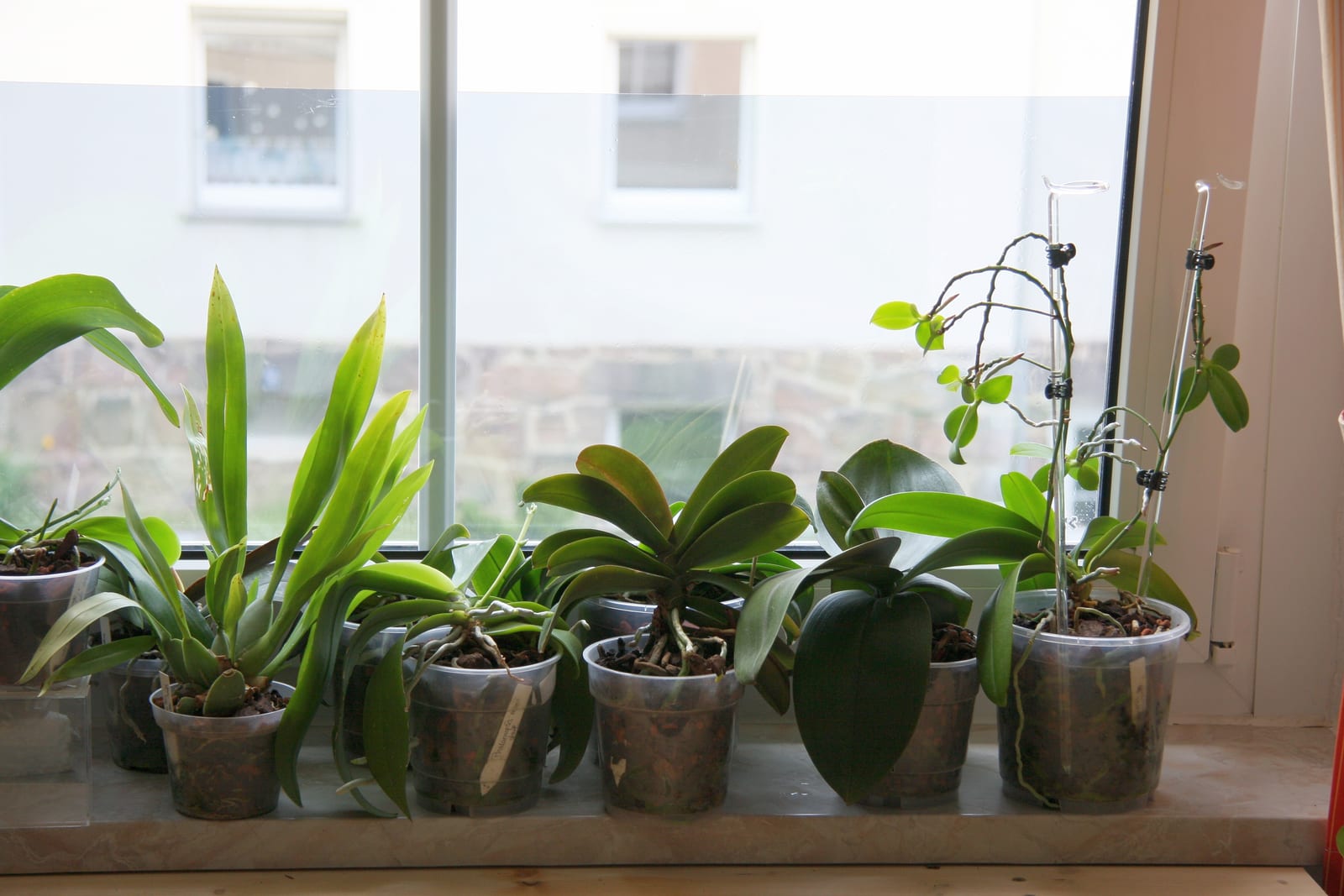
How much light does an orchid need?
Read moreShow less
Bright, indirect light is the baseline that Iowa State Extension, the University of Wisconsin Extension, the New York Botanical Garden and Chicago Botanic Garden all give. Iowa State compares it to what an African violet likes. The hot sun of a summer afternoon is the part to avoid, because it can scorch the leaves.
Here's the catch that trips people up: "low light" on an orchid tag is low for an orchid. The moth orchid, the classic low-light orchid, wants about 11,000 to 16,000 lux (1,000 to 1,500 foot-candles), per the American Orchid Society. On the houseplant light scale in our indoor light guide, that's the level of a bright window with some softened sun. So a spot that a houseplant chart calls medium light may keep a moth orchid going for a while. It takes the brighter end to make it bloom.
Light is the first thing to check when an orchid refuses to flower. The AOS, University of Maryland Extension, Clemson Extension and Iowa State all name too little light as the most common cause. The rest of the story, including the cool spell many orchids need, is in our rebloom guide.
Going deeper
Light for plants is measured in foot-candles or lux (one foot-candle is about 10.8 lux), and most phone light-meter apps read lux. The numbers on this page are the foot-candle figures the sources give, converted to lux and rounded. Measure at leaf height around midday, and treat a phone reading as an estimate that's good for comparing spots, as our indoor light guide explains.
Why does light matter so much for flowers? Light is what a plant turns into the energy it spends on a flower spike. A 2018 review in Plant Diversity cites research showing that stronger light helps established moth orchids start spikes. Temperature still acts as the switch: light builds the battery, and a cooler spell flips it on. Our rebloom guide explains that part.
Which window is best for an orchid?
| Window (Northern Hemisphere) | What it gives an orchid | Good for |
|---|---|---|
| East | Gentle morning sun, then bright light | Moth, slipper, pansy and dancing lady orchids; the safe default (Iowa State, Chicago Botanic Garden, AOS) |
| South | The most light, with strong sun | Cattleya, Dendrobium, Cymbidium, Vanda; add a sheer curtain in summer (UConn Extension, Clemson) |
| West | Bright, then hot afternoon sun | High-light orchids behind a sheer curtain; Chicago Botanic Garden calls it too hot for most |
| North | The least light | Too dark for most orchids to bloom (Chicago Botanic Garden, U.S. Botanic Garden); a bright one can suit jewel and pansy orchids and Masdevallia (their cards) |
South of the equator, swap north and south: there, the north window gets the most sun.
A few habits help in any window. Keep the leaves from touching the glass, which Chicago Botanic Garden warns against. Light fades fast as you step back from a window, so "near the window" means close to it. And the seasons change things: Maryland Extension says a moth orchid can take direct sun from a south window in the short days of winter, and the RHS gives Cymbidium all the light it can get in winter. Move plants back from strong sun as spring days lengthen.
The U.S. Botanic Garden suggests a quick check on a bright day: hold your hand over the spot. A faint shadow means only low-light orchids will do well there. A crisp, sharp shadow means there's enough light for the high-light types.
How much light does each type of orchid need?
The table runs from the least light to the most. The middle column matches each orchid's care card. The measured light comes from the sources named, converted to lux.
| Orchid | Light on its care card | Measured light, where a source gives it | Care card |
|---|---|---|---|
| Jewel orchid (Ludisia) | Medium indirect: a north or east window, out of direct sun | No figure given | Jewel orchid |
| Lady slipper (Paphiopedilum) | Medium indirect: an east window, or a south or west one behind a sheer curtain | 5,000 to 27,000 lux (500 to 2,500 fc), NC State; 11,000 to 16,000 lux (1,000 to 1,500 fc), NYBG | Lady slipper |
| Moth orchid (Phalaenopsis) | Bright indirect: an east window, or south or west behind a sheer curtain | 11,000 to 16,000 lux (1,000 to 1,500 fc), AOS; 16,000 to 18,000 lux (1,500 to 1,700 fc), Clemson | Moth orchid |
| Pansy orchid (Miltoniopsis) | Bright, soft light: an east window with morning sun, or a bright north window | About 13,000 lux (1,200 fc), NYBG and NC State; 11,000 to 27,000 lux (1,000 to 2,500 fc), AOS | Pansy orchid |
| Masdevallia | Bright, diffuse light: an east or north window, or a grow light; no midday sun | 11,000 to 22,000 lux (1,000 to 2,000 fc), AOS and the Orchid Society of Great Britain | Masdevallia |
| Spider orchid (Brassia) | Bright indirect: bright, filtered light out of direct sun; an east or west window | No figure; the U.S. Botanic Garden puts it with the high-light orchids | Spider orchid |
| Dancing lady (Oncidium) | Bright, gentle sun: an east window, or south or west with shade from hot afternoon sun | No figure; the AOS says 1 to 5 hours of sun | Dancing lady |
| Zygopetalum | Bright indirect: an east or west window, out of hot midday sun | 27,000 to 43,000 lux (2,500 to 4,000 fc), AOS | Zygopetalum |
| Vanilla orchid (Vanilla) | Bright indirect: bright, filtered light out of hot sun; more light helps it flower | No figure; the AOS says it needs about as much light as a Cattleya to flower | Vanilla orchid |
| Dendrobium | Very bright: a south or west window behind a sheer curtain; no hot midday sun | 22,000 to 54,000 lux (2,000 to 5,000 fc), NC State and NYBG | Dendrobium |
| Cattleya | Bright, some sun: an east or west window, or south behind a sheer curtain | 22,000 to 38,000 lux (2,000 to 3,500 fc), AOS; 22,000 to 32,000 lux (2,000 to 3,000 fc), NYBG | Cattleya |
| Cymbidium | Some direct sun: a few hours of direct sun, shaded from strong summer sun | 32,000 to 65,000 lux (3,000 to 6,000 fc), AOS | Cymbidium |
| Vanda | Some direct sun: your sunniest window, shaded from hot midday sun | 32,000 to 54,000 lux (3,000 to 5,000 fc), NC State; 38,000 to 43,000 lux (3,500 to 4,000 fc), NYBG | Vanda |
A few sources disagree, and we show both sides. For slipper orchids, the AOS lists north windows, while Penn State Extension says a north window is probably too dark. For Zygopetalum, the AOS, the RHS and NC State keep it out of hot sun. For the spider orchid, the RHS says filtered light and the U.S. Botanic Garden says high light. When sources split like this, start with the gentler light and move toward more if the leaves turn dark green.
Two orchids need more light than most homes can give. The AOS recommends only miniature Cymbidium indoors, in a window with four or more hours of direct sun. The AOS also says a true Vanda is a poor fit for indoor growing, while NYBG grows it in a south window. A summer outside in light shade solves it for both, as our outdoor orchid guide explains.
What do the leaves say about the light?
| Leaf color | What it means | Sources |
|---|---|---|
| Medium or grassy green, sometimes olive | The light is right | Iowa State, AOS |
| Very dark green, often long and spindly | Too little light; it may refuse to bloom | Clemson, Iowa State, NYBG, Chicago Botanic Garden, Maryland Extension |
| Yellow-green, sometimes with pink or reddish edges | Too much light | Maryland Extension, AOS, Iowa State |
| A reddish tinge, such as reddish leaf edges on a slipper orchid | Too much light | AOS, NC State |
| Medium to golden green on a Cymbidium | The bright light it wants | AOS |
Too much light breaks down the green pigment in a leaf, the AOS says, which is why a sun-blasted orchid looks washed out. On a cane Dendrobium, NYBG adds another clue: floppy canes mean too little light.
Leaf color changes slowly, so give a move a few weeks before you judge it. And if a leaf turns yellow, light is only one of several causes. Our yellow leaves guide helps you tell them apart.
Can orchids take direct sun?
Read moreShow less
The high-light orchids want direct sun to bloom. The AOS says Cattleya needs more than four hours of direct sun in a window, and the dancing lady does well with one to five hours. Moth, slipper and jewel orchids do best with gentle sun or none, as their cards say. The AOS adds that an hour or two of early or late sun can even help a moth orchid bloom.
Sunburn usually follows a sudden change, such as moving a plant to a sunnier window or outdoors in spring, as the AOS and Iowa State describe. The damage sits on the most exposed, sun-facing part of a leaf: a pale or bleached patch that turns brown or black and dries to a tan scar. Warm leaves that wilt are an early warning, the AOS heat stress page says.
To give an orchid more light safely, move it in steps over a couple of weeks and watch the leaves. Shade it at once if a patch appears. The scar stays, but a mildly damaged leaf keeps working, the AOS says. Our yellow leaves guide shows what sunburn looks like next to other leaf problems.
Can I grow an orchid under a grow light?
A grow light helps when your brightest window falls short, through a dark winter, or for high-light orchids in a dim home. Penn State says slipper orchids do well under lights, and the AOS says the same for Masdevallia. Here's how to set one up:
- Pick a high-output, full-spectrum LED or fluorescent light, as Iowa State advises. NC State Extension calls LEDs the most common grow lights today, because they're efficient and run cool.
- Hang it 15 to 30 cm (6 to 12 inches) above the leaves (Iowa State). Light fades quickly with distance, so closer gives more.
- Run it about 12 to 14 hours a day. Iowa State gives at least 14 hours for supplemental light and Clemson gives 12 to 16, while Chicago Botanic Garden warns that 12 hours or more can stop many orchids from blooming. If a plant stops blooming, stay near 12.
- Put it on a timer so the nights stay dark. The AOS says lamps on a moth orchid at night can delay its spikes, and Chicago Botanic Garden says many orchids won't bloom with 12 or more hours of light a day.
- Watch the leaves for a few weeks: dark green means move the light closer, and yellow-green or reddish means back it off.
The hours are where sources pull in different directions: Iowa State's 14 hours or more for growth against Chicago Botanic Garden's warning about 12 hours or more for blooming. The takeaway: about 12 to 14 hours of light a day, staying near 12 if a plant stops blooming. The AOS also notes that slipper orchids flower poorly when the artificial light is too weak.
Frequently asked questions (FAQ)
Can an orchid live in a north window?
It can survive there, but most won't bloom. Chicago Botanic Garden and the U.S. Botanic Garden call north windows too dark for most orchids. The exceptions are the low-light types on their cards: jewel orchids, pansy orchids and Masdevallia can take a bright north window.
How far from the window should my orchid be?
Close. Light drops quickly as you move back from the glass, so keep most orchids right at a bright window, with the leaves just short of touching it. Our indoor light guide shows how fast it fades.
Should I turn my orchid toward the light?
Leave it be while it's in bud. The AOS says that moving a moth orchid in bud makes the spike turn toward the light again, which twists the flowers into an untidy spray.
Do orchids need darkness at night?
Many do, to bloom. The AOS says lamps on a moth orchid at night can delay its flower spikes, and Chicago Botanic Garden says even a streetlight shining in can be enough to hold some orchids back. A room that gets dark at night is the easy fix.
Sources
- Growing Orchids Indoors and Diagnosing Issues with Orchids Grown Indoors : Iowa State University Extension and Outreach (A. Steil, reviewed January 2026)
- Phalaenopsis, the Genus, Top Ten Uncommonest Questions Asked about Phalaenopsis and Novice Culture Sheet: Phalaenopsis : American Orchid Society
- Cattleya, Cymbidium, Oncidium, Paphiopedilum, Miltoniopsis, Zygopetalum, Vanda and Masdevallia culture sheets : American Orchid Society
- Novice Culture Sheet: Paphiopedilum and Novice Culture Sheet: Cymbidium : American Orchid Society
- Flowering Vanilla : American Orchid Society, Collector's Items
- Growing Phalaenopsis. What Can Go Wrong? : American Orchid Society, Orchids magazine (S. Bottom, June 2025)
- Heat Stress : American Orchid Society, Orchid Pests and Diseases
- Orchids : Clemson Cooperative Extension, Home and Garden Information Center
- Care of Phalaenopsis Orchids (Moth Orchids) : University of Maryland Extension
- Orchids : University of Wisconsin-Madison Extension
- Orchids as Houseplants : Penn State Extension
- A Beginner's Guide to Orchids : UConn Home and Garden Education Center (D. Pettinelli, March 2024)
- Orchid Home Care : U.S. Botanic Garden
- Orchid care : Chicago Botanic Garden
- Light Considerations for Indoor Plants : NC State Extension, Richmond County Center
- Orchid FAQs, Hard Cane Dendrobium, Vanda orchid, Cattleya, Paphiopedilum and Miltonia and Miltoniopsis : New York Botanical Garden, Mertz Library
- Paphiopedilum, Dendrobium, Vanda, Oncidium and Miltoniopsis roezlii : NC State Extension Gardener Plant Toolbox
- Masdevallia orchid care guide : Orchid Society of Great Britain
- How to grow cymbidium orchids, Brassia caudata and Zygopetalum James Strauss gx 'Scentsation' : Royal Horticultural Society
- Physiological diversity of orchids : Zhang and others, Plant Diversity 40(4), 2018