Plant care card
Lady slipper orchid
Paphiopedilum · Orquídea zapatito
Also called slipper orchid or tropical lady slipper
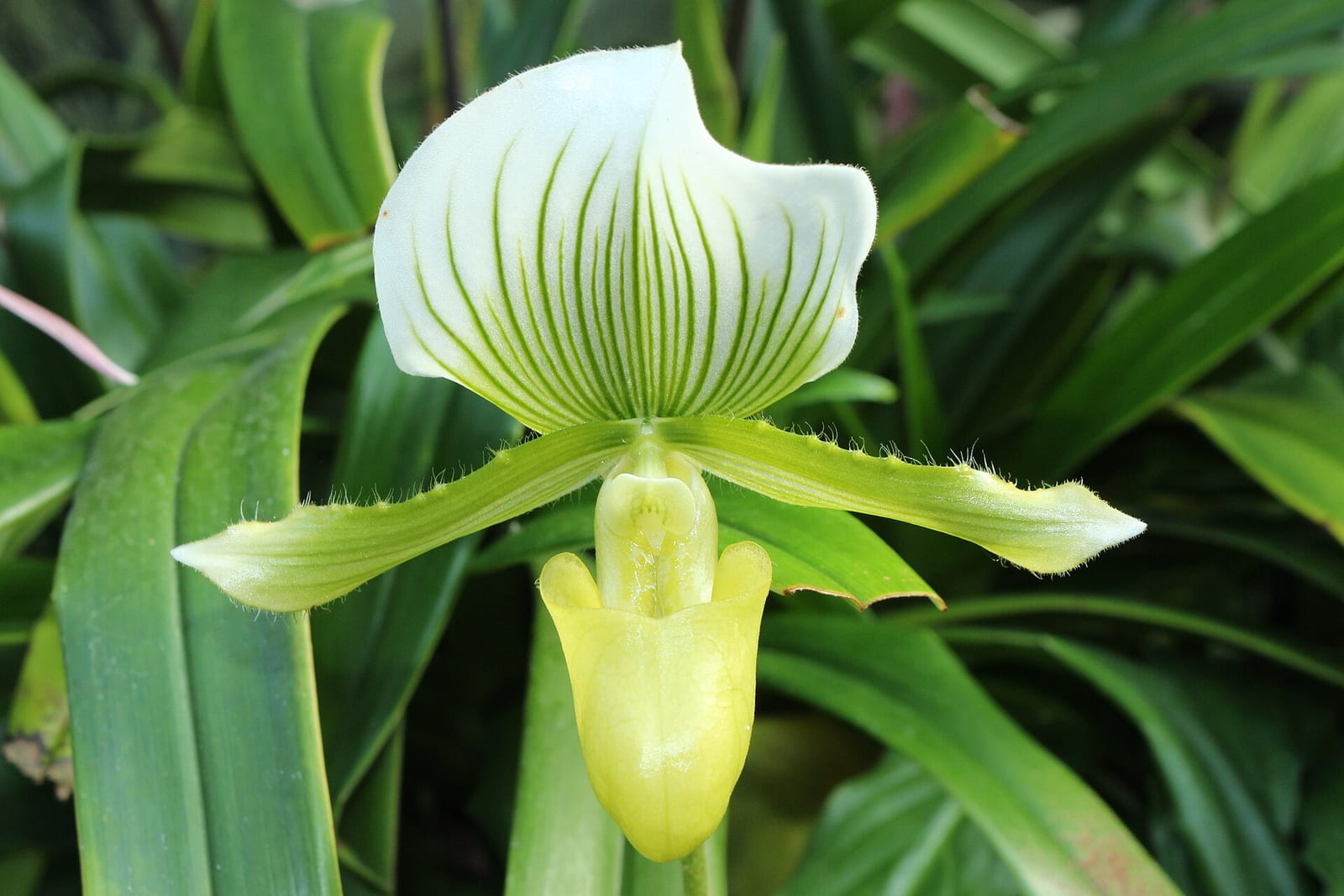
Photo by Holger Krisp on Wikimedia Commons, CC BY 3.0

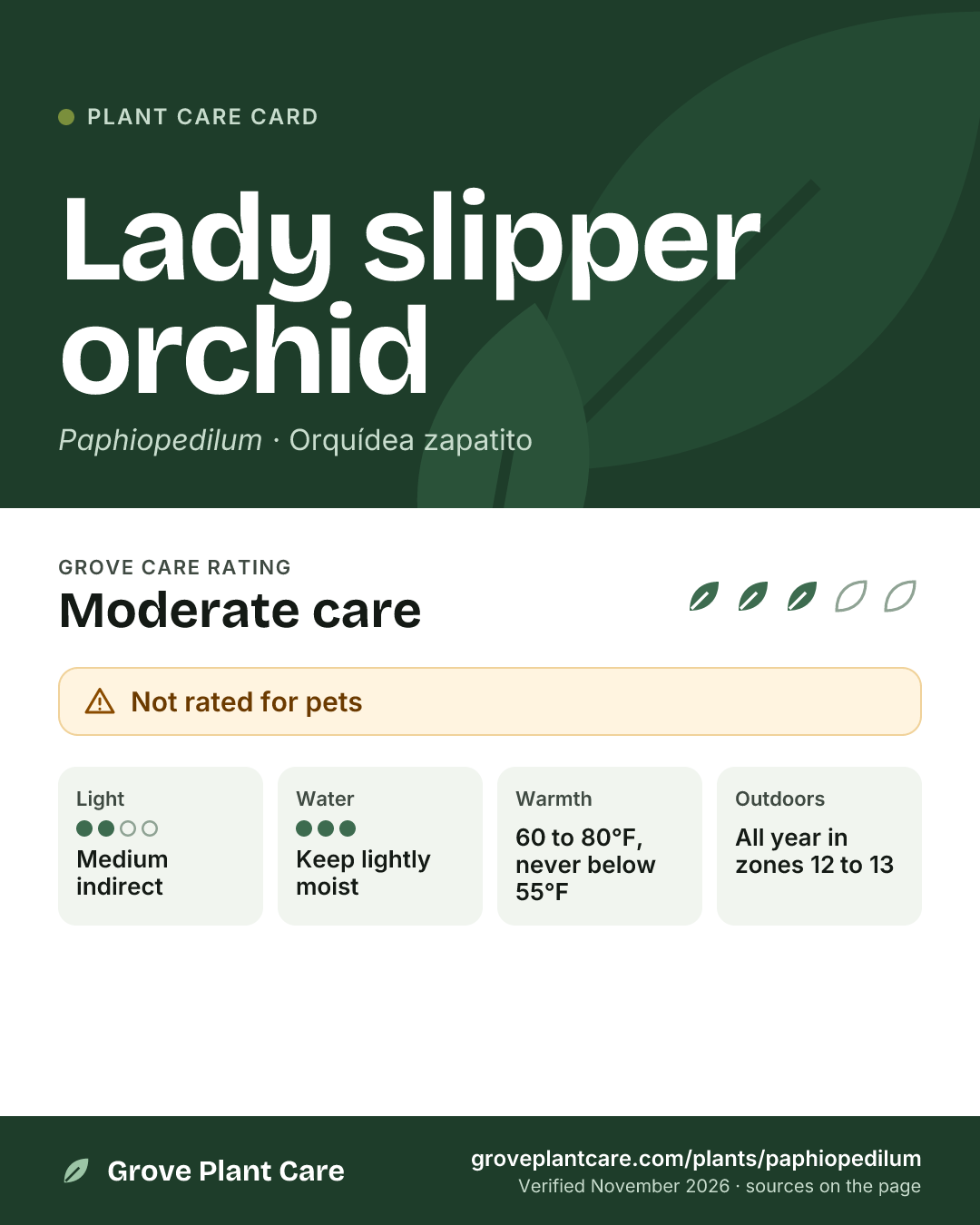
A lady slipper orchid likes the same temperatures you do, an east window and a mix that stays lightly moist. It has no pseudobulbs to store water, so it never wants to dry out, and it takes gentler light than most orchids. Check the leaves: mottled ones like it warmer, plain green ones cooler.
Not rated for pets
The ASPCA doesn’t list it. The “lady slipper” on its non-toxic list is Impatiens, a different plant. NC State gives no rating. No reputable source rates it, so keep it away from pets that chew plants until one does. Children: No poison information listed by NC State or the ASPCA.
Pet poison line: ASPCA (888) 426-4435
Good for: an east window, a second orchid after a moth orchid, people who like to water often · Think twice if: you often forget to water for a week or more, your air is very dry and you won’t use a pebble tray or humidifier.
Needs at a glance
- Light2 of 4 · Medium indirectAn east window, or a south or west one behind a sheer curtain
- Water3 of 3 · Keep lightly moistWater as the top of the mix dries; it has nothing to store water in
- Humidity2 of 3 · Above averageAt least 40 to 50%; use a pebble tray, since misting does little
- Soil when pottedFine orchid bark mixHolds some moisture and drains well; replace it before it breaks down
Indoors: best at 60 to 80°F (16 to 27°C). Keep it above 55°F (13°C) and away from drafts and heat vents.
How the rating adds up
0 = easiest · 1 = moderate · 2 = hardest
- Missed waterings2 of 2 · HardestHas no pseudobulbs; never let the mix dry out
- Light flexibility1 of 2 · ModerateGentle light; hot sun scorches it and a north window is too dark
- Humidity1 of 2 · ModerateAt least 40 to 50%; NC State asks for 60%
- Pests and disease1 of 2 · ModerateRot from overwatering or water left in the crown
- Sensitivity to change1 of 2 · ModerateDislikes softened water and wet leaves; repotting is fine
Growing outdoors
All year: USDA zones 12 to 13, where the coldest winter nights average 50°F (10°C) or warmer.
Elsewhere: summer outside in shade. Bring it in when nights reach 55 to 65°F (13 to 18°C).
- Containers
- Summer outdoors in shade (warm-growing types)
Sources: Missouri Botanical Garden, NC State, American Orchid Society, NYBG, Penn State, RHS, ASPCA plant list and USDA zone map. Full list below.
Verified · How we rate plants
How do I care for a lady slipper orchid?
Give it an east window, a fine bark mix kept lightly moist, at least 40 to 50% humidity and weak fertilizer while it grows. The American Orchid Society compares its care to an African violet’s, and Penn State says it suits ordinary home conditions, which makes it a good second orchid after a moth orchid. The two things it won’t forgive are drying out and hot sun.
How often should I water a slipper orchid?
Often enough that the mix never dries out. It has no pseudobulbs, the swollen stems other orchids use to store water, so it needs water sooner than most. In bark, the American Orchid Society finds about every five days is usually right; in moss, water when the top feels dry. Run lukewarm water through the pot for a minute, let it drain completely and never leave it standing in water. Keep water out of the center of the leaves, where it can rot. Skip softened and distilled water. Our orchid watering guide covers bark, moss and timing.
How much light does a lady slipper need?
Gentle light. It belongs to the low-light orchids, and an east window is ideal; a south or west window works behind a sheer curtain. Reddish leaf edges mean too much light, and a plant that never flowers may need more. Sources differ on north windows: the American Orchid Society lists them, while Penn State says one probably won’t be bright enough. The RHS adds that it can take full, unshaded light in winter.
Mottled or plain leaves: what changes?
The temperature it wants. Types with mottled leaves are the warm growers, and types with plain green leaves come from cooler mountain forests, as NC State explains. The RHS keeps plain-leaved ones above 10 to 13°C (50 to 55°F) on winter nights and mottled ones above 18°C (65°F). NYBG gives similar nights: 55 to 60°F (13 to 16°C) for plain leaves and 60 to 65°F (16 to 18°C) for mottled ones. NYBG also finds the mottled group the easiest for home growers. The tall types with several flowers on one stem like it warm and brighter.
How do I get my slipper orchid to bloom again?
Keep it growing well and wait for a new growth. With enough light, water and food, it flowers about once a year, according to Penn State, and the American Orchid Society says a new growth usually sends up a flower within a year. Too little light is a common reason it doesn’t. NYBG adds that a few weeks of cooler nights can help start a flower. Most flower between fall and spring, and each flower lasts one to two months (NC State, NYBG) or up to three (RHS).
What do I do when the flower fades?
Cut the flower stem down to the leaves once it turns brown, and keep watering and feeding as usual. Each fan of leaves flowers once, and new fans grow beside it to carry on. Right after flowering is also the time to repot or divide it, never while it’s in bud.
American Orchid Society, NYBG, Orchid Society of Great Britain, RHS
When should I repot a lady slipper?
Every one to two years, before the mix breaks down, because rotting mix rots its roots. NC State says at least once a year, NYBG every one to two years, and the American Orchid Society about every two years. Use a fine bark mix in a pot just big enough for the roots, and set the plant at its old depth. The American Orchid Society adds that a few species want a little lime in the mix.
Is it legal to own a lady slipper orchid?
Yes, when it was grown in a nursery. Every wild Paphiopedilum species is on CITES Appendix I, the treaty’s strictest list, which bans international commercial trade in plants taken from the wild, while the nursery-grown plants and hybrids sold in stores can be traded legally with a certificate showing they were propagated. Collecting has wiped out some wild populations, so buy from sellers who grow their own plants.
Is a lady slipper orchid safe for cats and dogs?
We don’t know yet. The ASPCA doesn’t list Paphiopedilum. The “lady slipper” on its non-toxic list is Impatiens, a different plant, so don’t count that one. NC State gives no toxicity rating either, and we found no reputable source that lists it as toxic. Until one rates it, keep it away from pets that chew plants. If a pet eats part of it and seems unwell, call your vet or the ASPCA Animal Poison Control Center at (888) 426-4435.
Can a lady slipper orchid live outdoors?
In summer, in shade, yes, and all year only in very warm places. NC State says warm-growing, mottled types can spend summer outside in a shady spot, and cool-growing ones only where it stays cool. The American Orchid Society says it can grow outside in mild climates and handle heat to about 95°F (35°C). No source lists zones, so the card uses the RHS minimum for plain-leaved types, 50°F (10°C), which only zones 12 and 13 stay above. Bring plain-leaved plants in before nights drop to 50°F and mottled ones before 65°F (18°C).
How Grove helps
Grove turns watering into a check every few days, so the mix never dries out between busy weeks. You can add a repotting reminder after it flowers and assign it to whoever is home.
Sources
- Missouri Botanical Garden Plant Finder: Paphiopedilum (Medium maintenance; checked by hand, 2026-11-12)
- NC State Extension Gardener Plant Toolbox: Paphiopedilum
- American Orchid Society: Novice Culture Sheet, Paphiopedilum
- New York Botanical Garden, Mertz Library: Paphiopedilum (slipper orchid) research guide
- Penn State Extension: Orchids as Houseplants
- Royal Horticultural Society: Paphiopedilum (slipper orchid) growing guide
- American Orchid Society: Paphiopedilum culture sheet
- ASPCA Animal Poison Control: Toxic and Non-Toxic Plants
- USDA ARS Plant Hardiness Zone Map (2023)
- Kew Plants of the World Online: Paphiopedilum
- Kew: World Checklist of Vascular Plants (June 2026 release), the data behind Plants of the World Online
- Orchid Society of Great Britain: Paphiopedilum orchid care guide
- CITES: Appendices I, II and III (valid from 5 March 2026)
- Hinsley et al., A review of the trade in orchids and its implications for conservation (Botanical Journal of the Linnean Society, 2018)