How to repot an orchid, and which potting mix to use
Repot an orchid every one to three years, when its mix breaks down or the roots outgrow the pot. The best moment is after it finishes flowering, just as new roots start to grow. Take out every bit of old mix, trim the dead roots, and set the plant in fresh, chunky orchid mix in a pot just big enough for its roots, with drainage holes. Most orchids do well in bark. Moss holds much more water, so it needs a lighter hand. Regular potting soil smothers orchid roots, so skip it.
When should I repot my orchid?
Read moreShow less
The calendar matters less than the mix. Iowa State Extension and the American Orchid Society both give one to three years. University of Maryland Extension and the RHS say about every two years for bark, because bark breaks down and starts holding water longer.
Signs it's time:
- The mix has broken down. Chunky bark turns into dark, spongy, crumbly bits that smell musty and drain slowly (NYBG, Maryland, Iowa State). Clemson Extension has a handy tell: tiny fragments wash out of the pot when you water.
- The pot stays wet much longer than it used to. Old mix holds water and squeezes out air, which is how root rot starts (Iowa State, AOS).
- The roots have outgrown the pot and push the plant up and out of it (Iowa State, Wisconsin Extension).
- The roots look mushy or brown. Our root guide shows how to tell healthy roots from rotten ones.
Timing: after flowering, as new roots start. Every source we checked agrees on this. The AOS says an orchid recovers fastest when its new roots are just beginning, because fresh roots settle into fresh mix quickly. Clemson watches for new root growth in late winter or early spring, and the RHS repots any time of year as long as the roots are active, with green tips. One AOS writer, Sue Bottom, goes a step earlier: repot when the new growth is swelling, before the root tips get long and easy to snap.
Bought an orchid in bloom? Most store orchids come packed in moss, which holds a lot of water (Desert Botanical Garden). Let it finish flowering, keep a close eye on watering (our watering guide shows how), then repot.
Going deeper
Why wait for new roots? Ray Barkalow, writing for the AOS, explains that roots adapt to the mix they grow in. Old roots that grew in soggy, broken-down mix tend to die back after a move, while new roots grow to suit the fresh mix. Repot right as new roots appear and the plant replaces what it loses quickly. He also points out that old mix collects mineral and fertilizer residue and packs down, so it holds water and keeps air from the roots, the exact conditions that rot them.
How do I repot an orchid?
- Pick the time. After flowering, as new roots begin to grow (see above).
- Clean your tools and pot. Viruses and disease spread from plant to plant on blades and hands, the AOS warns. The NYBG soaks tools in 10% bleach or 70% alcohol for at least 10 minutes. The AOS also suggests flaming the blade or using a new single-edge razor blade for each plant. Work on newspaper and swap it between plants.
- Water first. Soak the roots for a few minutes so they let go of the pot and the old mix (NYBG, Iowa State, Maryland).
- Take the plant out. Squeeze a plastic pot, or run a clean knife around the inside to free roots that cling (Iowa State, NYBG).
- Remove all the old mix. Old bits hold damp pockets that invite rot (NYBG). Rinse off any bark stuck to the roots, and strip away store moss (Maryland, Desert Botanical Garden).
- Trim dead roots. Cut off roots that are soft, mushy, brown, black, hollow or papery, and keep the firm ones (Iowa State, NYBG, RHS, Clemson). Our root guide shows the difference.
- Choose the pot. Size it to the root mass and go up one size at most (Iowa State). An oversized pot stays wet too long (NYBG). Use a pot with drainage holes (AOS). The old pot is fine if the roots still fit (RHS).
- Set the plant at its old depth. A moth orchid goes in the center, with the base of its leaves at the surface of the mix (NYBG, RHS). For orchids that grow sideways along a creeping stem, like Cattleya and dancing ladies, the NYBG sets the oldest growth against the rim, so new growth has room to move toward the center.
- Leave aerial roots in the air. Roots growing above the pot can stay there. Forcing them into the mix can rot them (RHS, Maryland Extension). The NYBG says you can tuck some in, but you don't need to bury them all.
- Fill and firm gently. Pour fresh mix around the roots and work it in with a chopstick or pencil (Iowa State, Desert Botanical Garden). Press lightly: Clemson warns that pressing hard crushes the mix so it holds more water. When you're done, the plant shouldn't wobble.
- Stake it if it still wobbles. A small cane or two holds it steady while new roots anchor it (RHS, NYBG, UConn).
- Water well and let it drain. Run water through the new mix and let every drop drain away (Iowa State, Clemson, RHS, Maryland, NYBG, UConn).
- Go easy for a few weeks. Hold off on fertilizer for several weeks (NYBG, UF/IFAS). The NYBG also suggests a little more shade if you removed a lot of roots, and says some leaf shriveling right after repotting is normal.
After that, water when the new mix is nearly dry. Fresh bark dries faster than the old, soggy mix did, so check it more often at first. Our watering guide has the checks. For general repotting tips that apply to every houseplant, see our repotting guide.
Which potting mix is best for my orchid?
Orchids that grow on trees in the wild, like the moth orchid, have roots used to open air. In a pot, they need a mix that drains fast and leaves room for air. That's why bark is the usual base (AOS, NYBG, Iowa State, Maryland, Clemson). Regular potting soil and multipurpose compost hold too much water, and the roots rot (RHS, Clemson).
Pick the bark size by the plant. Small plants and orchids that like steady moisture want finer bark. Large plants and orchids that dry out between waterings want coarser bark (AOS, NYBG).
| Orchid | Mix | Repot about every | Sources |
|---|---|---|---|
| Moth orchid (Phalaenopsis) | Bark mix. Moss works too, but holds much more water | 1 to 3 years | NYBG, Maryland, Penn State, RHS |
| Cattleya | Coarse, fast-draining bark | 2 to 3 years, or when the creeping stem grows over the rim | NYBG, AOS |
| Slipper orchid (Paphiopedilum) | Fine bark with perlite and charcoal, sometimes some moss. Open, yet slow to dry out | 1 to 2 years (seedlings yearly) | NYBG, Penn State |
| Cymbidium | A bark-based orchid mix that holds some moisture and still drains | 2 to 3 years, soon after flowering | AOS, RHS |
| Dendrobium (the common hard-cane types) | Fast-draining bark or a moss-based orchid mix, in a small, snug pot | When the mix breaks down | NYBG only |
Only the NYBG gives specific advice for Dendrobium, and it's a huge group of orchids, so treat that row as a starting point. Slipper orchids are the exception to the "dries fast" rule: in the wild many grow in leaf litter on the ground, and Penn State Extension and the NYBG both want a mix that stays evenly damp.
What goes into orchid mixes. Bagged orchid mixes combine a few of these:
- Fir or pine bark: the base of most mixes. It drains fast and forgives a heavy hand with the watering can, but breaks down in one to two years (AOS, NYBG).
- Sphagnum moss: holds a lot of water. More on that below.
- Perlite (sponge rock) and horticultural charcoal: common additives that open up the mix (NYBG, AOS, UConn, Clemson).
- Coconut husk chips: used in some mixes (AOS, Acta Horticulturae). The AOS says coconut breaks down more slowly than bark.
- Tree fern fiber, lava rock and expanded clay (LECA): traditional or inorganic options (Clemson, NYBG, AOS, Iowa State). Growing in LECA alone is its own method: see our semi-hydroponics guide.
Want to mix your own? Our repotting guide has a sourced home-made mix for orchids and other plants that grow on trees.
Going deeper
How much does the mix really change? A 2010 trial in Acta Horticulturae grew one moth orchid variety in eight different mixes under commercial greenhouse conditions. Every mix produced good or acceptable plants. Sphagnum and wood fiber grew the best roots, while the coconut chip mixes gave smaller plants with fewer spikes and flowers. The standard mix to beat was mostly pine bark with some coarse peat. It's one variety in one greenhouse, so treat it as a hint. The bigger lesson matches what the extension services say: most mixes work once watering fits the mix.
Is bark or moss better for orchids?
| Bark | Sphagnum moss | |
|---|---|---|
| Holds water | Little. Dries quickly | A lot. Stays wet in the center after the edges dry (NYBG) |
| Overwatering risk | Lower: the AOS calls it forgiving | Higher: Iowa State and Clemson link it to rot |
| Lasts | One to two years before it breaks down (NYBG, AOS) | Turns more acidic over time; repot every one to two years (Maryland Extension) |
| Good to know | Comes in fine, medium and coarse grades (NYBG) | Hard to wet again once it dries out completely (NC State) |
Clemson notes that growers often use moss for shipping and store displays, and that it can lead to rot over the long run. Many supermarket moth orchids arrive in it.
Is moss good for beginners? Sources split. Iowa State calls it a good fit for beginners, while warning it raises the risk of rot. The NYBG finds it hard for beginners because it's so easy to overwater. Our take from both: moss works if you water less often and check the center of the pot first. If you love your watering can, choose bark. The AOS makes the same match: coarse, fast-draining mix for heavy waterers, and a mix that holds more water for people who forget or grow in dry homes.
Should I use a clear, plastic or clay pot?
Read moreShow less
Clay or plastic? Everyone agrees that unglazed clay (terracotta) dries out fastest (AOS, Iowa State, Clemson). Where they differ is which to choose:
- The AOS recommends plastic for most orchids grown indoors. Plastic dries slowest, while terracotta is heavy and dries too fast for orchids that like moisture. Glazed ceramic falls in between. It also says to avoid metal pots.
- Clemson says clay is often preferred because it's porous, and suggests making the hole bigger or adding holes near the bottom of the sides (Clemson).
The NYBG settles it by watering habit: terracotta for orchids that should dry out between waterings, and plastic for orchids that like moisture. If you tend to overwater, clay helps. If your home is dry or you forget to water, plastic helps.
Clear plastic pots. The RHS recommends clear pots for moth orchids, so you can see whether the mix is damp and check the roots. The RHS and Iowa State add that the roots can photosynthesize in the light. A clear pot is optional, though: the RHS says a moth orchid can move to a dark or terracotta pot (RHS), and for Cymbidium it says a clear pot helps you judge moisture but isn't necessary.
Pots with side holes and baskets. Extra openings let more air reach the roots. The NYBG suggests pots with side openings for Cattleya, and UConn, Clemson and Iowa State describe slotted pots, net pots and wooden baskets.
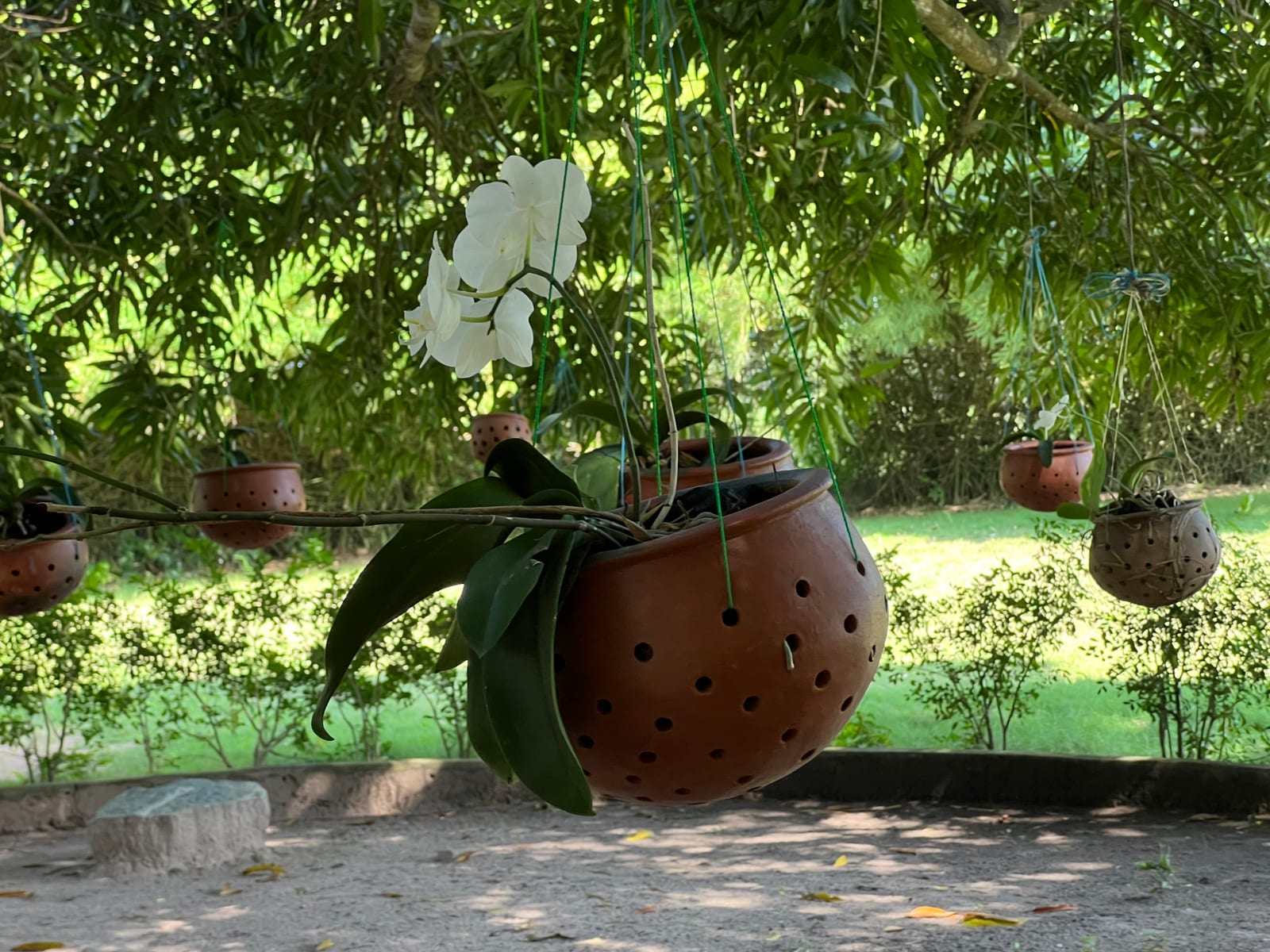
Decorative pots. Plenty of people slip the plastic pot inside a prettier one, as the AOS describes. Iowa State's rule: the outer pot must never hold standing water, so empty it after every watering.
Can I repot an orchid while it is in bloom?
Read moreShow less
The sources split:
- Wait. The AOS says to wait until flowering ends. The NYBG says the stress can drop buds or shorten the bloom, and its moth orchid and slipper orchid guides say plants in bud or flower are best left alone.
- It's fine for a healthy plant. University of Maryland Extension says you don't need to wait for the bloom to end once new growth starts. An AOS article by G. Woodward says a strong plant can be repotted in bloom.
The AOS itself covers both sides: repotting in bloom can be done if it's truly needed, at the risk of losing the flowers early. So put the roots first. Mushy roots or a sour, soggy pot can't wait. A healthy plant that just looks crowded can.
Can an orchid grow in a glass vase or in water?
Read moreShow less
Many gift orchids come planted in a glass vase or bowl with no hole in the bottom. We searched the extension services, botanical gardens and the AOS for advice on growing an orchid in a closed vase or in water. None recommends it. What they say instead:
- Use pots with drainage holes unless you're a very experienced grower (AOS).
- Never let an outer pot hold standing water (Iowa State).
- Roots kept soggy rot (UConn, Wisconsin Extension).
- Orchids need excellent drainage (Maryland Extension).
The reason is the root itself. An orchid root soaks up water quickly, then needs air. The AOS explains that a root kept wet too long suffocates and rots. Our root guide goes into how those roots work.
Got an orchid in glass? Move it to a pot with drainage holes, following the steps above. You can keep the glass as an outer pot if you empty any water that collects in it. If you like the look of roots in a clear container, two sourced options exist: growing in expanded clay over a small water reservoir (see our semi-hydroponics guide) or growing on a mount (see our mounted plants guide).
Frequently asked questions (FAQ)
Can I use regular potting soil for an orchid?
No. The RHS and Clemson both say orchids that grow on trees need a soilless mix. Soil packs around the roots, holds water and keeps out air, so they rot. Use an orchid bark mix instead.
What size pot does my orchid need?
One just big enough for the roots, and at most one size up from the old pot. Iowa State says to size it to the root mass. The NYBG warns that a pot that's too big stays wet and invites rot.
Should I water my orchid right after repotting?
Yes. Iowa State, Clemson, the RHS, Maryland, the NYBG and UConn all water thoroughly after repotting and let it drain. Then wait until the new mix is nearly dry before the next watering.
Can I divide my orchid when I repot it?
Yes, for orchids like Cymbidium that grow a row of pseudobulbs. Keep each piece big: the RHS keeps at least five pseudobulbs per division, and the AOS never fewer than three, ideally five or six.
How do I repot an orchid with rotten roots?
The same way, with extra care on step 6: cut every soft, brown or black root back to firm tissue with clean tools, and use a smaller pot to match the roots that are left. Our root guide and the root rot guide walk through it.
Sources
- How to Repot an Orchid and Growing Orchids Indoors : Iowa State University Extension and Outreach (A. Steil, reviewed January 2026)
- Care of Phalaenopsis Orchids (Moth Orchids) : University of Maryland Extension
- Orchid question : Ask Extension, answered by University of Maryland Extension Home and Garden Information Center (February 2025)
- Repotting Your Orchid : Clemson Cooperative Extension, Home and Garden Information Center (J. Jordan, March 2023)
- Orchids : Clemson Cooperative Extension, Home and Garden Information Center
- Orchids : University of Wisconsin-Madison Extension
- Orchids as Houseplants : Penn State Extension
- Orchid Care and Repotting : UConn Home and Garden Education Center (2019)
- Orchids : UF/IFAS Gardening Solutions
- Phalaenopsis : NC State Extension Gardener Plant Toolbox
- Orchids: Potting and Dividing, Phalaenopsis, Cattleya, Dendrobium, Paphiopedilum and Orchid FAQs : New York Botanical Garden
- How to grow Phalaenopsis (moth orchids), Growing Phalaenopsis orchids and How to grow cymbidium orchids : Royal Horticultural Society
- Orchid Plant Care Tips : Desert Botanical Garden (March 2025)
- Repotting and What is the best potting media? : American Orchid Society
- Repot Your Plants : American Orchid Society, Orchids magazine (R. Barkalow, June 2024)
- Orchid Parts and Why They Matter : American Orchid Society, Orchids magazine (S. Bottom, June 2024)
- Coconut husk : American Orchid Society (N. Nash)
- Cymbidium Culture : American Orchid Society (R. McHatton, March 2009)
- Cattleyas culture sheet and Novice Culture Sheet: Phalaenopsis : American Orchid Society
- Viruses : American Orchid Society (J. Freitas-Astúa, September 2003) and Cutting Tools : American Orchid Society
- Top Ten Uncommonest Questions Asked about Phalaenopsis : American Orchid Society (G. Woodward)
- Orchid Roots : American Orchid Society
- Evaluation of growing media components for Phalaenopsis : Amberger-Ochsenbauer, Acta Horticulturae 878, 2010