Orchid temperature and humidity: warm, intermediate and cool growers
Most orchids are happy at ordinary room temperatures, about 18 to 27 °C (65 to 80 °F) by day, with nights 6 to 8 °C (10 to 15 °F) cooler. They like the air more humid than most homes: 40 to 70%. Within that, orchids split into three groups. Warm growers like the moth orchid want the warmer end, cool growers like Cymbidium and Masdevallia want cool rooms, and intermediate growers like Cattleya sit in between. If you don't know which yours is, Iowa State says to treat it as intermediate.
What temperature do orchids like?
Iowa State Extension gives three groups, by daytime temperature:
| Group | Days | Examples Iowa State names |
|---|---|---|
| Cool | 16 to 24 °C (60 to 75 °F) | Cymbidium, Odontoglossum, Miltonia, some slipper orchids and Dendrobium |
| Intermediate | 21 to 27 °C (70 to 80 °F) | Cattleya, dancing ladies (Oncidium), some moth orchids, many slipper orchids and Dendrobium |
| Warm | 24 to 29 °C (75 to 85 °F) | Many moth orchids, some slipper orchids and Dendrobium |
For all three, Iowa State calls a night drop of 6 to 8 °C (10 to 15 °F) essential for growth and flowering. A cheap min/max thermometer by the plant shows you both numbers, and Iowa State recommends one. A windowsill can run much colder at night and hotter by day than the middle of the room, as the American Orchid Society points out, so measure where the orchid actually sits.
Going deeper
Why would a tropical plant want a cool room? Because "tropical" says nothing about altitude. Masdevallia comes mostly from cloud forests high in the Andes, as the AOS, NC State and the Orchid Society of Great Britain describe, where the air stays cool and wet all year. The big Cymbidium hybrids come from cool, bright mountain places in Asia, per the AOS and the RHS. Most Vanda, by contrast, are lowland orchids of warm, humid forest, the AOS says. The grower group is your orchid's memory of home. Our orchid origins guide maps where each one grows wild.
Is my orchid a warm, intermediate or cool grower?
Every value below matches the orchid's care card. "Lowest" is the coldest night the card advises indoors.
| Orchid | Grower group | Ideal range | Lowest | Care card |
|---|---|---|---|---|
| Moth orchid (Phalaenopsis) | Warm, intermediate | 21 to 27 °C (70 to 80 °F) | 13 °C (55 °F) | Moth orchid |
| Vanilla orchid (Vanilla) | Intermediate, warm | 18 to 30 °C (64 to 86 °F) | 18 °C (64 °F) | Vanilla orchid |
| Vanda | Intermediate, warm | 21 to 29 °C (70 to 85 °F) | 16 °C (60 °F) | Vanda |
| Jewel orchid (Ludisia) | Intermediate, warm | 21 to 29 °C (70 to 85 °F) | 15 °C (59 °F) | Jewel orchid |
| Cattleya | Intermediate | 21 to 29 °C (70 to 85 °F) | 13 °C (55 °F) | Cattleya |
| Spider orchid (Brassia) | Intermediate | 18 to 25 °C (65 to 77 °F) | 15 °C (59 °F) | Spider orchid |
| Dancing lady (Oncidium) | Cool, intermediate, warm | 21 to 29 °C (70 to 85 °F) | 13 °C (55 °F) | Dancing lady |
| Dendrobium (phalaenopsis types) | Cool, intermediate, warm | 18 to 29 °C (65 to 85 °F) | 16 °C (60 °F) | Dendrobium |
| Lady slipper (Paphiopedilum) | Cool, warm | 16 to 27 °C (60 to 80 °F) | 13 °C (55 °F) | Lady slipper |
| Pansy orchid (Miltoniopsis) | Cool, intermediate | 13 to 27 °C (55 to 80 °F) | 13 °C (55 °F) | Pansy orchid |
| Zygopetalum | Cool, intermediate | 21 to 27 °C (70 to 80 °F) | 7 °C (45 °F) | Zygopetalum |
| Masdevallia | Cool, intermediate | 13 to 22 °C (55 to 72 °F) | 10 °C (50 °F) | Masdevallia |
| Cymbidium | Cool, intermediate | 10 to 24 °C (50 to 75 °F) | 4 °C (40 °F) | Cymbidium |
Three orchids need a closer look at the type:
- Slipper orchids split by their leaves. The mottled-leaved types are warm growers, and the RHS and NYBG keep their nights at about 16 to 18 °C (60 to 65 °F). The plain green-leaved types are cool growers that take winter nights of 10 to 13 °C (50 to 55 °F), per the RHS.
- *Dendrobium covers several groups. The table shows the warmer phalaenopsis types. Cane types like Dendrobium nobile* want cool nights, about 13 °C (55 °F) in their winter rest, per NYBG, and the AOS says some rest best at about 5 to 8 °C (low to mid 40s °F).
- Dancing ladies range from cool to warm. The RHS sorts them into cool-growing and warm-growing types, and the cool ones take nights down to 11 °C (52 °F).
Why should nights be cooler than days?
Read moreShow less
The everyday drop is about 6 to 8 °C (10 to 15 °F), per Iowa State and Clemson Extension. UConn Extension gives a gentler 3 to 6 °C (5 to 10 °F). Cool growers want more: the Orchid Society of Great Britain gives Masdevallia a 5 to 10 °C (9 to 18 °F) drop, and NC State gives large Cymbidium a day and night difference of about 14 °C (25 °F) in summer.
A home often does this without help. The RHS notes that ordinary winter house temperatures usually give a moth orchid the drop it needs. A room you heat less at night, or a spot near a window with the leaves clear of the glass, can add a few degrees more.
The drop also matters for flowers. Many orchids need a few weeks of cooler weather to start a flower spike, and research shows that for moth orchids it's the cooler days that do most of the work. That story has its own page: see our rebloom guide.
How cold is too cold for an orchid?
Read moreShow less
The "Lowest" column in the table above is the floor for each type. Below it, damage starts even well above freezing. The AOS calls this chill injury: pitted, sunken or water-soaked patches that turn brown, sometimes showing up days after the cold. It also says moth orchids prefer nights above about 16 °C (60 °F) and tend to drop leaves after a chill. Our yellow leaves guide shows what cold damage looks like.
Most cold damage at home comes from a few places:
- Cold glass. A leaf touching a window on a winter night can chill well below room temperature. The RHS found that cold window glass, and curtains closed between the plant and the room overnight, were a winter risk for moth orchids.
- Drafts and swings. Sudden changes make orchids drop their buds. The AOS, NC State and the RHS all name temperature swings, and our bud drop guide covers the rest.
- Cold water. The AOS warns that water colder than 10 °C (50 °F) can injure Cattleya and pansy orchids. Water at room temperature.
How much cold each type tolerates varies. The AOS cold tolerance article says many Cattleya tolerate nights of about 7 °C (mid 40s °F) and should be protected below 10 °C (50 °F), while a Vanda is best kept above 16 °C (60 °F) unless you know your plant takes more cold.
How hot is too hot for an orchid?
| Orchid | Heat limit | Sources |
|---|---|---|
| Moth orchid | Up to about 35 °C (95 °F); days above 28 °C (82 °F) hold back flower spikes | AOS |
| Vanda | Days up to 35 °C (95 °F), and up to about 40 °C (105 °F) with more shade, water and air | AOS |
| Pansy orchid | Flowering suffers above about 27 °C (80 °F); avoid long spells above 24 to 25 °C (75 to 77 °F) | NYBG, NC State, Orchid Society of Great Britain |
| Masdevallia | Avoid long spells above about 24 °C (75 °F); days to 29 °C (85 °F) only with cool nights | Orchid Society of Great Britain, AOS |
| Cymbidium | The AOS says any heat above 24 °C (75 °F) stops blooming, while the RHS allows up to 30 °C (86 °F) in summer | AOS, RHS |
Heat is easier to take with air and moisture. The AOS says the phalaenopsis-type Dendrobium tolerates heat when it has moving air and humidity. Signs that an orchid is too hot, from the AOS heat stress page, include leaves that feel warm to the touch, wilting, and a reddish-purple tint or freckles. Move it out of hot sun, raise the humidity and get the air moving.
Indoors, the hot spots are sunny glass in summer, and heaters and radiators in winter. Purdue's vanilla guide warns to keep that orchid away from hot furnace drafts, which is good advice for any of them. Cymbidium is especially touchy: its card warns it drops buds in a warm room.
How much humidity do orchids need?
Iowa State puts the ideal at 40 to 70% and says indoor air, especially in winter, is usually well below that. Clemson agrees that most homes are drier than orchids like. NYBG says home humidity can fall to about 25% in winter. A humidity gauge (a hygrometer) by the plant tells you where you stand, and Iowa State recommends one.
Every value below is the humidity line on the orchid's care card.
| Orchid | Humidity on its care card | Care card |
|---|---|---|
| Moth orchid (Phalaenopsis) | 40 to 70%; a pebble tray helps more than misting | Moth orchid |
| Lady slipper (Paphiopedilum) | At least 40 to 50%; use a pebble tray, since misting does little | Lady slipper |
| Dancing lady (Oncidium) | About 40 to 60%; a pebble tray helps | Dancing lady |
| Cymbidium | 40 to 60%, most important in winter when it's in bud | Cymbidium |
| Zygopetalum | 40 to 75%, with air moving around the leaves | Zygopetalum |
| Cattleya | 50% or more; a pebble tray helps | Cattleya |
| Dendrobium | 50% or more; NC State says 60% | Dendrobium |
| Pansy orchid (Miltoniopsis) | 60 to 80%; a humidifier helps in heated rooms | Pansy orchid |
| Vanda | 65 to 80%, with air moving around the roots | Vanda |
| Masdevallia | 60 to 90%, with air moving gently around it | Masdevallia |
| Jewel orchid (Ludisia) | Above average: a pebble tray, a humidifier or a terrarium | Jewel orchid |
| Vanilla orchid (Vanilla) | Above average: a humidifier or pebble trays help most indoors | Vanilla orchid |
| Spider orchid (Brassia) | Above average: moist air with a gentle breeze | Spider orchid |
Dry air can show up as wrinkled leaves (Maryland Extension), accordion-pleated new leaves on a pansy orchid (AOS), or buds that drop (Orchid Society of Great Britain). Wrinkled leaves have other causes too, so check our wrinkled leaves guide before you blame the air.
Going deeper
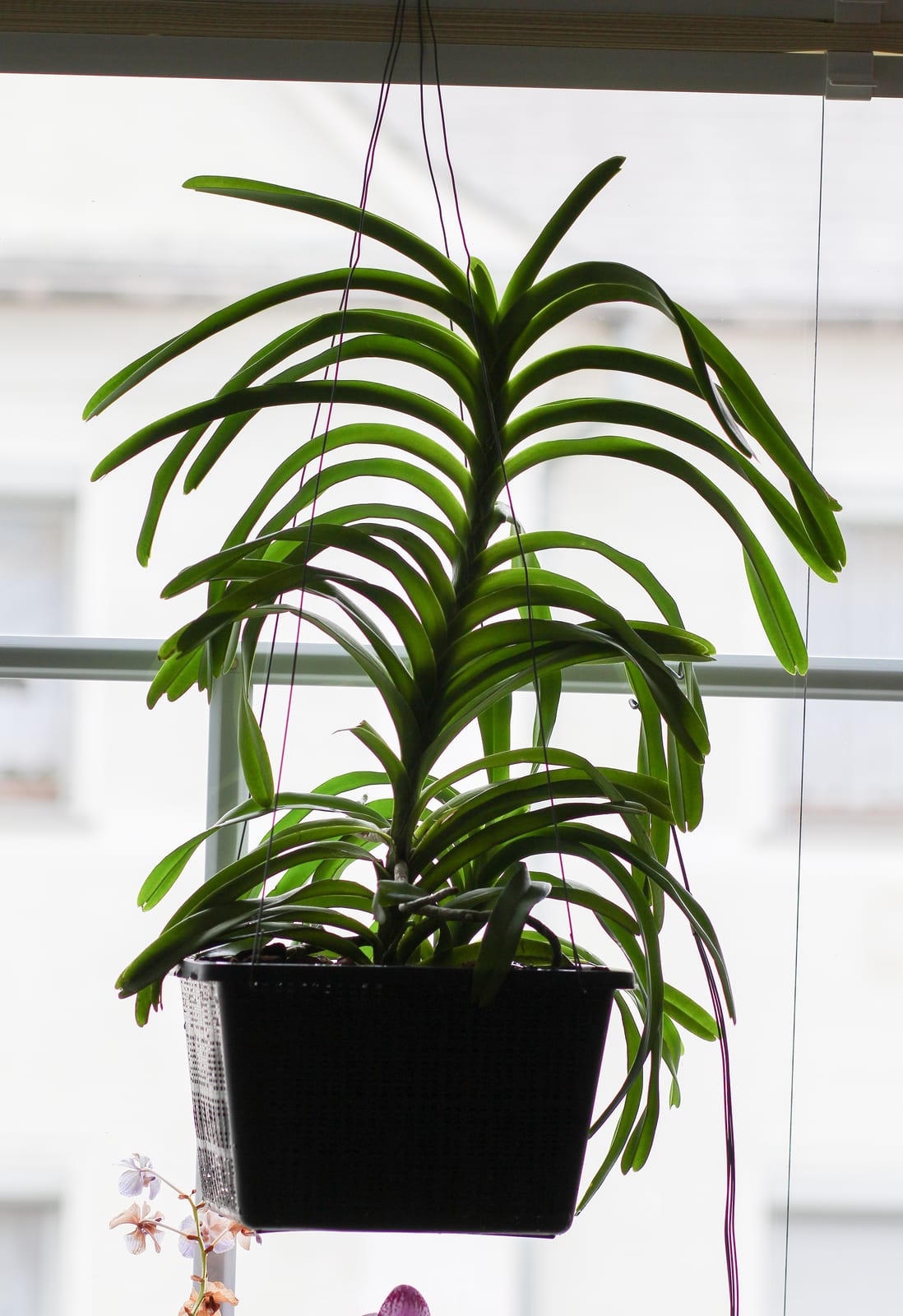
Why does a Vanda need so much more humidity than a moth orchid? Look at how it grows. In the wild it clings to trees in humid tropical forest with its thick roots hanging in the open air, as Fairchild Tropical Botanic Garden and NYBG describe. At home it's usually grown the same way, in an open basket with little or no potting mix. With nothing around them to hold water, those exposed roots dry out fast, and humid air slows that down, the AOS explains. A Vanda also has no pseudobulbs to store water, so it has no reserve. NYBG warns that without at least 65% humidity it may refuse to flower. A moth orchid in a pot of bark has a damp root zone and water stored in its thick leaves, so it copes with drier air.
How do I raise the humidity for an orchid?
- Group your plants. Plants clustered together raise the humidity around each other, says Iowa State.
- Use a pebble tray. Set the pot on a tray of pebbles with water in it. Iowa State, the AOS and NC State all suggest one. The AOS says a shallow water tray lets Masdevallia cope with lower room humidity.
- Run a humidifier for the high-humidity orchids or a dry, heated room. The pansy orchid's card names it for heated rooms.
- Try a terrarium for small plants like jewel orchids, which the Smithsonian grows that way. Iowa State lists terrariums too.
- Keep the air moving. Iowa State warns that high humidity in still air invites disease, and too much breeze dries plants out. A fan on low that barely stirs the leaves is right.
What about misting? Iowa State says misting doesn't raise humidity, because the droplets are too large, though it's handy for rinsing leaves. The RHS's moth orchid guide and Maryland Extension agree it does little. Wisconsin Extension and the RHS's general orchid tips do suggest misting. If you mist, do it in the morning, so the leaves are dry by night.
Frequently asked questions (FAQ)
What is the ideal temperature for a moth orchid?
Days of 21 to 27 °C (70 to 80 °F), with nights a few degrees cooler, per its care card. Keep it above 13 °C (55 °F), and the AOS prefers nights above 16 °C (60 °F). A few weeks of cooler autumn weather then helps it bloom, as our rebloom guide explains.
Can I keep an orchid in the bathroom for the humidity?
Only if it has a bright window. Humidity helps, but light comes first, and a dim bathroom won't give an orchid enough to bloom. Our light guide shows how much each type needs.
Can orchids live outside?
In summer, many can. Some, like Cymbidium, flower better for it, as long as you bring them in before nights fall below their limit. Our outdoor orchid guide covers when and where.
Does an orchid need a humidifier?
Moth, slipper and dancing lady orchids usually get by with a pebble tray or grouped plants, as their cards suggest. A humidifier helps most with the high-humidity types, such as Vanda, Masdevallia and pansy orchids, or in a dry, heated home in winter.
Sources
- Growing Orchids Indoors : Iowa State University Extension and Outreach (A. Steil, reviewed January 2026)
- Novice Culture Sheet: Phalaenopsis and Novice Culture Sheet: Dendrobium : American Orchid Society
- Cold Tolerance of Warm Growing Orchids : American Orchid Society, Orchids magazine (S. Bottom, December 2024)
- Cold Damage and Heat Stress : American Orchid Society, Orchid Pests and Diseases
- Vanda : American Orchid Society, Explore
- Phalaenopsis, the Genus : American Orchid Society
- Vanda, Cymbidium, Cattleya, Miltoniopsis and Masdevallia culture sheets : American Orchid Society
- Orchids : Clemson Cooperative Extension, Home and Garden Information Center
- A Beginner's Guide to Orchids : UConn Home and Garden Education Center (D. Pettinelli, March 2024)
- Care of Phalaenopsis Orchids (Moth Orchids) : University of Maryland Extension
- Orchids : University of Wisconsin-Madison Extension
- Phalaenopsis, Cymbidium, Miltoniopsis roezlii and Masdevallia : NC State Extension Gardener Plant Toolbox
- Vanda orchid, Paphiopedilum, Nobile Dendrobium Hybrids and Miltonia and Miltoniopsis : New York Botanical Garden, Mertz Library
- Types of Orchids, Identification and Care Guide : Fairchild Tropical Botanic Garden
- Paphiopedilum growing guide, How to grow cymbidium orchids, Cool growing oncidium orchids, Growing Phalaenopsis orchids, Phalaenopsis trial and Top tips for growing orchids at home : Royal Horticultural Society
- Masdevallia orchid care guide and Miltoniopsis orchid care guide : Orchid Society of Great Britain
- The Vanilla Orchid : Purdue Consumer Horticulture
- Ludisia discolor : Smithsonian Gardens Plant Explorer