Plant care card
Vanilla orchid
Vanilla · Planta de vainilla
Also called vanilla or vanilla vine
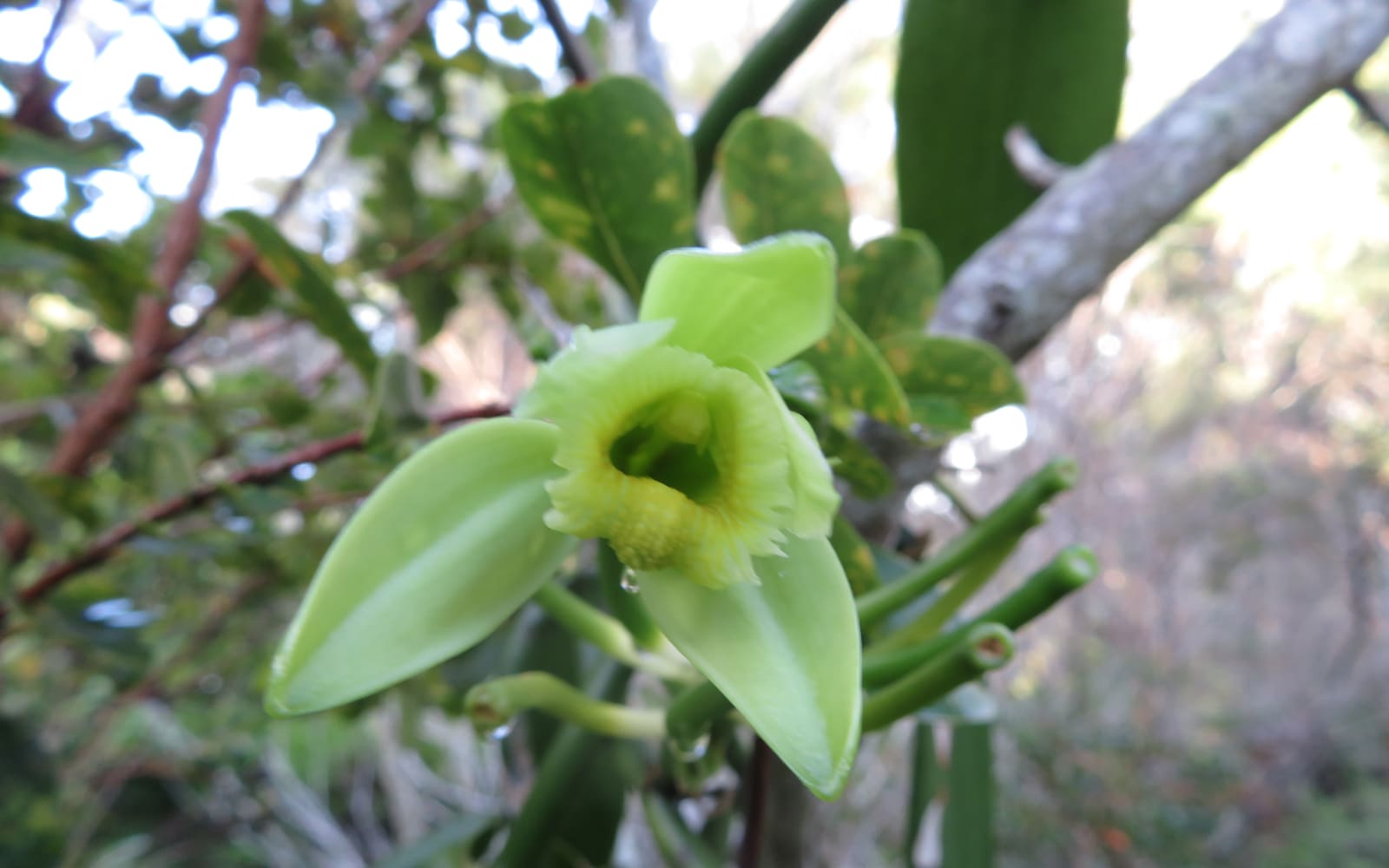
Photo by Forest and Kim Starr on Wikimedia Commons, CC BY 3.0 US

Yes, the vanilla in your kitchen comes from an orchid: the cured pods of Vanilla planifolia. At home it's a climbing vine that needs a pole or trellis, bright filtered light, humid air and warmth above about 64°F (18°C). It's easy enough to keep growing, but getting flowers is the real challenge: the vine has to grow long and thick first, which takes years, and in an ordinary home it rarely blooms.
Not rated for pets
The ASPCA doesn’t list vanilla. NC State has no page for it. Until a reliable source rates it, keep it away from pets that chew plants. Children: No poison information found for people.
Pet poison line: ASPCA (888) 426-4435
Good for: a bright, warm room with space for a long vine, a greenhouse or sunroom, patient growers · Think twice if: you want flowers within a year or two, your rooms drop below 64°F (18°C) in winter, you have no room for a vine many feet long.
Needs at a glance
- Light3 of 4 · Bright indirectBright, filtered light out of hot sun; more light helps it flower
- Water2 of 3 · Water regularlyLet the top of the mix start to dry; never leave it waterlogged
- Humidity2 of 3 · Above averageA humidifier or pebble trays help most indoors
- Soil when pottedAiry, bark-rich mixPlus a pole or trellis to climb, ideally one with bark it can root into
Indoors: best at 64 to 86°F (18 to 30°C). Keep it above 64°F (18°C) and away from drafts and heat vents.
How the rating adds up
0 = easiest · 1 = moderate · 2 = hardest
- Missed waterings1 of 2 · ModerateWater regularly; it rides out a short dry spell
- Light flexibility1 of 2 · ModerateBright, filtered light; harsh sun burns it
- Humidity1 of 2 · ModeratePrefers humid air; dry rooms are its main indoor problem
- Pests and disease1 of 2 · ModerateRoot and stem rot if the mix stays waterlogged
- Sensitivity to change1 of 2 · ModerateChill below 64°F (18°C) and drafts damage it
Growing outdoors
All year: USDA zones 10 to 11, where the coldest winter nights average 32°F (0°C) or warmer.
Elsewhere: summer outside in dappled shade. Bring it in before nights drop below 64°F (18°C).
- Containers with a support
- A vine on trees in South Florida
- Conservatories
Sources: Missouri Botanical Garden, American Orchid Society, UF/IFAS, Fairchild, NYBG, Purdue, ASPCA plant list, USDA zone map and Brooklyn Botanic Garden. Full list below.
Verified · How we rate plants
Does vanilla really come from an orchid?
Yes. Natural vanilla comes mostly from the cured seed pods of Vanilla planifolia, a climbing orchid native to southern Mexico, Central America, Colombia and northern Brazil, according to UF/IFAS, Purdue and Kew. Two relatives, Tahitian vanilla and Vanilla pompona, are grown for it on a smaller scale. A fresh pod has no taste until it's cured, Cornell notes, so a pod straight off the vine isn't the vanilla you know.
Will a vanilla orchid flower indoors?
It can, but rarely in an ordinary home, Purdue says. The vine flowers only once it's mature: UF/IFAS says about 2 to 4 years after planting a cutting, on stems about a quarter to half an inch thick, and the American Orchid Society expected one hobby vine to bloom once it reached about 20 feet. Light matters too: the AOS says it needs at least as much light as a cattleya, and one greenhouse vine finally bloomed after the roof was cleaned. Botanic gardens with big, bright conservatories do get flowers: Brooklyn Botanic Garden's vine bloomed two years after planting. UF/IFAS adds that a drier rest of about two months helps start flowering outdoors in Florida.
Purdue, UF/IFAS, American Orchid Society, Brooklyn Botanic Garden
Do I have to hand-pollinate vanilla?
Yes, if you want pods. Outside its native range, the bees that pollinate it are missing, and a small flap inside the flower, the rostellum, keeps the pollen off the stigma, so the flower can't do it alone. Each flower opens for just one day, so pollinate in the morning: UF/IFAS says between about 6 a.m. and noon. Open the lip, lift the flap with a toothpick or small twig, and press the pollen mass onto the stigma. The same flower's pollen works. If it took, the flower stays on and a green pod swells within weeks, then takes about 8 to 9 months to ripen; if it didn't, the flower drops in 2 or 3 days.
What kind of support does a vanilla vine need?
Something to climb from the start. It's a vine that roots along its stem, and in the wild it climbs tree trunks. The American Orchid Society suggests a support of water-absorbing material, like a slab of coarse bark, or a wire cylinder; UF/IFAS uses trellises and trees. Start it in a pot of airy mix, such as bark with charcoal, and tie the stem to a stake. As it grows, loop the vine around the support and back down: UF/IFAS says stems that touch the mix grow new roots and make the plant stronger.
How much light and warmth does a vanilla orchid need?
Bright, filtered light and a warm room. UF/IFAS describes bright, mottled shade, NYBG grows its vines in filtered light, and Purdue says a warm, brightly lit spot. Harsh direct sun is too much, but more light helps it flower. Keep it above about 64°F (18°C): UF/IFAS says cooler temperatures can damage the shoot tips or kill the plant, and it gives 64 to 95°F (18 to 35°C) as the growing range. Keep it away from cold drafts and hot heater vents, and raise the humidity with a humidifier or pebble trays, because dry indoor air is its biggest problem, Purdue says.
How do I propagate a vanilla orchid?
From stem cuttings with at least two nodes. UF/IFAS says to let the cut ends dry for a day or two, then plant the cutting upright with one node under the mix and tie the top to a support. Longer cuttings flower sooner: a 12-inch cutting takes about 3 to 4 years, a 3-foot one about 2 to 3. Seed is rarely used because it's so hard to germinate.
Is a vanilla orchid safe for cats and dogs?
We don't know yet. The ASPCA doesn't list vanilla as toxic or non-toxic, NC State has no page for it, and we found no reliable source calling the plant toxic to pets. Until one rates it, keep it where a pet that chews plants can't reach it.
Can a vanilla orchid grow outdoors?
Only where it stays frost-free. UF/IFAS grows it outdoors in South Florida, USDA zones 10 to 11, on trees or a shaded trellis, and says freezing temperatures can kill it. Even there, cold snaps matter: below about 64°F (18°C) the shoot tips can be damaged. Elsewhere, it can spend summer outside in dappled shade and should come back in before nights drop below 64°F. In South Florida it has even naturalized, alongside four native vanilla species that are endangered and protected.
How Grove helps
Grove keeps the watering checks steady for a vine that takes years to bloom, and you can add a reminder to loop new growth onto its support. When flowers finally open, set a morning task to pollinate and assign it to whoever is up first.
Sources
- Missouri Botanical Garden Plant Finder: Vanilla planifolia (High maintenance; checked by hand, 2026-11-12)
- American Orchid Society: Vanilla
- UF/IFAS Extension EDIS HS1348: Vanilla Growing in South Florida (2024)
- Fairchild Tropical Botanic Garden: The Florida vanilla vine, a big climbing orchid
- UF/IFAS Gardening Solutions: Vanilla
- New York Botanical Garden, Plant Talk: A Hint of Vanilla (2019)
- Purdue Consumer Horticulture: The Vanilla Orchid
- UF/IFAS Extension Miami-Dade: Fundamentals in growing vanilla as a cash crop, Part I (2025)
- American Orchid Society, Collector’s Items: Flowering Vanilla
- ASPCA Animal Poison Control: Toxic and Non-Toxic Plants
- USDA ARS Plant Hardiness Zone Map (2023)
- Brooklyn Botanic Garden: Vanilla Beans Ripen in the Tropical Pavilion (2024)
- Cornell University Conservatory: Vanilla planifolia
- Kew: World Checklist of Vascular Plants (June 2026 release), the data behind Plants of the World Online
- UF/IFAS Extension Miami-Dade: Fundamentals in growing vanilla as a cash crop, Part III (2025)