Plant care card
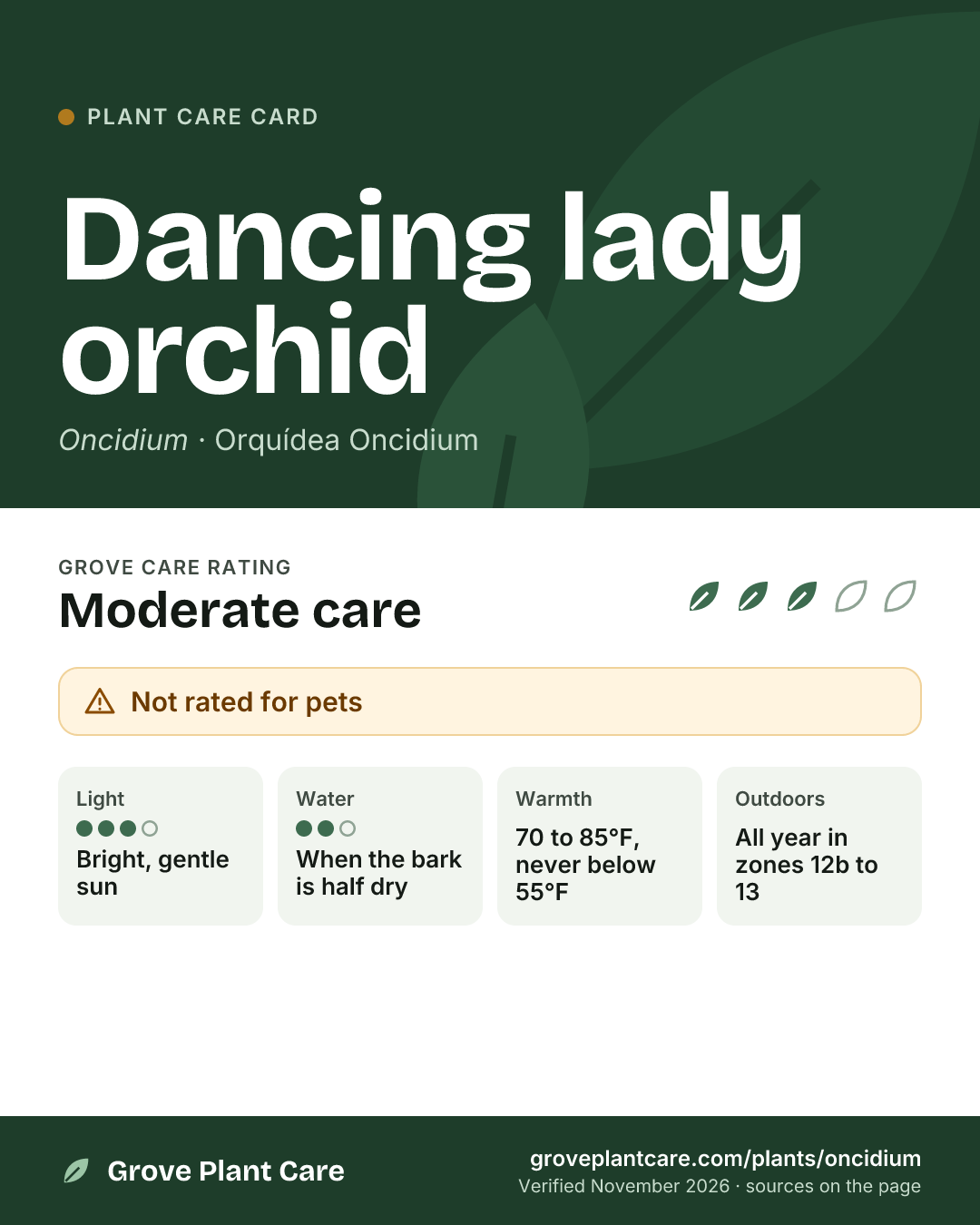
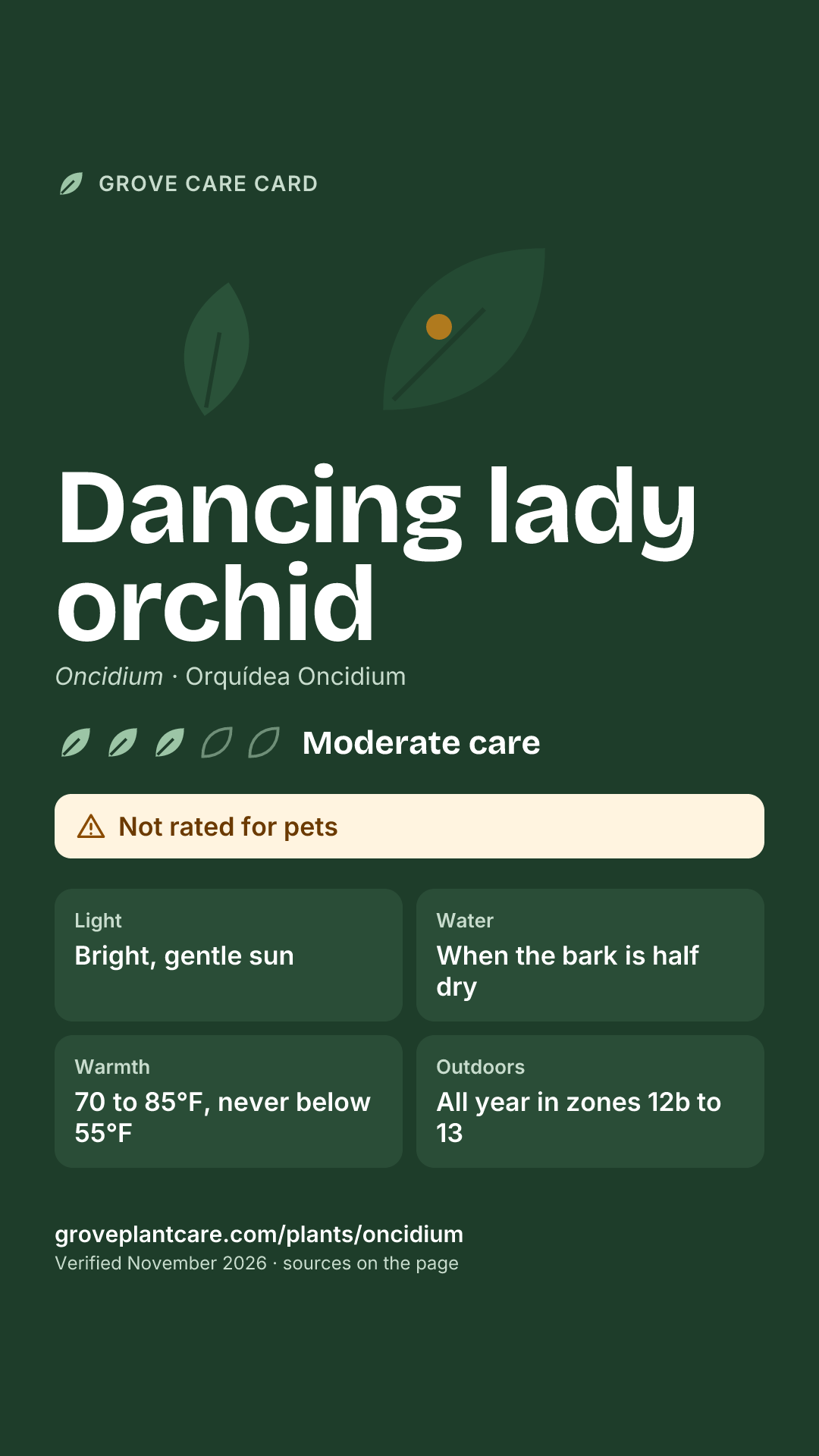
Dancing lady orchid
Oncidium · Orquídea Oncidium
Also called oncidium orchid
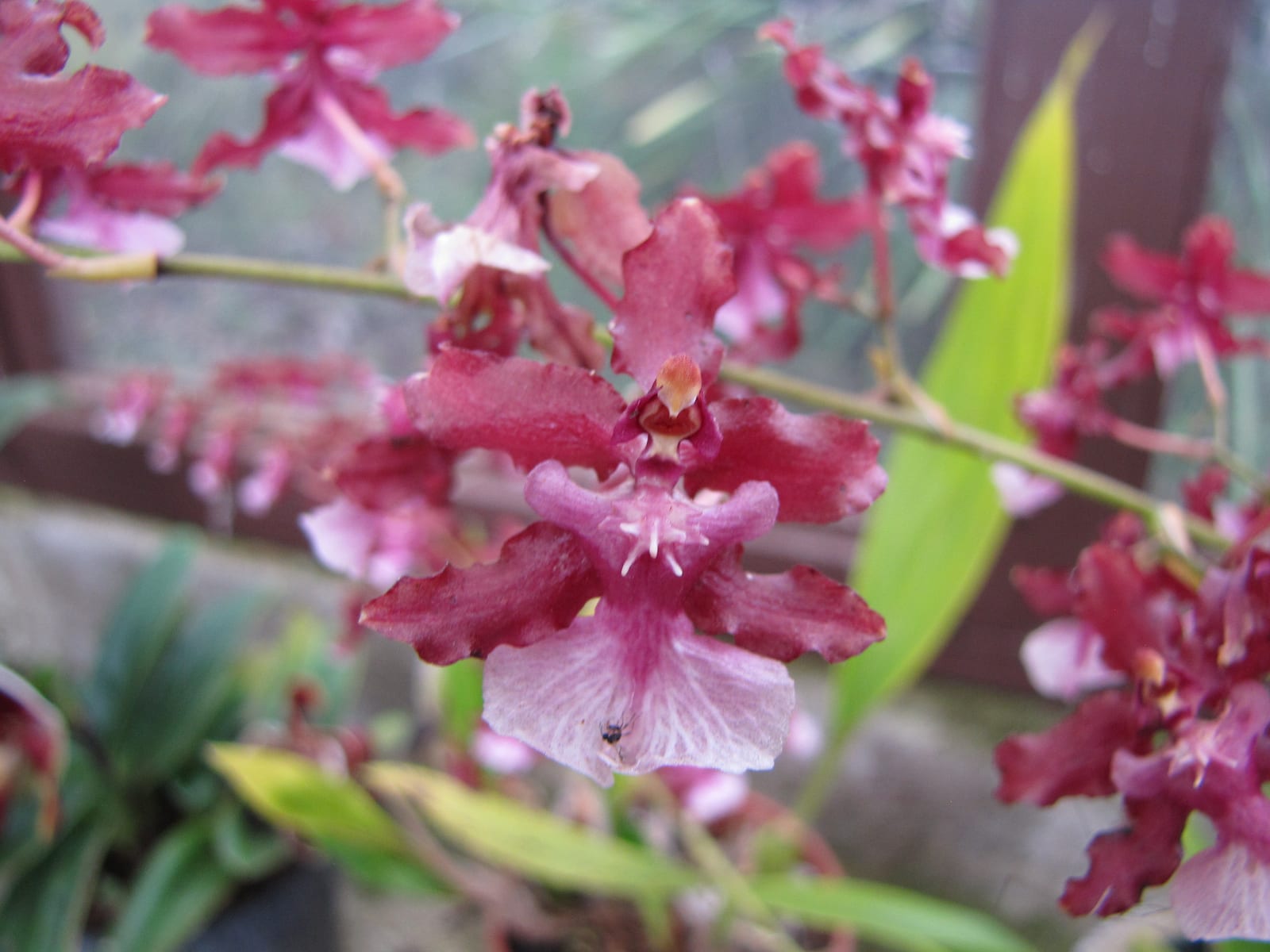
Photo by Forest and Kim Starr on Wikimedia Commons, CC BY 3.0 US

The dancing lady orchid (Oncidium) wants bright light with shade from hot afternoon sun, a fast-draining bark mix, and water once the mix is about half dry. Many plants sold as Oncidium or Cambria are hybrids with close relatives like Brassia and Miltonia, and they share that care. It flowers each time a new pseudobulb matures, often with a scent of vanilla or chocolate.
Not rated for pets
The ASPCA lists the dancing doll orchid (Oncidium flexuosum) and golden shower orchid (Oncidium sphacelatum) as non-toxic; store hybrids aren’t those species. No reputable source lists any Oncidium as toxic, but nobody rates the genus as a whole. Children: No poisoning information listed for the genus.
Pet poison line: ASPCA (888) 426-4435
Good for: a bright east window, fans of fragrant flowers, someone who waters on the light side · Think twice if: you water often, just in case, your only spot is far from a window.
Needs at a glance
- Light3 of 4 · Bright, gentle sunAn east window, or south or west with shade from hot afternoon sun
- Water2 of 3 · Let it dry partwayWater when the mix is about half dry; less in winter
- Humidity2 of 3 · Above averageAbout 40 to 60%; a pebble tray helps
- Soil when pottedFine orchid bark mixSome mixes add sphagnum moss; never regular potting soil
Indoors: best at 70 to 85°F (21 to 29°C). Keep it above 55°F (13°C) and away from drafts and heat vents.
How the rating adds up
0 = easiest · 1 = moderate · 2 = hardest
- Missed waterings1 of 2 · ModeratePseudobulbs store water, but long dry spells pleat new growth
- Light flexibility1 of 2 · ModerateNeeds bright light with shade from hot afternoon sun
- Humidity1 of 2 · ModerateSources ask anywhere from 30 to 75%; about 50% suits most
- Pests and disease1 of 2 · ModerateMealybugs, aphids, spider mites; rot from overwatering
- Sensitivity to change1 of 2 · ModerateFussy about hard water and pots that are too big
Growing outdoors
All year: USDA zones 12b to 13, where the coldest winter nights average 55°F (13°C) or warmer.
Elsewhere: summer outside in shade. Bring it in when nights reach 55 to 60°F (13 to 16°C).
- Containers
- Mounted on cork, for twig and mule-ear types
Sources: NC State, American Orchid Society, NYBG, RHS, U.S. Botanic Garden, Wisconsin, ASPCA, ASPCA plant list, Iowa State and USDA zone map. Full list below.
Verified · How we rate plants
Is my plant really an Oncidium?
Maybe, or maybe a cousin. Many orchids sold as Oncidium are hybrids between Oncidium and close relatives such as Brassia and Miltonia, the New York Botanical Garden explains. You'll often see an × on the tag, as in ×Aliceara or ×Oncostele, and the RHS calls one popular group Cambria. The cool-growing types used to be called Odontoglossum, a name some sellers still use. Keep the tag, because it tells you whether your plant leans cool or warm.
How often should I water a dancing lady orchid?
When the bark is about half dry, which NC State puts at every 2 to 10 days depending on your home, and less often in winter. The American Orchid Society and NC State both say to wait until the mix has dried about halfway down the pot, then soak it and let it drain. Its pseudobulbs, the swollen stems at the base, store water, so it can take a little drying, but the New York Botanical Garden warns never to let the mix dry out completely. Iowa State is the one source that says to let it dry fully. Long gaps show up as pleated, accordion-like new leaves. Overwatering is the bigger danger: it rots the roots.
How much light does it need?
Bright light with a little gentle sun. An east window works well, and the RHS says south or west windows are fine with shade in summer. The American Orchid Society suggests 1 to 5 hours of sun a day, kept off the leaves in the hottest part of the afternoon. Leaf color is your guide: bright green is right, a reddish tint means too much light, and dark green means too little. Cool-growing types, including many Cambria hybrids, like softer light, and the RHS puts those in a north or north-east window.
What do I do when the flowers fall off?
Cut the flower stem off at its base once it turns brown. Each pseudobulb flowers only once, so the next spike will come from a new pseudobulb. Keep watering and feeding as usual so that new growth can fill out. If the bark has broken down, right after flowering is a good time to repot.
How do I get it to bloom again?
Grow a strong new pseudobulb, and the flowers usually follow. The American Orchid Society says dancing ladies need no special trigger: they bloom when new growth matures, up to three times a year. The RHS and the New York Botanical Garden add that nights about 10°F (5°C) cooler than days, around 60°F (16°C) for a few weeks, encourage a spike. Give it bright light, steady watering and weak feeding while it grows. Most bloom from fall into spring, and many modern hybrids can flower at any time.
Why are the pseudobulbs wrinkled?
Usually it's thirst. The RHS says wrinkled pseudobulbs most often mean underwatering, so soak it more thoroughly. If the roots are black and mushy, though, the plant is wrinkling because rotten roots can't take up water, and the fix is to repot it and cut away the rotten roots with clean tools.
When should I repot it?
About every two years, or when the bark breaks down, ideally as new growth starts in spring. Never repot while it's in spike. Use a fine orchid bark mix in a pot only a little bigger, place the newest growth toward the center so it has room to grow, and keep it at the same depth. Too big a pot holds water and leads to root rot.
Is a dancing lady orchid safe for cats and dogs?
We can't say for sure. The ASPCA lists two wild species as non-toxic to cats, dogs and horses: the dancing doll orchid (Oncidium flexuosum) and the golden shower orchid (Oncidium sphacelatum). NC State also tags O. sphacelatum and the lace orchid (O. alexandrae) as non-toxic. The hybrids sold in stores aren't those species, and nobody rates the genus as a whole. We found no reputable source that lists any Oncidium as toxic. If your pet chewed it and seems unwell, call your vet or the ASPCA Animal Poison Control Center at (888) 426-4435.
Can a dancing lady orchid live outdoors?
Only all year where nights stay warm. NC State lists USDA zones 9a to 12b, but NC State, the American Orchid Society and the RHS all put the minimum at about 55°F (13°C), and only zones 12b and 13 stay that warm, so those are the zones on the card. Cool-growing types take a little less: the RHS gives 52°F (11°C). Elsewhere it can spend summer outside in shade and come in before nights drop to 55 to 60°F (13 to 16°C).
How Grove helps
Grove turns watering into a check of how dry the bark is, so nobody waters on autopilot. Add a reminder to look for new pseudobulbs in spring, the best time to repot, and assign it to whoever is home that week.
Sources
- NC State Extension Gardener Plant Toolbox: Oncidium
- American Orchid Society: Oncidium Culture Sheet
- New York Botanical Garden Mertz Library: Oncidium Intergeneric Hybrid Orchids
- Royal Horticultural Society: How to grow oncidium orchids (warm growing)
- U.S. Botanic Garden: Orchid Home Care
- Royal Horticultural Society: Cool growing oncidium orchids, growing guide
- University of Wisconsin-Madison Extension: Orchids
- ASPCA Animal Poison Control: Dancing Doll Orchid (Oncidium flexuosum)
- ASPCA Animal Poison Control: Golden Shower Orchid (Oncidium sphacelatum)
- ASPCA Animal Poison Control: Toxic and Non-Toxic Plants
- Iowa State University Extension: Growing Orchids Indoors
- USDA ARS Plant Hardiness Zone Map (2023)
- NC State Extension Gardener Plant Toolbox: Oncidium sphacelatum
- Kew Plants of the World Online: Oncidium
- Kew: World Checklist of Vascular Plants (June 2026 release), the data behind Plants of the World Online
- NC State Extension Gardener Plant Toolbox: Oncidium alexandrae